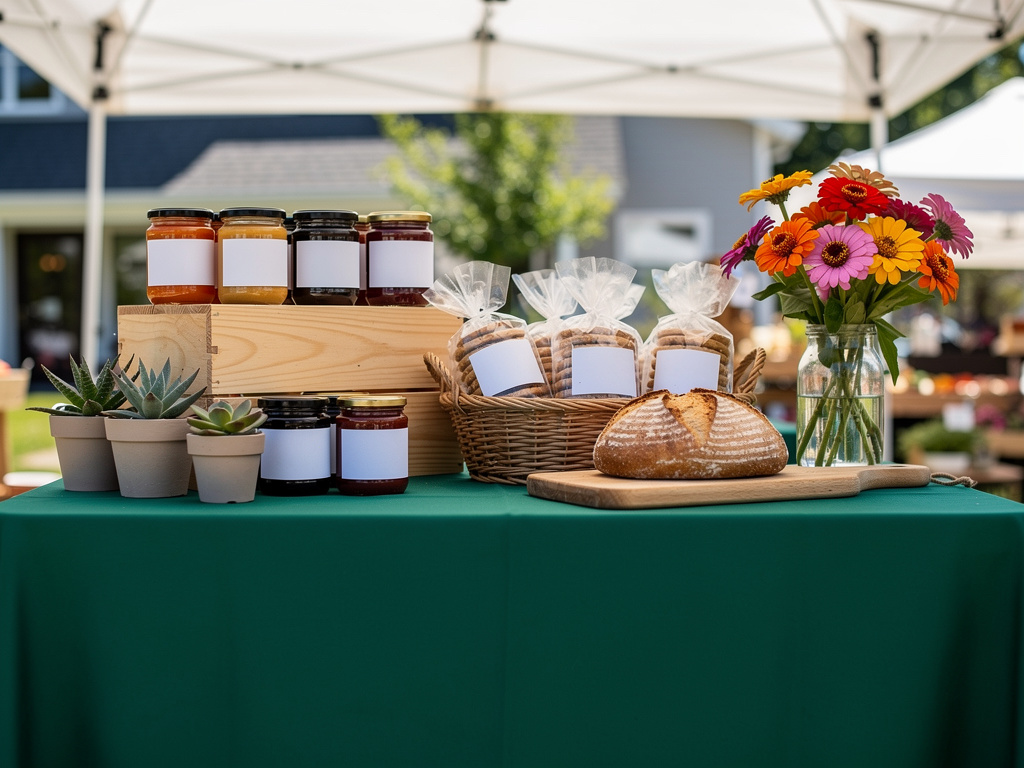


The short version: Good market stall decor picks one solid color that makes your products stand out, a tablecloth big enough to reach the ground, and two or three natural props like baskets, a pine box or a plant stand. A starter decor kit costs about $50.97 and a fuller one about $201.89, using IKEA and WebstaurantStore prices from October 13, 2026. Keep your canopy white, tan or beige so food looks its true color, skip candles and tape, and plan for 10 to 40 pounds of weight on each canopy leg, depending on your market. Then put the same colors and logo on your online storefront so the shopper who liked your stall can find you and order again.
Checked October 13, 2026: decor prices on IKEA's and WebstaurantStore's product pages, weight and decor rules in four market handbooks plus one market's tent page, and Homegrown's prices on findhomegrown.com/signup. Prices change, so check before you buy. Homegrown customers create an account to place a first order, and Homegrown has no drops or timed-release feature.
Picture two jam stalls side by side. Same jars, same prices. One has a wrinkled print tablecloth that stops a foot above the asphalt, a cooler showing underneath and a blue tarp overhead. The other has a solid green cloth to the ground, jars stepped up on a pine box, a basket of samples and a white canopy. Shoppers walk to the second one, and most of them never know why.
That is what decor does. It is not about spending money. It is about making a small stall look like a real food business from 20 feet away. This guide covers color, cloth size, canopy color, props, backdrops, lights, seasonal touches, decor by product, and the market rules that limit what you can hang. If you have not set up your table layout yet, start with our farmers market booth setup ideas, which cover height, price signs and product grouping. This page is about the look that sits on top of that layout.
Market stall decor sells when every piece does one job: it makes your products easier to see, or it makes your stall easier to remember. UT Extension's merchandising guide says it takes about three seconds for people to form a first impression. In three seconds a shopper does not read your story card. They notice color, height, and whether the stall looks cared for.
So good decor is mostly restraint. A pressed $27.99 cloth in the right color does more for a stall than $100 of mismatched props. A busy pattern, five colors and a pile of props all compete with the jar of jam you actually want them to pick up. Decor that works tends to share four traits:
Decor also has a second job that most vendors forget. It is how a shopper finds you again next Saturday. A stall with a recognizable color and a clear name is easy to point a friend toward. A stall that looks different every week is not.
The rest of this guide takes each piece in order, starting with the decision that drives every other one: your color.
Pick one solid cloth color that sits across the color wheel from your main product, then repeat it on your banner, bags and apron. That is the rule UT Extension's merchandising guide for direct farm marketers gives. Its examples: a green tablecloth under strawberries or red tomatoes, and a blue cover under orange pumpkins. The same guide warns that a checked cloth "calls attention to" itself and clutters the look, and that a solid, non-patterned color works best.
Here is how that plays out for common market products:
University of Tennessee's Center for Profitable Agriculture gives the same advice in a one-page worksheet: a single-color or plain cloth, in colors that mimic nature, plus branded apparel so you are part of the look.
A solid cloth in the right color costs no more than one in the wrong color: WebstaurantStore listed the Intedge 72 x 120 inch cloth at $27.99 in every color we checked on October 13, 2026. If you already have a logo or label colors, start there. Our guide to a brand color palette for a food business walks through picking two or three colors and keeping them the same everywhere. Your stall is simply the biggest surface that palette will ever sit on.
A 90 x 132 inch tablecloth reaches the ground on a standard 6-foot folding table, while the common 72 x 120 inch cloth stops about 8 inches short. The math is simple. Lifetime lists its 6-foot commercial folding table at 72 by 30 inches and 29 inches tall. Subtract the table from the cloth and halve it to get the drop on each side.
Scroll sideways to see every column.
| Cloth size | Drop on the long sides | Drop at the ends | On a 29 inch tall table | Best for |
|---|---|---|---|---|
| 72 x 120 in | 21 in | 24 in | Stops 8 in short on the long sides, 5 in at the ends | A first season; boxes behind the table still hide well |
| 90 x 132 in | 30 in | 30 in | Reaches the ground | Hiding coolers and stock under the front of the table |
Table size from Lifetime's listing for its 6-foot commercial folding table (72 x 30 x 29 inches nominal), loaded October 13, 2026. Measure your own table before you buy a cloth.
On October 13, 2026, WebstaurantStore listed an Intedge 72 x 120 inch poly/cotton cloth for $27.99 in 21 colors. The 90 x 132 inch white spun polyester cloth we found there came only in a case of 12, at $20.75 each, which is a good buy to split with two or three vendor friends.
Wash and hang your cloth the night before, then fold it in thirds over a hanger for the drive. A cloth with fold creases every 12 inches reads as careless from 20 feet away, and UNH Extension's market guide says whatever covers your table should be clean and wrinkle-free.
Mississippi State Extension suggests a cheap alternative for a first market: a fitted bed sheet over the tabletop, because the elastic corners stay put under the table legs.
Yes, a colored canopy tints everything under it, so a white, tan or beige top is the safest choice for food. UT Extension says white, tan or beige is best "because it allows the product to be seen in natural light," and that light filtered through a bright tent can make products look unappealing. UNH Extension is blunter: "Go with white." Its guide adds that a blue, green or red tent can make produce look dull or unripe, and that a white tent absorbs less heat in summer.
That matters more than most decor choices, because the canopy is the biggest piece of color in your stall. To test yours, set 3 products on the table under the top at noon, then carry the same 3 products into open sun and compare them in a phone photo. A red canopy over a table of sourdough turns the crust a strange pink. A green canopy over strawberries makes them look less ripe than they are.
If you already own a colored canopy, you have three options:
Our guide to the best canopy tents for farmers market vendors compares six 10x10 models, their colors and weights, and what each costs.
At least 10 good market stall decor ideas cost nothing or close to it, because they use things you already own or can borrow. Every idea on this list costs $0 if you already own the piece. Before you buy anything, walk through your house and garage with this list:
UT Extension's guide also mentions old or antique boxes, crates and baskets as display containers, and colored wildflowers in a pitcher as a simple touch.
The one free thing every stall needs is a clean, clear front edge. Move the cash box, phone, water bottle and bags out of sight. That alone changes how a stall looks more than any prop you can buy.
Once you know which of these you have, the next question is what is worth buying.
A starter decor kit for a 6-foot market table costs about $50.97, a mid kit about $133.93 and a full kit about $201.89, using prices loaded on October 13, 2026. Every piece below was priced on its own product page that day and checked against what it has to do on a market table, from the cloth's drop to the plant stand's load limit.
Swipe left to see each kit in full.
| Kit | What is in it | Price of each piece | Kit total | What it does for the stall |
|---|---|---|---|---|
| Starter | Intedge 72 x 120 in poly/cotton cloth; IKEA FLÅDIS seagrass basket (9 7/8 in across); IKEA FEJKA faux succulents, 3 pack | $27.99; $17.99; $4.99 | $50.97 | One solid color, one natural texture, a little green that never wilts |
| Mid | Starter, plus 2 IKEA KNAGGLIG pine boxes (18 x 12 1/4 x 9 3/4 in), IKEA OLIVBLAD plant stand (22 in tall), IKEA SOLVINDEN battery string light (12 lights) | $19.99 each; $29.99; $12.99 | $133.93 | Two levels on the table, a third level beside it, a warm glow on gray days |
| Full | Mid, plus IKEA LYDERSHOLM in/outdoor rug (2 ft 7 in x 4 ft 11 in), a second FLÅDIS basket, 2 more FEJKA 3 packs | $39.99; $17.99; $4.99 each | $201.89 | A defined floor, matching baskets, green on every level |
Prices from IKEA's US product pages and WebstaurantStore's Intedge listing, loaded October 13, 2026, before tax and shipping. IKEA sells the KNAGGLIG box online in a minimum order of 2. Batteries for the string light (3 AA) are sold separately. IKEA marked the SOLVINDEN string light Last chance on October 13, 2026, so it may be gone soon; any battery string light near that price keeps the mid kit total about the same.
Three honest notes on these picks. IKEA's own page says the KNAGGLIG pine box is "Not approved for food contact" and "Not suitable for outdoor use." Use it under your cloth or behind packaged products, not as a bread board, and bring it in when the rain starts. IKEA's FLÅDIS basket page says much the same: "Recommended for indoor use only. Not approved for food contact." Line the basket with a cloth or a food-safe liner before food goes in, and keep it out of the rain. The OLIVBLAD stand is the outdoor-rated riser of the group, with a 110 pound maximum load listed.
You do not need the full kit to look good. Most stalls look finished at the starter level, as long as the cloth is pressed and the color is right.
Crates, baskets and plants work best when you use three of the same kind instead of ten different ones. Matching pieces read as a plan. A mix of a plastic bin, a metal tray, a wicker basket and a cardboard box reads as whatever was in the car.
Ways to use each one:
One rule from UW-Madison Extension is worth keeping in mind for every prop: most customers shop between knee and eye level, and tables 36 to 40 inches high suit most of them. A standard folding table is 29 inches tall, so a box or stand under your best-selling products lifts them into that zone. Keep props out of the front 6 inches of the table, where customers need room to pick things up.
The back wall of a 10 by 10 foot canopy is the best spot for a backdrop, because it stays visible over the heads of shoppers standing at your table. UNH Extension notes that a typical market booth is about 10 feet by 10 feet and tells vendors to make good use of vertical space.
Good backdrop ideas for a food stall:
Your name sign belongs where people can see it from down the aisle, which is up high, not on the front of the table where customers block it. Our guide to farmers market signage ideas covers what to put on each sign and which materials hold up outdoors.
Before you hang anything, check your market's rules. Some markets require a minimum sign size. Corvallis-Albany, for example, requires identification signs of at least 8.5 by 11 inches. Kingsport Farmers Market, for example, bans duct tape and command strips on its facility, which we cover in the rules section below.
Add lights if you sell at an indoor winter market, an evening market or a stall with heavy shade, and skip them at a sunny daytime market. Daylight does most of the work outdoors. Indoors, a hall's overhead lights can make products look flat, and a little warm light on your table pulls the eye.
What to look for in market lighting:
If you do plug anything in, read the cord rule first. Tigard Farmers Market's 2026 vendor handbook says vendors need the market manager's permission to run a cord across a public walkway and must bring carpets to cover the cord wherever shoppers will walk. That is one more reason battery lights are the simpler choice.
Seasonal decor works best when you change one or two accents each season and keep your base color the same all 52 weeks of the year. Shoppers learn to find you by your color. Swapping the whole look every month undoes that.
Mississippi State Extension's market guide puts it well: add seasonal decorations, especially ones you can sell, like corn stalks in the fall and cut flowers in the summer.
Swipe the table sideways to see every season.
| Season | Accent ideas | Can you sell it too? | Watch for |
|---|---|---|---|
| Spring | Potted herbs, tulips or daffodils in a jar, pastel napkins in baskets | Herb starts, if your market allows plants | Wind; set light pots and jars of flowers low and toward the back |
| Summer | Zinnias or sunflowers, a striped runner over your base cloth, fresh fruit in a bowl | Cut flowers, if your market allows them | Heat; keep chocolate and frosting out of direct sun |
| Fall | Small pumpkins, gourds, corn stalks tied to the canopy legs, a plaid runner | Pumpkins and gourds, if you grow them | Stalks blowing into the aisle; tie them low |
| Winter and holidays | Evergreen sprigs, battery string lights, red or plaid ribbon on gift boxes | Wreaths or gift boxes of your products | Open flames; never use real candles |
Selling plants, flowers or produce may need its own approval from your market, and some markets limit what each vendor can sell. Ask your market manager before you add a product.
A runner is the cheapest seasonal swap. Lay a narrow strip of fabric down the middle of your base cloth, and change only the runner each season.
The right decor depends on your product, and about half of the products on Homegrown are baked goods, which look best on a dark or cream cloth with wood and linen. The rest of the catalog spreads across jams and pantry products, ready-to-eat food, soap and body care, vegetables, meat and plants.
In a pull of the Homegrown catalog on October 13, 2026, 1,497 of the 2,884 products listed by 317 vendors were in the Bakery category, about 52%, from 189 vendors. Pantry was next with 366 products from 63 vendors. We counted by the category each vendor picks for a listing, not by words in product names, so the groups are only as tidy as vendors make them (one hair soap bar sits in Pantry).
Homegrown products by category
Source: public Homegrown catalog pull, October 13, 2026, 2,884 products from 317 vendors, the seven largest of 16 categories.
Decor ideas by product type:
If you sell baked goods, your packaging is part of the decor too. Our guide to bakery packaging ideas covers boxes, bags and labels that look good stacked on a table.
Between them, the five markets we read limit decor in five ways: canopy weights, open flames, tape on their property, power cords and staying inside your booth space. These rules come from each market, and local fire codes can also limit open flames and tents, so ask your market manager too. Each market writes its own handbook, so read yours before you buy decor. Here is what four market handbooks and one market's tent page said when we read them on October 13, 2026.
Scroll sideways to read each market's rules.
| Market | Weight per canopy leg | Other decor rules |
|---|---|---|
| Portland Farmers Market, Oregon (2026 handbook) | At least 10 lb on each leg, in any weather | Banners and tents stay up until the market closes; ground tarps for berry and stone fruit vendors at some sites |
| Corvallis-Albany Farmers' Markets, Oregon (2026 handbook) | At least 20 lb; add 15 more (35 total) when high winds are forecast | Name and city sign at least 8.5 x 11 inches |
| Tigard Farmers Market, Oregon (2026 handbook) | 25 lb on each leg; $100 fine each week for improper weights | Cords across walkways need permission and must be covered with carpet |
| La Grange Farmers Market, Illinois (tent rules page) | At least 40 lb on each leg of a 10 x 10 tent | No open flames under tents; no stakes in the ground |
| Kingsport Farmers Market, Tennessee (2026 handbook) | Tents secured per fire marshal rules | No duct tape or command strips on the facility; no open flames; everything stays inside your booth space |
From each market's own handbook or rules page, read October 13, 2026. Rules change every season. Your market's current handbook is the one that counts.
Candles, lanterns and tiki torches look lovely in photos of market stalls, but La Grange bans open flames under tents and Kingsport bans them at the market entirely. Use battery tealights or string lights instead. Check your own market's rule before you bring anything that burns.
The Corvallis-Albany handbook is a good model of what to look for. Its 2026 vendor handbook raised its weight minimum to 20 pounds a leg this year and spells out the extra 15 pounds for windy days, right next to the sign size rule.
Keep decor from blowing away by weighting the canopy first, then keeping every light piece low, heavy or tied down. A canopy that lifts takes your decor with it, which is why markets set weight minimums from 10 to 40 pounds a leg in the rule sets above.
Practical ways to wind-proof your stall:
The tablecloth clip is the cheapest fix on this list and the one most first-season vendors forget. Pack them in the same bag as the cloth so they always travel together.
Pack decor in one labeled bin, in the order you set it up, so the whole look goes up in the same sequence every week. Market mornings are short. Decor that takes 40 minutes to arrange will get skipped by July.
A setup order that works for a 10 by 10 stall:
Take a phone photo of the finished stall on your first good day. That photo becomes your setup guide for every market after it, and it tells a helper exactly where everything goes.
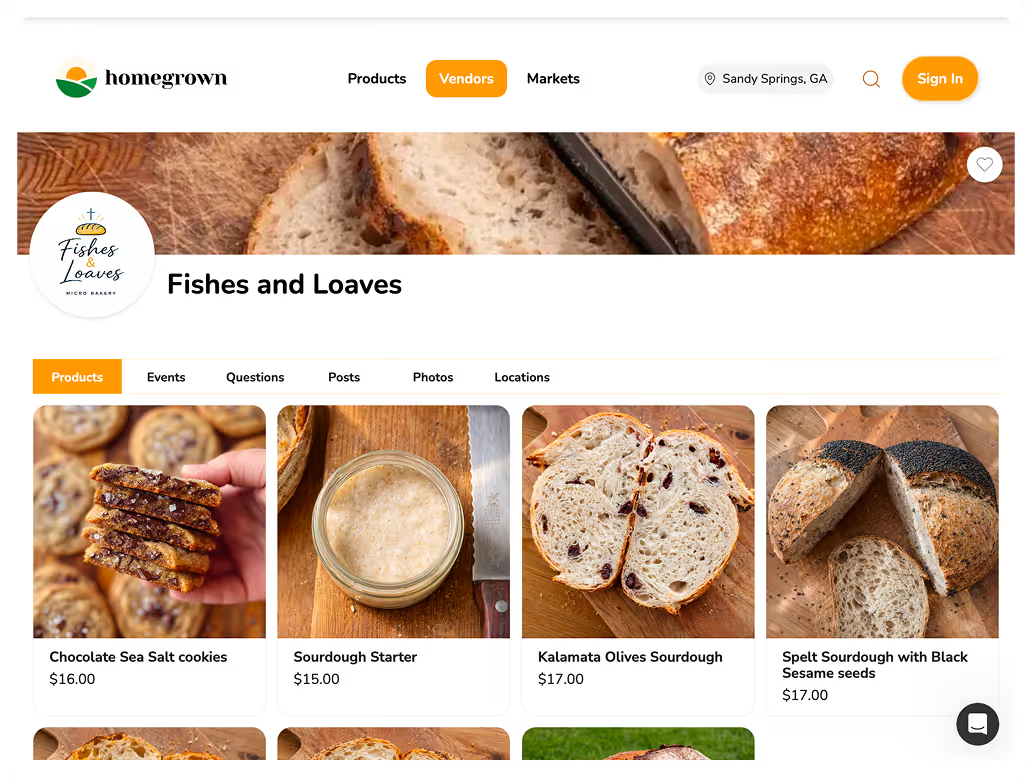
Your stall decor gets a shopper to stop once, and an online storefront with the same look is how they find you and order again between markets. The person who bought your jam on Saturday will not remember your name by Wednesday unless something reminds them, and a matching storefront link on your sign is that reminder.
Homegrown is built for that hand-off. It costs $10 a month billed annually ($12.50 billed monthly) with 0% commission, plus 2.9% + $0.30 card processing per order that you pay, not your customer. Your storefront carries your logo and a banner image, so you can use the same colors and photos as your stall. Homegrown also gives you a printable QR code for your booth sign, and you can add your markets from a list of more than 8,800 so regulars can pre-order and pick up at your stall.
Swipe left to see the full fee stack for each platform.
| Platform | Monthly plan | Trial | Platform fee | Card processing (online) | Customer pays on a $20 order | Vendor pays on a $20 order | Vendor pays in a month of 50 orders at $20 |
|---|---|---|---|---|---|---|---|
| Homegrown | $10 billed annually ($12.50 monthly) | 7 days, no charge until day 8 | None, 0% commission | 2.9% + $0.30, paid by the vendor | $20.00 | $0.88 plus the plan | $54.00 ($56.50 on the monthly plan) |
| Square Online, Square Free plan | $0 | None needed on a $0 plan | None listed | 3.3% + 30¢, paid by the vendor | $20.00 | $0.96 | $48.00 |
| Shopify Basic | $29 billed yearly ($39 monthly) | 3 days, then $1 a month for 3 months | None with Shopify Payments (2% with another provider) | 2.9% + 30¢, paid by the vendor | $20.00 | $0.88 plus the plan | $73.00 ($83.00 on the monthly plan) |
Prices from findhomegrown.com/signup, Square's online store plans page and Shopify's pricing page, all loaded October 13, 2026. Card processing is figured on the $20 price before tax. Square's in-person rate is lower (2.6% + 15¢); this table compares online orders.
Square's free plan costs less on paper at this size: $48.00 against Homegrown's $54.00 for 50 orders, and Homegrown only comes out ahead past 125 orders of $20 a month on the annual plan, or past 156 on the monthly plan. Square is a fine choice if you already run its card reader at the stall. Homegrown fits better if you want market days, pickup at your stall, sales tax handled for you and a marketplace listing in one place built for local food. Shopify can do almost anything, but at $29 a month it is more website than a weekend stall needs.
To be clear about the limits: Homegrown will not design or print your decor, signs or banner. Customers create a Homegrown account to place their first order. There is no drops or timed-release feature. Your storefront is listed on the Homegrown marketplace, but plan on most orders coming from people you send to your own link, starting with the QR code on your stall.
If your stall already looks like a brand, give it a matching place to take orders. Start your Homegrown storefront with a 7-day trial (no charge until day 8), print the QR code for your booth sign, and let Saturday's shoppers pre-order next week's bread from their phones.
The decor mistakes that make a stall look cheap are almost all about clutter and care, not budget. A $50 stall can look better than a $500 one. These are the most common problems:
The fix for most of these is the 20 foot check from the setup steps. Look at your stall from where shoppers first see it, every week, and remove one thing that does not help.
The cheapest way to decorate a market stall is a solid-color cloth, boxes from home under it for height, and garden herbs or flowers in a jar. Mississippi State Extension even suggests a fitted bed sheet as a table cover. A starter decor kit of a 72 x 120 inch cloth, a seagrass basket and faux succulents came to $50.97 at October 13, 2026 prices.
The best tablecloth color is a solid shade that contrasts with your main product. UT Extension gives green under red strawberries or tomatoes and blue under orange pumpkins as examples. Brown baked goods look best on cream, white or a deep green, and a mixed table looks good on natural linen or burlap.
A market stall looks professional when it has one color story, a cloth that reaches the ground, products lifted toward eye level, a name sign up high and nothing personal on the table. Matching your apron and bags to your cloth adds to it. Walk 20 feet down the aisle before opening and look at your stall the way shoppers will.
Not at every market. Two of the five markets we read ban open flames: La Grange Farmers Market under tents and Kingsport Farmers Market at its whole facility, according to rules read on October 13, 2026. Battery tealights and battery string lights give the same glow without the risk.
Canopy legs need between 10 and 40 pounds each at the four markets we checked that set a number. Portland requires at least 10 pounds, Corvallis-Albany 20 (35 when high winds are forecast), Tigard 25 with a $100 weekly fine, and La Grange 40 for a 10 x 10 tent. Your own market's handbook sets the number for your stall.
You do not need lights for a sunny daytime outdoor market, because daylight shows food best. Lights help at evening markets, indoor winter markets and stalls under heavy shade. Choose battery lights with an outdoor rating, since IKEA's LEDFYR string, for example, is listed for indoor use only.
These guides cover the pieces of a market stall that sit next to decor: the table layout under it, the signs on top of it, the canopy over it and the QR code that turns a passing shopper into a repeat order. Four of them are written for small, part-time food vendors at weekly markets, and the last one is for a roadside stand.
A stall people remember is worth more when they can order from you between markets. Your color, your cloth and your banner do the work on Saturday. The rest of the week, a shopper needs a link that looks like the stall they liked. Many regulars will not hunt for you online. They will scan a code on your sign while they wait for change, or they will forget your name by Wednesday. A storefront in the same colors as your cloth, with the same banner photo, tells them they found the right place in the first second.
Put the same look on a Homegrown storefront for $10 a month billed annually, with 0% commission and 2.9% + $0.30 card processing that you pay. Print the QR code onto your booth sign, add your market days, and let regulars order ahead so the best loaf on your table is already spoken for.