
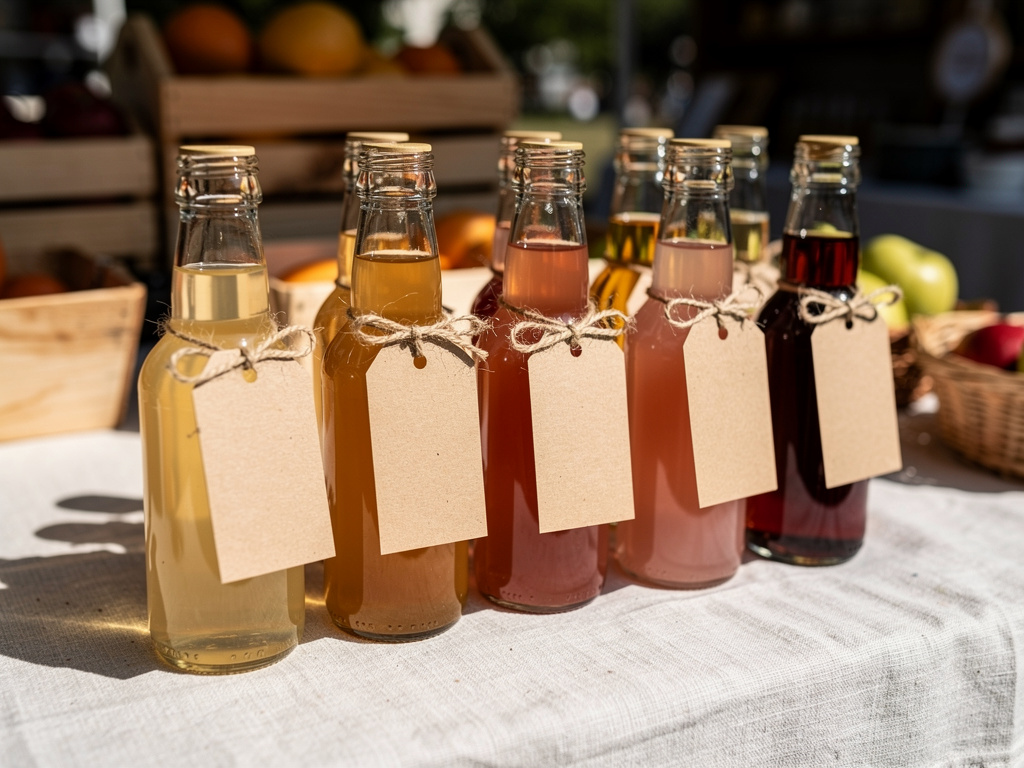


The short version: Charge $9 for an 8-ounce bottle of flavored vinegar you make from store-bought vinegar, and about $8 for 8 ounces of raw apple cider vinegar you ferment yourself where you are set up to make it. That is $1.13 and $1 an ounce, well above the 4 to 32 cents an ounce a Target store charged for most of its vinegar on October 1, 2026, and below the $1.19 to $3.85 an ounce three small-batch vinegar brands charged on their own shops. One 8-ounce flavored bottle costs you about $3.31 to fill with white wine vinegar or $2.07 with cider vinegar, bottle, cap, label and herbs included, so $9 leaves you $5.13 to $6.37 after card processing.
Checked on Target's website, the brands' own shops, Fillmore Container's bottle pages, OnlineLabels' label page, Etsy's and Square's fee pages and Homegrown's signup page, October 1, 2026: prices change, so reload them before you print a sign. Vinegar you ferment yourself from apples or other fruit falls under federal alcohol rules, and state cottage food rules for vinegar differ, so verify your state's current rules before you sell. Homegrown customers create an account to place their first order, and Homegrown has no drops feature.
A shopper at your table picks up your rosemary vinegar, turns it over, and thinks about the jug of cider vinegar at home that cost a few dollars. Your price has to make sense next to that jug and next to the fancy bottles at the kitchen store.
This guide gives you a number you can defend. It lines up what a grocery store, three small-batch vinegar brands and one Homegrown vendor charged on the same day, works out what one 8-ounce bottle costs you to fill from real supplier prices, and shows what card and platform fees take from each sale. It also covers the one federal rule that changes what kind of vinegar a home vendor can make.
Price an 8-ounce bottle of flavored vinegar at $9, and an 8-ounce bottle of raw apple cider vinegar you ferment yourself at about $8. Both sit between grocery vinegar and craft vinegar on a per-ounce basis, which is where a hand-filled bottle from a local vendor belongs.
Three facts back the $9 price:
If you have not started making vinegar yet, our guide on how to sell apple cider vinegar from home walks through the fermenting, the equipment and the market table. This guide sticks to the number on the tag.
Most of the vinegar we priced at one Target store cost 4 to 32 cents an ounce, and the most expensive was 85 cents, so a shopper's mental price for "a bottle of vinegar" is a few dollars. We pulled the prices below from Target's website for its Minneapolis Nicollet Mall store on October 1, 2026.
Swipe the table to see each vinegar's size and price per ounce.
| Vinegar | Size | Shelf price | Price per ounce |
|---|---|---|---|
| Good & Gather distilled white vinegar | 128 oz | $4.59 | $0.04 |
| Good & Gather apple cider vinegar | 64 oz | $3.59 | $0.06 |
| Good & Gather apple cider vinegar | 16 oz | $1.29 | $0.08 |
| Bragg apple cider vinegar | 128 oz | $22.49 | $0.18 |
| Good & Gather white wine vinegar | 12.7 oz | $2.69 | $0.21 |
| Good & Gather red wine vinegar | 12.7 oz | $2.69 | $0.21 |
| Bragg organic apple cider vinegar | 32 oz | $6.89 | $0.22 |
| Bragg organic apple cider vinegar | 16 oz | $4.99 | $0.31 |
| Good & Gather balsamic vinegar of Modena | 16.9 oz | $5.49 | $0.32 |
| Bragg apple cider honey vinegar | 16 oz | $7.89 | $0.49 |
| Good & Gather Signature balsamic vinegar of Modena | 8.5 oz | $7.19 | $0.85 |
Prices come from Target's website for one store (Minneapolis, Nicollet Mall) on October 1, 2026. Price per ounce is the shelf price divided by the fluid ounces on the label. Prices vary by store and change often.
Two numbers here matter most to you:
A shopper who wants cheap vinegar already has it. Your customer is paying for flavor, a local vendor and a nice bottle, so price against the craft shelf, not the grocery aisle.
Small-batch vinegar brands charged $13 to $38 a bottle on October 1, 2026, which works out to $1.19 to $3.85 an ounce. These are the prices your customers see when they shop for "good" vinegar online or at a kitchen store. The last row is not a small-batch brand. It is one Homegrown vendor's cider vinegar, added for comparison.
Drag the table sideways to compare bottle size and price per ounce.
| Brand and vinegar | Bottle size | Price | Price per ounce |
|---|---|---|---|
| American Vinegar Works apple cider vinegar | 32 oz | $38 | $1.19 |
| American Vinegar Works apple cider vinegar | 8.5 oz | $13 | $1.53 |
| American Vinegar Works tarragon wine vinegar | 8.5 oz | $13 | $1.53 |
| Lindera Farms raspberry vinegar | 6.76 oz (200 ml) | $18 | $2.66 |
| Lindera Farms ginger vinegar | 6.76 oz (200 ml) | $22 | $3.25 |
| Brightland Parasol champagne vinegar | 6.76 oz (200 ml) | $26 | $3.85 |
| Homegrown vendor KairosGO, apple cider vinegar | 32 oz | $7.99 | $0.25 |
We checked each brand's price and bottle size on its own online shop on October 1, 2026, and the KairosGO listing in our same-day Homegrown catalog pull. Shipping is not included. We left out two brands whose product pages did not state the bottle size.
What one ounce of vinegar costs a shopper
Source: Target's website (one Minneapolis store), each brand's own shop and our Homegrown catalog pull, all on October 1, 2026. Bar width is the price per ounce divided by $3.85.
What the craft prices tell you:
Compare vinegar by the ounce, because a $26 bottle can cost three times as much per ounce as a $38 one. Brightland's $26 bottle holds 200 ml, which is $3.85 an ounce. American Vinegar Works' $38 bottle holds a full quart, which is $1.19 an ounce. Bottles on the shelf run from 6.76 ounces to a gallon, so a bottle price alone hides most of the difference.
Your customers do this math without a calculator. They pick up an 8-ounce bottle at $9 and compare it to what they paid for a jug. Make the comparison easy:
A per-ounce price is also how you decide what a bigger bottle should cost, which we cover in the section on quarts below.
One 8-ounce bottle of rosemary vinegar costs about $3.31 to make with white wine vinegar, or $2.07 with cider vinegar. The bottle, cap and label add up to $1.20 of that, so packaging is a bigger cost than the vinegar unless you use wine vinegar.
Slide the table to see each cost line for both base vinegars.
| Cost line | Where the price comes from | White wine vinegar base | Cider vinegar base |
|---|---|---|---|
| 8 oz of base vinegar | Target store-brand: white wine 12.7 oz $2.69; cider 64 oz $3.59 | $1.69 | $0.45 |
| 8 oz glass woozy bottle | Fillmore Container, $10.10 for a case of 12 | $0.84 | $0.84 |
| 28-400 cap with a PolyCone liner | Fillmore Container, $0.28 each | $0.28 | $0.28 |
| 3" x 2" label | OnlineLabels sheet labels, about $7.62 to $7.87 per 100 | $0.08 | $0.08 |
| Dried rosemary | Target store-brand 0.75 oz jar, $2.49, one sixth of a jar per bottle | $0.42 | $0.42 |
| Total per bottle | $3.31 | $2.07 |
Sources, all loaded October 1, 2026: Target's website for one Minneapolis store, Fillmore Container's product pages for the bottle and cap, and OnlineLabels' listing for its 3" x 2" sheet labels. The rosemary line assumes a sixth of a jar per bottle; your recipe sets the real amount. Shipping on supplies is not included.
The bottle and cap cost $1.12 together, more than twice the 45 cents of cider vinegar inside. Buying 56 or more cases of the same bottle drops Fillmore's price from $10.10 to $8.90 a case, about 10 cents less per bottle. Pick one bottle and stick with it so every order counts toward the next price break.
Costs that do not show up in the table:
Cider vinegar gives you the best margin: at 6 cents an ounce from a 64-ounce jug, it adds 45 cents to a bottle, against $1.69 for store-brand white wine vinegar. Distilled white vinegar is cheaper still at 4 cents an ounce, but its harsh flavor is a hard sell as a finished product.
Here is how the three bases compare at Target's prices on October 1, 2026:
Whatever you buy, check the acidity on the label. The FDA's guidance on vinegar, CPG Sec. 525.825, says the common vinegars should contain 4 grams of acetic acid per 100 mL, and that vinegar diluted with water should never be less than 4 percent. Start from a base whose label states its acidity, keep it at or above that 4 percent line, and never water it down to stretch a batch.
Wine vinegar costs more per ounce than cider vinegar, and a bigger bottle may not help much. A 16-ounce Pompeian organic red wine vinegar ran $3.59 at the same store, 22 cents an ounce, a cent more than the 12.7-ounce store brand. Cider vinegar does get cheaper in bulk (8 cents an ounce in the 16-ounce bottle, 6 cents in the 64-ounce jug), so if margin matters most, start with cider vinegar.
Start from your cost per bottle, check it against the craft prices, then round to a price that is easy to say. Use the tables above and a calculator.
If your cost runs higher, for example because you use fresh fruit or a pricier base, push toward $10 to $12 and lean on the flavor in your sign and sample. Lindera Farms gets $18 for 6.76 ounces of raspberry vinegar, so there is room above $9 for a special flavor.
Raw apple cider vinegar you ferment yourself should sell for about $8 for 8 ounces, $1 an ounce, a little under flavored vinegar because shoppers compare it straight to Bragg. It takes far longer to make than a flavored bottle, but the customer sees "cider vinegar" and thinks of the Bragg bottle that cost $4.99 or $6.89 at the store.
Here is how to think about the price:
Fermenting your own fruit into vinegar is a federal question before it is a pricing one. The Alcohol and Tobacco Tax and Trade Bureau's alcohol FAQ (question G7, loaded October 1, 2026) says commercial vinegar made from fresh fruit or juice is classified as nonbeverage wine, and whoever makes it must qualify as a bonded wine cellar, get a formula approved and keep records. The same FAQ says TTB regulates vinegar making when there is potential alcohol tax "at any stage of production." Flavoring a finished vinegar you bought has no alcohol stage, which as we read it is why the infused bottles in this guide are the simpler product to start with.
That federal step is a real cost in paperwork and time, so if you plan to sell fermented cider vinegar, price it only after you know what getting set up will take. Our guide to selling apple cider vinegar from home covers the fermenting itself.
Price a quart about 22% lower per ounce than your 8-ounce bottle, which puts a 32-ounce bottle near $28 if your 8-ounce bottle is $9. That is the same step American Vinegar Works uses.
On October 1, 2026, American Vinegar Works sold the same cider vinegar two ways:
Apply that 22% step to your own price. At $9 for 8 ounces, you charge $1.13 an ounce. Take 22% off and you get about 88 cents an ounce, or $28 for 32 ounces. For raw cider vinegar at $8 for 8 ounces, the same step gives about 78 cents an ounce, or $25 a quart.
When a bigger size makes sense:
On Homegrown, both sizes can sit under one listing as variants, each with its own price, so a shopper picks 8 ounces or a quart without hunting for a second product.
On a $9 bottle, card processing costs you 56 cents on Homegrown at 2.9% plus 30 cents, and Homegrown's plan is $10 a month billed annually ($12.50 billed monthly). The table shows the full fee stack for each common way to sell one bottle, and for a month of 40 bottles.
Scroll sideways to see every platform's full fee stack.
| Platform | Monthly plan | Trial | Platform fee | Card processing | Customer pays on a $9 bottle | You pay on a $9 bottle | You pay for 40 bottles in a month |
|---|---|---|---|---|---|---|---|
| Homegrown | $10 billed annually ($12.50 billed monthly) | 7 days, no charge until day 8 | None, 0% commission | 2.9% + $0.30, paid by you | $9.00 | $0.56 plus the plan | $32.44 ($34.94 on monthly billing) |
| Etsy | $0 | No plan to try | $0.20 listing fee per bottle sold, plus 6.5% of the sale including shipping | 3% + $0.25 | $9.00 plus shipping | $1.31 before shipping, and you pack and ship glass | $52.20 before shipping |
| Square Free plan, online | $0 | Free plan | None | 3.3% + 30¢ | $9.00 | $0.60 | $23.88 |
| Square Free plan, tapped at your table | $0 | Free plan | None | 2.6% + 15¢ | $9.00 | $0.38 | $15.36 |
Fees come from Homegrown's signup page, Etsy's sell page and Square's pricing page, all loaded October 1, 2026. Etsy's row leaves out shipping; its 6.5% fee also applies to whatever shipping you charge. Etsy may also charge a one-time shop set-up fee and a 15% Offsite Ads fee on sales that come from its ads. Monthly totals use the unrounded fee per bottle. Taxes are not included.
What the table means at a vinegar table:
A customer who likes your rosemary vinegar will run out at some point, and often on a day you are not at the market. If the only way to get another one is to show up on Saturday, some of those reorders never happen. A pre-order page fixes that: they pick the flavor and size, pay, and grab it at your next pickup.
Homegrown is $10 a month billed annually ($12.50 billed monthly) with no percentage fees beyond standard payment processing of 2.9% plus 30 cents, which is 56 cents on a $9 bottle. For a vinegar table, the useful parts are:
Compare that to Etsy, which takes $1.31 of a $9 bottle before shipping and is built around mailing orders, or to taking orders in Facebook messages and keeping the count in your head.
Here is what Homegrown does not do. It does not ship by mail, so if your buyers are spread across the country, Etsy or your own shop fits better. Customers create a Homegrown account to place their first order. There is no drops feature for timed releases. Your storefront is listed on the Homegrown marketplace, but plan on most orders coming from people you send to your own link, like a QR code on your vinegar sign.
If your regulars keep asking when the next batch of a flavor is coming, set up your Homegrown storefront and let them reserve bottles at $9 before you start the next steep.
Two Homegrown products were vinegar sold as vinegar on October 1, 2026, out of 2,753 products from 309 vendors. That makes vinegar an open lane, and it also means you have little local price competition on the platform.
In a pull of the Homegrown catalog on October 1, 2026, we searched every product's name and description, in every category, for vinegar, shrub, oxymel, fire cider, switchel and balsamic. That found 25 products. We read each one: 23 used vinegar as an ingredient (hot sauces, pickled garlic, jams, bread) or mentioned it in passing. Two were vinegar sold as vinegar: KairosGO's apple cider vinegar at $7.99 for 32 ounces, and Heavenly Fresh Fruits' red wine vinegar at $12.50, with no size listed. No one listed a flavored vinegar or a shrub.
What that means for your price:
A case of 12 flavored bottles sold at $9 leaves you about $61.55 with a white wine vinegar base, or $76.43 with a cider vinegar base, after materials and card processing. That is before your plan, booth fee and time.
Here is the math for one case, using the cost table above and Homegrown's processing:
Now put your time against it. Say steeping takes no hands-on time, and straining, bottling, capping and labeling a case takes you two hours. Then a cider-base case pays about $38 an hour, before your booth fee. If it takes four hours, that drops to about $19 an hour.
Bottle in batches of 12 to match the case. One case of Fillmore's 8-ounce bottles at $10.10 holds exactly one batch, so you always know your bottle count, and a sold-out case tells you it is time to reorder before the next market.
State rules change what kind of vinegar you can sell from home and where you can sell it, and that shapes your price. If your state only allows certain vinegars, your cost and your product line follow from that.
Washington is a clear example. Its cottage food rule, WAC 16-149-120, loaded October 1, 2026, allows "Vinegars that are obtained from approved sources and are rebottled in the cottage food operation," and says flavors such as fruits and herbs may be added. In plain terms, a Washington home kitchen can flavor and rebottle store-bought vinegar, which is the $2.07 to $3.31 bottle in this guide. Fermenting your own cider vinegar is not on that list, but the rule also says the list "is not all inclusive" and that only products the department approves and lists in your permit may be made. So ask the department before you plan a fermented product.
What to check in your own state before you print a price:
Our cottage food laws by state guide is the place to start, and our guide to cottage food labeling requirements covers what goes on the bottle. Rules change, so verify your state's current rules with its agriculture or health department before you sell.
Pricing against Bragg instead of against craft vinegar leaves the most money behind of any mistake here: 8 ounces at Bragg's 31 cents an ounce is $2.50, against $9. Here are the others to watch for:
If you also make mustard or oils for the same table, our guides on pricing mustard and pricing olive oil use the same cost-per-bottle approach.
Charge about $9 for an 8-ounce bottle of homemade flavored vinegar and about $8 for 8 ounces of raw apple cider vinegar. That is $1 to $1.13 an ounce, above any grocery vinegar we priced and below small-batch brands at $1.19 to $3.85 an ounce, based on prices we checked October 1, 2026.
An 8-ounce bottle of herb-infused vinegar costs about $2.07 to $3.31 to make at October 2026 supplier prices. The glass bottle, lined cap and label are $1.20 of that. The rest is the base vinegar, 45 cents of cider vinegar or $1.69 of white wine vinegar, plus about 42 cents of dried herbs.
Selling flavored vinegar can be profitable because the ingredients are cheap and the bottle does most of the work. A case of 12 bottles sold at $9 leaves about $61.55 to $76.43 after materials and card processing, before booth fees and your time. Fermented vinegar from fruit brings federal paperwork that changes the math.
An 8-ounce glass bottle is a good standard size for selling vinegar at a farmers market: big enough to feel worth $9, small enough to try a new flavor. Add a 32-ounce size only for your most popular flavor, priced about 22% lower per ounce, which is around $28 if your 8-ounce bottle is $9.
You can charge more than the grocery store for raw apple cider vinegar with the mother, but shoppers compare it to Bragg, which a Target store sold for 18 to 31 cents an ounce on October 1, 2026. Around $1 an ounce, $8 for 8 ounces, is a fair start for a small vendor. Fermenting it from apples or cider for sale is regulated by the federal Alcohol and Tobacco Tax and Trade Bureau (see question G7 in its alcohol FAQ), so check that first.
Selling vinegar through an online pre-order page lets regulars reorder between markets and pick up at your table or your porch. Check your state's cottage food rules first, since some states limit online sales or keep sales inside the state. Shipping glass across the country adds cost and breakage, so local pickup is the simpler start.
Six guides cover the rest of a vinegar table, from fermenting cider vinegar to what goes on the label:
Ready to take vinegar orders between markets? Start your Homegrown storefront, list your 8-ounce bottles at $9 with a quart as a second size, and put the QR code on your vinegar sign.



