
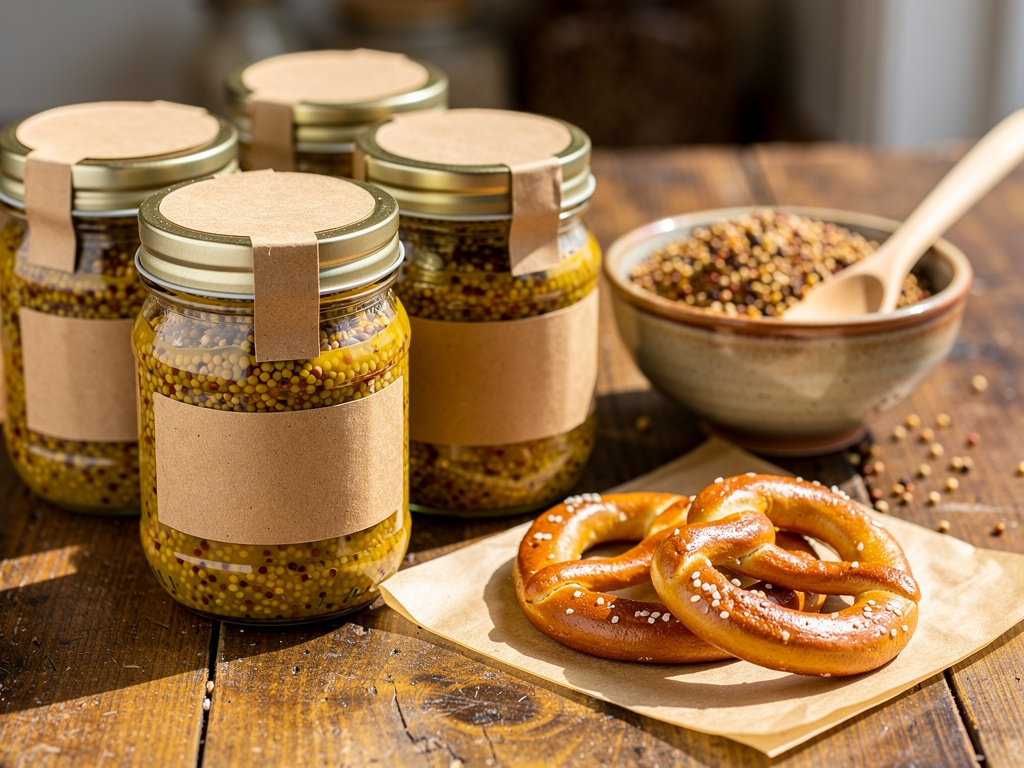


The short version: Sell homemade mustard for $9 to $12 an 8-ounce jar and $6 to $7 a 4-ounce jar, which puts you around the $10 median of six small-batch mustard brands we checked. An 8-ounce jar costs you about $2.45 to make: just under $1.00 of seeds, vinegar, sugar and salt, just under $1.42 for the jar and 4 cents for a label. At $10 you keep about $6.96 after a 59-cent card fee. Before you price anything, confirm your state lets a home kitchen sell mustard: California allows plain mustard made without eggs, Texas allows mustard after a food handler course, though its health department decides whether a vinegar recipe counts as an acidified food, Colorado and Washington list it as ineligible, Michigan rules out condiments, and Florida's approved list does not name it.
Checked September 30, 2026: grocery prices on Hy-Vee's and Whole Foods' online stores, six small-batch mustard brands' own websites, seed prices from Monterey Bay Herb Co., America's Test Kitchen's whole-grain mustard recipe, the California, Texas, Colorado, Washington, Michigan and Florida cottage food pages, the fee pages of Etsy, Shopify and Square, Homegrown's pricing on findhomegrown.com/signup and a pull of the Homegrown catalog. The hours in this guide are our estimate. Homegrown customers create an account to place their first order, and Homegrown has no timed release or drops feature.
A regular at your pretzel table asked if the grainy mustard in the dipping cups comes in a jar. Her neighbor wants two for a holiday gift basket. You need a number to text back, and mustard is an odd product to price, because the grocery store sells a 20-ounce bottle of French's for $2.54.
If you already sell pickles or relish, how much to sell pickles for walks through the same jar math for another jarred condiment. This guide does one job for mustard. It builds your price from numbers loaded on September 30, 2026: what grocery stores and small-batch brands charge, what a batch costs from a tested recipe, what each jar size earns, what selling fees take, and which states let a home kitchen sell mustard at all.
Sell an 8-ounce jar of homemade mustard for $9 to $12, a 4-ounce jar for $6 to $7 and a 16-ounce jar for $16 to $18. Those prices assume a whole-grain or smooth mustard made from whole seeds, vinegar, a little sugar and salt, packed in new Ball jars and sold by pre-order or at a farmers market in a state that allows it.
The range sits in the middle of what small-batch mustard brands charge on their own websites. The six small-batch mustards we picked, one per brand, cost $6.95 to $13.95 for an 8 or 9 ounce jar, and the middle two both cost $10.00. A jar of Grey Poupon Dijon is $4.59 for 8 ounces on Hy-Vee's online store, so the everyday grocery mustards are not your competition. The specialty jars on the same shelf, at $1.27 to $1.42 an ounce, are.
Scroll sideways to see every column.
| Jar size | Suggested price | Price per ounce | Your cost, new jar | Card fee, one jar per order | You keep per jar |
|---|---|---|---|---|---|
| 4 oz jelly jar | $6 to $7 | $1.50 to $1.75 | $1.95 | $0.47 to $0.50 | $3.57 to $4.54 |
| 8 oz half pint | $9 to $12 | $1.13 to $1.50 | $2.45 | $0.56 to $0.65 | $5.99 to $8.90 |
| 16 oz pint | $16 to $18 | $1.00 to $1.13 | $3.62 | $0.76 to $0.82 | $11.62 to $13.56 |
Your cost is the mustard (about 12.5 cents a fluid ounce from the recipe costed below), a new Ball jar with lid and band, and one 2-inch weatherproof label, at prices loaded on September 30, 2026. The card fee is Homegrown's 2.9% + $0.30 per order from findhomegrown.com/signup, checked the same day. Jars hold fluid ounces and store mustard is sold by net weight, so the per-ounce comparisons in this guide are close, not exact.
Pick the top of each range if your mustard has a story a customer can taste, like a local beer or a sparkling wine that costs you real money. Pick the bottom if you are new, if your market already has a condiment vendor at $8 a jar, or if most of your mustard goes into $1.50 dipping cups next to your pretzels.
Whether a home kitchen can sell mustard depends on your state, so confirm your own state's rule before you set a single price. Mustard is a vinegar condiment, and states treat condiments very differently under their cottage food laws, which are the rules that let you sell some foods made in a home kitchen. Here is what six state agencies said on September 30, 2026.
The California Department of Public Health (CDPH) Approved Cottage Foods list has a category called "Vinegars and Mustards" that covers "Mustards (plain, without eggs)." The copy we read was last reviewed in April 2026.
Under SB 541, which the Texas Department of State Health Services (DSHS) cottage food page says local health departments had to follow from September 1, 2025, a cottage food operation can make any food except a short list: meat, poultry, seafood, ice products, low-acid canned goods, products with CBD or THC, and raw milk. Mustard is not on that list. The income limit is $150,000 a year, which the statute says the state adjusts each year for inflation.
Texas adds conditions. Every cottage food operator must complete an accredited food handler course. The same DSHS page lists the recipe sources it accepts for "acidified (pickled) and fermented foods": the USDA Complete Guide to Home Canning, So Easy to Preserve and three Ball books. To use another recipe, you send DSHS a Request for Official Determination. The America's Test Kitchen recipe costed below is not on that list, so before you sell a vinegar mustard, ask DSHS at foodestablishments@dshs.texas.gov whether it counts as an acidified food. If DSHS treats it as one of the "plant-based acidified canned goods" its label rule names, the label also needs a unique number for each batch.
The state health department's Cottage Foods Act page lists "Condiments such as ketchup, mustard, and hot sauce" among the foods that are ineligible. A Colorado home kitchen cannot sell mustard under that law.
The Washington State Department of Agriculture (WSDA) cottage food page lists "Barbeque sauces, ketchups, or mustards" among the cottage food products that are not allowable. Its FAQ gives the reason: "Acidified food products such as mustards, barbeque sauces and ketchup sauces are made into shelf-stable products because of the formulation or acidification process." It adds that this "requires pH control and in many cases a process authority review." A Washington home kitchen cannot sell mustard under a cottage food permit. For foods that are not allowed, the same page points you to a WSDA Food Processor license.
The Michigan Department of Agriculture and Rural Development (MDARD) cottage food one-pager, dated March 2026, lists "Salad dressings, sauces, or condiments." under "Foods that Cannot Be Cottage Foods." Mustard is a condiment, so a Michigan home kitchen cannot sell it as a cottage food.
The Florida Department of Agriculture and Consumer Services cottage food page lists 12 approved product types, from loaf breads to popcorn, and mustard is not one of them. Ask the department before you sell mustard as a Florida cottage food.
You may also run into a federal rule. The FDA's acidified foods regulation, 21 CFR 114.3, leaves out "condiment sauces" that contain only small amounts of low-acid food and whose final pH is close to the vinegar they are made from, and it leaves out foods kept under refrigeration. That rule is about food plants. It does not decide whether your state lets a home kitchen sell mustard. Your state's cottage food office does.
Before you print a price tag, get answers to these from your state:
Honey mustard made with mayonnaise or eggs can count as a different product under state rules. California's list says "plain, without eggs." Our guides to homemade salad dressing and homemade BBQ sauce go deeper on how states treat vinegar sauces. Rules change, so verify your state's current rules with its cottage food office before you sell.
Grocery mustard runs from about 7 cents to about $1.42 an ounce, from a 14-ounce That's Smart! Yellow Mustard at $1.00 to a 7.75-ounce jar of Stonewall Kitchen Caramelized Onion Mustard at $10.99. These are the prices your customers see when they shop, loaded from Hy-Vee's and Whole Foods' online stores on September 30, 2026.
Swipe left for the per-ounce prices.
| Mustard | Store | Size | Price | Price per ounce |
|---|---|---|---|---|
| That's Smart! Yellow Mustard | Hy-Vee | 14 oz | $1.00 | 7.1¢ |
| Hy-Vee Original Yellow Mustard | Hy-Vee | 20 oz | $1.77 | 8.8¢ |
| French's Classic Yellow Mustard | Hy-Vee | 20 oz | $2.54 | 12.7¢ |
| French's Classic Yellow Mustard | Hy-Vee | 8 oz | $1.38 | 17.3¢ |
| French's Spicy Brown Mustard | Hy-Vee | 12 oz | $3.99 | 33.3¢ |
| Koops' Stone Ground Mustard | Hy-Vee | 12 oz | $4.29 | 35.8¢ |
| Organicville Stone Ground Mustard | Whole Foods | 12 oz | $5.39 | 44.9¢ |
| Inglehoffer Stone Ground Original Mustard | Hy-Vee | 10 oz | $4.99 | 49.9¢ |
| Grey Poupon Dijon Mustard | Hy-Vee | 8 oz | $4.59 | 57.4¢ |
| Grey Poupon Dijon Mustard | Whole Foods | 8 oz | $4.69 | 58.6¢ |
| Maille Natural Dijon Mustard | Whole Foods | 7.5 oz | $6.59 | 87.9¢ |
| Maille Old Style Mustard | Whole Foods | 7.3 oz | $6.59 | 90.3¢ |
| Colman's of Norwich Mustard | Hy-Vee | 3.53 oz | $4.49 | $1.27 |
| Stonewall Kitchen Traditional Pub Style Mustard | Hy-Vee | 8 oz | $10.99 | $1.37 |
| Stonewall Kitchen Caramelized Onion Mustard | Hy-Vee | 7.75 oz | $10.99 | $1.42 |
Search results for "mustard" on hy-vee.com and wholefoodsmarket.com at each site's default store, loaded September 30, 2026. We read all 136 results on Hy-Vee's three pages; ground mustard, seeds and snacks are left out. Prices vary by store and week.
You will not beat the yellow squeeze bottles on price, and you should not try. A shopper buying 20 ounces for $1.77 wants a hot dog topping. Your customer is paying for what the bottle does not give them:
The most useful rows are the specialty jars at the bottom of the table. Maille Old Style, a French whole-grain mustard, sells for about 90 cents an ounce at Whole Foods. Colman's hot English mustard is $1.27 an ounce in its small 3.53-ounce jar, and Stonewall Kitchen's Pub Style is $1.37 an ounce on the same Hy-Vee search. A homemade 8-ounce jar at $10 is $1.25 an ounce, less than Hy-Vee already charges for those two jars.
The six small-batch mustards we picked, one per brand, cost $6.95 to $13.95 for an 8 or 9 ounce jar on each brand's website, with a median of $10.00, or $1.25 an ounce. These are small companies, and they are the closest match to what you are making. We loaded each brand's own product page on September 30, 2026.
Slide this table sideways to compare all six jars.
| Brand and mustard | Where it is made | Size | Price | Price per ounce |
|---|---|---|---|---|
| Raye's Mustard, Old World Gourmet | Eastport, Maine | 9 oz | $6.95 | $0.77 |
| MyZucchini, Fermented Mustard Original | Sacramento, California | 8 oz | $9.99 | $1.25 |
| Beth's Farm Kitchen, Whole Grain Deli Style | Hudson Valley, New York | 8 fl oz | $10.00 | $1.25 |
| Miss Amy's, Blue Point Mustard | Not stated | 8 oz | $10.00 | $1.25 |
| Jim Stacy's, Sausage Mustard | Not stated | 8 oz | $13.00 | $1.63 |
| American Spoon, Whole Seed Mustard | Petoskey, Michigan | 8 oz | $13.95 | $1.74 |
Each brand's own website, loaded September 30, 2026, one mustard per brand, all listed as available that day. Shipping costs are not included.
Price per ounce, six small-batch mustards
Source: each brand's website, September 30, 2026, 6 mustards. Bars are scaled to the highest price per ounce.
The pricier jars each give the customer a reason on the label:
Raye's sits at the low end for a reason too. The family has made stone-ground mustard in Eastport, Maine since 1900, in its own mustard mill, and a home kitchen cannot match a mill on cost. If your mustard is plain and your market is price-sensitive, $9 is fair. If it has a local beer in it and a story on the table sign, $10 to $12 sits between Miss Amy's $10 stout mustard and Jim Stacy's $13 ale mustard.
A 2-cup batch of whole-grain mustard costs about $2.00 in ingredients, or 12.5 cents a fluid ounce, which is about what French's charges per ounce for finished yellow mustard in a 20-ounce bottle. We costed America's Test Kitchen's whole-grain mustard recipe, which "makes 2 cups," at prices loaded on September 30, 2026.
Swipe left to see what each ingredient costs.
| Ingredient | Amount in one batch | Price loaded | Cost per batch |
|---|---|---|---|
| Yellow mustard seed | 1/3 cup | $4.55 a pound, Monterey Bay Herb Co. (about 3 cups a pound) | $0.51 |
| Brown mustard seed | 1/3 cup | $5.98 a pound, Monterey Bay Herb Co. (about 3 cups a pound) | $0.66 |
| Cider vinegar, 5% acidity | 3/4 cup (6 fl oz) | Heinz, 32 fl oz for $3.82, Hy-Vee | $0.72 |
| Light brown sugar, packed | 2 tablespoons | Hy-Vee, 32 oz for $2.99 | $0.09 |
| Salt | 1 1/4 teaspoons | Morton, 26 oz for $1.99, Hy-Vee | $0.02 |
| Water | 1/2 cup | Tap | $0.00 |
| Total, 2 cups (16 fl oz) | $2.00 |
Recipe amounts from America's Test Kitchen's Whole-Grain Mustard. Sugar and salt converted to weight with King Arthur's ingredient weight chart (packed brown sugar 7 1/2 ounces a cup, table salt 2/3 ounce a tablespoon). All prices loaded September 30, 2026. Monterey Bay Herb Co. sells by mail, and shipping is extra on orders under $250, so a first order of a pound or two of seed costs more than the seed alone. The line costs add to $2.00 before rounding.
The recipe itself is simple, and most of the time is waiting:
That 1 to 2 day rest matters for pricing. You cannot make mustard the night before a market. If you take orders, take them before you soak the seeds.
An 8-ounce Ball jar with its lid and band costs $1.42, which is more than the $1.00 of mustard you put in it, so the glass jar and label are about 60% of what one filled 8-ounce jar costs you. Hy-Vee's online store sells 12 regular-mouth 8-ounce Ball jars for $16.99 and 12 quilted 4-ounce jelly jars for the same $16.99, loaded September 30, 2026.
That same price is the whole story for small jars:
So a 4-ounce jar costs you 80% as much as an 8-ounce jar and holds half as much. Price it for the jar, not the ounces. That is why the table at the top asks $6 to $7 for 4 ounces, not half of $10.
The label is one of the cheapest parts. OnlineLabels sells its 2-inch round weatherproof matte labels at $79.81 for 100 sheets of 20, which is 4 cents a label, loaded September 30, 2026. Weatherproof matters for a jar that lives in the refrigerator and sweats on a market table.
Buy jars and seed together before you set prices, then run the cost once. If you buy seed by the quarter pound at $2.05 for yellow and $2.69 for brown instead of by the pound, the seeds in one batch cost $2.11 instead of $1.17, and the whole batch costs about $2.93 instead of $2.00. Price from what you actually pay, not from the pound price.
Start from your real cost per jar, check it against the $6.95 to $13.95 small-batch range, and land on a round price that leaves you at least $5 on an 8-ounce jar after fees. Here is the order that works, with the numbers from this guide.
If your true cost with time comes out above $12, look at your time first. At $3.75 a jar it is the biggest line. Of the things you buy, the jar costs the most, and a pint jar holds twice the mustard for 17 cents more.
Charge $6 to $7 for a 4-ounce jar when your 8-ounce jar is $9 to $12, which puts the small jar at $1.50 to $1.75 an ounce and the big jar at $1.13 to $1.50. A higher price per ounce on the small jar is normal, because the jar costs the same.
Small-batch brands do the same thing. Beth's Farm Kitchen sells a 2-ounce mini of its whole-grain mustard for $5.50, or $2.75 an ounce, next to the 8-ounce jar at $10.00, or $1.25 an ounce. Chef Shannon Smith in Tulsa sells only a 4-ounce jar of coarse-grain mustard, at $8.00, or $2.00 an ounce.
Each size has a job:
Sell three 4-ounce jars as one $18 gift set instead of three $6 orders. The card fee on one $18 order is $0.82, and on three $6 orders it is $1.42, so you keep 60 cents more at the same price. A three-flavor set is also easier to give than one jar.
Charge $1 to $2 more for a flavored mustard when the add-in costs you real money, and keep the plain price when it does not, because many brands charge one price across flavors. Raye's Mustard lists 20 mustards in its 9-ounce jar, and 19 of them cost $6.95, its beer mustard and both horseradish mustards included, loaded September 30, 2026. Only the seasonal Fall Harvest, made with chunks of Maine cranberry, costs more, at $8.50. Beth's Farm Kitchen charges $10.00 for its Garlic Rosemary Mustard, the same as its plain Whole Grain Deli Style, but $14.99 for its 8-ounce Paprikash Mustard, made with sweet and hot paprika and upstate New York bell peppers.
The small-batch brands that charge $13 or more all name a special ingredient: a sparkling wine at American Spoon, an ale and local honey at Jim Stacy's. A customer can taste that, and a table sign can say it.
When you price a flavor, do the math on the add-in:
An add-in can change which rules apply. Any add-in, beer and honey included, can move a mustard out of the "plain" category California allows, and fresh garlic, fresh peppers, mayonnaise or eggs can matter in other states too. California's list says "Mustards (plain, without eggs)." Check a new flavor with your state before you sell it, not after.
A quadruple batch makes eight 8-ounce jars, and at $10 a jar you keep about $55.65 after ingredients, jars, labels and card fees, or roughly $37 for each hour of hands-on work. Here is that math, using this guide's costs and our own estimate of the time.
Mustard needs no oven, and the recipe says it keeps up to 6 months in the refrigerator, so a jar that does not sell on Saturday is not lost by Monday. The math still leaves out your market booth fee. If you pay $30 for a Saturday and sell eight jars, the fee takes $3.75 a jar. The real cost of selling at farmers markets walks through the other costs of a market day.
Your batch size is capped by your food processor and your refrigerator. Eight jars can fill a refrigerator shelf. If you plan to sell 30 jars a month, plan for four quadruple batches and the refrigerator space to hold them.
On a $10 jar sold as its own order, card processing through Homegrown is $0.59, while Etsy's listing, transaction and payment fees add up to $1.40. Every platform below was checked on its own pricing page on September 30, 2026, and every row shows the full stack.
Scroll right for the full fee stack on each platform.
| Platform | Monthly plan | Trial | Platform or listing fee | Card processing | Customer pays on a $10 jar | You pay on a $10 jar | You pay in a month of 40 one-jar orders at $10 |
|---|---|---|---|---|---|---|---|
| Homegrown | $10 billed annually ($12.50 billed monthly) | 7 days, no charge until day 8 | None, 0% commission | 2.9% + $0.30, paid by you | $10.00 | $0.59 plus the plan | $33.60 ($36.10 on the monthly plan) |
| Etsy | $0 (a one-time shop set-up fee may apply) | No plan to try | $0.20 listing fee plus 6.5% transaction fee | 3% + $0.25 | $10.00 plus any shipping | $1.40 | $56.00 |
| Shopify Basic | $29 paid yearly ($39 monthly) | 3 days free, then $1 a month for 3 months | None with Shopify Payments (2% with another provider) | From 2.9% + 30¢ online (3.5% + 30¢ on premium cards) | $10.00 | $0.59 plus the plan | $52.60 ($62.60 monthly) |
| Square Free, online | $0 | No plan to try | None | 3.3% + 30¢ online (2.6% + 15¢ in person) | $10.00 | $0.63 ($0.41 in person) | $25.20 ($16.40 in person) |
We checked these on each company's own page on September 30, 2026: findhomegrown.com/signup, etsy.com/sell, shopify.com/pricing and squareup.com/us/en/pricing. Etsy fees are figured on a $10 jar with no shipping; Etsy charges its transaction fee on shipping too, and adds a 15% Offsite Ads fee on sales that come from its ads. Card fees here are figured on the $10 price before any sales tax, and Shopify's use its standard card rate.
A few things the table does not show:
Fees change. Etsy's fees above come from its sell page (etsy.com/sell), checked September 30, 2026. Re-check each platform's own page before you compare, and look at what a whole month costs, not one sale.
Give your mustard regulars one link where they can order and pay before you soak the next batch, so you make the number of jars people already bought. Mustard has a built-in reorder moment: the jar runs out. If the only way to get another is to find you at the market on a Saturday, that reorder can slip away.
Homegrown costs $10 a month billed annually ($12.50 billed monthly) with no percentage fees beyond standard payment processing of 2.9% + $0.30, which you pay. Customers see your jars and flavors, pick a size, pay, and choose a pickup time, or local delivery if you offer it. On a $10 jar that is $0.59 in processing. Etsy takes $1.40 on the same jar and is built around shipping, which is costly for heavy glass. Square Free costs nothing a month and includes a basic online site, with online card payments at 3.3% + 30¢, or $0.63 on a $10 jar. Shopify Basic does the job too, with a $29 monthly plan (paid yearly) once its trial ends.
What it looks like for a mustard vendor:
Homegrown does not tell you whether your state allows mustard, test your pH, or print your labels. Your storefront is listed on the Homegrown marketplace, but plan on most orders coming from people you send to your own link. Customers create a Homegrown account to place a first order, and there is no timed release or drops feature. If that fits how you sell, you can set up your mustard storefront with a 7-day trial and no charge until day 8.
No one sells a jar of mustard on Homegrown yet: 0 of 2,765 products from 313 vendors, in a pull of the catalog on September 30, 2026. That means your price should be set against the small-batch brands above, not against other Homegrown vendors.
In a pull of the Homegrown catalog on September 30, 2026, we searched the name and full description of all 2,765 products from 313 vendors for "mustard," "dijon" and "moutarde," then read all 14 matches. None was a jar of mustard. They were pickles with mustard seed, including Sonkissed Shire's honey-mustard pickles at $5.50 a half pint and $8.50 a pint, mustard greens and microgreens, a pork dinner made with Dijon, Scotch quail eggs, and Retro Pretzels' pretzel packs that come with Gulden's Spicy Brown Mustard packets.
The closest products on Homegrown are other jarred condiments, and they give you a feel for what local shoppers pay:
A $9 to $12 jar of mustard sits in the same price band, though an 8-ounce jar at $10 is $1.25 an ounce, against 50 cents an ounce for an $8 pint of relish. And the pretzel pack with store-bought mustard packets is a reminder that some local food vendors pair their product with mustard and do not make it. That is a wholesale question worth asking, covered next.
Sometimes, but check your state first, because some cottage food laws ban selling through a store and others allow it only under set conditions. Florida's cottage food page says plainly: "Cottage food products cannot be sold wholesale." Texas lets a cottage food operation sell to a cottage food vendor, which is a person or business in Texas with a contract to sell your food to shoppers at a farmers market, farm stand, restaurant or store. The DSHS page says those vendors must register with the state, and it adds one exception: a food that needs time and temperature control for safety cannot be sold wholesale.
If your state allows it, the price math changes. A shop needs its own markup, so it will pay you less than your table price. As an example only, if a deli pays you $6 for an 8-ounce jar you sell for $10, you keep $3.55 over your $2.45 cost, before your time.
Before you agree to a store price, ask these:
A local pretzel stand or brewery is a good first account, as long as you price by the ounce. How much to sell pretzels for found that a 2-ounce dip cup, filled with 1.5 ounces of French's, costs a pretzel stand about 28 cents and sells for $1.50. At the $6 wholesale example above, 75 cents an ounce, 1.5 ounces of your mustard would cost the stand about $1.13 before the cup, most of that $1.50. So pitch it as a premium cup the stand sells for more, or offer a bigger wholesale container priced by the ounce, not as a swap for French's.
Raise your price by $1 a jar when you sell out two markets in a row, or when your seed, vinegar or jar costs go up enough to move your cost per jar by 25 cents or more. On September 30, 2026, yellow seed was $4.55 a pound and brown was $5.98. If either jumps, re-run your batch cost.
Signs it is time to change the price:
Change prices at the start of a season or on a new flavor, not mid-month on your regulars' favorite jar. A sign that says "new 2026 price" with a round number reads better than a price that drifts by a quarter.
The costliest mistake is pricing mustard by its ingredients, which run about $1.00 for 8 ounces, and forgetting the $1.42 jar that costs more than the mustard. These are the ones to avoid:
Most of these come down to the same fix: cost one real jar, with the jar, and price from there.
Price homemade mustard at $9 to $12 for an 8-ounce jar and $6 to $7 for a 4-ounce jar. The six small-batch mustards we picked on September 30, 2026, one per brand, cost $6.95 to $13.95 for 8 or 9 ounces, with a median of $10.00. The two jars at the top, $13.00 and $13.95, name an ale and a sparkling wine, while Raye's sells its beer and horseradish mustards at the same $6.95 as its Old World Gourmet.
The ingredients alone cost about the same as French's yellow, but a filled 8-ounce jar costs more than French's once you add a new jar and label. At about $2.45, that jar works out to about 31 cents an ounce, close to French's Spicy Brown at 33 cents and well under Grey Poupon Dijon at 57 cents. The ingredients in a homemade whole-grain mustard cost about 12.5 cents a fluid ounce at September 30, 2026 prices, close to the 12.7 cents an ounce of a 20-ounce French's bottle. Against Maille Old Style at about 90 cents an ounce, making your own saves a lot.
An 8-ounce jar of homemade mustard costs about $2.45 to make: just under $1.00 of seeds, cider vinegar, brown sugar and salt, just under $1.42 for a new Ball jar and 4 cents for a label. A 4-ounce jar costs about $1.95, because the jar costs the same. Those figures use prices loaded on September 30, 2026.
It depends on your state's cottage food law. California's approved list includes "Mustards (plain, without eggs)," and Texas allows any food except a short list that does not include mustard, once you complete a food handler course, but ask the Texas Department of State Health Services whether your recipe counts as an acidified food, since the recipe in this guide is not on its list of accepted recipe sources. Colorado and Washington list mustard as ineligible, Michigan's list of foods that cannot be cottage foods includes condiments, and Florida's approved list does not name it. Confirm with your state before you sell.
The whole-grain mustard recipe from America's Test Kitchen says it keeps in the refrigerator for up to 6 months. It rests at room temperature for 1 to 2 days first, then goes in the refrigerator once it reaches the heat you want. Put the made-on date on your label so customers know how fresh their jar is.
Yes. Grey Poupon Dijon is $4.59 for 8 ounces at Hy-Vee. Your 8-ounce jar costs about $2.45 to make, so selling at $4.59 leaves you about $1.70 after a 43-cent card fee, before your time. A homemade 8-ounce jar at $9 to $12 is priced against small-batch brands, which charge a median of $10.00.
These guides cover the jobs that sit around a jar of mustard, from the state rules you check first to the other condiments and snacks that share your table. Start with the two permission guides if you have not confirmed your state yet, then use the pricing guides to set prices for the rest of your table:
Set your three jar prices today, $6 to $7 for 4 ounces, $9 to $12 for 8 ounces and $16 to $18 for 16 ounces, then take orders before the seeds go in the vinegar. Mustard needs up to a day of soaking and 1 to 2 days of rest, so know your jar count before you start.
Here is a simple way to start this week:
When you are ready, start your Homegrown storefront at $10 a month billed annually, with a 7-day trial and no charge until day 8. Your regulars can order a jar, pay, and pick it up at your door or your market booth, and you soak exactly the seeds you need.



