

The short version: You get a table at a school or church bazaar by finding the vendor form early, sending clear photos of your products, paying the table fee when and how the form asks, and following the food rules the host writes down. In 13 vendor applications for 2026 bazaars, the cheapest single space ran $25 to $100 with a middle price of $50, 5 asked for a donated product for a raffle or silent auction and 8 wanted photos. Food is the catch, since 8 of the 13 set food rules, 4 banned homemade food or sweet treats outright, and in some counties, such as Clark County, Washington, a nonprofit host's own bake sale is exempt from permits when your table is not. Rebook on bazaar day, because at several of these events returning vendors book next year's spaces first.
Checked October 14, 2026: 13 published 2026 bazaar vendor applications from churches, schools and school parent groups in 11 states, USDA's Smart Snacks rule on eCFR, Clark County Public Health's bazaar FAQ, the Texas DSHS cottage food page, and Homegrown's prices on findhomegrown.com/signup. Food permit rules change by state and county, so check yours, and note that Homegrown customers create an account to place a first order and Homegrown has no drops or timed-release feature.
A church holiday bazaar in a fellowship hall can be one of the friendliest places to sell all year. The shoppers are neighbors, the table fee is small, and people come ready to buy gifts. The hard part is getting in. Most bazaars are run by a volunteer committee that fills its tables weeks or months ahead, often with the same vendors as last year.
This guide shows you how the invitation actually works. We read 13 real 2026 vendor applications from churches, schools and school parent groups, from Bend, Oregon to Raleigh, North Carolina, and counted what they ask for: the fees, the deadlines, the photos, the raffle donations and the food rules. You will also see the food rule that trips up many home bakers, and how to get asked back next year.
Many school and church bazaars fill tables in the order paid forms arrive, after a quick look at your photos to keep the mix varied: 5 of the 13 applications we read said first come, first served in writing. St. Joseph's in Raleigh also takes home-business brands such as Pampered Chef and Avon in the order their applications arrive. Only one, St. Luke's United Methodist Church in Indianapolis, called itself a juried event, which means a committee reviews your work and picks the best fits.
That does not mean every form gets a yes. The committee is protecting two things: variety for shoppers and the money the event raises for the church or school. Here is what the forms said they screen for:
So "getting invited" really means getting your form in early, in a category the committee still needs, with photos that make the choice easy, and with the space fee paid when the form asks for it (the cheapest single space ran $25 to $100 in our sample). If you sell food, the rules are tighter, which we cover below. For what to make and how to set up once you are in, our guide to selling food at school fundraisers and church events covers the selling side; this page is about getting the table.
You find open bazaars through the host's own channels first: the church office, the parish bulletin, the PTO or PTA website and the school's Facebook page. Small bazaars rarely pay for ads. The 13 forms we read lived on church websites, PTO and PTA pages, a school district site and a band boosters' site, and one was hosted on a regional craft fair listing site.
Places to look, roughly in the order they pay off:
Start with the bazaars inside 20 minutes of home. You will often load and unload by yourself early in the morning, and a short drive matters more than a slightly bigger crowd.
Bazaar applications close anywhere from 12 days to about five and a half months before the event, so start looking in late spring, not in November. In our sample, Mountain View's fair wanted forms by June 1 for a November 14 event, 166 days ahead. Lebanon PTO's fair in New Hampshire closed applications August 15, 91 days ahead. Heritage Christian's deadline was November 2 for November 14, just 12 days out. Marvin United Methodist Church sets no application deadline at all, only a payment deadline of November 11 for its November 14 bazaar, 3 days ahead, after which unpaid booths go to standby vendors.
Early deadlines are only half of it. Popular bazaars fill before their deadline. Tukes Valley PTO stopped taking 3D-printed products on October 4, 2026, more than six weeks before its November 20 deadline, because that category was full. St. Joseph's in Raleigh listed a September 30 deadline and was full and taking only a waitlist when we checked on October 14. Returning vendors also book first: St. Luke's accepts paid forms from current vendors on bazaar day and holds their spaces until March 1 of the next year.
Here is the bazaar year as the forms describe it:
If you are reading this in October, focus on December bazaars and waitlists. Then set a reminder for next May.
The 13 applications asked for the same short list: a table fee, usually paid with the form, a description of what you sell, photos, and often a donated product, with food rules on more than half. Here is each one as published for its 2026 event.
Scroll sideways to see every column.
| Bazaar and host | Place | 2026 date | Cheapest single space | Deadline | Donation asked | Food rule on the form |
|---|---|---|---|---|---|---|
| Christmas Faire, St. Francis of Assisi Catholic Church | Bend, OR | Nov 14 | $40 ($45 after deadline) | Oct 1 | Silent auction product, required | No food; hand crafted only |
| Holiday Bazaar, First Baptist Church Hebron | Carrollton, TX | Nov 7 | $60 (8 ft table, 2 chairs) | With payment; no refunds after Oct 28 | None | Food subject to health department rules |
| Christmas Bazaar, Heritage Christian School | Bozeman, MT | Nov 14 | $50 (6 ft table space) | Nov 2 | None | None written |
| Fall Bazaar, St. Barnabas Episcopal Church | Denton, TX | Oct 17 | $40 (bring a card table) | Sept 28 | None | None written; church sells its own baked goods and casseroles |
| Holiday Bazaar, St. Luke's United Methodist Church | Indianapolis, IN | Nov 14 | $100 (6 x 5 ft booth) | Juried; current vendors rebook until Mar 1, 2027 | None | No food or drink sold by vendors; host runs a bake sale and luncheon |
| Joy of Christmas Craft Fair, St. Joseph's Catholic Parish | Raleigh, NC | Nov 7 | $35 (classroom space) | Sept 30; now waitlist only | Raffle product worth $15 to $20, required | Wrapped or sealed; not for eating on site |
| Candy Cane Express Bazaar, Tukes Valley PTO | Brush Prairie, WA | Dec 5 | $40 (9 x 6 ft) | Nov 20 | Auction product or $2 kids' shop gifts, requested | No food made in a home kitchen |
| Holiday Market, Cedarcrest High School PTSA | Duvall, WA | Nov 14 | $50 (about 8 ft wide) | Oct 16 | Raffle products worth $30+, required | Food must meet King County and Washington rules |
| Craft Fair, Parkway North Band Backers | St. Louis, MO | Nov 7 to 8 | $100 ($90 before June 30) | Oct 17 | Raffle product, asked | No sweet ready-to-eat food |
| Craft Fair, Mountain View school | Kingsley, PA | Nov 14 | $25 | June 1 | None | None written; new vendors sell handmade or homemade crafts only |
| Lebanon PTO Craft Fair | Lebanon, NH | Nov 14 to 15 | $100 (8 x 8 ft) | Aug 15 (pay by Sept 15) | None | Licensed only, with permits, insurance, pre-packaged |
| Christmas-by-the-Lake, Avon Lake High School PTA | Avon Lake, OH | Dec 5 | $75 (10 x 10, one table) | Not stated | None | None written; work must be original and handmade |
| Holiday Bazaar, Marvin United Methodist Church | Martinez, GA | Nov 14 | $30 (indoor 10 x 10) | Pay by Nov 11 | None | None written; church sells food in its cafe |
We loaded each host's published 2026 vendor application or vendor page on October 14, 2026. "Cheapest single space" is the lowest-priced indoor space one adult vendor can book, before table, chair or electric rental; youth rows and outdoor bring-everything rows are left out. Six hosts are churches and seven are schools or school parent groups. Dates and deadlines are the host's own and can change.
Three patterns stand out. Most forms want payment with the application, but follow the form: St. Luke's asks new vendors to send photos first and pay after acceptance, and Lebanon bills after it confirms you. Refund rules vary: some forms keep the fee once you are accepted, others refund until a set date, so note the cutoff on each form. And the strictest rules are about food, not crafts.
A single space at a school or church bazaar cost $25 to $100 in our sample, and the middle of the 13 was $50. That is the cheapest single space at each event. Bigger spaces and premium spots cost more: St. Luke's charges $190 for an 18-foot booth, and Lebanon charges $175 for two booths.
Cheapest single space at each bazaar we read, 2026
Source: each host's 2026 vendor application, loaded October 14, 2026. 13 events.
The table fee is rarely the whole bill. Watch for these extras on the form:
Before you pay, do the simple math. If your average sale is $10, a $50 table takes 5 sales just to cover the fee, before ingredients, packaging and your Saturday. Our guide to working out whether a craft fair table fee pays off walks through that calculation with your real costs.
Ask the chair one question before you pay: "About how many shoppers came through last year?" A $25 table at a bazaar with 150 shoppers can lose to a $75 table at a school fair that draws 1,500. If the chair has no door count, ask how many raffle tickets sold last year.
Sometimes, but it is the most restricted category: 8 of the 13 forms set food rules, and 4 banned homemade food or sweet treats outright. St. Francis in Bend asks vendors to bring no food at all. St. Luke's in Indianapolis does not let exhibitors sell food or drink at their booths. Tukes Valley PTO says sales of food made in a home kitchen are prohibited because of health department rules. Parkway North allows no "sweet ready-to-eat food."
The other four allowed food with conditions. St. Joseph's wants food individually wrapped or sealed and not meant to be eaten on site. Lebanon PTO allows food only if approved and licensed, with proof of permits and liability insurance, pre-packaged. First Baptist Church Hebron says all food is subject to health department rules and that getting the right permits is your job. Cedarcrest's PTSA says food must be prepared, packaged, labeled, displayed, sampled and sold under all King County and Washington State requirements.
There is a reason home bakers get turned away more than candle makers. The host is often selling food itself. 4 of the 13 bazaars run their own bake sale, lunch or cafe, and that table is part of what the event raises.
The church or PTO bake sale next to you may be legal without a permit when your table is not. Clark County Public Health in Washington says on its bazaar FAQ that baked goods that do not need refrigeration are exempt from a permit "ONLY when sold/served by non-profit organizations." You are a private vendor selling for yourself, so that exemption does not cover you. Ask your county health department what your own table needs.
How the rule plays out depends on where you live. Two examples we checked show how far apart places can be:
Clark County Public Health's FAQ for farmers markets, bazaars and temporary events says all food served to the public needs a notice to the health department and usually a permit, and says temporary event permit applications "must be submitted within 14 days of the event to avoid a late fee," which means at least 14 days before it. The same FAQ says a home kitchen can be used only with approval from the Washington State Department of Agriculture through a cottage food permit or food processor license, plus a notice to the health department. The Tukes Valley PTO, which is in Clark County, points vendors to that page when it bars home-kitchen food. Checked October 14, 2026.
The Texas DSHS cottage food page says a local health department may not require a cottage food operation to get a license or permit, or pay a fee, to sell directly to a consumer. The same page says cottage food operations that sell foods needing time and temperature control for safety must register with DSHS. Under SB 541, which local health departments had to follow starting September 1, 2025, a Texas cottage food operation can gross up to $150,000 a year. A Texas bazaar can still say no to food; that is the host's call, not the law's. Checked October 14, 2026.
Every state draws these lines differently, and counties add their own. Look up your state's limits in our cottage food laws by state guide, then verify your state's current rules with your health department before you list food on a bazaar form. Put the permit status right on the application, so the committee does not have to ask.
No, the federal Smart Snacks nutrition limits apply to food sold to students on campus during the school day, which ends 30 minutes after classes let out. The rule is in 7 CFR 210.11 on eCFR, which defines the school day as "the period from the midnight before, to 30 minutes after the end of the official school day." A bazaar in the gym on a Saturday or a weekday evening falls outside that window.
That matters because PTO volunteers sometimes say "we can't sell cookies at school" when they mean during the day. Here is how the timing works, as of the rule we loaded October 14, 2026:
Smart Snacks is only the federal rule. The district's facility rules can add more: the Tukes Valley PTO asks vendors to follow its school district's facility use guidelines as well as the county's food rules. If a school PTO says food is off the table, ask whether the rule is the district's or the PTO's, and respect it either way.
Pitch something the bake table does not sell: whole loaves, jars, gift boxes or a holiday pre-order, not single cookies and brownie squares. The host's bake sale is volunteer baking sold to raise money, and a committee will not let a vendor undercut it on the same treats.
That is a real problem for most home food vendors, because baked goods are most of what they make.
In a pull of the Homegrown catalog on October 14, 2026, 1,538 of the 2,921 products listed by 322 vendors were in the Bakery category, about 53%, from 194 vendors. Pantry products such as jams, sauces and spice blends were next with 368 products from 64 vendors, and arts and crafts had 84 from 12 vendors. We counted by the category each vendor picks for a listing, not by words in product names.
If you are one of those bakers, here are pitches that sit beside a church bake sale instead of against it:
Say this out loud in your email: "I will not sell single cookies or brownies, so I won't compete with your bake sale." Committees remember the vendor who thought about their fundraiser first.
A short email to the bazaar chair with what you sell, two photos, your permit status and a clear ask gets a faster yes than a long story. Send it to the name on the form. If there is no form yet, send it to the church office or the PTO's events address and ask who runs vendors.
Put these five things in the email:
Here is a version you can adapt:
> Hi Karen, I'm Maria, a home baker in Denton. I'd love a table at your November bazaar. I sell sourdough loaves ($10 to $12) and jars of jam ($8), packaged and labeled under Texas cottage food rules. I won't sell single cookies or brownies, so I won't compete with your bake sale. Photos of my products and my table are attached. I'm happy to donate a jam gift set to your raffle. Could you send the vendor form, or tell me how to pay for a space? Thank you, Maria
If you hear nothing in a week, reply once, or call if the form gives a phone number. Some hosts, like St. Joseph's in Raleigh, ask vendors not to call the parish office. Volunteers run these events around jobs and families, and a polite second note is normal. A third message is too many.
Send 2 to 4 clear photos: your best 2 or 3 products up close, your full product range, and your table as shoppers would see it. 8 of the 13 applications asked for photos. Avon Lake High School's PTA wants 3 to 4 color photos of your work and your booth, and says a missing photo can delay acceptance. St. Luke's will not accept an application without pictures. Parkway North asks for at least two clear photos that represent everything you plan to sell.
The committee uses photos to answer three questions: is it handmade, does it fit a family crowd, and does it duplicate a vendor they already have. Give them easy answers:
Name your files with your business name, like "Maria-Bakes-jam.jpg." Committees print and pass these around, and a photo called IMG_4021 gets lost. Our craft fair booth checklist for food vendors covers what to bring so the real table matches the photo.
Donate one product that shows off your best work and lasts until the drawing, worth what the form asks: $15 to $20 at St. Joseph's and at least $30 at Cedarcrest's PTSA. 5 of the 13 bazaars asked for a donation. At three of them it was required, and some want it weeks early: St. Joseph's needed raffle donations by September 30 for a November 7 fair, and St. Francis wanted silent auction pieces in the church office by October 1.
Good donations for food and handmade vendors:
Make your donation the same product you want to be known for and price it at your normal retail value on a tag. A $30 jam basket that wins at 3 p.m. puts your jars in a kitchen for weeks; a $30 basket of mixed odds and ends gets forgotten by Monday.
Keep a list of what you donate and its value. Whether a donated product can come off your taxes depends on your business setup, so ask your tax preparer rather than assuming.
Expect to sign a hold-harmless agreement and to be responsible for your own sales tax, permits and insurance, even at a one-day church bazaar. The forms were blunt about it. Cedarcrest's PTSA says each vendor is "solely responsible for collecting and remitting any applicable sales tax and for maintaining all business licenses, permits, registrations, and insurance." Parkway North says all county and state licenses, permits and taxes are yours. St. Joseph's says vendors collect and report all sales tax.
Here is what to have ready before you apply:
None of this is exotic. Put copies in one folder at least 7 days before the bazaar. It is the same paperwork you need for any market, and having it ready makes you look like the vendor who will not create problems for a volunteer committee.
You get invited back by rebooking before you leave and by being easy to host: on time, inside your space, staying until close and leaving it clean. Returning vendors book first at several of the bazaars we read. St. Luke's takes paid forms from current vendors on bazaar day, and Parkway North kept returning crafters in the same booth as last year if they paid by May 1, and Lebanon opens next year's returning-vendor applications on November 15, the fair's second day.
The forms list what committees hold against vendors. Avoid every one of these:
Then do the small things volunteers remember. Thank the chair before you leave. Send a short note within 7 days with how the day went and one useful suggestion. Pay next year's deposit early if they offer it. A committee that fills its room with returning vendors in March is a committee that already likes you.
A bazaar gives you a few hours with a room full of neighbors, and the vendors who earn the most from it are the ones who give those shoppers a way to order again in December, February and next fall. Most church and school bazaars happen once a year. Your regulars from that day will not wait a year if they can order from you next week.
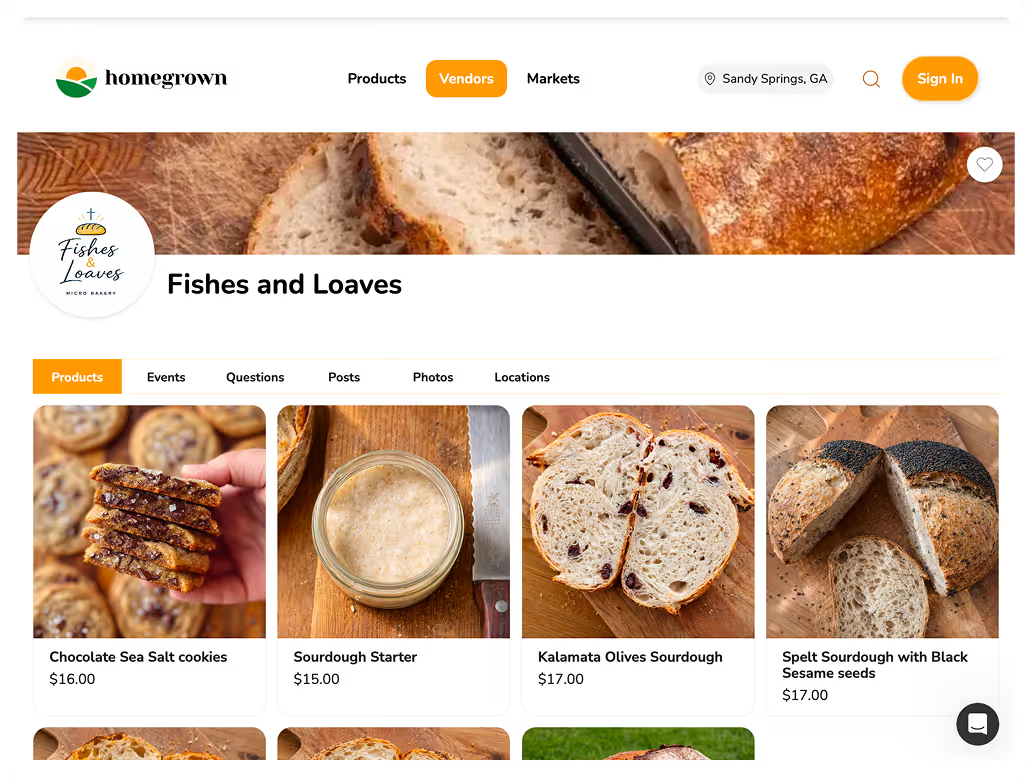
Homegrown is built for that hand-off. It costs $10 a month billed annually ($12.50 billed monthly) with 0% commission, plus 2.9% + $0.30 card processing per order that you pay, not your customer. You get one storefront link to print on a card at your bazaar table, and shoppers order and pay online for pickup from your porch, your market booth or another spot you set, like a church parking lot after Sunday service. Homegrown also collects and sends in sales tax for the products that need it, which helps if you sell a mix of taxable and untaxed products.
Scroll sideways to see the full fee stack for each option.
| Platform | Monthly plan | Trial | Platform fee | Card processing (online) | Customer pays on a $20 order | Vendor pays on a $20 order | Vendor pays in a month of 50 orders at $20 |
|---|---|---|---|---|---|---|---|
| Homegrown | $10 billed annually ($12.50 monthly) | 7 days, no charge until day 8 | None, 0% commission | 2.9% + $0.30, paid by the vendor | $20.00 | $0.88 plus the plan | $54.00 ($56.50 on the monthly plan) |
| Square Online, Square Free plan | $0 | None needed on a $0 plan | None listed | 3.3% + 30¢, paid by the vendor | $20.00 | $0.96 | $48.00 |
| Square Online, Square Plus plan | $49 per location, monthly | 30 days | None listed | 2.9% + 30¢, paid by the vendor | $20.00 | $0.88 plus the plan | $93.00 |
Prices from findhomegrown.com/signup and Square's online store plans page, both loaded October 14, 2026. Card processing is figured on the $20 price before tax: 2.9% of $20 is $0.58, plus $0.30, is $0.88; 3.3% of $20 is $0.66, plus $0.30, is $0.96. Square's in-person rate on the Free plan is 2.6% + 15¢; this table compares online orders.
Square's Free plan costs less at this size, $48.00 against Homegrown's $54.00 for 50 orders, and it is a good choice if you already run a Square reader at your bazaar table. Homegrown fits better if you want standalone pickup spots, market days, sales tax collected and sent in for you, and a listing on a marketplace built for local food and handmade vendors, all for one flat price. Taking orders through Facebook or Instagram messages costs nothing, but you track every order, payment and pickup time by hand, which gets hard after the first ten.
To be clear about the limits: Homegrown will not get you into a bazaar, fill out an application or handle a health permit. Customers create a Homegrown account to place their first order. Homegrown has no drops or timed-release feature. Your storefront is listed on the Homegrown marketplace, but plan on most orders coming from people you send to your own link, starting with the card on your bazaar table.
If you are taking holiday pre-orders at a bazaar this season, set the link up before the doors open. Start your Homegrown storefront with a 7-day trial (no charge until day 8), print the link or QR code on a card, and let bazaar shoppers order their Christmas cookie box from their phones.
The easiest way to miss a bazaar is to apply after the spaces are gone: Tukes Valley closed its 3D-printed category on October 4, more than six weeks before its November 20 deadline, and St. Joseph's was taking only a waitlist when we checked on October 14. The other mistakes are just as avoidable:
Fix these and a small church or school bazaar becomes a yearly date on your calendar, with the same shoppers looking for your table every November.
Email the church office, or call unless the host asks for email only (St. Joseph's in Raleigh does), and ask who runs the bazaar's vendor tables, then ask for the vendor form. Send it back early with the table fee if the form asks for payment up front, two or three product photos and a short description of what you sell. Of 13 church and school bazaar forms we read for 2026, 5 said in writing that spaces go first come, first served, so applying early is one of the biggest things you control.
The cheapest single space at the 13 bazaars whose forms we checked on October 14, 2026 cost $25 to $100, and the middle one was $50. Plan on $10 to $25 more if you rent the host's table and up to $20 for electricity. Some bazaars also ask you to donate a product to their raffle, worth $15 to $20 at one and at least $30 at another.
It depends on your state, your county and the bazaar's own rules. Of 13 bazaar forms we read, 4 banned homemade food or sweet treats outright and 4 more set conditions such as wrapping, county food rules, permits or insurance. In Clark County, Washington, for example, a nonprofit's bake sale of baked goods that need no refrigeration is exempt from a permit and a private vendor is not; in Texas, a local health department may not require a cottage food operation to get a permit to sell directly to a consumer, though one that sells foods needing time and temperature control for safety must still register with the state. Check with your county health department first.
Start in late spring for November and December bazaars. Application deadlines in our sample ran from June 1 for a November 14 school fair to 12 days before the event, and one parish fair was full and taking only a waitlist when we checked on October 14. Returning vendors often rebook on bazaar day, so the best time to get next year's space is the day of this year's bazaar.
Not always. Of the 13 forms we read, only Lebanon PTO's fair required proof of liability insurance, and only from food vendors. Cedarcrest's PTSA makes each vendor responsible for any insurance required, and First Baptist Church Hebron says vendors need their own policy for product liability coverage. Read the hold-harmless clause on the form too. Heritage Christian School says it insures its own building but "shall not be liable to insure the user" for injury or damage caused by a vendor or the vendor's customers.
Usually yes, if your state taxes what you sell. Several 2026 bazaar forms we read, including Cedarcrest's PTSA and St. Joseph's in Raleigh, said each vendor must collect and report their own sales tax. Food sold for home use is untaxed in some states and taxed in others, so check with your state's revenue department before the bazaar.
These guides cover the steps before and after the bazaar table: choosing which events are worth it, what to sell at the table, the break-even math on a table fee, and how to keep shoppers ordering afterward. All five are written for small, part-time vendors, not full-time show crafters.
A church or school bazaar puts you in front of your own neighbors for one afternoon, and the vendors who gain the most leave with a way for those neighbors to order again. The cheapest single space runs $25 to $100. The shoppers who loved your jam or your sourdough are worth far more than that if they can find you in January. Most will not remember your business name a week later. They will remember the card they tucked into a purse, or the code they scanned while you counted their change, and that is what brings them back between bazaars.
Give them a link before they leave. A Homegrown storefront costs $10 a month billed annually, with 0% commission and 2.9% + $0.30 card processing that you pay. Print the link on a card for your bazaar table, set a pickup spot near the church or school, and let your new regulars order ahead for the holidays.