
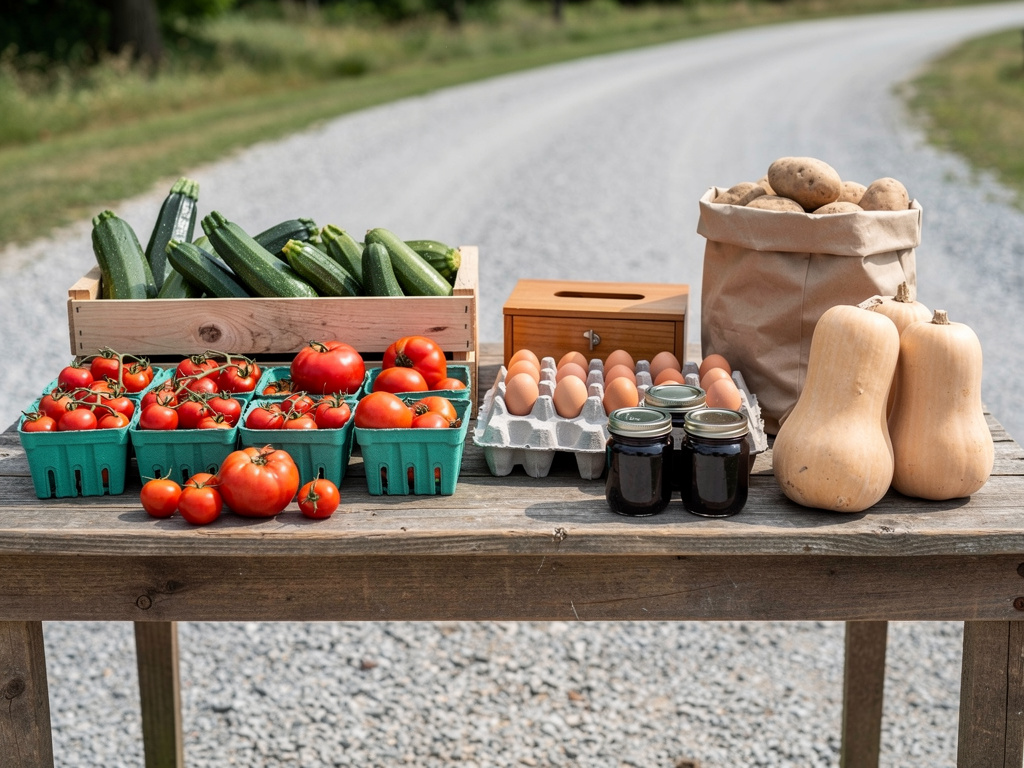


The short version: In this income report, a self-serve family farm stand with a big garden and 30 hens sells $2,695 in July and keeps $2,385.50 after every cash cost. In January it opens three days a week, sells $559 of eggs, potatoes, squash and jam, and keeps $405.12, about one sixth of July. The model holds the hens' feed at $111.92 in both months, and the January jam was paid for in July, so summer cash decides how good winter looks.
Checked on October 14, 2026: reference prices and the sugar and flour prices come from the U.S. Bureau of Labor Statistics, and the other supply prices come from the seller's page and every payment and platform fee from the company's own page, all loaded that day; the unit counts, payment split and hours are a stated model, not one real stand's books. Homegrown customers create an account to place their first order, and Homegrown cannot price by the pound yet.
Everyone knows a farm stand is busier in July than in January. Fewer people know by how much, or which costs keep running when the tomatoes are gone. This income report puts one peak summer month and one dead-of-winter month side by side for the same small stand, line by line, with every price checked on October 14, 2026. Market vendors ride the same seasonal swing, and our breakdown of how much you can make selling at farmers markets runs those numbers across a full market year.
The stand in this report is a model, not a real family's ledger. We built it so you can swap in your own numbers, and every place we made a guess, we say so.
In this model, the farm stand makes $2,695 in sales in July and $559 in January, so January brings in about 21% of July. After costs, the stand keeps $2,385.50 in July and $405.12 in January. January keeps a smaller share of each dollar because the hens eat the same amount of feed no matter how many people stop.
Here is the whole report in one table.
Scroll sideways to see every column.
| Month | Days open | Sales | Cash costs | Kept | Hours worked | Kept per hour |
|---|---|---|---|---|---|---|
| July 2026 (peak summer) | 31, every day | $2,695.00 | $309.50 | $2,385.50 | 95.25 | $25.04 |
| January 2027 (dead of winter) | 15, Friday to Sunday | $559.00 | $153.88 | $405.12 | 19.75 | $20.51 |
| January as a share of July | 48% | 21% | 50% | 17% | 21% | 82% |
Model built for this post on October 14, 2026. Prices and fees were loaded that day. Unit counts, the payment split and the hours are our assumptions for one family stand with 30 hens. "Kept" is before income tax and self-employment tax.
Three things jump out before we get into the details:
These numbers are for a small self-serve stand, open 31 days in July and 15 in January, at the end of a driveway on a two-lane county road, run by one family with a large vegetable garden, 30 laying hens and a row of blackberry canes. Nobody staffs it. Customers pay into a locked cash box, scan a Venmo business QR code, or reserve eggs and produce ahead on an online storefront and pick them up at the stand.
This is a small part-time stand, not an orchard market with a store and a cooler room. If your stand is bigger, the dollar figures will be larger, and how deep the winter drop goes depends on your climate and what you can sell after the harvest.
What the model assumes, so you can change it:
In July the stand sells $2,695 of six products, and slicing tomatoes are the biggest line at $960. Tomatoes of both kinds bring in $1,660, which is 62% of the month. Eggs, the product people most expect at a farm stand, are only $285 in July because the garden is doing the heavy lifting.
Slide the table to see each product's price anchor.
| Product | Unit and price | Units sold in July | Sales | Price anchor we used |
|---|---|---|---|---|
| Slicing tomatoes | 2 lb paper bag, $6 | 160 bags | $960 | $3 a pound; the BLS grocery average was $2.00 a pound in July 2026 |
| Cherry tomatoes | 1 pint basket, $5 | 140 pints | $700 | A Homegrown vendor lists a pint at $5 |
| Summer squash and zucchini | 2 lb paper bag, $4 | 90 bags | $360 | Homegrown listings run $2.49 for a 1 lb pack to $5.99 for a 2 lb bag |
| Cucumbers | Bundle of 3, $3 | 80 bundles | $240 | Homegrown listings run $1.49 to $2.29 each |
| Eggs | 1 dozen, $5 | 57 dozen | $285 | The median Homegrown dozen on October 14, 2026 |
| Basil | 1 bunch, $3 | 50 bunches | $150 | Homegrown fresh basil listings run $2 to $5.99 |
| July total | $2,695 |
Unit counts are our model. Price anchors come from the Homegrown catalog pull and the BLS average price series, both loaded October 14, 2026. The tomato and squash bags are weighed at home on a kitchen scale before they go out, so the stand sells fixed bags, not loose produce by the pound.
How the money came in matters for fees later, so here is the split:
In January the stand sells $559 of four products, and only the eggs were produced that month. Eggs lead at $175, then potatoes dug and stored in the fall at $150, blackberry jam made in July at $144, and stored squash last at $90. That is the main thing to understand about a winter farm stand: it mostly sells things you grew, stored or made months earlier.
Swipe sideways to see where each winter price came from.
| Product | Unit and price | Units sold in January | Sales | Price anchor we used |
|---|---|---|---|---|
| Eggs | 1 dozen, $5 | 35 dozen | $175 | The median Homegrown dozen on October 14, 2026 |
| Potatoes (stored) | 5 lb paper bag, $5 | 30 bags | $150 | $1 a pound; the BLS grocery average was $0.87 a pound in January 2026 |
| Blackberry jam (made in July) | 8 oz jar, $8 | 18 jars | $144 | A Homegrown farm stand lists its jams at $8 |
| Butternut squash (stored) | 1 squash, $3 | 30 squash | $90 | Homegrown listings run $2.99 for one small butternut to $5.75 for one regular butternut |
| January total | $559 |
Unit counts are our model. The $3 squash matches the smallest butternut on Homegrown ($2.99) and sits under the $4.99 and $5.75 listings on purpose, because a self-serve winter stand moves stored squash at a round, low price. Prices loaded October 14, 2026.
Winter changes how people pay, too:
Hens lay fewer eggs in winter mainly because laying follows day length, and many hens also molt, replacing their feathers, in early fall. University of Minnesota Extension names both causes, says hens need at least 12 to 14 hours of light each day to keep laying, and that a laying hen lays roughly six eggs a week and a 6-pound hen eats roughly 3 pounds of feed a week. Shorter January days push laying down, while the feed bill does not fall, and in a cold January it can rise.
Here is how that plays out for 30 hens:
So eggs bring in $285 in July and $175 in January, against the same $111.92 of feed. In July the hens clear $173 over feed. In January they clear $63, and that is with the light on. University of Maine Extension also notes that hens eat more in cold weather to stay warm: a hen may take in up to 340 kilocalories a day in winter against 260 in summer, so a cold-climate January feed bill could run up to about 30% higher than our flat figure.
Grocery egg prices swing hard, and your regulars notice. The Bureau of Labor Statistics average for a dozen grade A large eggs was $4.95 in January 2025, $6.23 in March 2025, $2.58 in January 2026 and $2.27 in September 2026. A $5 dozen looked cheap next to the store from February to April 2025 and looks like a premium product now. We checked those averages on October 14, 2026.
The federal egg safety rule is not the thing that limits a stand like this one. FDA's rule in 21 CFR 118.1 covers producers with 3,000 or more laying hens that do not sell all their eggs directly to consumers, and 30 hens is nowhere near that. Two federal rules do reach a 30-hen stand. 21 CFR 101.17(h) says the label of all shell eggs, sold in state or across state lines, must carry a boxed safe handling statement telling buyers to keep eggs refrigerated and cook them until the yolks are firm. 21 CFR 115.50 says shell eggs held for sale directly to consumers, in state or across state lines, must be stored and displayed at 45°F or colder. Your state can add its own rules on top, such as a license and labels, so verify your state's current rules and read our guide to farm stand permit requirements before you put a cooler of eggs by the road.
Most of the stand's prices sit above grocery store averages and inside the range other small sellers ask on Homegrown; cucumbers, at $1 each in a bundle of 3, sit below it. That is the usual spot for a farm stand: a little more than the supermarket because the food is fresher and local, and not so much that a driver keeps going.
We used two kinds of anchors. The Bureau of Labor Statistics average price series gives the national grocery price for eggs, tomatoes and potatoes each month. The Homegrown catalog gives what small vendors actually list.
Scroll right to compare the grocery price with the stand price.
| Product | Grocery average (BLS) | Farm stand price in this model | Stand price over grocery |
|---|---|---|---|
| Eggs, per dozen | $2.19 (July 2026), $2.58 (January 2026) | $5.00 | About 2.3 times July's average |
| Tomatoes, per pound | $2.00 (July 2026, field grown) | $3.00 ($6 for a 2 lb bag) | About 1.5 times |
| Potatoes, per pound | $0.87 (January 2026, white) | $1.00 ($5 for a 5 lb bag) | About 1.15 times |
BLS U.S. city average prices, series APU0000708111 (eggs), APU0000712311 (tomatoes) and APU0000712112 (potatoes), loaded October 14, 2026. January 2027 figures do not exist yet, so the January row uses January 2026.
Potatoes carry the smallest markup. Shoppers know what a 5-pound bag costs at the store, so a stand can only ask a little more. Eggs carry the biggest, because farm eggs feel like a different product to most buyers. For the full method behind egg prices, see our guide on how to price eggs at a farm stand.
In a pull of the Homegrown catalog on October 14, 2026, we found 2,927 products from 322 vendors. Fifteen listings from 14 vendors sold chicken eggs by the dozen, with a median price of $5 and a range of $3 to $8. We counted a listing when it sat in the Eggs and Dairy category, said eggs, and stated a dozen in its name, description or size option; we left out quail, duck and pickled eggs, half dozens, and four listings that did not say how many eggs were in the carton. Six vendors had "farm stand" or "farmstand" in their store name, and their 94 listings were 74 baked goods, 13 pantry products, 3 egg listings, 1 bag of dried apple chips, a bouquet, a cider and a block of beeswax, with no fresh vegetables at all. One of those six, a bakery and farm stand, had 51 of the 94 listings; the other five still listed 23 baked goods among their 43.
That catalog snapshot was taken in October, as fresh produce season was ending. It still shows what farm stand vendors choose to list online: things that keep, like bread, jam, honey and eggs.
The stand spends $309.50 in July and $153.88 in January. Feed is the biggest cost in both months, and in January it is 73% of everything the stand spends. July's bill also carries $88.96 of jam supplies that will not sell until fall and winter.
Swipe left to see both months' costs.
| Cost | How we figured it | July 2026 | January 2027 |
|---|---|---|---|
| Layer feed | 8 bags of 50 lb at $13.99 | $111.92 | $111.92 |
| Jam supplies for the winter shelf | 4 batches: 14.84 lb sugar at $1.024 a pound, 4 boxes of pectin at $3.69, 4 cases of 12 jelly jars at $14.75 | $88.96 | $0.00 |
| Egg cartons | $57.99 for 125 cartons, about 46 cents each | $26.44 (57 cartons) | $16.24 (35 cartons) |
| Pint baskets | $48.49 for 500, about 10 cents each | $13.58 (140) | $0.00 |
| Paper bags | $17.49 for 500, about 3.5 cents each | $8.75 (250) | $1.05 (30) |
| Venmo business fees | 1.9% + $0.10 per payment | $23.39 | $4.07 |
| Homegrown card processing | 2.9% + $0.30 per order | $26.46 | $10.60 |
| Homegrown plan | $10 a month, billed annually | $10.00 | $10.00 |
| Total | $309.50 | $153.88 |
Supply prices checked on October 14, 2026: Nutrena layer pellets at Hatchet Farm, Stromberg's large blank egg cartons, WebstaurantStore pint baskets and kraft bags, Fillmore Container's Ball 8 oz jelly jars, Sure-Jell pectin on Kroger's product page, and sugar from the BLS average price series. The jam recipe is the National Center for Home Food Preservation's blackberry jam with powdered pectin (8 1/2 cups of sugar, about 11 or 12 half-pint jars a batch); we used 11 jars and King Arthur's weight of 198 grams per cup of sugar.
A few costs are missing from that table on purpose, and we list them in the section on what this model skipped. The short version: spring seed and compost, the coop light's electricity, and anything the stand loses to the honor system.
Payment fees took $49.85 in July and $14.67 in January, under 3% of sales in both months, because half the July money came through the cash box with no fee at all. Venmo's business rate is the cheapest per payment. An online checkout costs more per order, but it is the only kind of option here that also takes the order ahead of time.
Here is the full fee stack for each way this stand could take money, on the same $20 order.
Scroll sideways to see every option's full fee stack.
| Payment option | Monthly plan | Trial | Platform fee | Card or payment processing | Customer pays on a $20 order | Stand pays on a $20 order | Stand pays in a month of 50 orders at $20 |
|---|---|---|---|---|---|---|---|
| Cash box | $0 | Not applicable | None | None | $20.00 | $0.00 | $0.00 |
| Venmo business profile | $0 a month | No paid plan to try | None | 1.9% + $0.10, paid by the stand | $20.00 (no fee to the customer, even on a credit card) | $0.48 | $24.00 |
| Square Free, card tapped at the stand | $0 per location | Free plan, nothing to try | None | 2.6% + 15¢, paid by the stand | $20.00 | $0.67 | $33.50 |
| Square Free, paid online | $0 per location | Free plan, nothing to try | None | 3.3% + 30¢, paid by the stand | $20.00 | $0.96 | $48.00 |
| Homegrown | $10 billed annually ($12.50 billed monthly) | 7 days, no charge until day 8 | None, 0% commission | 2.9% + $0.30, paid by the stand | $20.00 | $0.88 plus the plan | $54.00 ($56.50 billed monthly) |
| Local Line Core | $87 billed annually ($109 billed monthly) | 7 days, no card required | No commissions | 2.9% + $0.30 card, paid by the stand | $20.00 (no customer fee listed) | $0.88 plus the plan | $131.00 ($153.00 billed monthly) |
Checked on Venmo's fee page, Square's pricing page, Local Line's pricing page and Homegrown's signup page on October 14, 2026. Processing is figured on the $20 price. Venmo and the cash box take money but do not take orders ahead of time, keep a product list or track stock. Square's tap rate needs a card reader left out at the stand, which is a hard ask when nobody is there.
Two things in that table matter more for winter than for summer:
After every cash cost, the stand keeps $2,385.50 in July and $405.12 in January. Per open day, that is $76.95 in July and $27.01 in January, so a winter open day is worth about a third of a summer one.
Slide the table left to see January's column.
| Line | July 2026 | January 2027 |
|---|---|---|
| Sales | $2,695.00 | $559.00 |
| Minus feed | $111.92 | $111.92 |
| Minus packaging (cartons, baskets, bags) | $48.77 | $17.29 |
| Minus jam supplies for winter | $88.96 | $0.00 |
| Minus payment fees and the Homegrown plan | $59.85 | $24.67 |
| Kept | $2,385.50 | $405.12 |
| Kept per open day | $76.95 (31 days) | $27.01 (15 days) |
| Kept as a share of sales | 89% | 72% |
Model figures, October 14, 2026 prices. Kept is before income and self-employment tax, and before the spring garden costs and coop electricity that this cash view leaves out.
There is a second honest way to read January. The 18 jars of jam it sold cost about $1.91 each to make in July: $84.04 of the $88.96 went into the 44 filled jars, and the other $4.92 bought 4 empty jars still on the shelf. If you charge January for its share of those jars, $34.38, January keeps $370.74 instead of $405.12. If you take the jam supplies out of July, because they were really winter stock, July keeps $2,474.46. Count the 10 hours of jam making the same way and the hourly gap widens: January's share, about 4.1 hours, brings it to about $15.55 an hour, and July without any jam hours earns about $29.03.
July takes about 95 hours of family time and January about 20, so on the cash view January pays $20.51 an hour against July's $25.04. The stand is a lot less work in winter, not just a lot less money.
Scroll to the right for hours and pay per hour.
| Task | July 2026 | January 2027 |
|---|---|---|
| Restocking and tidying the stand | 23.25 hours (45 minutes a day for 31 days) | 7.5 hours (30 minutes a day for 15 days) |
| Picking, washing and bagging produce | 46.5 hours (90 minutes a day) | 2 hours (bagging stored potatoes and squash) |
| Caring for the hens and cleaning eggs | 7.75 hours (15 minutes a day) | 7.75 hours (15 minutes a day, open or not) |
| Making jam | 10 hours (4 batches) | 0 hours |
| Emptying the cash box, checking Venmo, packing pre-orders | 7.75 hours | 2.5 hours |
| Total | 95.25 hours | 19.75 hours |
| Kept per hour | $25.04 | $20.51 |
Hours are our estimates for one family, not measured. Your own first two weeks of a season, timed honestly, will beat any estimate here.
The hens are the one job that does not shrink. They need the same 15 minutes a day in January whether the stand is open or shut, which is why closing the stand for winter does not close the work.
July's jam shows up in January because winter stock has to be made while the fruit is ripe. The stand spends $88.96 on sugar, pectin and jars in July, makes 44 jars from its own blackberries, and sells 18 of them in January for $144. On a cash view, those January jars cost nothing that month, so they quietly make winter look better than it is.
This timing works the same way for every winter product on a small stand:
Before you plan jam for a winter stand, check that your state lets you sell it there. Jam is usually a cottage food, meaning a low-risk food you can make in a home kitchen, and each state decides where cottage foods can be sold. In Minnesota, for example, the Minnesota Department of Agriculture says cottage foods can be sold from a stand at your home property if your local zoning allows it, and you must register with the department before you sell. The same page says cottage food ordered online must still be provided to the customer in person, so plan to be at the stand when a regular picks up jam or bread they reserved online. Other states draw the line in different places, so verify your state's current rules before the jars go out. Our list of value-added products for a farm stand covers more winter shelf ideas.
The hardest part of a January stand is that a regular drives ten minutes in the cold, finds an empty egg cooler, and does not come back. A pre-order page fixes that by letting people reserve eggs, potatoes and jam before they leave the house. Homegrown costs $10 per month billed annually ($12.50 billed monthly) with no percentage fees beyond 2.9% + $0.30 card processing, and your customers pick up at the stand on the days you set.
Here is how it fits a self-serve farm stand:
How it compares with what most stands use now:
What Homegrown does not do, so you know before you start. It does not take cash or tapped cards at the stand, so keep your cash box and Venmo code. It does not price by the pound yet, so you sell fixed bags or bunches, each with its own price. Customers create a Homegrown account to place their first order. It has no drops or countdown release feature. Your storefront is listed on the Homegrown marketplace, but plan on most orders coming from people you send to your own link. Card processing of 2.9% + $0.30 is paid by you, with no pass-through to the customer.
If January is the month your regulars give up on the empty cooler, set up a pickup page for your stand before the first frost, so the habit of reserving starts while summer traffic is still high.
Adding a winter product you can make in the kitchen moves January the most in this model, and of the changes that keep the stand open, turning off the coop light hurts it the most. Closing the stand for January is worse still: it does not save money, because the hens still eat.
Move the table sideways to see what January keeps after each change.
| Change to the January model | What January keeps | Change from $405.12 |
|---|---|---|
| No change (light on a timer, 35 dozen sold) | $405.12 | $0.00 |
| Add 30 sourdough loaves at $10, pre-ordered for pickup at the stand | $657.42 | +$252.30 |
| Raise eggs from $5 to $6 a dozen | $440.12 | +$35.00 |
| Turn the coop light off, sell 10 dozen instead of 35 | $291.72 | −$113.40 |
| Close the stand for January, keep the hens, keep paying the $10 annual-billed plan, which is already paid for the year | −$121.92 | −$527.04 |
Bread line: $300 of sales, minus $30 of ingredients at $1.00 a loaf and $17.70 of card processing on 30 orders; bread bags not counted. The bread row also counts no time for mixing, shaping and baking the 30 loaves, so it does not compare hour for hour with the other rows. King Arthur's naturally leavened sourdough recipe uses 685 grams of flour plus 454 grams of ripe starter for two loaves, about 912 grams of flour if half the starter's weight is flour, or about 1 pound a loaf, which is $0.55 at the September 2026 BLS flour price; we rounded up to $1.00 for salt, whole wheat flour and starter feedings. The egg price change assumes the extra dollar comes in as cash. The light-off row assumes the 25 dozen not sold would have been cash sales, and saves their 25 cartons. Model figures, October 14, 2026.
Bread is a cottage food too, so the same state check applies. It can also turn a quiet winter stand into a weekly stop. On Homegrown, sourdough loaves at stores named with "farm stand" or "farmstand" run $8 to $15.
Open the winter stand on weekends only. In this model, dropping from 31 open days to 15, with a shorter 30-minute winter restock, cuts restocking from 23.25 hours to 7.5, and the regulars who reserve ahead still get their eggs. Post the winter days on the stand sign and your storefront in early November so nobody makes a wasted trip.
Real stands report a winter drop too, but how deep it goes depends on climate and on what they sell once fresh produce stops. One owner who published his numbers credits jams and jellies with holding up his winter weekends, and national data shows most farms that sell directly to consumers sell some processed or value-added products.
What the data and owner reports say:
Direct-to-consumer farm sales by channel, 2020 ($ millions)
Source: USDA National Agricultural Statistics Service, Direct Farm Sales of Food, results from the 2020 Local Food Marketing Practices Survey (April 2022), loaded October 14, 2026.
This model counts the cash that moved in each month, so a few real costs are left out. Each one would lower the $2,385.50 July and $405.12 January figures, and you should add your own versions before you trust the totals.
The costs we did not count:
None of these change the main finding. July pays for the year, and January mostly pays for the hens.
You can build this same report for your stand with one notebook and about 15 minutes a week. Pick one peak month and one slow month, and track the same things in both.
This model's answer is simple: winter is worth opening for if summer already covers the costs that never stop, like hens, and if you have stored or kitchen-made products to sell. If you want help choosing what to grow and stock for each month, our seasonal farm stand planning guide goes month by month.
Once you know which weeks carry your year, give your regulars a way to reserve ahead so the busy weeks sell out on purpose and the slow weeks have orders waiting.
In this income report, a small self-serve farm stand with a big garden and 30 hens sells $2,695 in July and keeps $2,385.50 after supplies, feed and payment fees. Stands on busier roads or with more products make more, and stands on quiet lanes make less. The best way to know your own number is to count one full summer month of sales and costs.
In the same model, the farm stand sells $559 in January while open Friday to Sunday and keeps $405.12. Most of that comes from eggs, stored potatoes and squash, and jam made the summer before. Turning the coop light off drops this model's January to $291.72 kept.
A small farm stand can be profitable in summer by a wide margin, because the produce comes from your own garden and there is no booth fee. In this model, July keeps 89% of its sales and January keeps 72%. The weak spot is winter, when costs that never stop, like feed for laying hens, take a much bigger bite of a much smaller month.
Keep your farm stand open in winter if you have eggs, stored crops or kitchen-made products to sell and regulars who will come. In this model, closing for January would lose $121.92 in feed and the ordering plan with no sales, while staying open on weekends keeps $405.12. Winter takes about four fifths less work, mostly because there is nothing to pick.
Hens lay fewer eggs in winter mainly because laying follows day length, and many hens also molt in early fall. University of Minnesota Extension says hens need at least 12 to 14 hours of light each day to keep laying, and January days are shorter than that in every U.S. state. A light on a timer in the coop can keep a farm stand flock laying through the slow season.
Eggs, stored potatoes and winter squash, jam and other preserves, bread and baked goods, and honey are the usual winter sellers at a farm stand. In the Homegrown catalog on October 14, 2026, stores with "farm stand" or "farmstand" in their name listed 74 baked goods and 13 pantry products among 94 listings, with no fresh vegetables. Check your state's cottage food rules before selling kitchen-made foods.
These five guides answer the next questions most stand owners ask after running their own summer and winter numbers:



