


The short version: A caption for a homemade food post sells when it does five things in about 40 to 60 words: names the dish, gives one detail that makes it sound good, states the price, says when and where to pick it up, and tells people how to order before a cutoff. Below are 107 captions grouped by the food you actually sell (dinners and meal prep, tamales and empanadas, jam, salsa and pickles, candy) and by the moment you are posting (orders open, last call, sold out, pickup day, a customer review). Instagram now allows 5 hashtags on a post, so use 5 specific ones. Keep "organic" out unless you follow the federal organic rules, and keep "cures" and made-up reviews out of your captions, and point every selling caption at one order link instead of your DMs.
Checked September 27, 2026: the 5-hashtag limit comes from Instagram's Help Center page on hashtags, and the Homegrown, Hotplate and Shopify prices in this post come from their own pricing pages, loaded that day. Homegrown customers create an account to place their first order, and Homegrown has no drops feature.
You made a tray of green chile chicken enchiladas, took a photo on the counter, and now the caption box is blinking at you. Most lists of homemade food captions will hand you "Made with love" or "Food coma incoming." Those get a few hearts from your aunt. They do not get an order, because nobody reading them knows the price, the pickup day, or how to buy a tray.
This list is for the home cook who sells: weekly dinners, meal prep, tamales, jam, salsa, pickles, fudge. Every group has short lines you can drop under a photo and full selling captions you can copy and change to your own dish, price and day. The sections after the lists cover the 5-hashtag limit, the words that can get you in trouble, how to quote a customer review the right way, and where your caption should send people once they are hungry.
A caption sells homemade food when it answers five questions in 40 to 60 words: what it is, why it is good, what it costs, when and where to get it, and how to order. The photo already answers the first question. Most homemade food captions stop there, and that is why they collect likes instead of orders.
Here is the pattern a full selling caption follows:
Put together, it reads like this: "Smoked brisket tacos are back this Friday. Twelve hours on the smoker, corn tortillas, pickled onions, salsa verde on the side. $14 for a three-taco plate, porch pickup Friday 4 to 6 p.m. Order by Wednesday 8 p.m., link in bio." That is 41 words, and a hungry follower has nothing left to ask.
The photo is the other half of the post. Our guide to food photos that get orders on Instagram covers the shot itself, including why the price belongs near the top of the caption. Write the caption as if the reader will act on it in the next 60 seconds, because the ones who buy usually do.
Short homemade food captions work best on Reels and photo-first posts, where the picture does the selling and the caption adds one line plus your price and pickup day. Here are 20 first lines. Under each one, add your own version of "$12, Friday pickup, order at the link in bio."
Just sharing dinner, not selling it? Skip the price line and pick one by tone:
A short line still needs the selling details somewhere. On Instagram, put the price and day on the second line so they show above the cutoff. On a Reel, say the price out loud or put it on screen, then repeat it in the caption. A post with the price in it gives a follower one less reason to leave, and a $12 plate is an easier yes than a mystery.
A weekly dinner or meal prep caption should list each dish with its price and portion, the pickup window, the order cutoff, and one line on how to reheat it. The reheating line is the part home cooks skip, and it is the part a busy parent reads twice. Portion size matters too: "1.5 lb tray, feeds two" answers the question before anyone asks it.
In Homegrown's September 27, 2026 catalog pull, the 49 dinners, plates and main dishes listed by 10 vendors had a median price of $12.00, so a $10 to $15 plate is the range your followers will see elsewhere.
Full dinner and meal prep captions to copy:
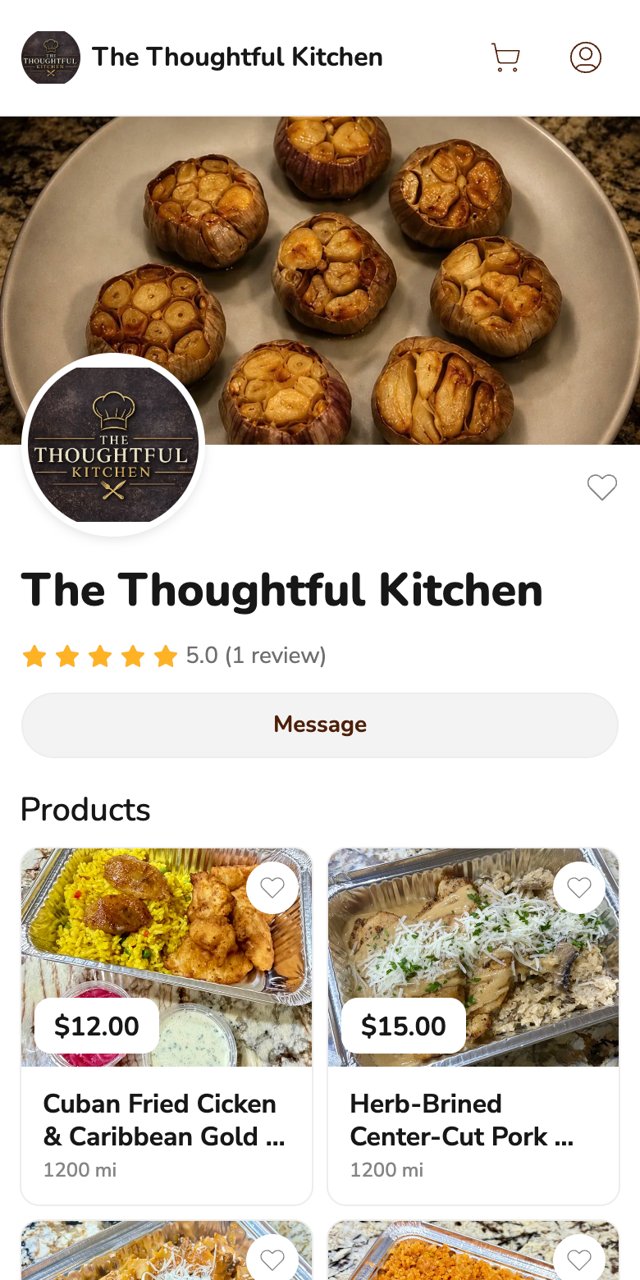
The Thoughtful Kitchen puts the day in the product name: "Crispy Carnitas Plate (Available Tuesday)", "Glazed Bone-In Angus Beef Shanks (Available Monday)". That does half the caption's work. Your post can say "5 dinners this week, one each weeknight, $10 to $15" and the store answers which night each dish is ready. We read that storefront on September 27, 2026.
Check that you are allowed to sell a plated dinner before you caption one. In California, for example, the Department of Public Health says a cottage food operation "can prepare and package certain non-potentially hazardous foods," limited to the state's approved list (checked September 27, 2026). A dinner that has to be kept hot or cold is not that kind of food, and selling it from home takes a different permit where one exists. Our guide to MEHKO home kitchen permits for cooked meals covers the option some places offer. Verify your state's current rules before you post.
The best captions for tamales, empanadas and other family recipes lead with the story in one line, then give the filling, the price per dozen or each, and the order cutoff. People buy a family recipe partly for the family. One true sentence about where it came from beats three paragraphs.
Name the dish the way your customers search for it. One Homegrown vendor, Casa Isla Mía, writes "empanadillas (empanadas/pastelillos/turnovers)" in her store description so a customer who knows only one of those words still finds her. Do the same in your caption.
Captions to copy:
Tamales and empanadas are pre-order food, so the cutoff date matters more than the photo. For holiday batches, post the first caption 3 to 4 weeks ahead, then a reminder the week the orders close. Before the first post, check the permit side: our guide to selling tamales from home explains why most cottage food laws do not cover tamales and which permit or commercial kitchen routes do.
A jam caption sells when it names the fruit and where it came from, gives the jar size and price, and says one way to eat it. "Strawberry rhubarb, 8 oz, $9, perfect on biscuits" does more than "Spread the love." A sealed jar needs no reheating line, so the whole caption can go to flavor, size and price.
In a pull of the Homegrown catalog on September 27, 2026, we counted 64 jams, jellies and fruit butters, from 14 vendors, among the 265 pantry listings, with a median price of $9.00 and a range of $5.00 to $14.00. One vendor, Gram's Jams, had 12 flavors, and another had 12 jam listings, which is why a "this week's flavors" caption with prices is worth writing once and reusing.
Captions to copy:
Pepper jelly, hot pepper jams and low-sugar jam are not allowed under some cottage food laws. California, for example, allows only jams and jellies that meet the federal standard in 21 CFR Part 150, made only from the fruits listed there, according to the state's Approved Cottage Food List (checked September 27, 2026). Look up your own state's approved list before you post them.
Our guide to selling jam from home covers the rest of the jar: whether it is legal where you live, what the label needs, what to charge and where jam sells.
Salsa, hot sauce and pickle captions should give the heat level in plain words, the jar size and price, and one food to put it on. Answer the heat question on the first line, before anyone has to ask: "Mild, medium, or 'call your mother' hot." A heat scale of 1 to 5 in the caption is easy to read and easy to compare.
One Homegrown vendor, Sunset Salsa, sells 7 products at one price, $7.49 each (checked September 27, 2026). A single price makes a caption simple: list the flavors, state the price once.
Captions to copy:
Keep the heat scale the same every week. A customer who liked your "3 of 5" should know exactly what "4 of 5" means next time. Our guide to selling salsa from home covers the pH rules that decide which salsas you can sell at all, plus pricing.
Refrigerated or frozen foods like kimchi usually fall outside cottage food rules. Check your state before you sell them.
Candy, fudge and snack captions work best when they sound like a treat, give a price per piece or per bag, and suggest a reason to buy more than one: a gift, a party, a road trip. Candy is an impulse buy, so the price should be low and visible. One Homegrown vendor lists 65 kinds of freeze-dried candy at $5.00 each (checked September 27, 2026), and one flat price is easy to put in every caption.
Captions to copy:
If you sell candy at a farmers market, add the table location to every market-day post: "Look for the pink tablecloth by the entrance." A treat is easy to buy once someone can find you.
When orders open, post the full menu with every price and the cutoff. The day before orders close, post a last call with how many spots are left. When you sell out, say so within the hour and tell people when the next batch opens. Those three posts do most of the selling for a weekly home food business.
Our guide to the Instagram menu post that gets food orders covers the opening post in detail, including why it should go up at the same time every week.
Orders open:
Last call:
Sold out:
Restock and waitlist:
A sellout post is good news, not an apology. Keep it to 20 words and point to the next date. For the details of handling a sellout without losing the customers who missed it, see our guide on what to post when you sell out on Instagram.
A pickup day caption should say the time window, the exact spot, and one thing to bring or know. A market day caption should say the market name, your table location, your hours and 2 or 3 products with prices. Both posts go up the morning of, 1 to 3 hours before you open.
Pickup day captions:
Market day captions:
Tag the market's own account in market day posts. When a market reshares a vendor post, your caption lands in front of its followers the same morning, and a tag makes that one tap for them. If your table is mostly produce, eggs, honey or flowers, these farmers market Instagram captions by crop and market moment cover the whole week, from the evening-before preview to the Story that says "6 dozen eggs left."
Refrigerated or frozen foods like soup and hot dog chili usually fall outside cottage food rules. Check your state before you sell them at a market.
Turn a customer review into a caption by quoting it word for word, naming the customer only with their permission, and adding your price and pickup day underneath. A real review in a caption often does more than anything you write about yourself, because it is a neighbor saying it, not you.
Here is a real one from a Homegrown storefront. A customer wrote on The Thoughtful Kitchen's page on June 25, 2026: "Great food at a great price! Nicely packaged, great tasting, ready for the oven." A caption built on it could read: "'Nicely packaged, great tasting, ready for the oven.' That's the whole goal. This week's dinners are $10 to $15, order by Sunday."
Review captions to copy (fill in real quotes only):
Keep review captions honest. The FTC's rule on consumer reviews and testimonials went into effect on October 21, 2024, and lets courts impose civil penalties for knowing violations, such as writing or buying fake reviews. The FTC says a thank-you gift for a review is not banned, as long as you do not require the review to be positive, and you should disclose the gift. That is how the FTC's Q&A read when we loaded it on September 27, 2026. Never write a review yourself and post it as a customer's. For ways to get more real ones, see our guide on how to get reviews as a food vendor.
A Facebook group or Nextdoor post should be longer and more complete than an Instagram caption, because neighbors read it like a note on a bulletin board: full menu, every price, the pickup address area, the cutoff, and a link. On Instagram, the photo and the first line do the work. In a group, the text does.
Read each group's rules before you post. Some local groups allow selling only on a set day or only in a pinned weekly thread, and admins can delete a post in the wrong place. That rule belongs to the group, not the platform, so check it every time you join a new one.
Scroll sideways to see every column.
| Where you post | Best length | What goes first | Where the order link goes | Example ending |
|---|---|---|---|---|
| Instagram post or Reel | 40 to 60 words | The dish and one detail | Your bio, pointed to in the caption | "$12, Friday pickup, link in bio" |
| Instagram Story | 10 to 15 words on screen | The price and the cutoff | A link sticker on the Story | "Orders close tonight, tap the link" |
| Facebook local group | 80 to 150 words | A friendly "Hi neighbors" and the full menu with prices | Pasted in the post, if the group allows links | "Pickup near Elm and 5th, order by Wednesday" |
| Nextdoor | 60 to 120 words | That you live nearby and cook from home | Pasted in the post | "Porch pickup, 3 blocks from the school" |
| Text to regulars | 20 to 30 words | Their name, then what is new | The link on its own line | "Want me to save you one?" |
The word ranges are our recommendations, not platform limits. The hashtag limit we checked, Instagram's 5-tag cap, is not in this table. It has its own section below, sourced to Instagram's Help Center page as we loaded it on September 27, 2026.
A Facebook group version of the dinner caption above:
"Hi neighbors! I cook dinners from my home kitchen every week and this week's menu is up. Pork chops with parmesan mushroom rice, $15. Chicken scallopini, $12. Spaghetti and meatballs, 1.5 lb tray, $10. Everything comes cold with reheating notes on the lid, and most trays take 20 minutes in a 350 oven. Pickup is Monday to Wednesday, 9 to 3, near Elm and 5th. Order by Sunday at 6 p.m. at [your link]. Questions are welcome in the comments, and I answer them every evening."
That is 86 words, and it still ends in one link. For more on neighborhood apps, our guide to marketing on Nextdoor covers what gets a post seen there.
A homemade food post should use up to 5 hashtags, because 5 is now Instagram's limit. Instagram's Help Center page on hashtags says "You can use up to 5 tags on a post," and "If you include more than 5 tags on a single photo/video, your comment won't post." It also says special characters like $ and % will not work inside a tag. We loaded the Help Center on September 27, 2026 to confirm it.
If you learned to paste 20 or 30 hashtags under every post, that habit no longer works on Instagram. If you keep a saved block of tags in your phone's notes, cut it to a few sets of 5 and rotate them. The 5-tag rule was current when we read it on September 27, 2026.
With only 5 tags, each one should do a job. A good set mixes:
Six ready sets of 5 to adapt:
Swap each bracket for your real town or market with no spaces. Building all six sets once takes about 10 minutes, and then each post is copy and paste. To find local tags your customers actually use, look at the last 10 posts from other vendors at your market and note which town and market tags keep showing up.
Keep three kinds of words out of a homemade food caption: "organic" unless you follow the organic rules, any claim that a food treats or cures a disease, and allergen claims like "nut-free" you cannot back up. Each one sounds like a small marketing choice. Each one can turn into a real problem for a $9 jar.
"Organic." Under federal rules, a small grower or maker can sell its food as organic without getting certified if its organic sales total $5,000 or less a year, per 7 CFR 205.101. It still has to follow the organic production and labeling rules and keep records for 3 years. The same rule also lets you name certified organic ingredients, like certified organic strawberries, as organic in the ingredient list on your label without getting certified yourself. We read the regulation on September 27, 2026. If you buy regular strawberries at the store, "organic" does not belong in your jam caption. "Made with local strawberries" is honest and sells just as well.
Health and cure claims. FDA's page on label claims explains that only a drug can legally claim to "diagnose, treat, cure or prevent any disease" (checked September 27, 2026). Keep "cures colds" and "fights inflammation" out of captions for broth, elderberry syrup, ginger shots and hot sauce, because those are disease claims. Leave "boosts immunity" and "detox" out too. FDA's page says a claim about how a food affects the body has to come from its nutrition, and it cannot hint, even indirectly, at a disease. Say what is in it instead: "ginger, turmeric, lemon and local honey."
Allergen promises. "Nut-free" or "gluten-free" in a caption is a promise about your whole kitchen, not just the recipe. If you also make pecan brittle on the same counter, write "made without nuts in a kitchen that also handles nuts." Our guide to the big 9 allergens on a cottage food label covers what the label itself must say.
Other words to use carefully:
This is not legal advice, and state rules differ. Verify your state's current cottage food rules for anything that goes on your label or in your posts.
Outside of baked goods, the homemade food on Homegrown is mostly pantry products like jam, salsa and pickles, and ready-to-eat food like dinners, empanadas and candy. When we pulled Homegrown's catalog on September 27, 2026, 2,727 listings from 308 vendors were live, and 1,432 of them, or 52.5%, were in the Bakery category. The next two food categories were pantry goods, 265 listings from 63 vendors, and ready-to-eat food, 186 listings from 21 vendors.
Homegrown food listings by category
Source: Homegrown catalog pull, September 27, 2026, 2,727 listings from 308 vendors, counted by the category each vendor chose. Health and wellness and non-food categories left out.
What that means for your captions:
Your caption is competing with other home cooks' posts, not with a grocery store. A clear price, a clear day and a clear link are how a $9 jar or a $12 plate wins that comparison.
A caption turns into an order without a pile of DMs when it sends people to one link where they can see the menu, pick a pickup time and pay. A caption that ends "DM me to order" turns every sale into a conversation: what's left, how much, can I pay Friday, where do I get it. At 20 orders a week, that is 20 threads to track by hand.
Homegrown gives your captions that one link. It costs $10 per month billed annually with no percentage fees beyond standard payment processing, and it gives you a storefront where customers see your dishes and jars, choose a pickup window you set, and pay before they arrive. You put the link in your bio and every caption points to it. There is also a built-in customer messaging inbox for the questions that still come in, and a free Instagram caption generator that writes 5 captions from your product and pickup day.
Here is how that compares to two tools a home cook might weigh against it. Hotplate has no monthly plan but charges a 5% + $0.55 service fee, which is $1.55 on a $20 dinner, and you choose whether you pay it or pass it on to the customer at checkout. Shopify Basic is $29 a month billed yearly and built for full online shops, which is more setup than a weekly dinner menu needs.
Scroll sideways to see every column.
| Platform | Monthly plan | Trial | Service or platform fee | Card processing | Customer pays on a $20 order | Vendor pays on a $20 order | Vendor pays in a month of 50 orders at $20 |
|---|---|---|---|---|---|---|---|
| Homegrown | $10 billed annually ($12.50 monthly) | 7 days before the first charge | None, 0% commission | 2.9% + $0.30, paid by the vendor | $20.00 | $0.88 plus the plan | $54.00 |
| Hotplate, customer pays the fee | $0 | No plan, so no trial | 5% + $0.55, paid by the customer | 2.9% + $0.30, paid by the vendor | $21.55 | $0.88 | $44.00 |
| Hotplate, vendor covers the fee | $0 | No plan, so no trial | 5% + $0.55, paid by the vendor | 2.9% + $0.30, paid by the vendor | $20.00 | $2.43 | $121.50 |
| Shopify Basic | $29 billed yearly ($39 monthly) | 3 days, then $1 a month for 3 months | None with Shopify Payments (2% with another provider) | 2.9% + 30¢ online | $20.00 | $0.88 plus the plan | $73.00 |
We checked every price in this table on Homegrown's signup page, Hotplate's pricing page and Shopify's pricing page on September 27, 2026. Card processing is figured on the $20 price; if a platform charges it on a total that includes fees, tips or tax, it runs a few cents higher. The 50-order column adds the monthly plan billed annually or yearly.
Prices on all three platforms change. We loaded each pricing page on September 27, 2026. Check them again before you choose, and compare annual billing to annual billing.
What Homegrown does not do, so you can decide with the full picture:
If your captions are getting "how do I order?" comments, the fix is one link that answers the question for you. Set up a Homegrown storefront with this week's dinners or jars, put the link in your bio, and end your next caption with it.
The most common caption mistake is leaving out the price, and the second is ending with "DM me" instead of a link and a cutoff. Both force the customer to start a conversation to buy a $10 plate, and most will not bother. Here are the mistakes that cost home food vendors the most orders:
Fixing the first two alone changes what your comments look like: fewer "how much?" questions, more "ordered!" replies. If you want your captions to end in orders instead of DMs, a Homegrown storefront gives every caption the same link to point at.
A good caption for homemade food names the dish, adds one reason it tastes good, and gives the price, pickup day and how to order. For example: "Green chile chicken enchiladas, fresh tortillas, $14 a tray. Porch pickup Thursday 5 to 7. Order by Wednesday, link in bio." Short lines like "Dinner's handled" work on a photo post if the price and day are on the next line.
A short caption for home cooked food is one line that makes the dish sound like home, such as "From my stove to your table," "Slow-cooked, not slow to sell out," or "One less night of 'what's for dinner?'" If you are selling the food, add a second line with the price and the pickup day. That second line is what turns a like into an order.
Use up to 5 hashtags on an Instagram post, because Instagram's Help Center says 5 is the limit and that with more than 5, "your comment won't post" (checked September 27, 2026). Pick one or two food tags, one or two local tags with your town or market, and one tag for how people buy, like #preorder or #cottagefood. Rotate a few sets of 5 instead of pasting the same block every time.
Yes, put the price in every caption that sells something, ideally in the first two lines. A follower who has to message you to learn that a jar is $9 often never asks. If you sell several flavors at one price, state the price once: "Strawberry, peach, blackberry, all $9."
Only if you follow the federal organic rules. Under 7 CFR 205.101, an operation with $5,000 or less a year in organic sales can use the word without certification, but it must still meet the organic production and labeling requirements. If your ingredients are not grown and handled to those rules, describe them honestly instead, such as "made with strawberries from my garden."
Yes, as long as the review is real and you quote it word for word. The FTC's rule on consumer reviews, in effect since October 21, 2024, bans fake reviews and paying for reviews that have to be positive or negative, and the FTC says you should disclose any gift given for a review. Ask the customer before using their name, and never write a review yourself and post it as theirs.
These seven guides answer the questions a home food vendor usually has after writing the first selling caption. Start with the photo guide if your posts get likes but no orders, and with the MEHKO guide if you sell dinners and have not checked your permit. Each one is a live Homegrown guide, checked on September 27, 2026.
Every caption in this post ends the same way: a price, a day and a place to order. Homegrown is that place for $10 per month billed annually, or $12.50 billed monthly, with no commission and card processing of 2.9% + $0.30 paid by you, not added to your customer's total.
Here is the whole routine, start to finish:
That is four posts a week, each one pointing at the same link, and the orders arrive paid with a pickup time attached. Customers create a Homegrown account the first time they order, and after that the same link works for them every week. Start your Homegrown storefront and put this week's menu in your bio.



