

The short version: A farmers market caption sells when its first line says which market, which day and where your booth is, and the next line names two or three products with prices. Post the full caption the evening before, a short Story on market morning, a low-stock update mid-market and a thank-you after you pack up. Write produce captions around what just came into season, and only call a product "organic" if you are certified or fall under the small-farm exemption and follow its labeling rules. Instagram allows 2,200 characters and 5 hashtags, but the first line does most of the work because it shows before "more." End every caption with one place to go, either your booth or a link where a regular can order for pickup before the next market.
Checked October 13, 2026: the 5-hashtag limit on Instagram's Help Center page on hashtags, the 2,200-character caption cap in Meta's developer documentation, and Homegrown's pricing on findhomegrown.com/signup ($10 a month billed annually, 0% commission, 2.9% + $0.30 card processing paid by the vendor). Customers create a Homegrown account to place a first order, and Homegrown has no drops (timed release) feature.
It is Friday night. The truck is half loaded, the eggs are washed, and you still have not posted. You open Instagram, take a photo of the tomato crates, and then the caption box just sits there.
This guide fills that box. It is for the small vendor who sells at one or two farmers markets a week: the grower with a pickup truck of produce, the egg and honey table, the flower farmer, the person selling plant starts in spring. Every caption here is written to get a real person to your booth or to an order, not to collect likes. You will find captions for each moment of the market week, captions for each kind of farm product, and what you can and cannot claim in a caption.
If you want the bigger picture first, our guide to Instagram for farmers market vendors covers your bio, Stories and a weekly posting routine. And if your table is mostly baked goods or prepared food, the Instagram captions for a bakery and captions for homemade food posts are built for those products. This page is about the farm table.
A farmers market caption needs four things: where and when, what you are bringing, a reason to come early, and one next step. If a follower reads the first two lines and still does not know which market you will be at, they will not come looking. Clever wording comes last.
Here are the four parts, in the order a shopper reads them:
Most market captions that fall flat are missing part one. A shopper who loves your peaches may follow 30 other local accounts, and the post that tells her exactly where to walk on Saturday morning is the one she acts on. Put the market and day at the very start of the first line, so they show up before Instagram folds the rest of the caption behind "more."
A quick test before you post: cover everything after your first sentence with your thumb. If the first sentence alone tells someone where to be and why, the caption is ready.
A market caption can run up to 2,200 characters, but the line that matters is the first one, because that is what shows in the feed before "more." Meta's developer documentation caps an Instagram caption at 2,200 characters, and Instagram's Help Center limits a post to 5 hashtags (both checked October 13, 2026). Most market posts work best at one to four short lines, with a longer caption saved for a story about the farm.
Timing matters as much as length. A post that goes up Saturday at 7 a.m. reaches people after they have made their weekend plans, so aim for the preview to go up about 12 hours before you open. The table below is a simple plan for one market week. Swap the days if your market runs midweek.
Scroll sideways to see every column.
| Post | When it goes up | Where | What the first line must say | Length | The one next step |
|---|---|---|---|---|---|
| The market preview | Evening before market day | Feed post or carousel | Market name, day, hours, your spot | 2 to 4 lines, prices included | Come early, or order ahead for pickup |
| The setup check-in | Market morning, while you set up | Story | "We're open" or "Tables are up," plus the time | One line | Come now |
| The low-stock update | Mid-market, when something runs low | Story | The product and how many are left | One line | Come before it is gone |
| The thank-you | After you pack up, same day | Feed post or Story | Thanks, and what sold out first | 1 to 3 lines | See you next week, or order between markets |
| The farm story | A quiet weekday | Feed post or Reel | One thing that happened on the farm this week | Up to a short paragraph | Reply or follow along |
A starting plan, not a rule. The 2,200-character cap comes from Meta's developer documentation for Instagram captions and the 5-hashtag limit from Instagram's Help Center page on hashtags, both checked October 13, 2026. Neither page gives a number for how many characters show before "more," so keep the market and day in the first line.
If you only have time for one post a week, make it the preview. It does the heavy lifting: it tells your followers where to be, it gives the market's own account something to reshare, and it is the post people screenshot so they remember your booth spot.
The night-before post should list the market, the hours, your spot and two or three products with prices, so a follower can plan their morning around you. Post it between dinner and bedtime the evening before, when people are deciding what tomorrow looks like. Use a photo of the actual harvest or the loaded crates, not a stock shot.
Here are 10 preview captions to copy and change. Replace the bracketed parts with your own details.
A carousel works well for this post. Put the booth photo first so people recognize your tent, then one photo per product with the price in the caption. Shoppers who swipe through all of it are the ones who show up with a list.
Market morning posts should be one line in a Story, posted while you set up, that says you are open and what is on the table right now. Nobody needs a paragraph at 7:45 a.m. They need to know the corn made it and you are in your usual spot. Stories disappear after 24 hours, which makes them a good fit for "right now" updates.
Market morning Story captions:
A short video works even better than a photo here. Ten seconds of you stacking melons or setting out bunches of carrots tells people the booth is live. If you use Stories to take orders, our guide to Instagram Stories for food orders shows how to add a link sticker without inviting a pile of DMs.
A mid-market update should name the product and give a real count, like "6 dozen eggs left," because a number moves people and "almost gone" does not. Post it in your Stories when something is about two-thirds sold. People still at home will decide whether to come based on that number. Only post counts you can see.
Mid-market update captions:
When you sell out early, the sold-out post is one of the best posts of your week. It tells followers your product is worth getting there for, and it sets up next week. Our guide on what to post when your food sells out covers how to turn that moment into a waitlist instead of disappointed comments.
Put the count in the first three words of a low-stock Story, like "6 dozen left," and post it when about two-thirds of that product is gone, not when the last box is on the table. A shopper who lives 15 minutes away needs that head start, and a sold-out post with nothing left to buy only helps next week.
Produce captions sell best when they announce what just came into season, because "the first strawberries" gives a shopper a reason to come this week instead of next. Name the variety when you can, give the price per pint, pound or bunch, and say how long it will last. A tomato is a tomato until you call it a Cherokee Purple.
Spring captions:
Summer captions:
Fall captions:
Produce is a smaller share of Homegrown's catalog than you might guess. Most of the catalog is baked goods, which is one reason a produce booth that posts every week stands out in a local feed.
In a pull of the Homegrown catalog on October 13, 2026, 2,897 products were listed by 319 vendors. 447 of those products, from 72 vendors, were listed under the farm categories: vegetables (128), meat and poultry (117), plants and flowers (114), eggs and dairy (54) and fruits (34). Bakery made up 1,507 products, or 52%. We counted by the category each vendor picks for a listing, not by words in product names. Some baked goods, pickles, jams, salsa, dried fruit snacks and snack boards are filed under these categories too, so the true count of farm products is lower.
Homegrown products listed in each farm category
Source: Homegrown public catalog pull, October 13, 2026, 2,897 products from 319 vendors, counted by the category field each vendor picks.
Egg, honey and meat captions should answer the question a shopper would ask at the table: how many you have, what size or cut, and how it is kept. These products often sell out or sit in a cooler where nobody sees them, so the caption has to do the showing. Give a count and a price, and say where in the booth to look.
Egg captions:
Honey captions:
Meat captions:
Careful with claims like "pasture-raised," "grass-fed" or "free-range." They are fine when they describe how you actually raise your animals, but meat and egg sales come with their own state and federal rules. For meat or poultry from a USDA-inspected plant, the USDA's guideline on animal-raising claims explains how to back up those claims on a label. For eggs and state-inspected meat, check with your state's agriculture department before you post the claim.
Flower and plant start captions should name the variety, the price per bunch or pot, and how long it will last or when it can go in the ground. Flower shoppers buy on color and timing, and plant start shoppers buy on what they can plant this weekend. A caption that says "tomato starts ready for May planting" sells more than "lots of plants."
Cut flower captions:
Plant start captions:
If your flower or plant start table is busy all morning, post the variety list the night before. People who garden like to plan.
A bad-weather caption should say plainly whether you are coming, how long you will stay, and what you are bringing, because shoppers check your account before they decide to brave the rain. Post it at least 2 hours before the market opens, by the time you would usually leave the farm. If the market is cancelled, say so in the first line and give people another way to get your products.
Weather captions:
Cancellation captions:
Rain-day sales usually drop, but a rain-day post can save part of the week. Our farmers market rain day tips cover the booth side: tarps, displays and keeping produce dry.
Only the market itself can cancel a market, usually through its manager. Before you post that a market is cancelled or closing early, check the market's own account or message the manager. If you are leaving early yourself, say "we're packing up at 10:30," not "the market is closing," so shoppers do not skip the other vendors.
Season markers like opening day and the last market of the year are the posts that bring back customers who drifted away, so give each one a date, a product and a plain reason to come. People who shopped with you last August may not have thought about you since. An opening-day post reminds them, and a last-market post gives them a deadline. Post each one 3 days ahead and again the night before.
Opening day captions:
Last market captions:
Winter market and holiday captions:
The after-market post should thank people, say what sold out first, and tell them when you will be back. It turns a one-time shopper into someone who looks for your preview next week. Post it within 3 hours of packing up, while the market is still fresh in people's minds.
After-market captions:
Customer photos make great after-market posts, but ask first. A quick "Can I share this on our page?" is enough, and most people say yes. Never post a photo of children without a parent's clear okay.
When regulars start asking how to get your products between markets, that is a good sign. It means the posts are working and you need a way to take an order that does not live in your DMs.
A between-market caption should offer one pickup day, one place and a cutoff time, like "order by Monday night for Wednesday pickup at the farm." Your regulars already trust your eggs and greens. What stops them from buying midweek is not knowing how. A caption that spells out the when and where turns a Saturday regular into a twice-a-week customer. Leave at least 24 hours between the order cutoff and pickup so you can harvest to the count.
Between-market captions:
The weak spot in most of these plans is the order itself. If "order ahead" means "send us a DM," you end up copying names, counts and payment notes into a notebook at midnight. Our guide to getting market regulars to order between markets covers how other vendors set up that midweek pickup.
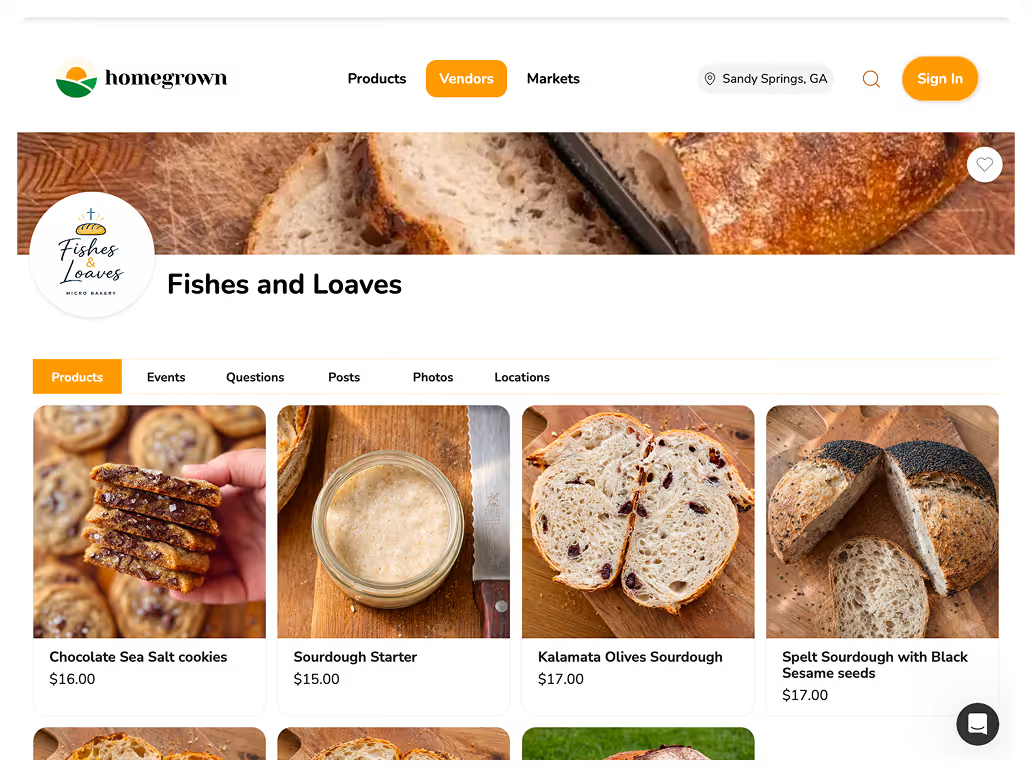
A link fixes the DM problem. With a Homegrown storefront, the "order ahead" line in your caption points to a page where a regular picks eggs or a salad bag, chooses your Wednesday pickup or Saturday market pickup, and pays by card. You see a list of orders with names on it instead of a stack of messages.
Only say "organic" in a caption if your farm is certified, or if you sell $5,000 or less in organic products a year and follow the organic production and labeling rules anyway. That is the federal rule, and a caption is marketing just like a label is. For market tokens and matching dollars, say what your market tells you, because those run through the market. SNAP can come either through your market's program or through your own SNAP authorization as a direct-marketing farmer.
Here is what the federal sources say, checked October 13, 2026:
What that means for your captions:
Word claims like "organic" follow federal rules, and many food sales also follow state rules that change from state to state. Before you post a claim about how a product was grown or what payment programs you take, verify your state's current rules and ask your market manager. We loaded the USDA and eCFR pages linked above on October 13, 2026.
Tag the market's account, add the market as the location, use up to 5 hashtags and write a one-sentence alt text, all from the same screen where you type your caption. All four take about 2 minutes together, and each helps a different group find you: the market's followers, people browsing the location, people searching tags, and people using screen readers.
You can also fix a post after it goes up. Instagram's Help Center says you can add a hashtag later by editing the caption, which helps when you remember the market tag after you have already posted from the truck.
Your caption can send a shopper to your booth on market day, but between markets it has to send them somewhere they can order, and that is the job of the link in your bio. If "DM to order" is your only option, every caption that works creates more messages to sort, more payment requests to chase and more chances to double-book the last dozen eggs.
Homegrown is built for that gap. It is $10 a month billed annually ($12.50 billed monthly) with no percentage fees beyond standard payment processing. Your caption's "order ahead" line points to one storefront where a regular picks products, chooses one of your pickup times (your market booth, the farm stand or a weekday spot) and pays by card. Here is how the costs compare with the tools market vendors usually use:
Scroll sideways to see every column.
| Option | Subscription | Trial | Platform fee | Card or payment processing | Customer pays on a $20 order | Vendor pays on a $20 order | Vendor cost, 50 orders in a month |
|---|---|---|---|---|---|---|---|
| Homegrown (billed annually) | $10/mo | 7 days, no charge until day 8 | $0, 0% commission | 2.9% + $0.30, vendor-paid | $20.00 | $0.88 | $54.00 |
| Homegrown (billed monthly) | $12.50/mo | 7 days, no charge until day 8 | $0, 0% commission | 2.9% + $0.30, vendor-paid | $20.00 | $0.88 | $56.50 |
| Hotplate (default, fee charged to the customer) | $0 | No subscription to try | 5% + $0.55, paid by the customer | 2.9% + $0.30, paid by the vendor | $21.55 | $0.88 | $44.00 (customers pay $77.50 in fees) |
| Hotplate (vendor covers the fee) | $0 | No subscription to try | 5% + $0.55, paid by the vendor | 2.9% + $0.30, paid by the vendor | $20.00 | $2.43 | $121.50 |
| Square Free plan, online orders | $0 | No subscription to try | None | 3.3% + $0.30 online, paid by the vendor | $20.00 | $0.96 | $48.00 |
| Instagram DMs + Venmo business profile | $0 | None needed | None | 1.9% + $0.10, paid by the vendor | $20.00 | $0.48 | $24.00, plus every order tracked by hand |
We checked these on October 13, 2026: findhomegrown.com/signup; Hotplate's pricing page and its post "What Hotplate does," which says the fee goes to your customer by default and 80% of chefs keep that default; Square's pricing page (Square Free plan, online card rate; in person it is 2.6% + 15¢); and Venmo's fee page (business profile rate; a personal account charges 2.99% on payments marked as goods and services). Venmo is free for the shopper from a Venmo balance, debit card or bank account; a shopper who pays by credit card pays Venmo 3%, or $0.60 on $20. Processing is figured on the $20 price. Hotplate's own pricing example charges $1.27 processing on a $30.00 order that also carries its $2.05 fee, a $3.00 tip and $2.55 in sales tax. That is more than 2.9% + $0.30 of $30 ($1.17), because processing is figured on more than the item price, so its real processing cost can run a few cents higher than shown.
Each option fits a different vendor. DMs and Venmo cost the least per order, but you keep the order list, the pickup times and the payment matching yourself, and that work grows with every caption that lands. Hotplate has no subscription and is built around timed drops; by default your customer pays $1.55 more at checkout on a $20 order, or you pay $2.43 if you cover the fee. Square is the reader many market vendors already use at the booth, and its free plan includes an online site, though its online card rate on that plan is 3.3% + 30¢.
What Homegrown adds for a vendor who sells at markets:
Now the honest bounds. Homegrown does not post to Instagram for you, schedule your posts or grow your following. You cannot price produce by the pound on Homegrown yet (sell by weight is on the roadmap); you list fixed sizes like a pint, a bunch or a half-peck, each with its own price. There is no drops feature, meaning no countdown or timed release, and no date for one. Email and text broadcasts to your customer list are planned, not live. Your storefront appears in the Homegrown marketplace, but plan on most orders coming from people you send to your own link, and customers create a Homegrown account to place a first order. If your captions are filling the booth and you want the midweek orders too, set up your Homegrown storefront and put the link in your bio before Saturday's preview goes up.
Write all of next week's market captions in one sitting on a quiet evening, using the same six slots every week, and you will spend about 20 minutes instead of an hour scattered across the week. The slots never change; only the products, prices and weather do. That is what makes it fast.
Midweek farm story captions, for the quiet-day post in the table near the top of this guide:
If writing is the slow part, Homegrown has a caption generator for farmers market and bakery posts that gives you 5 captions with hashtags for a market announcement, a new product, a restock and other post types. Use it as a first draft and add your own prices and booth spot.
Photos are the other half of a post that sells. Our guide to food photography for farmers market vendors covers shooting produce and booth setups with only a phone.
The habit that costs market vendors the most is leaving out the booth location, because a shopper who saw your post still has to find you among 40 tents. The rest are smaller, but they add up across a season of 25 or 30 market days.
Caption habits to drop:
A good farmers market caption starts with the market name, the day and your booth spot, then names two or three products with prices. For example: "[Market] Saturday, 8 to noon, blue tent on the north row. Sweet corn $7 a dozen, tomatoes $4 a pound." End with one next step, like "come early" or "order ahead from the link in our bio."
Post the main farmers market caption the evening before market day, when your followers are planning their morning. Then add a one-line Story when you open, a low-stock Story mid-market and a thank-you after you pack up. A post that only goes up on market morning reaches followers after most of them have already made plans.
Instagram's Help Center allows up to 5 hashtags on a post (checked October 13, 2026). A good set for a market vendor is your town, your market's name and two or three product tags, such as a town farmers market tag plus #SweetCorn or #LocalHoney.
Only if you are certified organic, or your organic sales are $5,000 or less a year and you follow the federal organic production and labeling rules, per 7 CFR 205.101 and the USDA's organic labeling page. An exempt farm still cannot write "certified organic" or show the USDA organic seal, per 7 CFR 205.310. Otherwise, describe what you actually do, such as "no spray" or "grown without synthetic pesticides," and check your state's rules too.
Yes, put prices in your market captions when you know them. A price answers the most common question before anyone has to ask, and it helps a shopper decide to make the trip. If prices change by size or weight, give the most common one, such as "$6 a dozen" or "$4 a pound."
Say the market is cancelled in the first line, say when you will be back, and offer another way to buy, such as a porch or farm pickup. Check the market's own account first, because only the market itself can cancel, usually through its manager. If you are just leaving early, say that you are packing up, not that the market is closing.
Each of these posts covers another piece of selling at the market with Instagram, from the bio above your captions to the photos under them. Start with the first one if you have not set up a weekly posting routine yet, and the last one if your table carries jars and prepared food alongside the produce:
Pick the preview caption that fits your table, swap in your market, spot and prices, and post it the evening before your next market. Then save three one-line Stories in your notes app for market morning, mid-market and sold-out. That one habit, done every week, does more than any clever line.
Over a season, those posts add up. Followers learn when to look for you, the market reshares the ones that tag it, and regulars start asking how to order before Saturday. Keep the captions that bring people to the booth and drop the ones that do not. By midsummer you will have a notebook of lines that work for your farm, and writing the preview will take 5 minutes.
When those regulars ask, have an answer ready. Start your Homegrown storefront for $10 a month billed annually with 0% commission, and the 7-day trial has no charge until day 8. Put the link in your bio and the next "can I order ahead?" comment turns into an order.