


The short version: The bakery logo ideas that real home bakers pick fall into six styles, and one of them leads by a wide margin. Of the 152 Homegrown bakery storefronts that had a logo image in a September 27, 2026 catalog pull, 71 (47%) use a badge, with the whole design inside a closed frame (67 of those frames are circles), 43 (28%) use a drawn picture with no frame, beside the name in 40 of them and on its own in 3, most often a baked good or tool, and the rest use a name-only wordmark, a photo, a mascot or initials. Round fits a practical fact: your logo lives in circles. On a Homegrown storefront it shows in a 104-pixel circle on a phone and a 36-pixel circle in the top bar, and Instagram's phone-width web page draws your profile photo as a 96-pixel circle. A logo made in Canva costs $0, a Looka logo file costs $35 to $72, a designer on 99designs starts at $249, and 100 two-inch round stickers from Sticker Mule cost $69.
Checked on Canva's, Looka's, 99designs', Sticker Mule's and Avery's pricing pages, Homegrown's signup page, Hotplate's pricing page and Etsy's fee pages, September 27, 2026: prices change, so check them before you buy. On Homegrown, a customer needs a Homegrown account to place a first order, and there is no drops or countdown release feature, which is the main thing Hotplate does.
A bakery logo is the small picture that stands in for you when you are not there. It sits on the sticker that seals a cookie box, in the circle on your Instagram profile, and at the top of the page where people order. Most bakery logo lists online show famous city bakeries or AI mockups. This one starts from the real logos of small bakeries selling on Homegrown, counts which styles they chose, and then measures the places a home baker's logo actually has to work.
If you are still deciding whether you need a logo at all, read why you don't need a logo to start selling food first. Plenty of bakers sell for months with just a name. If you already know you want one and need the step-by-step for making it yourself, our guide to making a DIY logo with free tools covers the how. This page covers the what: the styles, the real examples, the sizes and the prices.
Here is how the count worked. We pulled every public product on Homegrown on September 27, 2026: 2,737 products from 307 vendors. We called a store a bakery when at least half of its listings sit in the Bakery category. That gave 158 bakery stores (7 unnamed placeholder stores left out, two stores with the same name counted once). 152 of them had uploaded a logo image, and we looked at each one and sorted it into one main style.
Real home bakeries most often use a badge: 71 of the 152 bakery logos on Homegrown, or 47%, put the whole design inside a closed frame, and 67 of those frames are a circle, ring, wreath or round seal. The other four frames are two ovals, a hexagon and a triangle. The next most common is a drawn picture with no frame (43 logos, 28%), set beside the name in 40 and shown alone in 3, and 33 of those 43 pictures are a food or a baking tool. Name-only wordmarks, photos, mascots and initials make up the last quarter between them.
Main logo style on 152 Homegrown bakery storefronts
Source: Homegrown catalog pull, September 27, 2026. Bakery store = at least half of its listings in the Bakery category. 152 storefront logo images, each sorted by hand into one main style.
Each logo got one main style, using the first rule that fit, in this order:
Swipe the table to see all six logo styles.
| Logo style | Bakery logos | Share of 152 | Real examples on Homegrown | How it holds up in a small circle |
|---|---|---|---|---|
| Badge (67 of 71 are circles) | 71 | 47% | Super Suzi's Sourdough, Gracie's Sourdough, Baked by the Smiths | A round badge fits the circle, unless a ribbon or banner runs past the ring and gets its ends trimmed; the text around the ring is the first thing to blur |
| Icon plus name | 43 | 28% | Pryority Sourdough, MSC Bakery, Scratch Made Sourdough | Good if the icon is bold; a wide layout shrinks to fit inside the circle |
| Wordmark | 13 | 9% | Simple Cakes, Baddies Bakehouse, Gary's Granola | Short names read well; long names get very small |
| Photo | 12 | 8% | Crust & Crumb, The Banana Bred Company | A close-up photo reads; a wide photo turns into a blur of color |
| Mascot | 7 | 5% | Apricake, Miss Laney's Pawtisserie | A big face still read at 36 pixels in our test; the name under it may not |
| Initials | 6 | 4% | Honey Mint Sweets, Green Acres Daily Bread Bakery | Bold letters, like Green Acres' "GA", stayed readable at 36 pixels in our test; thin letters, like the "HMS" in Honey Mint Sweets, faded |
Counts come from a pull of the Homegrown catalog on September 27, 2026, sorted by hand from the storefront logo images. The "small circle" column describes the storefront logo circle, 104 pixels wide on a phone, measured the same day.
In a pull of the Homegrown catalog on September 27, 2026, 158 of the 299 vendor names (leaving out 7 unnamed placeholder stores) were bakery stores (at least half their listings in the Bakery category), and 152 of those had a logo image on their storefront. 59 of the 152 logos set the name in script or hand lettering, 70 carry an extra line of small words such as a slogan, a town or a founding year, and 7 put an email, phone number, street address, website or social handles inside the logo itself.
Round badge logos, 67 of the 152 bakery logos we counted on Homegrown (44%), suit a home bakery because three of the places its logo appears are circles: the Homegrown storefront logo spot, the Instagram profile photo, and a round sticker on a box. We cannot know why each baker picked round, but the fit is easy to see. A design that is already round loses little when a website crops it, as long as nothing sticks out past the ring. A square or wide design gets its corners trimmed or shrinks to fit.
A badge is any logo where the name and picture sit inside a closed shape. On Homegrown the badges fall into a few families:
The badge has one weak spot. The words curved around the ring are usually the smallest words in the logo, and 42 of the 71 badges on Homegrown carry an extra line of small words, such as "made with love," a town name or the year the bakery opened, often curved around the ring. When we shrank all 152 logos to the 104-pixel storefront circle, that ring text was the first thing we could no longer read, while bold center names like Legacy Fudge and Mal's Bake Shop stayed clear. Keep the ring text short, or accept that only the center will read on a phone.
Badge ideas to borrow for your own bakery:
An icon logo pairs one drawn thing, usually the food you are known for, with your name, and 43 of the 152 bakery logos on Homegrown (28%) are built this way, 3 of them with the picture alone and no name. 27 of those 43 draw a food, most often a cookie or a loaf, and 8 draw a tool like a whisk, a stand mixer or a chef's hat, with 2 drawing both. The other 10 draw something else, such as a bell, a sun, a leaf, a tree or a castle.
Real examples from the count:
The icon style works best when the icon is the food people come back for. A cinnamon roll baker with a cinnamon roll icon is recognized at a glance. A generic cupcake on a sourdough bakery's logo tells people the wrong thing.
Icon ideas by what you bake:
Keep the icon to one object with thick lines. The whole logo will be 104 pixels wide on a phone, so fine shading and thin hatching disappear first.
A wordmark is the right bakery logo when your name is short and distinctive, because then the name itself is the picture. Only 13 bakery logos in our count of 152 are wordmarks (9%), which makes it the third most common of the six styles.
The wordmarks on Homegrown split into two moods. Simple Cakes sets its two words in heavy black serif letters on white, and nothing else. Baddies Bakehouse puts a white serif name on solid black with "Bakehouse" spaced out underneath. Gary's Granola is two lines of rough hand-drawn script, and Le Paton Bakery pairs a script name with a plain "Bakery" and a short slogan.
A wordmark is the cheapest style to make well, because it is just type. The questions that decide it:
If you go this way, the font choice is the whole logo. Our guide to fonts that make a food brand look established covers how to pick one and where to get fonts you can legally use.
A mascot or face works when the bakery is really about a person or a pet, but only 7 bakery storefronts out of 152 (5%) use one as the main picture. Another 24 logos include a drawn person, animal or character somewhere, mostly inside badges, which brings the total with any mascot to 31.
The examples show the range:
Three things to know before you pick a face:
You can, and 12 of the 152 Homegrown bakery storefronts (8%) do, but a photo works better as a profile picture than as a logo, because it is hard to print cleanly on a small sticker or label. Four of the 12 are photos of a person, and seven show food.
A photo makes sense in a few cases:
The trouble starts when you need to print. A wide photo of a table full of pastries has dozens of small details to squeeze into a 2-inch circle, and a home printer on plain label stock softens it further. If you use a photo, crop it tight so one object or one face fills the circle.
Initials work well when the full bakery name is long, because two big, bold letters stay sharp even at 36 pixels, and 6 bakery storefronts on Homegrown (4%) build their logo around them. Honey Mint Sweets sets a large "HMS" inside a thin ring with a small bee under the name. Green Acres Daily Bread Bakery uses a tall "G" and "A" with a wheat stalk worked into the letters. Pastry Palette puts "PP" and a small cinnamon roll inside an oval.
A monogram needs the full name somewhere nearby, because "HMS" alone means nothing to a new customer. The pattern that works: the initials are the logo in small places (the storefront top bar, a box sticker), and the full name appears in text next to it.
Initials suit a few kinds of bakery especially well:
The most common details inside Homegrown bakery logos are a drawn food item, script lettering and an extra line of small words. Here is how often each shows up across the 152 logos, counted in the September 27, 2026 pull:
Two of those deserve a second look. Wheat and loaves show up in 40 of the 140 drawn logos, more than a quarter, so a wheat stalk alone will not make you stand apart at a market with three bread tables. And contact details inside a logo age badly: the day you change your email or move, every sticker you printed is out of date. Put contact details on the label or the card, not inside the logo.
On a Homegrown storefront your logo shows as a 104-pixel circle on a phone, a 140-pixel circle on a laptop, and a 36-pixel circle beside your store name in the top bar. We measured those sizes on live bakery storefronts on September 27, 2026, at a 390-pixel phone width and a 1,440-pixel desktop width. The page fits your whole image inside a square and then trims it to a circle, so anything touching the corners or the edges gets cut.
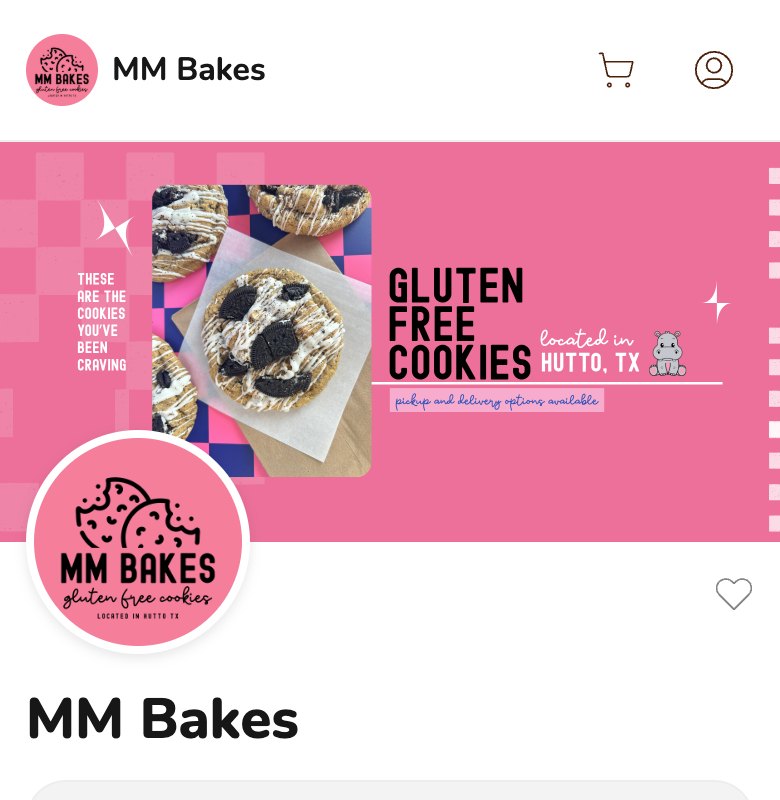
MM Bakes shows how this plays out. Its logo is a pink square, and the circle trims the corners without touching the cookies or the name, because the design sits well inside the square. The line at the very bottom, "Located in Hutto TX," is about 50 pixels tall in the 2,000-pixel image the bakery uploaded, or about 2.5% of its height. In the 104-pixel storefront circle that works out to about 2.5 pixels tall, and in the 36-pixel top bar about 0.9 pixels. The bakery's banner carries "Hutto, TX" in big letters instead, which is where that information can actually be read.
Here is every place the logo showed up on the storefronts we measured:
Swipe sideways to see each place your logo shows up.
| Where your logo shows | Size we measured | Shape | What still reads at that size |
|---|---|---|---|
| Homegrown storefront, logo spot, phone | 104 pixels wide | Circle | A bold name, a single icon, a face |
| Homegrown storefront, logo spot, laptop | 140 pixels wide | Circle | The same, plus short secondary words |
| Homegrown top bar, beside your store name | 36 pixels wide | Circle | Shape and color only, and very bold letters |
| Homegrown banner, phone | 390 by 200 pixels | Wide rectangle | Big words and a photo |
| Homegrown banner, laptop | 1,440 by 280 pixels | Very wide strip | Only a middle band of a tall image |
| Instagram profile photo, phone-width web page | 96 pixels wide | Circle | A bold name, a single icon, a face |
| Instagram profile photo, desktop web page | 150 pixels wide | Circle | Short secondary words |
Homegrown sizes were measured on live bakery storefronts on September 27, 2026, at 390 and 1,440 pixels wide. Instagram sizes were measured the same day on King Arthur Baking's public profile page in a web browser; the Instagram app may draw it at a different size.
Three things we saw while measuring:
If you skip the logo, the circle is not empty. A store without a logo image shows a gray shop icon in that spot (we saw it on one of the six bakery stores without one).
Put your logo in the logo spot and your wide name art in the banner, not the other way around. A tall logo used as a banner gets its top and bottom cut off on a laptop, which we saw on a live bakery storefront on September 27, 2026. A wide banner image used as a logo shrinks to a short strip of small words across the middle of the circle, which is what the wide logos did in our test render at storefront size.
Instagram trims your profile photo to a circle and, on its phone-width web page, draws it 96 pixels wide, only about 8% smaller than the 104-pixel Homegrown storefront logo spot. We measured it on King Arthur Baking's public profile on September 27, 2026: 96 pixels at a 390-pixel phone width and 150 pixels on a desktop browser.
That near match is good news for a home baker. One square file with the design centered and a little empty space around the edge works in both places. What to do with it:
A 2-inch round sticker is a practical size for a cookie box or a bread bag, and 100 of them cost $69 on Sticker Mule's circle sticker page on September 27, 2026, or $0.69 each. The same page, Sticker Mule's circle stickers, sells 1-inch, 3-inch and 4-inch circles too.
Use the size of the thing it seals:
The same small-words math from the storefront applies on paper. That 50-pixel town line on a 2,000-pixel logo is about 2.5% of the height, so on a 2-inch sticker it prints about 0.05 inches tall, a little over 1 millimeter. If a word matters, make it bigger or move it to the label.
Your logo can go on your cottage food label, but it does not replace the words the label must carry, and in Texas the business name itself has to be there in legible writing. Texas' cottage food page, loaded September 27, 2026, says the label must include legible writing, the name of the cottage food production operation, your address or the unique identification number Texas gives you when you register, the common name of the product, any major food allergens, and this statement word for word: "THIS PRODUCT WAS PRODUCED IN A PRIVATE RESIDENCE THAT IS NOT SUBJECT TO GOVERNMENTAL LICENSING OR INSPECTION." If you sell a food Texas calls time and temperature control for safety, meaning it has to be kept cold or hot to stay safe, the label must also show the date the food was made, and the label or the receipt must carry a "SAFE HANDLING INSTRUCTIONS" statement in at least 12-point type. A logo is not on that list.
What that means for your design:
For a label that carries your logo and still passes, our guide to a compliant, on-brand cottage food label walks through the layout.
A bakery logo costs $0 to make yourself in Canva Free, $35 to $72 as a one-time file from Looka, and from $249 from a designer on 99designs, based on each company's pricing page on September 27, 2026. The price mostly buys you better files and a person's judgment, not a different style.
Swipe to compare every logo option and its price.
| Option | Price | How you pay | What you get | Good fit when |
|---|---|---|---|---|
| Canva Free | $0 | No charge | A drag-and-drop editor and templates; you design it yourself | You want a simple badge or wordmark and have an evening |
| Canva Pro | $144 a year for one person | Yearly plan | Premium templates and more tools, including background removal | You will also make posts, menus and signs all year |
| Looka Basic Logo Package | $35 | One time | One low-resolution PNG file | You only need a profile picture for now |
| Looka Premium Logo Package | $72 | One time | High-resolution PNG, EPS, SVG and PDF files, color versions including transparent backgrounds, changes after purchase | You will print stickers and labels |
| Looka Brand Kit | $96 a year | Billed yearly | The logo plus ready-made social, card and letterhead designs | You want matching templates for everything |
| 99designs logo design | From $249 | One time | A professional designer's custom logo, with digital and print-ready files | You have steady orders and want something no template can give you |
| 99designs logo and brand guide | From $329 | One time | A logo plus a guide to your fonts, colors and styling | You are about to print packaging in bulk |
We checked these prices on Canva's, Looka's and 99designs' pricing pages on September 27, 2026. Prices change often; confirm on each site before you buy.
If you do hire out, 99designs' logo design service listed custom logos from $249 on September 27, 2026, with digital and print-ready files included. The simplest path for most home bakers, though, is to start in Canva Free, live with the logo for a few months, and pay for a designer only once you know the name and the products are staying. The DIY logo guide covers how to make the free version look clean.
Looka's own pricing page, checked September 27, 2026, describes the $35 Basic package as "one low-res file." A profile picture only needs a small file, but stickers, labels and a banner need a larger one, so if you plan to print, compare that with the $72 Premium package's PNG, EPS, SVG and PDF files before you pay.
Printing your logo costs as little as $0.12 a label on sheets you print at home, at Avery's sale price that day ($0.24 at its regular price), and about $0.20 to $1.16 a sticker from a print shop, depending on how many you order. Here is what the pages showed on September 27, 2026:
Swipe sideways for every sticker size, quantity and price.
| Option | Quantity | Price | Cost each | Shipping shown |
|---|---|---|---|---|
| Sticker Mule, 1-inch circle | 50 | $51 | $1.02 | Free, 4-day turnaround |
| 2-inch circle, small run | 50 | $58 | $1.16 | Free |
| 2-inch circle, standard run | 100 | $69 | $0.69 | Free |
| 2-inch circle, bulk run | 1,000 | $200 | $0.20 | Free |
| Sticker Mule, 3-inch circle | 100 | $86 | $0.86 | Free |
| Avery 22807 round labels, 2 inch, print at home | 120 (12 per sheet) | $14.49 on sale (regular $28.34) | $0.12 on sale ($0.24 at the regular price), plus your ink | $5.95 flat; the page also showed free shipping over $50 in one spot and over $75 in another |
The four 2-inch and 3-inch rows are Sticker Mule circle stickers too. Prices from Sticker Mule's circle sticker page and Avery's 22807 round label page, checked September 27, 2026. With Avery's $5.95 shipping, 120 labels come to $20.44 at the sale price, or about $0.17 each before ink, and $34.29 at the regular $28.34 price, or about $0.29 each.
If you would rather print at home, Avery's 2-inch round labels, product 22807, come 12 to a sheet and work in a regular inkjet or laser printer. Put the pieces together and you get three honest starting budgets:
On Sticker Mule's page on September 27, 2026, 1,000 two-inch stickers cost $200, or $0.20 each, against $1.16 each for 50. The big order only saves money if the logo lasts. Order 50 of a new logo first, use them on real boxes for a couple of months, and buy the 1,000 once you stop wanting to change it.
The guide to using stickers and labels as marketing covers where to put them beyond the box.
Your logo should lead to one page where people can see what you bake this week and order it, because a logo that gets noticed and then sends people into a DM thread can lose the order. Every sticker, profile photo and label is a small ad for your bakery. The payoff comes when someone who sees it can order in a minute.
That is the job Homegrown does for a home bakery. You upload your logo and a banner during setup, and your storefront link opens a page that is yours: your logo, your products, no marketplace menu, and a small "powered by Homegrown" at the bottom. The price is $10 per month billed annually, or $12.50 on the monthly plan, and there are no percentage fees beyond standard payment processing: 2.9% + $0.30 on each order, paid by you. There is a 7-day trial, with no charge until day 8.
Here is how that compares with two places bakers often send people, on a $20 cookie order:
Swipe to see the full fee stack for each platform.
| Platform | Monthly plan | Trial | Platform or transaction fee | Card processing | Customer pays on a $20 order | Baker pays on a $20 order | Baker pays in a month of 50 orders at $20 |
|---|---|---|---|---|---|---|---|
| Homegrown | $10 billed annually ($12.50 monthly) | 7 days, no charge until day 8 | None, 0% commission | 2.9% + $0.30, paid by the baker | $20.00 | $0.88 plus the plan | $54.00 ($56.50 on the monthly plan) |
| Hotplate, fee passed to the customer | $0 | No plan, so no trial | 5% + $0.55 on the subtotal, paid by the customer | 2.9% + $0.30, paid by the baker | $21.55 | $0.88 | $44.00, while customers pay $77.50 in fees |
| Hotplate, baker pays the fee | $0 | No plan, so no trial | 5% + $0.55 on the subtotal, paid by the baker | 2.9% + $0.30, also paid by the baker | $20.00 | $2.43 | $121.50 |
| Etsy | $0 (a one-time set-up fee may apply) | No plan, so no trial | $0.20 listing fee plus 6.5% transaction fee | 3% + $0.25 in the US, paid by the seller | $20.00 plus shipping | $2.35 | $117.50 |
We checked these fees on Homegrown's signup page, Hotplate's pricing page, and Etsy's fees and payments policy pages on September 27, 2026. Card processing is figured on the $20 price for all three platforms. Hotplate lets the baker pass its 5% + $0.55 fee to the customer or pay it, so it gets two rows: passed on, the customer pays $1.55 and the baker pays $0.88; paid by the baker, the baker pays $1.55 + $0.88 = $2.43 per order, or $121.50 for 50 orders. Hotplate's own example charges its baker processing on more than the subtotal ($1.27 on a $30 order, where 2.9% + $0.30 on $30 would be $1.17). Etsy charges its processing on the whole sale including shipping and tax, and its 6.5% transaction fee on shipping and gift wrap too, so both run a few cents higher in practice. Etsy can also charge an Offsite Ads fee of 15% on an order that came from one of its outside ads, for shops under $10,000 in sales over the past year.
Why the fit differs for a baker with a new logo:
Honest bounds, so you know before you sign up:
Hotplate's pricing page, checked September 27, 2026, lists "Storefront + drop setup" and a "Countdown timer" in its list of what is included. Homegrown does not have drops. If a countdown drop is the center of how you sell, weigh that before you switch.
Once your logo is ready, the next step takes about 15 minutes: start your Homegrown storefront, upload the logo to the round spot and your wide name art to the banner, and put the link on the sticker, the card and your Instagram bio so everyone who sees the logo has one place to order.
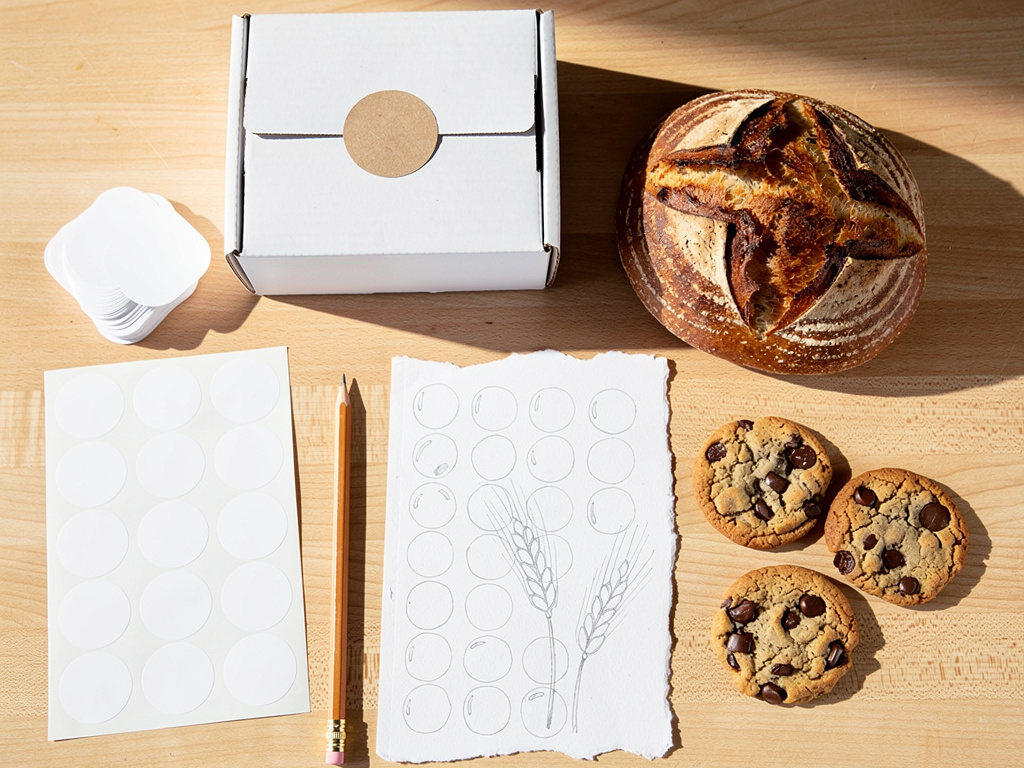
Test a bakery logo in the four places it will live (your storefront's top bar, a round profile photo, a 2-inch sticker and the box you pack), at the size it will live there, before you pay for a big print run. It takes one evening and a printer, and it catches the problems a big screen hides.
If the logo fails the first two steps, the fix is usually to delete words, not to add anything. Take off the slogan, the year and the town, make the name bigger, and test again.
The costliest bakery logo mistake is ordering 1,000 stickers, $200 at the 2-inch size on Sticker Mule, before the logo has been tested small, because every later change throws away what you already paid for. Most of the rest comes from what we saw on real storefronts:
A logo matters less than the bread in the box. It is worth getting right mostly because you will print it hundreds of times, and a small change now is cheaper than a reprint later. For the colors that go with it, see how to choose a brand color palette.
A round badge with one baked good in the center and a short name is a low-risk bakery logo idea, and it was also the most common style in our count: 71 of the 152 bakery storefront logos we counted on Homegrown on September 27, 2026 were badges, and 67 of those were round. It fits the circles your logo lives in, like the storefront logo spot and the Instagram profile photo. If your name is short, a bold name-only wordmark is a strong second choice.
A bakery logo needs your bakery name and, if you want one, a single picture of what you bake. Everything else is optional, and small extra words like slogans, towns and years are the first thing to blur at storefront size. Put your contact details, pickup days and ingredients on the label or card instead of inside the logo.
A bakery logo costs $0 if you make it yourself in Canva Free, $35 to $72 as a one-time file from Looka, and from $249 from a designer on 99designs, based on what those companies charged when we checked on September 27, 2026. Printing adds cost too: 100 two-inch round stickers cost $69 on Sticker Mule's page the same day.
Make the logo file square and large, and design it to still read when it is small. On a Homegrown storefront it shows as a 104-pixel circle on a phone and a 36-pixel circle beside your store name, and Instagram's phone-width web page draws a profile photo about 96 pixels across. On paper, a 2-inch round sticker is a practical size for a cookie box or bread bag.
Yes. Canva Free cost $0 on Canva's pricing page on September 27, 2026, and it is enough to make a simple badge or wordmark bakery logo. Canva Pro, at $144 a year for one person, adds premium templates and tools like background removal. Our guide to making a DIY logo with free tools walks through the process.
A round bakery logo is not required, but it is the easiest shape to use, because the Homegrown storefront logo spot and Instagram profile photos are both shown as circles. A square or wide logo still works if everything important sits well inside the middle, away from the edges the circle trims.
Five more guides sit right next to these bakery logo ideas. The first two are the honest bookends: one shows you how to make a logo for $0, and the other explains why you can sell for months without one. The last three cover the fonts, colors and business steps that sit around a logo.
A good bakery logo is simple enough to read in a small circle, printed on a sticker you tested before you bought 1,000, and pointed at one place people can order. Pick a style from the six real bakers use, keep the words to your name, and test it at 36 pixels and 2 inches.
Here is the short path, in order:
Then give it a home. Set up your Homegrown storefront for $10 a month billed annually, with no percentage fees beyond standard payment processing, upload your logo to the round spot, and share one link everywhere your logo shows up.



