
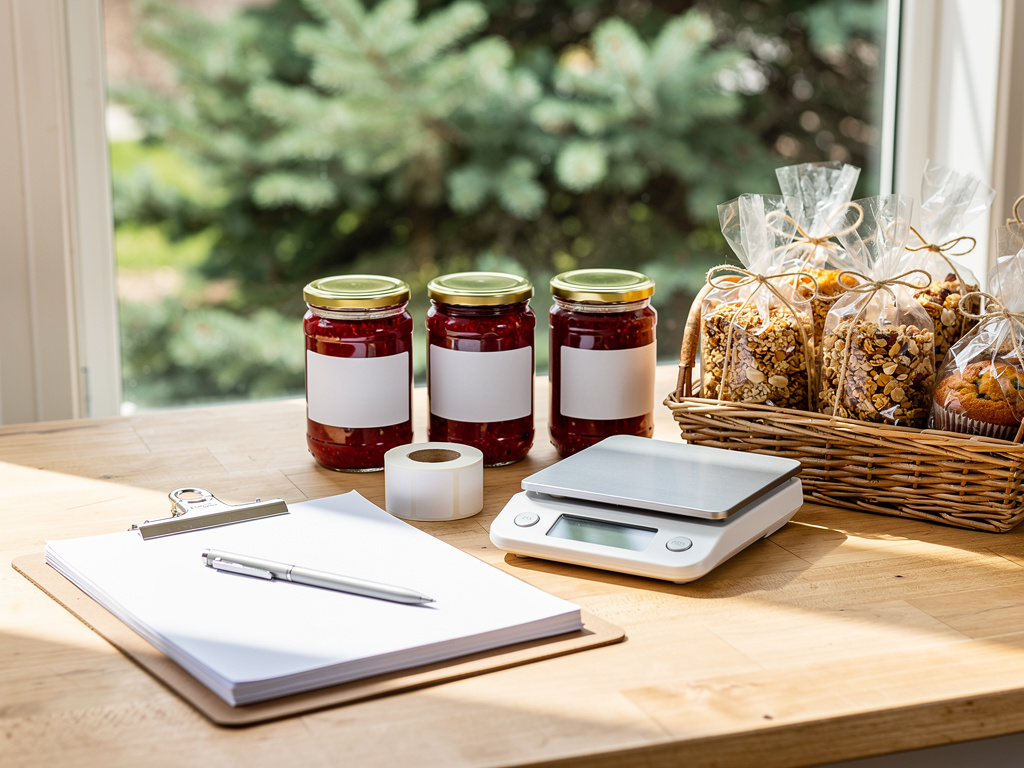


The short version: To start a cottage food business in Washington, you get a food worker card and a state business license, then apply to the Washington State Department of Agriculture (WSDA) for a Cottage Food Permit, which costs $355 for two years and comes after a review of your labels and a home-kitchen inspection. WSDA says the process averages 6 to 8 weeks from a complete application, and once you have the permit your gross sales are capped at $35,000 a year per home. You can sell only the low-risk foods printed on your permit, directly to customers inside Washington, and you can never ship. WSDA's FAQ lets you take orders online but says "product delivery and payments must be directly from the producer to the end consumer in a person to person transaction," so plan on collecting payment when you hand over the food, and ask WSDA in writing before you take any payment online.
Checked on WSDA's Cottage Food Operation page, RCW 69.22, WAC 16-149, the Department of Health and the Department of Revenue, October 8, 2026: the fees, cap, timing and payment wording above come from those pages, and the state law reads stricter than WSDA's FAQ while WSDA's 2026 brochure reads looser. Homegrown prices come from findhomegrown.com/signup the same day; Homegrown's checkout takes card payment online with no pay-at-pickup option, customers create a Homegrown account to place a first order, and Homegrown has no drops (timed product release) feature.
Once you have your WSDA permit and know how your customers may pay, you can set up a Homegrown storefront and try it free for 7 days.
To start a cottage food business in Washington, you get your food worker card and a Washington business license, prove your kitchen uses safe water, apply for a WSDA Cottage Food Permit, pass a home-kitchen inspection, label your products with your permit number, and start selling in person. The permit costs $355 for two years, sales are capped at $35,000 a year, and WSDA says payment and delivery happen person to person, with no shipping. This is the step-by-step playbook, with the costs worked out line by line. For the full legal detail behind each step, see our Washington cottage food law guide.
If you landed here searching for "cottage law" because of a backyard cottage or an accessory dwelling unit, that is a housing rule. This page is only about selling food you make in your own home kitchen.
You start a cottage food business in Washington in nine steps, and the first five happen before you send WSDA anything. WSDA's own page says a Cottage Food Permit "must be issued before you sell your product," so nothing goes on sale until step eight.
The rest of this guide walks through each step, what it costs, and where new vendors get stuck.
You need three things before you apply: a food worker card for each person making the food, a Washington business license, and proof that your kitchen uses safe water. WSDA's 2025 overview slides list exactly those three under "Before submitting a Cottage Foods Permit Application," and its web page asks for signed copies of the cards and a copy of the license.
Here is what each one involves:
Your cottage food permit comes from the state agriculture department, not your county health department. RCW 69.22.100 says permitted cottage food operations are not subject to "permitting and inspection by a local health jurisdiction." Your county still matters for the food worker card training and for septic and well advice, but the permit itself is WSDA's.
The WSDA application is a packet, not a one-page form: a completed application, a drawing of your kitchen, a label for every product and variation, your sales plan and processing dates, your food worker cards, your business license, your water proof, and pet or child plans. WAC 16-149-060 lists the required pieces, and WSDA's 2025 overview slides add the plans the current packet asks for.
What to put together:
Two rules shape the packet. First, one permit holds at most 50 master products, and a master product can have variations: WSDA's example counts chocolate chip cookies with walnuts and with pecans as one product. Second, the recipe rules disagree. WSDA's page says the whole application is a public record, "including recipes, so do not submit recipes with your application," and its slides say a reviewer can ask for a recipe if there is a concern. The written rules (WAC 16-149-060 and 16-149-120) still list recipes as part of the application. If the form you download asks for recipes, email cottagefoods@agr.wa.gov and ask which instruction to follow. Either way, WAC 16-149-120 says your recipes stay on file at home, and WSDA can ask to see them.
Apply with a short menu. WSDA's 2026 brochure says "the more products that are submitted, the longer the review will take," and every product needs its own label. A short list of master products with variations should move faster than a long list of separate ones, and you can add products at your two-year renewal at no extra charge instead of paying WSDA's $105 amendment fee (plus $125 if WSDA re-inspects) mid-term.
A solo vendor pays $415 in state fees to open a Washington cottage food business: $355 for the WSDA permit, $10 for a food worker card and $50 to open a business license. Add each helper's $10 card, any city endorsement or trade name fee, and your first labels, packaging and ingredients.
Scroll sideways to see every column.
| Cost | Amount | Who sets it | When you pay |
|---|---|---|---|
| WSDA Cottage Food Permit | $355 for two years, nonrefundable once WSDA receives it | WSDA | With your application, then every two years |
| Reinspection | $125 | WSDA | Only if your first inspection fails |
| Permit amendment between renewals | $105, plus $125 if WSDA requires a new inspection (WAC 16-149-070) | WSDA | Only if you add or change products mid-term |
| Food worker card | $10 per person | Department of Health | Before you apply; the first card lasts 2 years |
| Business license, new business | $50 processing fee, plus any endorsement or trade name fees | Department of Revenue | Before you apply |
| Well water bacteria test | Set by the lab | Accredited lab | Within 60 days before applying, then once a year; private wells only |
| Labels and packaging | About $20 to $100 to start (our planning range) | Your suppliers | Before your first sale |
| First batch of ingredients | About $30 to $150 (our planning range) | Your suppliers | Before your first sale |
| Ordering storefront (optional) | Homegrown: $10 a month billed annually ($12.50 billed monthly), 0% commission, 2.9% + $0.30 card processing per order | Homegrown | Yearly on annual billing ($10 a month) or monthly ($12.50), first charge on day 8 after the 7-day trial |
Government fees as listed on October 8, 2026 by WSDA's Cottage Food Operation page, the Department of Health's food worker card page and the Department of Revenue's business license processing fee page. The supply ranges are our rough planning figures, not quotes; your own prices will differ. Homegrown's price is from findhomegrown.com/signup the same day.
State fees a solo vendor pays to open ($415 total)
Source: WSDA, Department of Revenue and Department of Health fee pages, October 8, 2026. Bars are each fee divided by the largest ($355). Endorsement and trade name fees not included.
Add it up and a solo vendor can plan on about $465 to $665: the $415 in state fees plus $20 to $100 for labels and packaging and $30 to $150 for a first batch, using our planning ranges. The permit is the big line, but it covers two years, which works out to $177.50 a year or about $14.79 a month.
What is inside the $355? WSDA publishes only the total. WAC 16-149-060 lists a $30 processing fee, a $75 public health review fee and $125 for each annual inspection, and those add up to $355 when you count two inspections, one for each year of the permit. That split is our arithmetic from the rule, not a WSDA breakdown.
Plan on about 8 to 10 weeks from your first step to your first legal sale: roughly two weeks to collect your card, license and labels, then the 6 to 8 weeks WSDA says the permit usually takes once your packet is complete. That total is our planning math from the agency figures below, not a WSDA promise.
WSDA's own numbers vary by document. Its Cottage Food Operation page says the process averages 6 to 8 weeks "from the time a complete application is received by our office and when the permit is issued." A WSDA blog post from April 9, 2026, "Starting a Cottage Food Business in Washington State", encourages applicants to allow 4 to 6 weeks. Plan for the longer one.
A realistic calendar:
Incomplete packets stretch this out. WSDA's April 2026 post says the application "must be fully completed before it will be processed."
The WSDA inspection checks that your home kitchen and every area on your floor plan can produce food safely with ordinary residential equipment. WSDA's page says it covers the kitchen, the packaging area, the restroom and the storage areas for ingredients and finished products. A failed inspection costs $125 to redo, and failing twice ends the application.
What to have ready:
WSDA's 2025 slides describe the first permitting inspection as virtual, with kitchen photos sometimes requested, while its web page says a specialist will schedule a visit, so be ready for either. Under RCW 69.22.040 your kitchen is inspected before the permit and annually after, and the slides say an inspector schedules an on-site visit around a year after permitting. Our Washington cottage food law guide has the full inspection checklist.
You can sell low-risk foods that stay safe at room temperature, and only the exact products WSDA approves and prints on your permit, up to 50 master products per permit. WSDA's page lists the commonly approved groups, and WAC 16-149-120 holds the full rule:
Frosting is where bakers most often get tripped up. WSDA's FAQ says an approved frosting has a 3 to 1 ratio of shelf-stable ingredients like sugar to perishable ones like butter, eggs or milk, by weight, or it gets a cook step. Our cottage food labeling guide covers how to list those ingredients once your recipe passes.
Anything that needs refrigeration is off the list, along with meat, poultry and fish (and foods made with them), dairy products like milk, cheese and yogurt, home-canned fruits and vegetables, and beverages. WSDA's prohibited list (WAC 16-149-130, plus WSDA's cottage food page and FAQ answers) includes:
WSDA's 2026 brochure and the prohibited list on its own cottage food page go further than the rule. The brochure lists "any foods containing fresh fruits or vegetables" as not permitted, and the page lists "food products made from fresh fruits or vegetables," while WAC 16-149-130 says "cut" fresh fruits or vegetables and WSDA's FAQ allows produce baked into the batter. Name each product exactly on your application so the reviewer can tell you which side it falls on. If your product is not allowed, WSDA points you to a Food Processor License and a licensed kitchen; our guide to using a commissary kitchen as a cottage food vendor covers that route.
In a pull of Homegrown's public product feed on October 8, 2026, 1,492 of 2,920 products (51%) were listed in the Bakery category, from 188 of 313 vendors. Pantry Goods came next with 364 products from 63 vendors. Those counts use the category each vendor picked, not words in product names. Reading the Pantry Goods names shows why a category is not a permit: jams and granola, which Washington allows, sit next to salsa and pickles, which a Washington cottage food permit does not cover.
Every Washington cottage food label needs your business name and permit number, the product name, the ingredients, allergens, net weight and WSDA's home-kitchen statement in at least 11-point type. RCW 69.22.020 and WAC 16-149-110 set the list:
You don't need your home address on the label. Hand-printed labels are fine if they are legible, in permanent ink and at least 11-point size. Wedding cakes and other cakes that can't hold a sticker get a printed label sheet delivered with them, and cupcakes need their own label even when they use your cake recipe. The Big 9 allergen guide shows how to write the allergen line.
You can sell Washington cottage food anywhere you hand it to the customer yourself inside the state: from your home, at farmers markets, craft fairs, festivals, holiday bazaars, charitable events, your own farm stand, or a shop you run yourself. WAC 16-149-040 requires every sale to go directly to the consumer, and says a copy of your permit must be displayed wherever you sell. Every one of those sales counts toward your $35,000 yearly cap.
Washington allows these sales:
Washington rules out:
Markets can add their own rules on top of the permit, such as insurance. Neither RCW 69.22 nor WSDA's cottage food page requires insurance, but a market can. Our Washington farmers market vendor permit guide covers what you need on market day.
You can take orders online under WSDA's FAQ, but the same FAQ says payment and delivery happen person to person, so do not plan on online card payment without WSDA's written OK. We read seven Washington documents on October 8, 2026, they give three different answers, and the strictest one is the law itself.
The seven statements, word for word, as each page read on October 8, 2026:
Three of those (the statute, the sales FAQ and the blog post) say no internet sales. The rule, the internet FAQ and the 2025 slides allow online orders when the sale finishes in person, and the FAQ counts payment as part of that. Only the brochure reads as if an online sale with in-person pickup is fine. The setup that fits the most sources is: take the order online or by message, collect cash or a card tap when you hand over the food, and keep a record of each sale.
Before you take any payment online, email WSDA's cottage food team at cottagefoods@agr.wa.gov or call 360-902-1876. Describe exactly how your customers will order and pay, and keep the written reply with your permit records. We checked all seven statements above on October 8, 2026, and they had not been brought into line.
The ordering setup that matches WSDA's FAQ most closely is one where your customer pays you in person at the hand-off. Some setups do that for free, some charge a fee even on cash orders, and online checkouts put the payment online, which puts them in the "ask WSDA first" pile.
Scroll sideways to see every column.
| Setup | When the customer pays | Fits the FAQ's person-to-person wording? | Monthly plan | Trial | Platform fee | Card processing | Customer pays on a $20 order | Vendor pays on a $20 order | Vendor pays in a month of 50 orders at $20 |
|---|---|---|---|---|---|---|---|---|---|
| Facebook or Instagram post, orders by message | In person at pickup, cash or card tap | Yes | None | Not needed | None | Cash: none. Card tap on Square Free: 2.6% + 15¢ | $20.00 | $0.00 cash; $0.67 card | $0.00 cash; $33.50 card |
| Hotplate, Cash option at checkout | In person at pickup, in cash | Yes, the payment happens in person | $0 | Not needed | 5% + $0.55, paid by the customer by default and deducted from your payout | None on cash orders | $21.55 | $0.00 (the $1.55 fee is inside the customer's cash) | $0.00 ($77.50 if you cover the fee) |
| Hotplate, card checkout (default) | Online at checkout | No; ask WSDA first | $0 | Not needed | 5% + $0.55, paid by the customer by default | 2.9% + $0.30, paid by the vendor | $21.55 | $0.92 | $46.25 ($121.50 if you cover the fee) |
| Square Online on Square Free | Online at checkout; no pay-at-pickup option | No; ask WSDA first | $0 | Not needed | None | 3.3% + 30¢ online | $20.00 | $0.96 | $48.00 |
| Homegrown storefront | Online at checkout; no pay-at-pickup option | No; ask WSDA first | $10 billed annually ($12.50 billed monthly) | 7 days, no charge until day 8 | None, 0% commission | 2.9% + $0.30, paid by the vendor | $20.00 | $0.88 plus the plan | $54.00 ($56.50 on monthly billing) |
We checked every price on October 8, 2026: Square on its fees page (Square Free has "no monthly subscription costs") and its website payments help page, which lists cards, Apple Pay, Google Pay, Afterpay and Cash App Pay but no pay-at-pickup option, Hotplate on its pricing page and its help article on accepting cash, Venmo or Zelle, and Homegrown on findhomegrown.com/signup. Card fees are figured on the $20 price with one item per order, no tax, tips or delivery fee. Hotplate's own $30 example charges $1.27 in processing, more than 2.9% + $0.30 of the subtotal, so its default card row is figured on the $21.55 the customer pays. The Homegrown month is 50 card fees of $0.88 plus the $10 plan. Hotplate's cash option can only be switched on for your whole storefront, and its help article says chasing a cash customer who doesn't show up is on you.
A post on Facebook or Instagram costs nothing and keeps payment in person, but the orders scatter across message threads, and you track quantities, pickup times and who still owes you by hand. At 20 or 30 orders a week, that means dozens of threads to keep straight.
That is where an ordering page earns its keep, with one catch for Washington. Homegrown gives you one link where customers pick from your permitted products and choose a pickup window or a local delivery slot you set, for $10 a month billed annually ($12.50 billed monthly) with no percentage fees beyond standard payment processing. Every order lands in one dashboard, so you have one record to add up against the $35,000 cap instead of a phone full of messages. Compare that to Hotplate, which by default charges customers 5% + $0.55 per order even when they pay you in cash, or Square Online, which is $0 a month but charges 3.3% + 30¢ on every online card payment.
The catch: Homegrown's storefront, like most online stores, takes card payment at checkout, so it does not match WSDA's person-to-person wording for a cottage food permit. Get WSDA's answer before you charge cards online for cottage food. If WSDA tells you online payment with in-person pickup is fine for your setup, Homegrown fits that workflow. Homegrown has no pay-at-pickup option, no shipping, and it does not track the $35,000 cap for you. Customers create a Homegrown account to place their first order, and there is no drops (timed product release) feature. Your storefront is listed on the Homegrown marketplace, but plan on most orders coming from people you send to your own link.
You can gross up to $35,000 a year selling cottage food in Washington, which is about $673 a week or $2,917 a month. The cap counts gross sales, every dollar customers pay you before costs, and it is counted per home, so two people baking in one kitchen share one $35,000 limit under RCW 69.22.050.
At $20 an order, the cap is 1,750 orders a year, or about 34 a week. To get the most out of a fixed ceiling:
The cap is reviewed every four years. RCW 69.22.050 tells WSDA to raise it by the Seattle-area consumer price index, but as of October 8, 2026, WSDA's page still lists $35,000 and announces no change.
Work out your break-even on the permit before you set prices. If a loaf sells for $9 and costs you $3 in ingredients and packaging, each one clears $6, so about 70 loaves cover the $415 in opening state fees. After that, the permit costs you nothing more until renewal two years out.
The most expensive mistake is selling before WSDA issues your permit, because that is a misdemeanor under RCW 69.22.090. These are the others that cost new Washington vendors time or money:
Selling cottage food in Washington without a valid permit is a misdemeanor, and a second or later violation is a gross misdemeanor, under RCW 69.22.090. An offense more than five years after a previous conviction counts as a first offense again.
The same section lets WSDA impose a civil penalty of up to $1,000 per violation per day, but only for a violation "that has not been punished pursuant to subsection (1)." In plain terms, the fine is used instead of a criminal charge, not stacked on top of one. Breaking any other rule in the chapter, such as shipping or selling over the cap, falls under the same penalty section, and exceeding the cap also means no refund of your permit fees under RCW 69.22.050.
The permit itself is also at risk. Under RCW 69.22.070, WSDA can deny, suspend or revoke a permit after a hearing if a vendor fails to follow the chapter or its rules, fails to keep the required records, refuses WSDA access to the permitted kitchen, or goes over the $35,000 annual sales cap. WSDA can also suspend a permit right away, before any hearing, if it finds conditions that are an immediate danger to public health or is refused access (RCW 69.22.070(2)). That is why the records list matters: keep your food worker cards, business license, water test or water bill, recipes, ingredient receipts, a running total of gross sales, and a list of the markets and other places you sold, where you can hand them over.
You don't need an LLC to get a Cottage Food Permit, but you do need a Washington business license, because WSDA asks for a copy with your application. If you do form an LLC, the Department of Revenue says you file with the Washington Secretary of State before you apply for the business license. See whether you need an LLC to sell food from home for the tradeoffs.
On taxes, WSDA's FAQ sends sales tax and filing questions to the Department of Revenue. DOR's business license page lists the triggers for a license, including selling a product that requires sales tax collection or grossing $12,000 a year or more, and your license account is how you file. Washington does not currently have an individual income tax. A new 9.9% tax on adjusted gross income over $1 million starts January 1, 2028, according to DOR's income tax page, which a business capped at $35,000 a year will not reach on its own. The state business tax is a different story. DOR's business and occupation tax page says "Most businesses in Washington are subject to a gross receipts tax known as business and occupation (B&O) tax," and it lists a Small Business B&O Tax Credit that can reduce what you owe. Federal taxes still apply: our guide to cottage food taxes on Schedule C covers reporting your income.
Yes. Washington requires a WSDA Cottage Food Permit, which costs $355 for two years and includes a review of your labels and a home-kitchen inspection, before you sell any food made at home. The permit comes from the state agriculture department, not your county health department, and selling without one is a misdemeanor.
The state fees for a solo vendor come to $415: the $355 two-year permit, a $10 food worker card and the $50 processing fee to open a business license. With labels, packaging and a first batch of ingredients, a solo vendor starting a cottage food business in Washington can plan on roughly $465 to $665, using our planning ranges for supplies.
You can gross up to $35,000 a year, about $673 a week, counted per home rather than per person. The law tells WSDA to review the cap every four years against Seattle-area inflation, and WSDA's page still listed $35,000 on October 8, 2026.
You can take orders online under WSDA's FAQ, but you cannot ship, and WSDA says payment and delivery must happen person to person: the customer pays and picks up, or you deliver and collect payment in person. The state law itself says cottage food "may not be sold by internet," so email cottagefoods@agr.wa.gov before you use any online checkout.
Low-risk foods that don't need refrigeration: breads, muffins, cookies, cakes with shelf-stable frosting, most baked pies, stovetop candies, full-sugar jams and fruit butters, dry spice, herb and tea mixes, granola and small-batch roasted coffee. Pumpkin pie, cream or fresh-fruit fillings, salsa, pickles, meat, dairy products like milk and cheese, and drinks are not allowed.
WSDA says the permit takes 6 to 8 weeks on average from a complete application, and a WSDA post from April 2026 suggests allowing 4 to 6 weeks. Add about two weeks before that for your food worker card, business license and labels, so plan on about 8 to 10 weeks to your first legal sale when starting a cottage food business in Washington.
No. You can start as a sole proprietor with a Washington business license, which WSDA requires with the application. An LLC is optional and mainly about liability protection; if you form one, file with the Secretary of State before you apply for your business license.
More on selling homemade food in Washington and beyond:
Washington asks for a permit and an inspection up front, but the two-year term and a clear product list make it manageable once you are through. Get your food worker card and business license this week, send WSDA a complete packet, and pass your inspection. Then take orders ahead, collect payment at the hand-off, and get WSDA's answer in writing before you move payment online. If you are next door, compare the steps for starting in Oregon or starting in Idaho.
When you are ready for one link your regulars can order from, see how a Homegrown storefront handles pickup windows and local delivery for $10 a month billed annually, and check it against WSDA's payment wording first. Comparing other tools? See the best platform to sell food from home.
*This guide is general information, not legal advice. Cottage food rules change, so verify your state's current rules with WSDA's Cottage Food Operation page before you start selling. Last verified: October 8, 2026.*



