
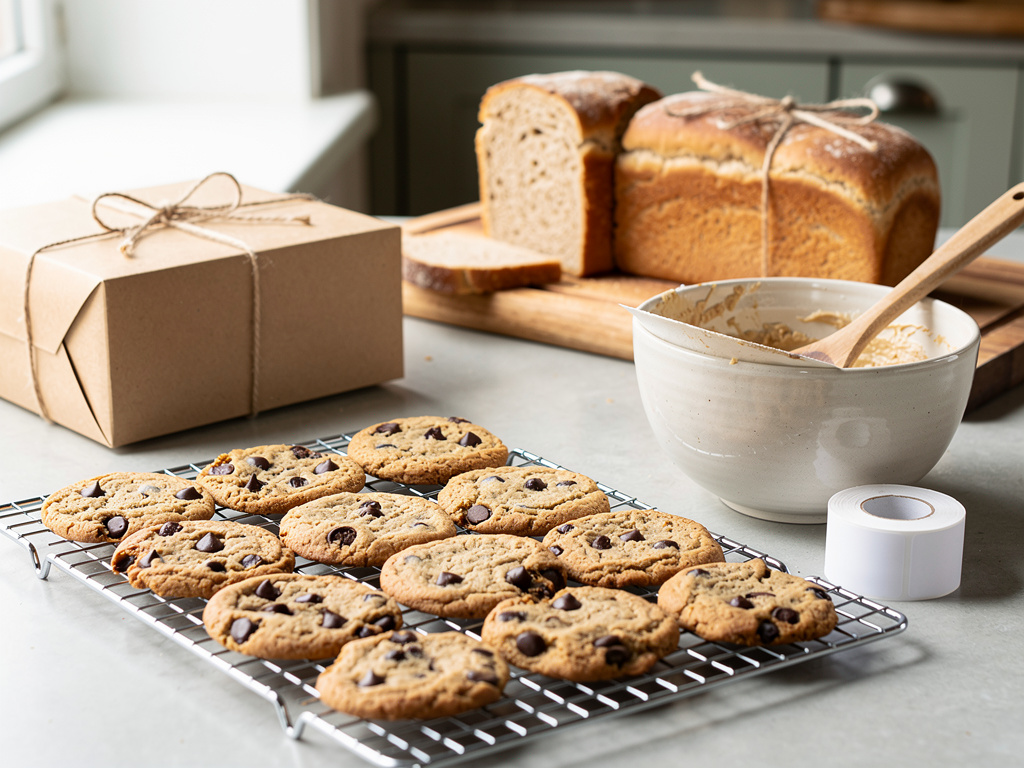


The short version: To start a cottage food business in Tennessee, you pick a food the Food Freedom Act allows, make it in your own home, put the required label on it and start selling, with no state license, permit, inspection or sales cap. Shelf-stable foods like bread, cookies, candy and jam can be sold in person, online or through a shop and shipped anywhere inside Tennessee, while refrigerated foods like cheesecake and cream pies, allowed since July 1, 2025, are only handed over face to face, by you or someone selling for you. Every label needs who made it (name, home address, phone), the product name, the ingredients by weight and the state's two-sentence statement. The paperwork that can still apply is local and tax related: a $15 county minimal activity license once you gross more than $3,000 a year, and sales tax on what you sell.
Checked on the Tennessee Department of Agriculture's Food Freedom Act page and the text of T.C.A. § 53-1-118, October 8, 2026: the rules come from those two sources and the University of Tennessee's January 2026 fact sheet, with tax figures from the Department of Revenue and Homegrown's price from findhomegrown.com/signup, all loaded that day. Shell eggs are not part of the Food Freedom Act, Homegrown customers create an account to place their first order, and Homegrown has no drops or countdown release feature.
If you want Tennessee customers to order ahead for pickup or delivery, you can set up a Homegrown storefront and try it free for 7 days.
To start a cottage food business in Tennessee, you confirm what you're making is allowed, make it at home, label it the way the law spells out, and start selling. There is nothing to apply for at the state level and no sales cap, and since July 2025 the allowed list includes refrigerated foods like cheesecake and cream pies, sold in person. This is the step-by-step playbook for getting your first product out the door: the order to do things in, what it costs, how to price, and where the paperwork actually shows up. For every rule in full, see our Tennessee cottage food law guide.
You can start a Tennessee cottage food business in 8 steps, and none of them involves a state application, a state fee or a kitchen inspection. The order matters, because the food you pick decides where you're allowed to sell it, and that decides how you take orders.
Step 2 is the one to slow down on. A cheesecake is legal, but it can't go on a website checkout, while a jar of strawberry jam can be sold from a website and mailed to a customer in Memphis. Decide your first three to five products with that split in mind and the rest of the plan falls into place.
No, there is no Tennessee cottage food license, no application form and no registration to file. The Tennessee Department of Agriculture's Food Freedom Act page says the department does "not issue permits, licenses, or conduct inspections" for products made under the law, and that the department cannot give advice about a specific product or business. If you've seen a "cottage license application" online, it belongs to another state's program, not Tennessee's.
What you might still apply for in Tennessee is not a food license:
Local governments can't add their own food rules: the law preempts counties and cities from banning or regulating the making and sale of homemade food (§ 53-1-118(d)). That covers government rules only; it says nothing about a homeowners association's covenants, so check yours if you have one. Local business tax licensing still applies, because the law keeps tax law in force (§ 53-1-118(c)(4)).
The state can still get involved in two cases. The Department of Health can investigate a reported foodborne illness, and Agriculture officials can take enforcement action against a homemade product that falls outside the law's exemption.
You can legally start the same day, because there is no license to wait for: it takes zero days to "get" a Tennessee cottage food license. The realistic timeline is set by your kitchen and your label printer, not by a government office.
The only waits that can stretch this are ones you choose. A farmers market may take weeks to approve a new vendor, and an LLC filing takes as long as the Secretary of State's processing. Neither is required before your first sale from home.
You can start a Tennessee cottage food business for about $126 to $141 with the lean budget below, because the state charges no fee. Your real costs are labels, packaging, ingredients and a way to take orders, and two of the lines are planning numbers you should replace with your own.
Swipe left to see the whole budget.
| Cost | Amount | Required? | Where the number comes from |
|---|---|---|---|
| State license, permit or registration | $0 | Nothing to buy | Exempt under the Food Freedom Act (TDA) |
| Labels: 250 printable 2" x 4" labels | $13.49 (about 5.4 cents each) | A label is required; this brand is not | Avery 5263 product page |
| Packaging: boxes, bags, jars | $40 (planning number) | Yes, for packaged products | Your choice of packaging |
| First batches of ingredients | $60 (planning number) | Yes | Your recipes |
| Online storefront, first month | $12.50 billed monthly, or $10/month billed annually | No | Homegrown signup page; 7-day trial, no charge until day 8 |
| Food handler course | $15 | No, good practice | ServSafe Food Handler online course and assessment |
| Lean total | $125.99, or $140.99 with the course | Sum of the lines above, monthly storefront plan |
We checked the label price on Avery's product page, the course price on ServSafe's product page and Homegrown's plan on its signup page on October 8, 2026. Packaging and ingredients are planning numbers, not quotes.
Costs that come later, and only if they apply to you:
Tennessee lets you sell almost any homemade food, and the law's exclusion list is written for refrigerated foods, which can't be or contain raw milk, alcohol, fish, shellfish, or red meat and meat products. Alcohol stays out of shelf-stable foods too, because the university reads the law's definition of a homemade food item as under 0.5% alcohol in the finished product. Most meat products stay out as well, because federal USDA inspection still controls them, per the university's PB1909 fact sheet. The university's 2025 presentation still tells home producers to keep red meat, fish, shellfish, raw milk and alcohol out of all products, so call its extension office about any shelf-stable fish or shellfish product first. Beyond those limits, your products split into two lanes, and the lane sets where you can sell. The law calls them non-time/temperature control for safety foods and time/temperature control for safety foods; in plain words, foods that are safe on a shelf and foods that need the fridge.
Drag the table sideways to compare both lanes.
| Shelf-stable foods | Refrigerated foods (allowed since July 1, 2025) | |
|---|---|---|
| Examples | Breads, cookies, cakes with low-moisture frosting, candy, fudge, chocolate, caramels, peanut brittle, jams, jellies, syrups, dried fruit, nuts, granola, spice blends, properly canned pickles, salsas and relishes | Cheesecake, cream pies, cream-filled pastries, fresh salsa, cut fruit, cooked rice or pasta dishes, pasteurized milk, fresh cheese, yogurt |
| Sold in person | Yes | Yes, by you or your agent only |
| Sold online or by phone | Yes | No |
| Through a shop or grocery store | Yes | No |
| Delivered or shipped inside Tennessee | Yes, by you, an agent, the store or a carrier | No, handed over in person |
| Out of state | No | No |
From T.C.A. § 53-1-118(b) and the University of Tennessee's PB1909 fact sheet and 2025 Food Freedom Act presentation, all loaded October 8, 2026. Examples follow the university's categories, not a list in the law; cheesecake, cream pies and fudge are our examples of those categories.
The full allowed and prohibited lists and the labeling rules are in our Tennessee cottage food law guide and cottage food labeling guide. For a first launch, a simple plan is to lead with two or three shelf-stable products you can sell every way, then add one refrigerated product for in-person pickup days.
A product is shelf-stable when its acidity or its low moisture stops bacteria from growing, and the University of Tennessee measures moisture as water activity on a scale from 0 to 1. Its PB1909 fact sheet gives a clear example: frosted cupcakes with a water activity below 0.88 don't need refrigeration for safety, while frosting or fresh fruit toppings above 0.88 make the cupcake a refrigerated food.
Quick ways to sort a product:
If you can't tell, the University of Tennessee's Department of Food Science extension (865-974-7331) works with home food businesses on whether a product needs refrigeration.
Yes, freeze-dried candy and freeze-dried fruit fit the Food Freedom Act as shelf-stable foods, so you need no license and you can sell them online and ship them anywhere in Tennessee. That is our reading: the law doesn't list freeze-dried foods by name, but the University of Tennessee's 2025 presentation lists candy and dried fruits, vegetables and nuts as shelf-stable because of their low water activity, and freeze-drying removes water.
Where freeze-dried products get tricky:
A bag of freeze-dried candy carries the same label as a loaf of bread. Our guide to selling freeze-dried candy from home covers equipment and pricing in more depth.
The University of Tennessee handles carton eggs outside the Food Freedom Act: its PB1909 fact sheet on the law points anyone selling eggs from their own flock to a separate guide, PB1898, so a carton of eggs from your own hens is not a Food Freedom Act product. Carton egg sales follow federal small-flock rules: the University of Tennessee's PB1898 guide explains that Tennessee's Egg Law was repealed, and that farms with fewer than 3,000 laying hens who raise and pack only their own eggs are exempt from many federal requirements but must print "Safe Handling Instructions" on the carton. Eggs used as an ingredient in a cake or cheesecake are fine under the Food Freedom Act.
The 2025 amendment added refrigerated foods, not shell eggs. We checked the law's text and UT's PB1898 egg guide on October 8, 2026: shell eggs follow federal small-flock rules, and refrigerated homemade foods, including dairy, are sold in person only.
Dairy and chicken, in short:
You have to make, and if you package it, package, every Food Freedom Act product in your own home. The law defines a homemade food item as one "produced and, if packaged, packaged at the private residence" of the person making it, and the University of Tennessee says that using a church, community, restaurant or other commercial kitchen requires a food manufacturing permit from the Department of Agriculture, or a food service permit from the Department of Health.
That rule matters if you used to bake in a church kitchen. From 2017 until 2022 that was allowed; since the first Food Freedom Act it isn't. If your home kitchen is too small, the choice is to scale at home or get permitted in a commercial space.
A home kitchen setup the university recommends, even with no inspection:
The Department of Health may ask to see your work area if it investigates a reported illness, so keep it the way you'd want it seen.
Every packaged Tennessee cottage food product needs a label with all four required parts, however you sell it. Phone and custom orders of unpackaged food get a lighter rule, explained below the template. Here is the template, filled with placeholders you replace:
Where the label goes depends on how you sell. A packaged product carries it on the package, however you sell it. Food sold loose from a bulk container gets it on the container, and unpackaged food gets a sign at the point of sale. A product sold only online can show it on the web page, and a phone or custom order needs you to tell the customer the statement and give the rest on request, though a packaged product still needs the full label.
Good additions the university recommends: "Keep Refrigerated" on refrigerated foods, and an accurate net weight if you list one. Health claims are not allowed.
Print on 2" x 4" labels, not 2" circles. Tennessee's label carries a full street address, a phone number, an ingredient list and a 21-word statement, and a circle that size runs out of room fast. A 250-pack of Avery 2" x 4" labels was $13.49 on October 8, 2026, about 5.4 cents a label.
Tennessee lets shelf-stable homemade food go almost anywhere in the state, with one firm rule for refrigerated food: it is sold face to face. The list, from the law and the university's guidance:
Because Tennessee allows online sales and in-state shipping for shelf-stable products, a real storefront makes selling far easier than juggling texts and DMs for your cookies, candy and jam. Homegrown gives Tennessee cottage food vendors an online storefront with built-in payments and pickup for $10 a month billed annually, with 0% commission, so you keep every dollar except standard card processing. Start your 7-day trial (no charge until day 8) and have your shelf-stable menu live in about 15 minutes, then sell your cheesecakes at the pickup table in person.
One practical note on "agent." The law lets an agent sell refrigerated food in person for you, and its own example is a farm stand on the property where the food was made. A family member staffing your market table fits the plain meaning; a shop selling your cheesecake on consignment does not, because the university says no third-party vendor may sell homemade refrigerated food.
Making homemade food at your private residence and selling it to consumers inside Tennessee needs no food permit at all, and neither does handing out samples at a farmers market if you follow seven conditions. The permits start when you cook outside your home or sell across state lines, and a booth permit may apply if you prepare refrigerated food at the market itself (our reading).
Slide sideways to see who needs a permit.
| What you want to do | Food permit needed? | Rule |
|---|---|---|
| Bake or cook at home and sell to consumers in Tennessee | No | T.C.A. § 53-1-118 |
| Sell shelf-stable products through a shop or grocery store | No | T.C.A. § 53-1-118(b)(1) |
| Give samples at a farmers market | No, if 7 conditions are met | T.C.A. § 68-14-727 |
| Prepare and serve refrigerated food on site from a market booth | Yes, a $300 farmers market food unit permit after an inspection (our reading) | T.C.A. §§ 68-14-728 and 68-14-713(a)(6) |
| Cook in a church, community or rented commercial kitchen | Yes, from Agriculture or Health | UT PB1909 |
| Sell to a restaurant, food truck or caterer | Not allowed for homemade food | UT PB1909, FDA Food Code |
| Sell to customers in another state | Yes, a commercial facility and food manufacturing permit | T.C.A. § 53-1-118(c)(5), UT PB1909 |
Loaded October 8, 2026 from the law's text, the University of Tennessee's PB1909 fact sheet and the Department of Health's farmers market food unit rules. The market booth row is our reading: no state page we loaded ties the food unit permit to Food Freedom Act vendors by name.
The seven sampling conditions in the farmers market law are:
For the full market-day checklist, see our Tennessee farmers market vendor permit guide.
Price each product so it covers ingredients, packaging, the label, card processing and your time, then add margin; on a $12 loaf, card processing alone is $0.65 (2.9% + $0.30). Two of those lines are easy to forget, the processing fee and your own hours, and leaving them out is how a busy Saturday ends up paying so little.
In a pull of the Homegrown catalog on October 8, 2026, Bakery made up 1,484 of the 2,912 products listed, about 51%, from 187 vendors. The median listed base price of those bakery products was $11.00, and the middle half sat between $6.00 and $15.00. Pantry goods, the next category vendors chose, had 363 products from 62 vendors at a median of $9.00. The median vendor listed 7 products. Counts are by the category each vendor chose, the pull does not record which state each vendor is in, and a listed price is not a sale.
Homegrown products by category
Source: public Homegrown catalog pull, October 8, 2026, 2,912 products from 313 vendors, counted by the category each vendor chose.
A simple pricing pass for each product:
Our guide to pricing baked goods walks through the math with worked examples.
There's no cap: Tennessee's law sets no sales limit, income limit or production limit, so you can earn as much as demand and your home kitchen allow. Fifty orders of $20 a month is $1,000 in gross sales, and at that pace a location passes the $3,000 line for a county minimal activity license during its fourth month. To get the most out of it:
The real ceiling is your oven and your hours, not the state. A vendor baking 30 loaves on a Friday has a different business than one baking 300, and both are legal.
Once your shelf-stable products have a few regulars, the next problem is orders: who wants what, who paid, and when they're picking up. Homegrown is $10 per month billed annually ($12.50 billed monthly) with no percentage fees beyond standard payment processing, and it gives you one link where Tennessee customers browse your bread, cookies or jam, pay up front and pick a pickup time or ask for local delivery inside the radius you set (1 to 25 miles). Sales tax is calculated at checkout and, per Homegrown's signup page, filed for you.
How it compares with two options a Tennessee baker might weigh, on 50 orders of $20 in a month:
Swipe left to see every fee for each platform.
| Platform | Monthly plan | Trial | Platform fee | Card processing | Customer pays on a $20 order | You pay on a $20 order | You pay for 50 orders of $20 |
|---|---|---|---|---|---|---|---|
| Homegrown, billed annually | $10 | 7 days, no charge until day 8 | $0, 0% commission | 2.9% + $0.30, paid by you | $20.00 | $0.88 plus the plan | $54.00 |
| Homegrown, billed monthly | $12.50 | 7 days, no charge until day 8 | $0, 0% commission | 2.9% + $0.30, paid by you | $20.00 | $0.88 plus the plan | $56.50 |
| Hotplate, default split | $0 | None (no subscription) | 5% + $0.55, paid by the customer | 2.9% + $0.30, paid by you | $21.55 | about $0.92 | $46.25 (customers pay another $77.50) |
| Hotplate, you cover the fee | $0 | None (no subscription) | 5% + $0.55, paid by you | 2.9% + $0.30, paid by you | $20.00 | $2.43 | $121.50 |
| Etsy | $0 | None; a one-time set-up fee may apply | $0.20 listing + 6.5% transaction | 3% + $0.25, paid by you | $20.00 | $2.35 | $117.50 |
Checked on October 8, 2026 on Homegrown's signup page, Hotplate's pricing page and its post "What Hotplate does" (which says the fee goes to the customer by default and 80% of Hotplate chefs keep that default), and Etsy's fees and payments policies. Processing is figured on the $20 price; Hotplate's is figured on the $21.55 the customer pays, and per-order amounts are rounded. Etsy assumes one $0.20 listing renewal per sale and no ads. Sales tax is left out of every row.
Hotplate is built around drops, timed sales where your orders open and close on a schedule, and by default its fee shows up on your customer's checkout. Etsy is built for shipping to buyers nationwide, which a Tennessee cottage food vendor can't do with homemade food. Homegrown fits a weekly pickup rhythm with a flat price.
The honest bounds, including one that is specific to Tennessee:
The mistake that matters most is selling a refrigerated food the wrong way, because it takes the product outside the law's exemption. The rest are cheap to avoid if you know them:
Each of these is easy to fix before your first sale and painful after a complaint.
You don't need an LLC to start a Tennessee cottage food business, but you do need to handle sales tax and, once you pass $3,000 in gross sales at a location, a $15 county business license. You can start as a sole proprietor under your own name.
What each piece costs and who collects it:
A $24 dozen of cookies carries $1.68 in state sales tax and up to $0.66 in local tax, or up to $2.34 in all, which your customer pays. The Department of Revenue's marketplace page says a vendor who also sells outside a marketplace, such as through their own website or storefront, may need a sales tax registration of their own if they have a physical presence in Tennessee, and it names "operations located in Tennessee" as an example. Tennessee sales tax returns are filed and paid online through the state's Tennessee Taxpayer Access Point (TNTAP). Homegrown's signup page says it calculates and files sales tax on storefront orders; your cash sales at a market are yours to handle, so ask a tax preparer how to set that up.
On July 1, 2025, the Food Freedom Act added most refrigerated foods, sold in person, and two federal poultry exemptions; before that, Tennessee home vendors could sell only shelf-stable foods. The University of Tennessee's 2025 Food Freedom Act presentation lays out the history:
For a new vendor in 2026, the change means a cheesecake, a cream pie or a tray of cream puffs is now a legal product from your home kitchen, as long as you hand it over in person. When we checked the Department of Agriculture's page on October 8, 2026, it announced no further change to the law.
No. The Food Freedom Act exempts homemade food from state licensing, permitting and inspection, and the Department of Agriculture says it issues no permits or licenses for these products. You can start today as long as you label every product with the four required parts. A $15 county business license only applies after a location takes in over $3,000 in a year.
About $126 to $141 on a lean budget, because there are no state fees. That covers 250 printed labels ($13.49), packaging and first ingredients (planning numbers of $40 and $60), and a first month of an online storefront at $12.50, plus $15 if you take a food handler course. Costs after that depend on how big you grow.
There's no sales, income or production cap in Tennessee's cottage food law, so your income is set by demand and what your home kitchen can make. Fifty $20 orders a month is $1,000 in gross sales. Past $3,000 in a year at one location, you owe the county a $15 minimal activity license.
A broad list: breads, cookies, cakes, candy, jams, properly canned foods and dried foods, plus, since July 2025, refrigerated foods like cheesecakes, cream pies and pasteurized dairy foods sold in person. Refrigerated foods can't include raw milk, alcohol, fish, shellfish or red meat, and alcohol and most meat products are out of shelf-stable foods too. University of Tennessee guidance from 2025 still lists all five as off limits for any product, so run a shelf-stable fish or shellfish idea past the university before selling it. Shell eggs are not part of the Food Freedom Act and follow federal small-flock rules.
Yes for shelf-stable products, which can be sold online or by phone and delivered or shipped within Tennessee. Refrigerated foods like cheesecake must be sold in person by you or your agent, so they can't go through a website checkout. Out-of-state sales aren't allowed for any homemade food.
You can start the same day, because there's nothing to apply for at the state level. A realistic plan is two to four days to design a label, make a test batch and set up a way to take orders. A Tennessee cottage food license takes zero days to get, because the state doesn't issue one.
No. You can start as a sole proprietor, and an LLC is optional, mainly about separating business and personal liability as you grow. If you form one, the Secretary of State's filing fee for a one-member LLC is $300.
More Homegrown guides for Tennessee home food businesses:
Tennessee's Food Freedom Act asks for no license and charges $0 in state fees, with no sales cap, and since July 2025 it covers refrigerated foods sold in person. Confirm what you're making and which lane it's in, label it with all four parts, and set up an easy way for customers to order and pay. Set up a Homegrown storefront to take Tennessee orders for your shelf-stable products online, see the best platform to sell food from home, read the full Tennessee cottage food law, and compare other states on our cottage food laws by state hub.
*This guide is general information, not legal advice. Cottage food rules change, so verify current requirements with the Tennessee Department of Agriculture and the text of T.C.A. § 53-1-118 before you start selling. Last verified: October 8, 2026.*
Selling at farmers markets? See our Tennessee farmers market vendor permit guide for the permits you need on market day.



