
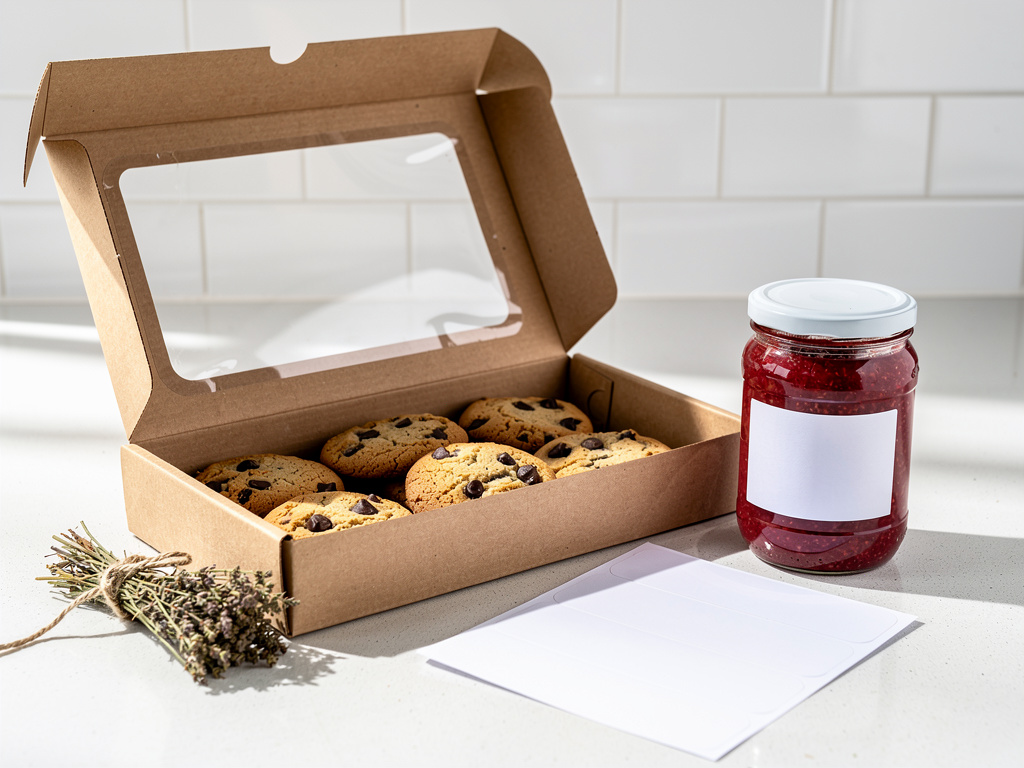


The short version: To start a cottage food business in Missouri, make sure your product is a baked good, a canned jam or jelly, or a dried herb or herb mix, register for a free Missouri retail sales license, label every package, and sell directly to customers who are in Missouri. There is no state food permit, no health department inspection before you start and no sales cap, but the sales license can take up to 10 business days to come through, and some cities, such as St. Joseph, also require a city business license. A starter kit of a business name filing, labels, bakery boxes and a kitchen scale came to $58.47 when we priced it on October 7, 2026, before ingredients. You can sell from home and online inside Missouri, but not to stores, not to resellers and not across state lines.
Checked on the Missouri Revisor of Statutes, DHSS's Home-Based Kitchen Food Production Guidance, the Department of Revenue's registration pages and the Secretary of State's fee schedule, October 7, 2026: RSMo 196.298 still shows the version in effect since August 28, 2022, HB 3108 (a 2026 bill to widen it) was never heard in committee, and Homegrown's prices come from its signup page that day, and Homegrown asks your customers to create an account before their first order and has no drops feature. This is general information, not legal advice, so verify the current rules with your city and county before you sell.
Once your sales license is in place, you can set up a Homegrown storefront so Missouri customers can order ahead, and try it free for 7 days.
Missouri keeps the food side of a home business simple. The state issues no food permit for it, no health department inspects your kitchen before you start, and there is no limit on how much you can earn. What trips new vendors up is the paperwork that sits outside the food law: a sales tax license from the Department of Revenue, a business license in some cities, and a name filing if you sell under anything other than your own name.
This guide walks through every step in order, with what each one costs and how long each one takes, from the state and city pages we read on October 7, 2026. For the full legal detail on which foods qualify and why, keep our Missouri cottage food law guide open next to this one.
You start a Missouri cottage food business in eight steps, and none of them is a state food permit application. The order matters, because the sales license takes the longest and a city business license usually needs it first.
Most of these steps take minutes. The two that take real time are the sales license, which runs on DOR's clock, and your recipes, which run on yours. Use the wait to test batches, weigh finished packages and print labels, so you can open orders as soon as your paperwork is done.
No, Missouri has no state cottage food license, permit or registration, so the state food fee is $0, but that is not the same as no paperwork. DHSS's guidance says it plainly: "There is no food permit or license for cottage food production operations, but products must meet the labeling requirements listed by law."
The law gets there in two moves. RSMo 196.298 says a home operation that makes these foods "is not a food service establishment" and is not subject to the state's health or food code laws other than that one section. It also says a local health department "shall not regulate the production of food" at a cottage food operation. That is why nobody comes to inspect your kitchen before you start.
The statute does not mention business licenses, zoning or sales tax, and it does not stop a city or the Department of Revenue from asking for them. So "no cottage food license" means no food permit. It does not mean no license of any kind.
You need a free retail sales license from the Department of Revenue, and depending on where you live and what you call your business, a city business license and a $7 name filing. Here is the paperwork a Missouri cottage food vendor is most likely to run into, and whether it applies to you:
Scroll sideways to see every column.
| Paperwork | Who issues it | Cost | Do you need it? | Where that comes from |
|---|---|---|---|---|
| Food permit or license | No one | $0 | No, for the three cottage food categories | DHSS guidance, questions and answers |
| Kitchen inspection | No one | $0 | No; local health departments may not regulate how you make the food | RSMo 196.298.3 |
| Retail sales license | Missouri Department of Revenue | $0 | Yes, before your first retail sale | DOR registration FAQ; RSMo 144.083 |
| Fictitious name registration | Missouri Secretary of State | $7, good for five years | Only with a business name that is not your legal name | Secretary of State fictitious name FAQ |
| City business license | Your city | Set by your city | Depends on your city; St. Joseph requires one | St. Joseph Health Department guidance, February 2024 |
| Fire inspection permit | Your city's fire marshal | Set by your city | St. Joseph says you may need one | St. Joseph Health Department guidance |
| Zoning (home occupation rules) | Your city | Set by your city | Springfield treats home food making as a home occupation and says to follow zoning | Springfield-Greene County Health Department |
| Food handler certificate | Some local agencies | Set by the course | No statewide certificate; St. Joseph requires no training for cottage food | DHSS food safety FAQ; St. Joseph guidance |
| LLC | Missouri Secretary of State | $50 online, $105 on paper | Optional | Secretary of State fee schedule |
We read each source on October 7, 2026: DHSS's Home-Based Kitchen Food Production Guidance and food safety FAQ, the statute on the Missouri Revisor of Statutes site, the Department of Revenue's registration FAQ and RSMo 144.083, the Secretary of State's fictitious name FAQ and fee schedule, and the St. Joseph and Springfield health department pages.
Missouri also has a second path, for sales from a stand only, that covers other low-risk foods such as honey, fruit butters and dry soup mixes. It sits in the Missouri Food Code and only applies where your local code allows it, so ask your health department before you count on it. Our guide to Missouri's cottage food rules compares the two paths side by side.
You register with the Missouri Department of Revenue before your first sale, the license costs $0, and DOR's FAQ says processing takes 10 business days. The same FAQ says "Taxpayers are required to have a Missouri retail sales license prior to making sales," and RSMo 144.083 says the license is issued "at no cost to the licensee."
Farmers markets count. DOR's small business registration page lists craft shows and farmers markets as special events and says anyone selling goods to a final consumer there must register for retail sales tax using Missouri Tax Registration Application Form 2643.
What to know before you apply:
That last point is why the sales license comes first. Where a city requires a business license, RSMo 144.083 says it has to see your DOR license and "no tax due" statement before it issues or renews one. Our guide to sales tax at farmers markets covers how to track cash and card sales so the return is quick.
Only when the name on your labels differs from your legal name. Missouri's fictitious name law, RSMo 417.200, requires anyone doing business under a name that is not their "true name" to file a fictitious name registration with the Secretary of State. People often call this a DBA, short for "doing business as."
Here is how it works, from the Secretary of State's FAQ and fee schedule on October 7, 2026:
So if you sell as "Jane Smith," you file nothing. If your labels and storefront say "Your Town] Cookie Co.," you file the $7 registration and use that same name on your labels, your storefront and your bank account. Before you print 2,500 labels, search the name online and on the Secretary of State's business search, because the filing does not protect it. Our guide on [how to name a food business walks through picking one that is easy to find and say out loud.
If you form an LLC instead, the LLC's legal name is your business name, and the fictitious name filing only comes in if you sell under a different name.
You pay $0 to the state for food permits and $0 for the sales license, and the four starter supplies we priced on October 7, 2026 (a name filing, a label pack, a 10-pack of boxes and a scale) totaled $58.47. Ingredients come on top, and so does anything your city charges.
Swipe the table to see each cost.
| Cost | What we priced | Price | Required? |
|---|---|---|---|
| State food permit or license | None exists for cottage food | $0 | No |
| Retail sales license | Missouri Department of Revenue | $0 | Yes |
| Business name filing | Secretary of State fictitious name registration, five years | $7.00 | Only with a business name |
| Labels | Lavex 4" x 2" blank paper label sheets for laser printers, 2,500 labels (about 1 cent each) | $24.49 | You need labels; this pack is one choice |
| Bakery boxes | Baker's Lane 10" x 10" x 5" kraft window bakery box, 10-pack ($1.20 a box) | $11.99 | Packaging of some kind |
| Kitchen scale | Galaxy 10 lb. round digital portion control scale | $14.99 | A way to weigh packages for the net weight line |
| Starter kit total | Name filing, labels, boxes and scale | $58.47 | |
| LLC (optional) | Secretary of State articles of organization | $50 online, $105 on paper | No |
| Liability insurance (optional) | FLIP Pro general liability | $25.92 a month, or from $299 a year | Not required by the cottage food law |
| Online ordering (optional) | Homegrown storefront | $10 a month billed annually, or $12.50 billed monthly, plus 2.9% + $0.30 per order | No |
| City business license | Your city | Varies | Depends on your city |
Supply prices from WebstaurantStore product pages, insurance from FLIP's home page, fees from the Missouri Secretary of State and Department of Revenue, and Homegrown's price from its signup page, all checked October 7, 2026, before shipping and sales tax. The 10" x 10" box fits nine 3-inch cookies per layer, so a dozen sits in two layers.
A few notes on the numbers. The box and label for one dozen cookies come to about $1.21, which belongs in your price along with flour, butter and chocolate. If you sell under your own name, drop the $7 and the kit is $51.47. If you add an LLC filed online, the kit plus the LLC is $108.47.
Weigh five finished boxes before you print a single label. If they vary, print a net weight no higher than the lightest one, so no customer ever gets less than the label says. A $14.99 scale and ten minutes on day one save you from reprinting 2,500 labels later.
Plan on about 14 days from your first phone call to your first legal sale, because the retail sales license takes up to 10 business days to process. Nothing on the food side makes you wait: there is no application, no inspection and no class to schedule.
A realistic timeline:
Your city's timing is the one number this guide cannot give you. St. Joseph, for example, requires a city business license and may require a fire inspection permit, so ask your city hall how long each takes when you call on day one.
You can sell three kinds of food and nothing else under Missouri's cottage food law: baked goods, canned jams or jellies, and dried herbs or herb mixes. The statute defines baked goods as cookies, cakes, breads, danish, donuts, pastries, pies "and other items that are prepared by baking the item in an oven," as long as they are not potentially hazardous, meaning they do not need a fridge to stay safe.
Baked goods are also the biggest category on Homegrown. In our October 7, 2026 pull of the Homegrown catalog, 1,471 of the 2,901 products sat in the Bakery category their vendors chose, so most of what you will see when you look for pricing ideas is bread, cookies and cakes.
DHSS's guidance lists these foods as not allowed under the cottage food law, and ends the list with "And more":
DHSS also leaves out "No Sugar Added," "Sugar Free" and hot pepper jams and jellies, and says meringue and cream pies need an inspected kitchen. The St. Joseph and Springfield health departments both add pumpkin pies, meringue pies and cream cheese frosting or filling to their not-allowed lists. If your best product is a carrot cake with cream cheese frosting, ask your local agency before you list it.
The full list, with every exception and where it comes from, lives in our complete Missouri food list, and our cottage food labeling guide covers how to word each label.
You usually need an inspected kitchen once your product falls outside the three categories, unless your local agency allows it under the Food Code stand exemption described above, and you always need one to sell to stores. DHSS's guidance says foods outside the cottage food law "may have to be produced in an approved commercial kitchen and are subject to routine inspection" by your local public health agency. Salsa, pickles and BBQ sauce go further: DHSS says the vendor must submit the recipe and process to a process authority, may need a better process control school, and must test the pH of every batch and keep records. Selling to a store or restaurant moves you under the DHSS Manufactured Food program, which Springfield's page says does not allow food made in a home. Meat needs a USDA or Missouri Department of Agriculture inspection mark, pet treats go through the Department of Agriculture, and eggs sold straight to customers fall under your local health agency, with a Department of Agriculture egg license needed to package them.
Start a Missouri cottage bakery with two or three shelf-stable products you can bake well every week, priced from what similar listings actually charge. Baked goods are the widest of the three categories, and the same steps above apply to a home bakery: no food permit, a free sales license, labels, and in-state customers only.
How to pick your first menu:
In a pull of the Homegrown catalog on October 7, 2026 (2,901 products from 310 vendors in many states), 35 listings from 32 vendors offered a dozen chocolate chip cookies, at prices from $10 to $50 and a median of $24. We counted a listing or a size option when it was one dozen full-size cookies, large bakery-style ones included, and plain chocolate chip or chocolate chunk was the cookie, or one of the flavor choices at that price; brown butter, sourdough, gluten-free and vegan versions counted. We searched names, descriptions and size options, then read every other product those 32 vendors list, and left out minis, assorted boxes and cookies with a second main flavor such as pumpkin, oatmeal or pecan. These are asking prices, not sales.
Asking price for a dozen chocolate chip cookies, 35 Homegrown listings
Source: Homegrown catalog pull, October 7, 2026, 35 listings from 32 vendors in many states. Asking prices, not sales.
Of the 35 listings, 18 sat between $15 and $25. Six of the 11 listings above $25 named a reason in the title: sourdough, organic, gluten-free or a large bakery-style cookie. If you are new, a price near the middle with a clear reason to pick you (a family recipe, a bigger cookie, a weekly flavor) is easier to defend than the cheapest dozen in town.
Every Missouri cottage food label needs your name, your address and a statement that the food was not inspected. Those three come from the statute itself, which says the label "shall include the name and address of the cottage food production operation and a statement that the food is not inspected by the department or local health department."
DHSS's guidance asks for six things in all, and says the label "must be legible to the consumer":
Wording differs by agency. Springfield-Greene County's page asks for a statement naming its own health department, and St. Joseph's names the state health department. A sentence that names both DHSS and your local health department covers the statute's own words.
A sample for a box of cookies might read: *"Brown Butter Chocolate Chip Cookies, one dozen. Your Name], [Street Address, City, MO ZIP]. Ingredients [listed heaviest first; weigh your own recipe to set the order]: chocolate chips (list the ingredients exactly as printed on your chocolate chip bag), flour, butter, brown sugar, eggs, vanilla, baking soda, salt. Contains: wheat, milk, eggs [plus any allergen your chocolate chip bag lists]. Net wt. 20 oz (567 g). This product was prepared in a home kitchen that is not inspected by the Missouri Department of Health and Senior Services or the local health department."* Check the allergen line against every ingredient you use, including the fine print on store-bought chips and sprinkles. At $24.49 for 2,500 labels, a printed label like this costs about a penny. Our [cottage food labeling guide has more templates.
You can sell directly to the person who will eat the food, from your home and online, as long as you and every buyer are in Missouri. The statute covers food made "for sale at the individual's home" and sold "only directly to consumers," and since 2022 it allows internet sales only when "both the cottage food production operation and the purchaser are located in this state."
Where you can sell:
Where you cannot sell:
Mail is the gray area. The statute only says you and the buyer must both be in Missouri, while St. Joseph's health department says "No delivery via mail is allowed." Plan on pickup and hand delivery until your own health department says otherwise, and read our guide on whether you can ship cottage food before you buy mailers. For market day paperwork, see our Missouri farmers market vendor permit guide.
If you bake in Kansas City or St. Louis, the state line is close. A delivery radius of 10 miles from downtown in either city reaches into Kansas or Illinois, and a sale to a buyer there is an out-of-state sale. If even 1 of your 30 orders a month is delivered to an address on the Kansas or Illinois side, that order crosses the state line and breaks the in-state rule. Keep your delivery area on the Missouri side, and check the address on every order before you drive.
Missouri's 2022 change made online ordering legal for cottage food, so the fastest way to fill your first two weeks of orders is one link that Missouri customers can order and pay from, instead of a pile of text threads. Taking orders through Facebook or Instagram messages and a payment app works for the first few, but the tracking gets hard fast: who paid, who wants which flavor, and which pickup day.
Homegrown is $10 per month billed annually (or $12.50 billed monthly), with no percentage fees beyond standard payment processing of 2.9% + $0.30 per order, which the vendor pays. New stores get a 7-day trial with no charge until day 8. For a Missouri cottage bakery, the parts that matter are:
Here is how it compares with two other ordering tools, on a $24 dozen (the median price in our catalog pull) and a month of 30 orders:
Swipe to see all four options.
| Option | Monthly plan | Trial | Platform or service fee | Card processing | Customer pays on a $24 order | Vendor pays on a $24 order | Vendor pays in a month of 30 orders at $24 |
|---|---|---|---|---|---|---|---|
| Homegrown | $10 billed annually ($12.50 billed monthly) | 7 days, no charge until day 8 | None (0% commission) | 2.9% + $0.30 (vendor pays) | $24.00 | $1.00 plus the plan | $39.88 ($42.38 on monthly billing) |
| Hotplate, default | $0 | No plan, so no trial | 5% + $0.55, charged to the customer | 2.9% + $0.30 (vendor pays) | $25.75 | $1.05 | $31.40 |
| Hotplate, vendor covers the fee | $0 | No plan, so no trial | 5% + $0.55, covered by the vendor | 2.9% + $0.30 (vendor pays) | $24.00 | $2.75 | $82.38 |
| Square Online, Free plan | $0 (Plus is $49 a month per location) | No plan cost, so no trial | None | 3.3% + 30¢ online | $24.00 | $1.09 | $32.76 |
We checked these on each company's own page on October 7, 2026: Homegrown's signup page, Hotplate's pricing page and its post "What Hotplate does" (which says "we charge a fee to your customer" by default and that 80% of chefs keep the default), and Square's online store plans page. Per-order figures are rounded to the cent; monthly totals use the unrounded amounts. Sales tax and delivery fees are left out of every row.
The fair read: on fees alone, Hotplate's default ($31.40, all of it the vendor's 2.9% + $0.30 card processing, taken on the customer's $25.75 total) and Square's Free plan ($32.76, all of it 3.3% + 30¢ online processing) cost the vendor less than Homegrown ($39.88, the $10 plan plus 2.9% + $0.30 processing) at 30 orders a month. Hotplate gets there by adding $1.75 to each customer's $24 order, $52.50 across the month, and every Hotplate order is placed through a "drop," a pre-order window that opens and closes at set times. Square's Free plan has no monthly cost but charges 3.3% + 30¢ on online card payments, and you set up and run the site yourself.
What Homegrown does not do:
If that fits how you plan to sell, set up your Missouri storefront a few days before your sales license is due, so nothing is left to build once DOR's approval comes through. Start it on day one and the 7-day trial runs out before a 10-business-day wait does.
Missouri puts no cap on what you earn from cottage food, so your income is set by demand and by how much you can bake. HB 1697 removed the state's old $50,000 yearly cap on August 28, 2022, and DHSS's guidance now says "There is no longer a limit to how much a cottage food producer can make annually." Your real limits are your oven, your weekends and the number of Missouri customers you can reach.
A simple way to size it: 30 dozen cookies a month at the $24 median is $720 a month in sales before ingredients, packaging, fees and taxes. Double the orders and you double the baking, so the next limit is time, not the law.
Ways to get the most out of a no-cap state:
Some local pages are behind the law. On October 7, 2026, the Lincoln County Health Department's cottage food page still said "Cottage food operations can sell up to $50,000 of products per year." That cap ended in 2022. The statute controls, but call your county anyway so you know how it reads its own page.
You do not need an LLC to start a cottage food business in Missouri, but you do need to handle two kinds of tax: sales tax through your DOR license, and income tax on your profit. The simplest setup is a sole proprietorship, which means you and the business are the same person for tax purposes and there is nothing to file with the state to form it.
The choices, with the Secretary of State's fees from October 7, 2026:
For the LLC question in more depth, read whether you need an LLC to sell food from home. If your city requires a business license, our guide to whether you need a business license to sell food from home covers what to ask at city hall.
Neither is required statewide for a Missouri cottage food business, but both are worth a look before you sell to strangers. DHSS's food safety FAQ says "There currently is no statewide food handler certification," and adds that some city or county agencies require one for the food establishments they inspect. St. Joseph's guidance, answering whether you need a food handler's license or training, says neither Missouri nor the city requires cottage food producers to have training, though the city does require a business license.
Training still helps you avoid the mistakes that cause complaints. DHSS's guidance names nine major allergens (milk, egg, fish, crustacean shellfish, tree nuts, peanuts, wheat, soybeans and sesame) and warns about allergen cross contact, which is when a food picks up an allergen from shared tools that were not properly washed, rinsed and sanitized. If you bake with peanuts and also sell a peanut-free cookie, that is the risk to plan around.
Insurance is a business choice, not a cottage food rule. Nothing in RSMo 196.298 requires it. On October 7, 2026, FLIP, a food liability insurance program, listed its FLIP Pro general liability plan at $25.92 a month, or an annual option from $299 a year. Some farmers markets ask vendors for proof of insurance, so ask your market manager before you apply. Our guide to cottage food business insurance explains what a policy covers.
Also remember that DHSS and your local health department keep a record of complaints about cottage food operations, and the statute still lets them investigate a foodborne illness or outbreak. No inspection before you start does not mean no one can ever look.
The nine mistakes below come from three places: what you sell, where it goes, and paperwork that sits outside the food law. The sales license one carries a penalty that starts at $500:
Not a food license. DHSS's guidance says "There is no food permit or license for cottage food production operations," and RSMo 196.298 bars local health departments from regulating how you make the food. You still need a free Missouri retail sales license before your first sale, and some cities, such as St. Joseph, require a city business license.
There is no cottage food license in Missouri, so it costs $0. The Department of Revenue's retail sales license is also $0 under RSMo 144.083. A business name filing with the Secretary of State is $7 when your business name differs from your legal name, and city business license fees vary by city.
When we priced a starter kit on October 7, 2026, a $7 name filing, 2,500 printable labels, a 10-pack of bakery boxes and a kitchen scale came to $58.47 before ingredients. State food fees are $0. Optional costs include an LLC ($50 online), liability insurance and an online storefront at $10 a month billed annually.
There is no sales cap. HB 1697 removed Missouri's old $50,000 limit effective August 28, 2022, so you can sell as much as demand and your kitchen allow, within the three allowed categories. As an example, 30 dozen cookies a month at $24 is $720 in monthly sales before costs.
Only three categories: baked goods, canned jams and jellies, and dried herbs and herb mixes. DHSS leaves out sugar-free, no-sugar-added and hot pepper jams and anything that needs refrigeration, such as cream pies, and the St. Joseph and Springfield health departments also list cream cheese frosting and pumpkin pie as not allowed.
Yes, when both you and the buyer are in Missouri, which RSMo 196.298.5 has allowed since 2022. Plan on pickup or hand delivery, because St. Joseph's health department says mail delivery is not allowed and the statute does not settle it. Selling to someone in another state, or to a store, is not allowed.
Plan on about two weeks. There is no food permit to wait for, but the Department of Revenue says a retail sales license takes 10 business days to process, and you need it before your first sale. A city business license, where your city requires one, comes after that.
No. You can start as a sole proprietor with nothing to file with the state, and an LLC is optional. If you want one, the Secretary of State's fee is $50 to file online or $105 on paper, and it mainly separates business claims from your personal assets.
Six Homegrown guides pick up where single steps on this page leave off. Start with the Missouri cottage food law guide if you are still deciding what to bake, then use the rest when you get to markets, labels, pricing and shipping:
Missouri asks very little of a home baker on the food side: no permit, no inspection and no cap, as long as you stick to baked goods, jam and jelly, and dried herbs, and label every package. The paperwork that does exist is quick and mostly free: a $0 retail sales license, a $7 name filing if you use a business name, and whatever your city asks for. Make your two calls and send your DOR application on day one, use the 10 business days to perfect two or three products, and open orders when the sales license, and any city license you need, comes in. When you are ready to take Missouri orders with pickup times and local delivery, set up a Homegrown storefront, compare platforms in our guide to the best platform to sell food from home, and check the rules next door in Kansas, Iowa, Arkansas and Illinois.
*This guide is general information, not legal advice. Cottage food rules change, so verify your state's current rules in DHSS's Home-Based Kitchen Food Production Guidance and with your local public health agency before you sell. Last checked: October 7, 2026.*
Selling at farmers markets? See our Missouri farmers market vendor permit guide for the permits you need on market day.



