
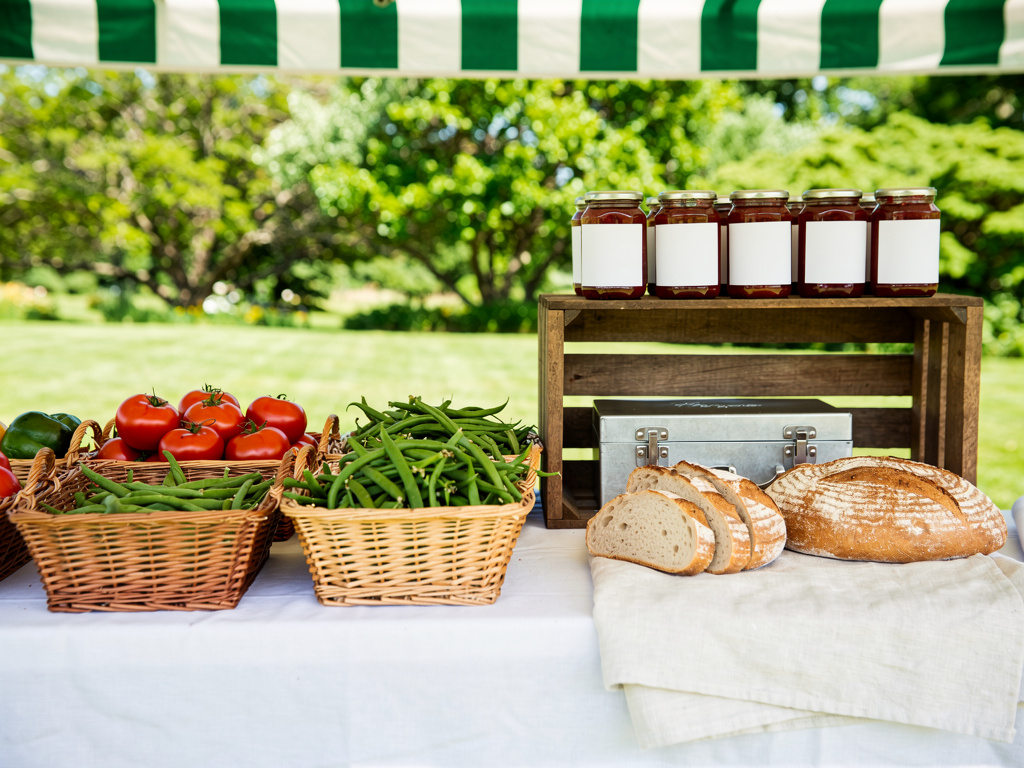


The short version: Missouri leaves farmers market permits to city and county health departments, and a home baker selling cookies, bread, fruit pies, canned jams or dried herbs needs no state food permit. Six of the seven local agencies we read also ask for no health permit for those foods at a market (in Kansas City, only when they are packaged and you hand out no samples), while Kansas City, Springfield, Columbia and both St. Louis agencies require local permits for some other market foods, such as samples, cooked food, eggs or meat. Most vendors also need a Missouri retail sales license, which costs nothing, though farm products you grow and sell at a farmers market are exempt from sales tax if your estimated market sales for the year are below $25,000. Call the health agency for the county where your market meets, and city hall about a business license, before your first market day.
Checked on the Missouri Revisor of Statutes (RSMo 196.298, 144.527 and 150.030), the Missouri Department of Health and Senior Services (DHSS) farmers market brochure and home kitchen guidance, the Department of Revenue's farmers market tax pages and seven city and county health department pages, October 7, 2026: rules vary by county, so verify your local agency's current rules before you sell. Homegrown customers create an account to place their first order, and Homegrown has no drops feature. This is general information, not legal advice.
If you want market regulars to order between market days, you can set up a Homegrown storefront and try it free for 7 days.
Missouri is easy on home bakers and strict on almost everything else. A loaf of bread or a jar of strawberry jam can go from your kitchen to a market table without any food permit from the state. A dozen eggs, a pound of sausage or a cup of salsa cannot. Eggs need a state egg license, meat needs a USDA or state mark of inspection, and salsa needs an inspected kitchen or a permit from the local health agency.
This guide covers what a small, part-time vendor actually needs at a Missouri farmers market: which foods need no permit, which ones do, what seven city and county health departments require and charge, the business license question, sales tax, samples and where to apply. For the full home kitchen rules (labels, online sales, the foods left out), read our Missouri cottage food law guide alongside this one.
In 6 of the 7 local agencies we read, no health permit is needed for baked treats, canned jams and jellies, or dried herbs (in Kansas City, only when they are packaged and you offer no samples), as long as you make them in your own home kitchen, label them and sell them yourself. The state needs no permit for them either, but DHSS ties market stands to a Food Code exemption that applies only where your local agency allows it, so the county or city where the market meets has the final say. Almost everything else needs a local health permit, a state license, or an inspected kitchen.
Here is how each common market product is treated across the state, before any local rules.
Scroll sideways to see every column.
| What you sell | Which rule covers it | What you need | Source |
|---|---|---|---|
| Cookies, breads, cakes, fruit pies (no cream cheese frosting, meringue or cream filling) | Cottage food law | No state food permit; a label with the not-inspected statement | RSMo 196.298; DHSS guidance (meringue and cream pies); St. Joseph guidance (cream cheese frosting) |
| Canned jams and jellies (not sugar-free, no-sugar-added or hot pepper) | Cottage food law | Nothing from the state beyond a label | RSMo 196.298; DHSS guidance |
| Dried herbs and herb mixes | Cottage food law | A label only | RSMo 196.298 |
| Fruit butters, sorghum, cracked nuts, packaged spices, dry soup or cookie mixes | Food Code stand exemption, only where your local agency allows it | A label and a sign at the booth (the Food Code requires the sign when you sell or sample unpackaged portions; DHSS's guidance lists it for every exempt stand) | Missouri Food Code; DHSS guidance |
| Whole, uncut fruits and vegetables, in-shell nuts, fresh herbs, pure honey packed on your own farm | Raw agricultural commodity | No health inspection | DHSS guidance |
| Shell eggs | Missouri egg law | A Missouri Department of Agriculture egg license ($25 a year), plus whatever the local health agency asks, since DHSS treats egg sellers as food establishments it inspects | 2 CSR 90-36.015; DHSS guidance and brochure |
| Beef, pork and other meats | Meat inspection | A USDA or Missouri Department of Agriculture mark of inspection on every package | DHSS guidance and brochure |
| Salsa, pickles, BBQ sauce | Acidified and low-acid canned foods | An inspected kitchen, a process authority review (an outside food safety expert checks your recipe and process) and Better Process Control School (a canning safety course for people who make acidified or low-acid canned foods) | DHSS guidance and brochure |
| Sauerkraut, kimchi, kombucha | Fermented foods | An inspected kitchen and special approval for the fermenting process before you sell | DHSS guidance and brochure |
| Food cooked or portioned at the market, samples of food that needs a fridge, and any sample in Kansas City or where the local agency does not allow the stand exemption | Local food code | A local permit from the health department where the market meets | DHSS guidance; local agencies |
Built from RSMo 196.298, the Missouri Food Code's "food establishment" definition, DHSS's Home-Based Kitchen Food Production Guidance and its farmers market brochure for food vendors, and Missouri Department of Agriculture rule 2 CSR 90-36.015, all read October 7, 2026.
The table is the floor. Your local health department can ask for more on anything outside the cottage food law, so the last step for every product is a phone call to the agency that covers your market's county.
Missouri's cottage food law lets you sell 3 kinds of home-made food with no food permit from the state and no sales cap: "a baked good, a canned jam or jelly, or a dried herb or herb mix." The law is RSMo 196.298, and its old $50,000 cap ended on August 28, 2022, when House Bill 1697 took effect. That is the permissive part.
The narrow part is the list. Candy, salsa, pickles, dog treats and anything that needs a fridge fall outside it. DHSS's guidance says these three categories are the only foods the law covers, and it lists cut produce, freeze-dried foods, sauces, meats, dairy and eggs as foods that cannot be sold under it. Freeze-dried candy has a second path: the same guidance says freeze-dried, non-potentially hazardous foods such as candy "may fall under the exemption in the Missouri Food Code, but that is only where local laws allow," and Springfield-Greene County lists freeze-dried candy as allowed.
The statute says a cottage food operation "is not a food service establishment" and that "A local health department shall not regulate the production of food at a cottage food production operation." You can read the whole section on the Missouri Revisor of Statutes, which still showed the version effective August 28, 2022 when we checked on October 7, 2026.
Three rules from the law follow you to the market:
One detail matters at a market. The statute defines a cottage food operation as one that makes food "for sale at the individual's home." DHSS's guidance answers the market question through a second rule, the Food Code exemption for individual stands, which applies "if local laws allow." In practice, six of the seven city and county pages in this guide either allow home-made, shelf-stable foods at markets without a health permit or list markets as a place to sell them (see the table further down). Our walkthrough on how to start a cottage food business in Missouri covers the setup steps before market day.
3 groups of food can go to a Missouri market without a health permit: the cottage food list, the longer Food Code stand list in areas whose health agency allows it, and raw farm products in their natural state. Everything outside those groups needs a permit, a license or an inspected kitchen.
Group 1, the cottage food law. Baked goods, canned jams and jellies, and dried herbs or herb mixes. City health departments give examples: St. Joseph names 7 products as allowed, namely cookies, brownies, cakes, cupcakes, breads, muffins and fruit pies such as apple, cherry and berry. St. Joseph also lists pumpkin pies, meringue pies and cream cheese frosting or filling as not allowed.
Group 2, the Food Code stand exemption. The Missouri Food Code's definition of a food establishment leaves out, "where local codes allow, individual stands" selling non-potentially hazardous processed food. Its list includes:
The seller must be the person who made the food or an immediate family member living in the household. A food counts as non-potentially hazardous when its water activity is 0.85 or less, or its pH is 4.6 or below at 75 degrees Fahrenheit, and DHSS has the final say on which foods qualify.
Group 3, raw agricultural commodities. DHSS's guidance lists whole, uncut fruits and vegetables, in-shell nuts, fresh herbs, grains, saps and honey. It says "the only cut that can be done is the harvest cut." A halved melon or a bag of chopped kale is processing and needs inspection.
The Food Code exemption asks for a sign at your booth whenever loose, unwrapped portions are sold or sampled: a "clearly visible placard" saying the food was made in a kitchen not subject to inspection by the department. DHSS's home kitchen guidance goes further and lists the placard as a requirement for every stand using the exemption, so post it at every market. A tray of loose cookies with no sign can cost you the exemption, even when every bagged cookie on the table is labeled.
At least 8 kinds of market food need a license, an inspection or a local permit in Missouri: eggs, meat, dairy, canned and fermented foods, sprouts, wild mushrooms and anything cooked at the market. DHSS's farmers market brochure for food vendors lists most of them under the heading "Foods that require inspection or licensing," and its home kitchen guidance covers the rest.
Pet treats are a separate track. DHSS's guidance says the state's agriculture department regulates pet foods and treats, so contact it before you put dog biscuits on the table.
You need a county or city permit when your food falls outside the three groups above, when you sample or portion food that needs temperature control, or when you cook at the market. The permit comes from the health agency covering the place where the market meets, not where you live. DHSS's local public health agency finder lists all 115 agencies.
DHSS's guidance says foods outside the cottage food law "may have to be produced in an approved commercial kitchen and are subject to routine inspection by the LPHA" (LPHA is the department's short name for a local public health agency). Its list of foods and activities that need inspection by the LPHA includes:
Lead times differ by agency. Springfield and St. Louis County want your application 10 days before you sell, Columbia/Boone County wants 14 days for a temporary food permit, and Kansas City's permit page says to return the application at least 30 days before your opening date. The Missouri Food Code asks a new food establishment to apply 30 calendar days before opening, but its approval-to-open rule "does not apply to temporary food establishments," so the local agency's number is the one that counts.
Vendor market permits in the seven local agencies we read range from no fee to $144 for a single permit (the City of St. Louis charges a market's organizer $350 a year), and St. Louis County caps a vendor's fees for several markets at $193. Several only apply to vendors who sample, cook or sell foods that need a fridge. Here is what each page said on October 7, 2026.
Swipe left on a phone to see all five columns.
| Local agency | Market permit and fee | Who needs it | Home-made, shelf-stable foods | Apply ahead |
|---|---|---|---|---|
| Kansas City Health Department | Farmers market vendor permit, valid January 1 to December 31; $119 in the fee schedule in city ordinance 220535 (2022) | Vendors selling prepackaged foods that need temperature control, or sampling | Not needed for whole, uncut produce or prepackaged non-potentially hazardous food with no samples | 30 days |
| City of St. Louis Department of Health | Farmers Market Food Permit, $100 a year per vendor ($350 for the organizer), plus the city's Temporary Food Safety Training Program, with a trained person at the booth the whole time food is handed out | Vendors selling potentially hazardous foods, per the city's temporary food permit definitions page | "City waivers are no longer required for cottage food" | Temporary permits: 2 business days, or a $10 expedite fee |
| St. Louis County Department of Public Health | Farmers Market Vendor permit, $50 for the first market and $30 for each more, up to $193; valid 120 days a year | Vendors not registering as Missouri farmers selling their own farm products; no cooking allowed | The forms we read do not say; call the county | 10 calendar days |
| Springfield-Greene County Health Department | Farmers' Market Permit, $144 prorated by month; Retail Vendor Permit, no fee | $144 permit: preparing samples or portions of potentially hazardous food; no-fee permit: eggs, meats or sprouts | Not needed under the cottage law | 10 days |
| Columbia/Boone County Public Health and Human Services | No market permit for exempt foods; occasional cooking needs a temporary food permit, $40 (1 to 3 days) or $70 (4 to 14 days); cooking every week needs a mobile food establishment permit, a commissary and a Columbia business license | Non-exempt processed foods need a health operating permit and a Columbia business license | No health permit and no Columbia business license, with a label and a booth sign | 14 days for temporary permits |
| City of St. Joseph Health Department | No health permit, inspection or training for cottage food | Every business needs a city business license; some need a fire inspection permit | Allowed at farmers markets, roadside stands and special events | Ask city hall |
| Lincoln County Health Department | None listed for cottage food | Not stated | Allowed at "farm markets, church bake sales, etc."; placard for unpackaged portions | Not stated |
Read October 7, 2026 on each agency's own page or form: Kansas City's farmers market permit FAQ and food permit page, St. Louis City's temporary food permits page and its permit definitions page, St. Louis County's farmers market vendor application and farmer registration forms, Springfield's Farmers Market Permits page, Columbia/Boone County's Guidelines for Farmers Markets and Guidelines for Temporary Food Facilities, St. Joseph's February 2024 Cottage Food Law Guidance, and Lincoln County's cottage food page. Kansas City's fee comes from the 2022 ordinance, the newest schedule we found; confirm it when you apply.
In Kansas City, Springfield and the City of St. Louis, the paid market permit is for vendors who sample or sell food that needs a fridge. And the agencies that write about home-made foods treat them the same way: label them, sell them yourself, and skip the health permit.
Lincoln County's cottage food page still said on October 7, 2026 that "Cottage food operations can sell up to $50,000 of products per year." The state removed that cap in 2022. When a county page and the statute disagree, the statute is the law, but call the county so you know how it reads its own page.
Only if your city requires a business license, because Missouri's state rules for cottage food do not. St. Joseph does require one, and Columbia does not for exempt home-made foods. The St. Joseph health department's February 2024 guidance says "The state of Missouri doesn't require any licensing," then adds "The City of St. Joseph requires a business license," and some vendors may also need a city fire inspection permit.
Columbia works the other way for home-made foods. Its farmers market guidelines list exempt foods that need neither a health permit nor a business license from the City of Columbia, and they require a Columbia business license only before you sell non-exempt processed foods.
Farmers get a state-level break. RSMo 150.030, titled "Farmer not merchant," says a Missouri farmer who grows or processes farm products on their own farm may sell them "free from license, fee or taxation from any county or municipality." Two limits apply, and neither one changes the $0 retail sales license most vendors still need from the state:
St. Louis County's farmer registration form repeats the point: farmers who grow or process farm products "are free from license, fee, or taxation," but their products still follow county rules. A home baker using store-bought flour is unlikely to count as a farmer selling farm products from their own farm, so ask your city clerk about a business license. Our guide on whether you need a business license for cottage food explains how to ask.
No state rule we read requires an LLC to sell at a Missouri farmers market. None of the statutes, DHSS pages or seven local agency pages in this guide mention one. An LLC is a choice about liability and taxes, not a permit.
Insurance comes up more often than an LLC. The Columbia Farmers Market, for example, requires every vendor to carry general liability insurance that covers "products-completed operations" and to send a certificate of insurance 30 days before their first market. Read your market's vendor rules before you buy anything. For the LLC question in depth, see whether you need an LLC to sell food from home, and for coverage, our farmers market vendor insurance guide.
Columbia Farmers Market asks for a $30 application fee, your permits and licenses, and a certificate of insurance 30 days before your first market. Have the insurance certificate in hand before you apply, at least 30 days before your first market, because the market's board review alone can take 2 to 4 weeks.
Farm products you grew are exempt from Missouri sales tax at a farmers market if you estimate your yearly market sales at less than $25,000; estimate $25,000 or more and none of them qualify, and most other products are taxable. RSMo 144.527 exempts "all sales of farm products sold at a farmers' market" from state and local sales tax, but its provisions "do not apply to any person or entity with estimated total annual sales of twenty-five thousand dollars or more from participating in farmers' markets."
"Farm products" in that law means fresh fruits, vegetables, mushrooms, nuts, shell eggs, honey, maple syrup, flowers, nursery stock, meat, milk, cheese and similar products, plus those products "processed by the participating farmer, including, but not limited to, baked goods made with farm products." The revenue department's tax matrix for farmers markets (revised March 28, 2025) shows where the line falls.
Swipe the table to read both columns on a phone.
| What you sell at a farmers market | Department of Revenue's answer (under $25,000 a year in market sales) |
|---|---|
| Fresh fruits and vegetables you grew | Exempt |
| Fresh fruits and vegetables you bought and resell | Taxable at the reduced food rate |
| Home baked goods made with farm products you grew and processed | Exempt |
| Baked goods you bought and resell | Taxable at the reduced food rate |
| Honey you made | Exempt |
| Meat from animals you raised | Exempt |
| Cooked foods for immediate consumption | Taxable |
| Candles, jewelry, wood crafts, knitted items | Taxable |
| Soap made from ingredients you grew / from store-bought ingredients | Exempt / Taxable |
| Everything, if your yearly market sales are expected to be $25,000 or more | Taxable |
From the Missouri Department of Revenue's Farmers Market Tax Matrix (issued March 27, 2023, revised March 28, 2025) and RSMo 144.527, both read October 7, 2026. The matrix says sales are taxable for anyone with yearly sales "in excess of $25,000," while the statute says "$25,000 or more"; plan on the statute's wording.
A cottage baker using store-bought ingredients falls on the taxable side. University of Missouri Extension's guide to the exemption says products "primarily made from purchased ingredients are not exempt from state and local sales tax." A loaf made from store-bought flour is taxable even at a market.
When you do owe tax, grocery-type food such as a loaf of bread or a jar of jam gets a lower state rate. Cooked food sold to eat right away does not. The Department of Revenue's sales tax page says qualifying food is taxed at "a reduced state tax rate of 1.225% plus any applicable local tax." On a $20 loaf, the state part is 24.5 cents before local tax. Our guide to sales tax at farmers markets covers how to collect and file.
Yes, register with the Missouri Department of Revenue before your first taxable sale; the retail sales license costs $0. The department's registration page says anyone selling products to a final consumer must collect Missouri sales tax and register using Form 2643, and it names "craft shows, farmers markets" as special events. RSMo 144.083 says the retail sales license is issued "at no cost to the licensee."
The license matters for city paperwork too. RSMo 144.083 makes a retail sales license and a "no tax due" statement from the department a condition for getting a city or county business license where you sell at retail. If St. Joseph or another city asks for a business license, get the state license first.
The department's FAQ on sales by farmers answers the farmer case directly. Asked whether sales made at farmers markets are taxable, it answers "No" for farm products, with the $25,000 limit. A grower selling only their own tomatoes under that limit may not need to collect tax at all; a baker using purchased flour almost always does. Read the Department of Revenue's farmers market FAQ before you decide.
Samples are often the point where a home baker first needs a health permit at a Missouri market. DHSS's guidance lists "sampling activities" among the operations that require inspection by your county or city health agency, and several cities charge for a permit to sample.
Samples of shelf-stable home foods, such as cookie bites or a taste of jam, can fall under the Food Code stand exemption, which covers exempt foods "sold, sampled or served" at a stand with a booth sign, where the local agency allows it. Kansas City draws a stricter line: its farmers market permit FAQ waives the permit only for vendors who offer no samples, so any vendor who samples there needs it.
DHSS's brochure sets the basics for anyone sampling: portion samples into cups or offer toothpicks, and keep sliced melons and tomatoes cold. Foods that need to stay cold must be held at or below 41 degrees Fahrenheit. Our farmers market sampling tips cover what to sample and how much to cut.
Yes: eggs need a $25 state egg license, meat needs a USDA or state inspection mark, and pure honey from your own hives needs neither.
Eggs. Missouri Department of Agriculture rule 2 CSR 90-36.015, effective November 30, 2024, requires a retailer's license "for any person selling eggs to a consumer" and lists a $25 retailer license for vendors who sell "at farmers markets or roadside stand." The department's form shows the 2027 license year runs July 1, 2026 to June 30, 2027. The rule exempts eggs from your own flock only when they are "not sold at an established place of business away from the premises," and DHSS's brochure says egg vendors at markets "must have the required license." DHSS's home kitchen guidance adds that operations selling eggs directly to consumers "are considered Food Establishments and are inspected by the local public health agency," so ask the agency where your market meets: Springfield issues a no-fee Retail Vendor Permit for eggs, while Columbia's guidelines list eggs among the foods that need no local health permit once you hold the state egg license. St. Louis County's farmer form asks for a copy of your egg license, and Columbia's guidelines say eggs must be held at no more than 45 degrees Fahrenheit at the market. The egg rule also says a "No Tax Due" letter from the Missouri Department of Revenue must come with the license application and be provided each year at renewal, and RSMo 144.083 makes a retail sales license a condition of any state license for a business that sells at retail, so register with the department first even if your eggs are tax-exempt. See whether you can sell homemade eggs for packing and pricing.
Meat. Every package needs a USDA or Missouri Department of Agriculture mark of inspection. Springfield also issues a no-fee Retail Vendor Permit for vendors selling eggs, meats or sprouts.
Honey. DHSS's guidance calls pure honey a raw agricultural commodity when you "harvest, filter and package" it on your own farm. Buying honey from another farm, adding flavors or sending it out to be packed makes you subject to inspection. The Food Code recommends adding "Honey is not recommended for infants less than twelve (12) months of age" to your label.
Jarred salsa needs an inspected kitchen and a process authority review, and salsa or lemonade mixed at the booth needs a permit from the local health department. Salsa is not on the cottage food list, and DHSS's guidance says jarred salsa, pickles and BBQ sauce need a process authority review and a pH test on every batch, and DHSS's farmers market brochure adds Better Process Control School.
Fresh salsa made at the booth is worse, not better. DHSS answers that exact question: a vendor making fresh salsa on site at a farmers market "is considered a food establishment and is subject to food safety regulations and inspection." Read whether you can sell homemade salsa for the inspected-kitchen path.
Lemonade and other drinks mixed at the market are local permit questions too. The City of St. Louis, for example, lists lemonade, popcorn and shaved ice under its Specialty Food Permit at $100 a year, and charges $50 per day per vendor for a traditional temporary food permit, up to 14 times a year. Kansas City's farmers market vendor permit does not allow cooking or food preparation beyond samples, so ask the city's health department which permit covers drinks mixed at the booth.
A sealed, labeled bottle made in an inspected kitchen is a packaged product, while a cup poured and mixed at the booth is food prepared on site. Ask the agency how it treats your setup before you buy a dispenser, because the answer decides which permit and fee apply.
Apply to the health department for the county or city where your market meets, and to the state only for eggs, meat and sales tax. Here is the order that keeps the paperwork from blocking your first market.
The DHSS farmers market page that older guides link to now returns a "page not found" error. The current version of DHSS's advice is its farmers market brochure, which tells vendors to check with the local public health agency where the market meets for additional requirements. The brochure carries a May 2017 date in its footer, so treat it as the baseline and the local agency as the final word.
Yes, in at least 4 ways: business licenses, zoning, market permits and the foods outside the cottage food law. The cottage food law only stops a local health department from regulating how you make cottage food in your own kitchen.
DHSS's guidance says that under Chapter 192 of Missouri law, local public health agencies "are granted the authority to adopt local food ordinances that are equal to or more stringent than current state regulations." Its farmers market brochure adds that some local agencies "have adopted regulations regarding retail food sales that may be more stringent than state requirements." Real examples from this guide:
The statewide farmers market vendor permit guide compares Missouri with other states, including neighbors Kansas and Illinois for vendors near Kansas City or St. Louis who sell across the state line.
A market permit gets you one morning a week with a line at your table. The question after that is how a regular who loved your bread on Saturday orders again on Wednesday. Homegrown answers that with a storefront where customers pre-order and pay, then pick up at your market booth, your porch or another spot you set. It costs $10 per month billed annually ($12.50 billed monthly), with no percentage fees beyond standard payment processing of 2.9% + $0.30, which you pay. A new store starts with a 7-day trial, with no charge until day 8.
What a Missouri market vendor gets for that:
Compare that with Square's card reader and with cash. Square's free plan charges 2.6% + 15¢ for in-person card payments and 3.3% + 30¢ online, and its Plus plan is $49 a month with 2.9% + 30¢ online. Cash costs nothing to accept, but it leaves you tracking pre-orders by text message.
Swipe left to see the fee columns.
| Option | Monthly plan | Trial | Platform fee | Card processing | Customer pays on a $20 order | Vendor pays on a $20 order | Vendor pays in a month of 50 orders at $20 |
|---|---|---|---|---|---|---|---|
| Homegrown, billed annually | $10 | 7 days, no charge until day 8 | None | 2.9% + $0.30, paid by the vendor | $20.00 | $0.88 plus the plan | $54.00 |
| Homegrown, billed monthly | $12.50 | 7 days, no charge until day 8 | None | 2.9% + $0.30, paid by the vendor | $20.00 | $0.88 plus the plan | $56.50 |
| Square Free, card tapped at the booth | $0 | None needed | None | 2.6% + 15¢ | $20.00 | $0.67 | $33.50 |
| Square Free, online order | $0 | None needed | None | 3.3% + 30¢ | $20.00 | $0.96 | $48.00 |
| Square Plus, online order | $49 | 30 days, free | None | 2.9% + 30¢ | $20.00 | $0.88 plus the plan | $93.00 |
Checked on findhomegrown.com/signup and Square's pricing page on October 7, 2026. Card processing is figured on the $20 price, before sales tax. Monthly plan prices are per location for Square.
Homegrown is not a card reader, so it does not take walk-up payments at your booth; Square's in-person rate is cheaper for that. Customers create a Homegrown account to place their first order. There is no drops or countdown release feature. Your storefront is listed on the Homegrown marketplace, but plan on most orders coming from people you send to your own link. If you already sell at a Missouri market, set up a Homegrown storefront and print its QR code for your next market sign.
The last change to the cottage food law took effect on August 28, 2022, when HB 1697 removed the old $50,000 cap and allowed in-state online sales. The Revisor's page still showed that 2022 version on October 7, 2026. HB 3108, a 2026 House bill titled "Modifies provisions relating to homemade food," would have widened what home cooks can sell, but the Missouri House's bill page shows its last action as "04/16/2026 - Public Hearing Scheduled, Bill not Heard (H)," and it was never heard in committee before the regular session ended at midnight on May 30, 2026, the end date the Missouri Constitution sets.
Smaller changes matter at the local level:
Check the cottage food statute at the start of each season; the page shows the effective date at the top.
In a pull of the Homegrown catalog on October 7, 2026, 1,471 of the 2,901 products listed by 310 vendors sat in the Bakery category their vendors chose, from 183 vendors. Baked goods are what Missouri's cottage food law is built for, though that category also holds products it leaves out, such as cakes with cream cheese frosting. Far fewer sat in categories that need a license or inspection in Missouri: 115 products from 16 vendors under Meat and Poultry, and 55 from 26 vendors under Eggs and Dairy. Counts are by the category each vendor picked, not by product names.
Six of the Homegrown catalog's 16 categories, and the Missouri rule that usually applies
Source: Homegrown public catalog pull, October 7, 2026, 2,901 products from 310 vendors in all states, counted by the category each vendor chose. The chart shows 6 of the 16 categories; Health and Wellness (137) and Plants and Flowers (107) are among those not shown. The rule in brackets is the usual Missouri path for that category; check each product.
Usually not for baked goods, canned jams and jellies or dried herbs: the state requires no permit for them, and 6 of the 7 health departments in our local table ask for no health permit at a market either (in Kansas City, only for packaged foods with no samples). You do need a permit or license for eggs, meat, canned or fermented foods, cooked food and, in many cities, samples. Missouri farmers market vendor permits come from the city or county health department where the market meets, so call that agency first.
Only three kinds of food: baked goods, canned jams or jellies, and dried herbs or herb mixes. DHSS leaves out sugar-free, no-sugar-added and hot pepper jams, along with anything that needs a fridge. Where your county allows it, the Food Code's exemption for individual stands adds fruit butters, sorghum, cracked nuts, packaged spices and dry mixes.
No. House Bill 1697 removed the old $50,000 yearly cap on August 28, 2022, and DHSS's guidance says "There is no longer a limit." Some county pages, such as Lincoln County's, still show the old cap, so go by the statute.
Yes, though not to how you make cottage food at home, which RSMo 196.298 keeps local health departments out of. Cities and counties can still require a business license (St. Joseph does), enforce zoning (Springfield does), charge for market permits and samples, and decide whether the Food Code stand exemption applies. DHSS says local agencies may adopt food rules "equal to or more stringent than" the state's.
Yes, if you make taxable sales, and the retail sales license costs nothing. Farm products you grow and sell at a farmers market are exempt as long as you expect under $25,000 a year in market sales. Baked products made mostly from store-bought ingredients are taxable, at a reduced state food rate of 1.225% plus local tax.
The state does not license cottage food, but some cities require a business license. St. Joseph asks every business for one, while Columbia does not require one for exempt home-made foods. Missouri farmers selling products they grew on their own farm are free from county and city license fees under RSMo 150.030, as long as they have no regular stand away from the farm. Ask your city whether it counts a weekly market booth as that kind of off-farm stand.
Yes, whole and uncut vegetables need no health inspection in Missouri, according to DHSS's guidance. Cutting, washing into salad mixes or slicing for samples turns them into processed food that needs a permit. Your market may still have its own rules, such as Columbia Farmers Market's rule that vendors sell only what they grow or make, within a 50-mile radius.
These 6 guides answer the questions Missouri market vendors usually ask next, once the permit question is settled. Each one is live on the Homegrown blog and was checked on October 7, 2026. Start with the cottage food law guide if you bake, and with the sales tax guide if you grow what you sell.
Missouri gives home bakers, jam vendors and herb growers a clear path: nothing to file with the state health department, no sales cap, and a label, plus a booth sign if you sell loose portions or rely on the Food Code stand exemption. Everything else at the market, from samples to salsa, runs through your city or county health department. Eggs need a state egg license from the Department of Agriculture, and every package of meat needs a mark of inspection from USDA or the state. Register for sales tax unless every product is a farm product you grew, your estimated yearly market sales are under $25,000 and you sell no eggs.
Once your paperwork is in order, the next job is turning one-time market buyers into weekly customers. Set up a Homegrown storefront for $10 per month billed annually, put its QR code on your booth sign, and let regulars pre-order for pickup at your next market.
*This guide is general information, not legal advice. Permit rules change and vary by local public health agency, so verify your state's current rules with Missouri DHSS and your local agency before selling. Last checked: October 7, 2026.*



