
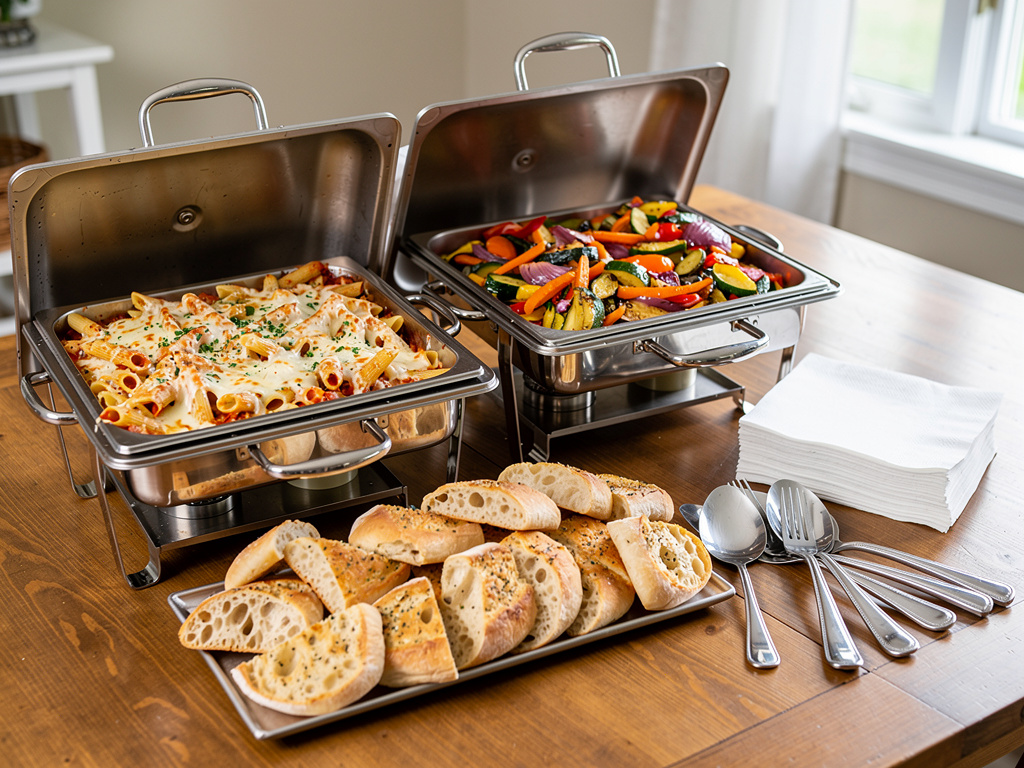


The short version: In all four states we checked, you cannot cater meat from your home kitchen, and in three of them hot meals, cheese and cut fruit are out too, because those foods have to be kept cold or hot and cottage food laws there cover foods that are safe at room temperature, like cookies and bread. Even California's and Utah's home kitchen laws, which do allow some home-cooked meals, say in the statute that they do not include a catering operation. The usual small, legal start is drop-off catering cooked in a shared commercial kitchen rented by the hour ($17 to $30 an hour at two kitchens we checked, plus a $125 quarterly membership at one of them), with a food protection manager certificate and a county caterer permit. With insurance, kitchen fees and basic gear, that start came to $1,816 to $2,194 using a Cleveland shared kitchen's fees and King County, Washington's permit fees, before food, kitchen hours, any business license and the county's $10 food worker license. If that is more than you want to spend yet, dessert and bread trays made under your state's cottage food law are the smaller first step.
Checked on September 28, 2026: California Health and Safety Code section 113825, Utah Code section 26B-7-401, the Washington and Texas cottage food pages, King County's and San Diego County's 2026 fee schedules, and the ServSafe, FLIP, WebstaurantStore and shared kitchen pricing pages. Rules and fees change by state and county, so verify your county health department's current rules before you book an event. On Homegrown, customers create an account to place their first order and pay the full price when they order; there is no deposit feature and no drops feature.
Search for how to start a catering business and the top guides quote $10,000 to $100,000, built around a van, a leased kitchen and a staff. Catering often starts much smaller: a friend asks you to "just do the food" for a baby shower, and then a coworker asks about the office lunch.
This guide is for that cook. It answers the question the big guides skip, which is whether you can legally cater from your home kitchen. Then it prices the smallest legal start, line by line, from named pages loaded on September 28, 2026. Where your state or county can change the answer, it says so and tells you who to ask.
For full catering, usually not: catering food mostly has to stay cold or hot, and in three of the four states we checked, the home kitchen laws either leave that food out or say they do not cover catering. Here is what four states' own laws and agency pages say, read on September 28, 2026:
So a tray of brownies for a shower may fit your state's cottage food rules, while a hot pan of chicken alfredo for 40 people is not home-kitchen food in any of those four states. If your menu can stay shelf-stable, the guide to starting a food business from home with no money walks through that cheaper route, and the cottage food laws by state list shows what your state allows.
A home kitchen meal permit is not a catering permit. It is easy to read California's MEHKO law as a way to cater from home, but section 113825(b)(1) of California's Health and Safety Code says a MEHKO does not include a catering operation, and Utah's law has the same line. We read both on September 28, 2026. Call your county health department and describe the event before you quote it.
The Texas Department of State Health Services cottage food page says a cottage food operation may sell food that needs time and temperature control if it registers with DSHS, keeps cold food at 41°F or below and hot food at 135°F or above, and labels it with the date it was made. Meat, poultry and seafood are still excluded, and cottage foods must be labeled and packaged, unless an item is too large or bulky to package. A buffet you set up and serve at a venue is a different thing from a labeled, packaged tray, so ask DSHS or your local health department before you plan one (checked September 28, 2026).
In the FDA Food Code, which the FDA calls "a model" for the retail food rules that state and local health departments adopt, a "catering operation" that provides food directly to a consumer is a food establishment, the same category as a restaurant. That is why a caterer needs a permit and an inspected kitchen even when the business has no dining room.
What turns a dish into a permit question is whether it needs time and temperature control for safety. Food Code section 3-501.16 says those foods must be held at 135°F or above, or at 41°F or below. Most catering menus are full of them:
Three questions usually decide which rules you fall under:
Food Code sections 3-501.16 and 3-501.19 set the limits: 135°F or above, 41°F or below, or up to 4 hours out of temperature control (6 hours for some cold food that stays at 70°F or below) under written procedures. Write your answers to the three questions down before you call the health department. It turns a vague "can I cater?" into a question the inspector can answer in one call.
A part-time cook can get into catering three realistic ways, and they differ by what you can serve and by a first bill that runs from a state cottage food fee to about $2,194. Start with the first or second and add the third once events are steady.
Scroll sideways to see every column.
| Path | What you can serve | Where you cook | What you need | Cost to start at our numbers | Good for |
|---|---|---|---|---|---|
| Cottage food event trays | Cookies, brownies, bread, focaccia, snack mix and other foods on your state's cottage food list | Your home kitchen | Your state's cottage food permit or registration, if it has one (Washington: $355 for two years) | Your state's fee, any business license and food worker card it requires, plus boxes and labels | Showers, dessert tables, office treats |
| Drop-off catering from a shared kitchen | Hot and cold dishes delivered and set up in disposable pans, no staff serving | A shared commercial kitchen rented by the hour | County caterer permit, food protection manager certificate, kitchen agreement, liability insurance | $1,816 to $2,194 to start, before food and kitchen hours, then $125 a quarter for the kitchen membership | Office lunches, family parties, team dinners |
| Full-service catering | Buffets and plated meals with you and helpers serving at the venue | A rented or owned commercial kitchen | Everything above, often a higher permit tier, food handler cards for helpers, and the venue's insurance rules | More than drop-off: helpers, rentals and a vehicle that fits the gear | Weddings and events over a few dozen guests |
The drop-off figure adds a $179 food protection manager course and exam, $299 a year of liability insurance, $340 of Cleveland kitchen fees (a $75 application, a $140 security deposit and the first $125 quarterly membership), $431.24 of gear and King County's 2026 caterer permit ($567 to $945 by risk level). All prices were loaded on September 28, 2026.
Under a typical cottage food law you can sell event food that is safe at room temperature, made in your home kitchen and sold straight to the customer. That rules out most of a dinner menu, but it covers a surprising amount of party food:
Real Homegrown vendors already list party-size, room-temperature trays. Bake Pure Co lists a bite-size dessert party tray from 4 to 96 pieces ($4.50 to $122), and Honey Buns Bakehouse lists a 9 by 13 inch sourdough focaccia that "serves 8-12" for $20, both in the September 28, 2026 catalog pull.
The party foods people ask for most are often the ones cottage food rules leave out. Washington's list of foods that are not allowed includes cakes or pastries with cream or cream cheese fillings, fresh fruit fillings or garnishes, and frostings with low sugar content, cream or uncooked eggs. Meat and cheese boards and cut fruit trays need refrigeration too. Our guide to selling charcuterie boards from home covers what those boards take in most states.
Where and how you may sell also varies. Washington's page says the sale must be made person-to-person between you and the customer, and it lists internet and mail sales as prohibited. Read your own state's rules on delivery and events before you promise a drop-off.
A drop-off caterer usually needs five things before the first paid event: a registered business, a food protection manager certificate, liability insurance, a signed kitchen agreement and a county caterer permit. Do them in this order, so the kitchen has your policy on file and the permit application has a kitchen and a certificate to point to.
Two extras depend on the job. Helpers who handle food may need food handler cards; in Washington, food worker cards come through your local county health department. Alcohol is usually a separate license from a separate state agency, so leave the bar to the venue or a licensed bartender until you have looked into it.
For the business side, the guide to general liability insurance for home food vendors explains what a liability policy covers and what it leaves out.
A county caterer permit costs hundreds of dollars a year, and the number depends on your county and how complex your menu is. Two county fee schedules we loaded on September 28, 2026 show the range:
Scroll the table sideways for the fees and what sets them.
| Permit | Where | Annual fee | What sets the price |
|---|---|---|---|
| Caterer, Risk 1 | King County, Washington | $567 | Simplest menus |
| Caterer, Risk 2 | King County, Washington | $756 | Middle tier of food complexity |
| Caterer, Risk 3 | King County, Washington | $945 | Most complex menus |
| Full Service Catering Facility and Direct Sales Catering | San Diego County, California | $715 | One annual fee for the permit type |
| Cottage food permit (for comparison) | Washington State Department of Agriculture | $355 for two years | Room-temperature foods only |
From the King County 2026 food program fee schedule, which says fees are "based on the type of business, as well as the complexity of the food being served," and the San Diego County food facility permit fees page, both checked September 28, 2026. Your county may also charge a plan review or first inspection fee.
King County ties the tier to how complex the food is, so a hot entrée menu that is cooked, cooled and reheated is likely to land higher than cold sandwiches and baked desserts. Ask your county which tier your menu falls in before you apply, because trimming one dish may drop the fee by a tier. In King County, the gap between Risk 1 and Risk 3 is $378 a year.
You rent commercial kitchen time the way you would book a studio: apply, show your insurance and certificate, then reserve hours on a calendar. Shared kitchens (also called commissary kitchens) rent stations to caterers, bakers and food trucks. Two we checked charge $17 to $30 an hour, with no monthly plan (Cleveland adds a $140 security deposit and a $125 quarterly membership; Unicoi's listing shows a $100 fee and a $250 deposit), and the third charges $14 to $17 an hour on top of a monthly plan:
Swipe sideways to see each kitchen's fees and an 8-hour day.
| Kitchen | Where | Hourly rate | Other fees | An 8-hour cook day |
|---|---|---|---|---|
| Central Kitchen incubator | Cleveland, Ohio | $25 an hour 6 a.m. to 8 p.m., $17 an hour overnight | $75 application fee, $140 security deposit and $125 quarterly membership; large equipment, a list that includes the ovens and range, adds $5 an hour; food liability insurance required | $200 by day, $136 overnight; $240 and $176 with the ovens or range |
| Mountain Harvest Kitchen | Unicoi, Tennessee | $30 an hour for non-members | Startup packages from $175 for 10 hours; the listing also shows a $100 fee and a $250 deposit | $240, or less on a package |
| Vida Kitchens | North Las Vegas, Nevada | $17 an hour past the $250 plan's 5 hours, or $14 an hour past the $580 plan's 40 hours | $75 contract fee; monthly plans only, such as $250 with 5 hours or $580 with 40 hours | $301 in a month with one 8-hour day ($250 plus 3 hours at $17) |
Rates from each kitchen's own pricing page (Mountain Harvest Kitchen's listing on The Kitchen Door), checked September 28, 2026. At Cleveland and Vida, storage shelves, cooler space and large equipment cost extra.
Overnight slots were the cheapest where a kitchen priced them separately (Cleveland: $17 an hour against $25), and a drop-off lunch cooked the night before fits them well. Ask each kitchen three questions before you sign: whether caterers can hold food in their cooler overnight, whether you can load a car at the door, and whether their permit covers your county's caterer permit or you need your own. Our guide to finding and renting a commissary kitchen has the full checklist for the tour.
A small, legal drop-off catering start cost $1,816.24 to $2,194.24 at the prices we loaded, before food and kitchen hours. That is far below the $10,000-plus figures in the top search results, because it skips the van, the leased kitchen and the staff.
Scroll sideways to see the source and how often each cost comes back.
| Line | Source | Cost | How often |
|---|---|---|---|
| Food protection manager course and exam | ServSafe Manager, online proctoring | $179.00 | Every 5 years per ServSafe; some states sooner (Utah: every 3) |
| Liability insurance | FLIP catering policy, starting price | $299.00 | Yearly |
| Kitchen application | Central Kitchen, Cleveland | $75.00 | Once |
| Kitchen security deposit and membership | Central Kitchen, Cleveland | $265.00 | $140 deposit once; $125 membership every quarter |
| Starter gear | WebstaurantStore, 6 products (next section) | $431.24 | Once, fuel and pans restocked |
| County caterer permit | King County, Risk 1 to Risk 3 | $567.00 to $945.00 | Yearly |
| Total before food and kitchen hours | $1,816.24 to $2,194.24 |
All prices loaded September 28, 2026, before shipping and tax. With San Diego County's $715 permit instead, the total is $1,964.24. Kitchen time adds $17 to $30 an hour on top at the Cleveland and Unicoi kitchens. The total leaves out any business license and, in King County, the $10 food worker license.
The line most people forget is kitchen time. At Cleveland's daytime rate plus its $5 an hour large equipment charge for the ovens and range, four hours for one lunch order is $120, and that cost comes back every event. Price it into every order, not into the startup budget.
For drop-off catering, you need a way to keep food hot or cold on the road, pans to serve it in, and a thermometer to prove it. Six products cover a first event of about 20 guests, for $431.24 before shipping:
Swipe the table to see what each product does and costs.
| Product | What it does | Price |
|---|---|---|
| Cambro UPC300 insulated food pan carrier | Holds up to 4 full-size pans, 2 1/2 inches deep; the listing says it keeps temperature for up to 4 hours with no power | $265.00 |
| Two Choice Economy 8 qt. full size chafers with folding frames | Keep hot dishes hot on the buffet table; each takes full, half or third size pans | $59.98 ($29.99 each) |
| Choice half size foil steam table pans, 2 9/16 inches deep | Disposable pans the food travels and serves in, 120 ounces each | $41.99 for 100 |
| Choice half size foil pan lids | Cover the pans for the drive | $27.49 for 100 |
| Choice 6 hour wick chafing fuel | Heat under each chafer | $26.99 for 24 |
| Choice 3 inch digital pocket probe thermometer | Checks that food is at 135°F or above, or 41°F or below | $9.79 |
WebstaurantStore product pages, checked September 28, 2026. Serving utensils, sheet pans and a few ice packs from home fill the gaps.
Buy the carrier first if money is tight. Chafers can be borrowed or rented for one party, but without a carrier it is hard to hold a pan at 135°F on a 30-minute drive, which is the line the Food Code sets.
Keep hot food at 135°F or above and cold food at 41°F or below from the moment it leaves the kitchen, and check it with a thermometer when you arrive. Those are the Food Code section 3-501.16 holding temperatures, and they are the numbers an inspector will ask about.
Here is a drop-off day for a lunch of 20, in order:
Some kitchens hold ready-to-eat food with time instead of temperature. Food Code section 3-501.19 allows up to 4 hours out of temperature control (or 6 hours for cold food that starts at 41°F or below and stays at or under 70°F), but only with written procedures prepared in advance, the discard time marked on the pan, and a starting temperature the code sets, usually 41°F or below or 135°F or above. Ask your county whether it lets caterers use that rule before you rely on it.
Write the temperature log on the back of the invoice. Three readings per pan (leaving the kitchen, arriving, and one hour into service) take about 2 minutes, and they answer the first question an inspector or an unhappy client will ask.
Your first catering menu should be three to five dishes that hold well in a pan for 2 hours, sold in sizes that match a headcount. Food that tastes as good at hour two as at minute one saves you the hardest part of catering.
Dishes that travel and hold well:
Dishes to skip at first: anything fried that goes soggy in a covered pan, anything plated to order, and anything that needs a last-minute sauce. Those are full-service dishes, and they need helpers.
Sell by headcount, not by pan. "Feeds 10 to 12" is easier for a client to order than "one half pan." Most Homegrown vendors do not do this yet, which is a gap you can use.
In a pull of the Homegrown catalog on September 28, 2026, 6 of the 2,778 listings from 312 vendors stated the headcount they feed, and all 6 came from 3 vendors. From Scratch sells four grazing boards in sizes like "Celebration Board (8–10 people)" for $125, and Honey Buns Bakehouse sells a 9 by 13 inch focaccia that "serves 8-12" for $20. D's Dough says one $13 package of noodles is "enough to feed 4." The rule we used: a listing counts when its name, description or a size option names a headcount in people or guests (like "8–10 people"), or says "serves," "feed" or "feeds" followed by a figure (like "serves 8-12" or "enough to feed 4"). Listings that only count servings, like an 8-serving pie or an 8-serving oat pouch, were not counted. Party-size listings without a headcount include Smoky Butts BBQ's Pastalaya Party Pan, a 20 by 12 by 3 inch pan for $150 that asks for 48 hours' notice.
For more on cooked meals sold by the week rather than by the event, our guide to selling meal prep and prepared foods covers menus, packaging and the prepared food rules.
Price catering per guest, and build the price from four costs: food, kitchen hours, disposables and payment processing, plus what you want to earn per hour. Here is a drop-off lunch for 20 guests at $15 each, a $300 order:
If shopping, delivery and setup add about 1.5 hours to the 4 kitchen hours, that $66.67 is $12.12 an hour for 5.5 hours of work. At $18 a guest the same order is $360, processing is $10.74, and $124.93 is left, or $22.71 an hour. Three dollars a guest is the difference between a side job and a real one.
Real Homegrown listings sized for about 8 to 12 guests land between $1.67 and $12.50 a guest, figured at the largest headcount each one states, depending on what is on the tray:
Price per guest at the top of the stated headcount
Source: Homegrown catalog pull, September 28, 2026. Listing price divided by the largest headcount the listing states: $125 for 8 to 10 people, $135 for 8 to 12, $75 for 8 to 10 guests, $75 for 8 to 10 guests and $20 for 8 to 12. At the smallest headcount the same listings run $15.63, $16.88, $9.38, $9.38 and $2.50 a guest.
Price the top of the headcount into the listing. A client feeding 10 will pick the tray that says 8 to 10, so make sure the price still works at 10 guests.
Catering orders come in two kinds that want different tools, and on a $300 order the fees you pay range from $3.00 to $24.55 depending on the tool. Set-menu trays at set prices (a lasagna half pan that feeds 10 to 12, a cookie tray of 48) want a menu customers can order and pay from. Custom events (a wedding for 120 with a tasting and a contract) want a quote, a deposit and a later balance.
For the set-menu side, Homegrown costs $10 a month billed annually ($12.50 billed monthly) with no percentage fees beyond standard payment processing of 2.9% plus $0.30, which you pay. Each tray size can be its own variant with its own price, order prep time sets how far ahead of each pickup date customers must order so you can book kitchen hours, and local delivery lets you set a radius of 1 to 25 miles, a flat fee and a minimum order. Sales tax is calculated and remitted for you.
Compare that with two tools you might also look at. Square's invoices page offers deposit requests with a separate due date for the balance, which fits custom events better than Homegrown does, and Square Free costs $0 a month, but its invoice card rate is 3.3% plus 30 cents. Hotplate has no monthly plan either, but its 5% plus $0.55 fee, which is $15.55 on a $300 order, is shown on the customer's checkout in its pricing example, and you can choose to pay it yourself.
Swipe the table sideways to see every fee column.
| Platform | Monthly plan | Trial | Platform fee | Card processing | Customer pays on a $300 order | You pay on a $300 order | You pay in a month of 4 orders at $300 |
|---|---|---|---|---|---|---|---|
| Homegrown | $10 billed annually ($12.50 monthly) | 7 days, no charge until day 8 | None, 0% commission | 2.9% + $0.30, paid by you | $300.00 | $9.00 plus the plan | $46.00 ($48.50 on monthly billing) |
| Square Free, invoice paid by card | $0 | None needed | None | 3.3% + 30¢, paid by you | $300.00 | $10.20 | $40.80 |
| Square Free, invoice paid by bank transfer | $0 | None needed | None | 1%, $1 minimum, paid by you | $300.00 | $3.00 | $12.00 |
| Square Plus, invoice paid by card | $49 per location | 30 days, per the pricing page FAQ | None | 2.9% + 30¢, paid by you | $300.00 | $9.00 plus the plan | $85.00 |
| Hotplate, customer pays the fee | $0 | No plan to trial | 5% + $0.55, paid by the customer | 2.9% + $0.30, paid by you | $315.55 | $9.00 | $36.00 (your customers pay $62.20 in fees) |
| Hotplate, you cover the fee | $0 | No plan to trial | 5% + $0.55, paid by you | 2.9% + $0.30, paid by you | $300.00 | $24.55 | $98.20 |
Checked September 28, 2026 on findhomegrown.com/signup, Square's pricing and invoices pages and Hotplate's pricing page. Processing is figured on the $300 price; a platform that charges it on a total with tips or tax runs a few cents higher. Hotplate's page says you can pay its fee yourself or pass it on to customers, calling it "your choice."
Be honest with yourself about the mix. If most of your work will be custom weddings with deposits, Square's invoices do that job and Homegrown does not: Homegrown has no deposit or quote feature, the customer pays the full listed price when ordering, and customers create a Homegrown account to place their first order. It also has no drops feature, and you should plan on most orders coming from people you send to your own link rather than from the marketplace. Where it fits is the weekly and party-tray side: a menu of tray sizes that office managers and families can reorder without a phone call.
If your catering starts with trays and drop-off lunches, set up a Homegrown storefront with three tray sizes and a 3-day order prep time, and send the link to the next person who asks you to "just do the food."
Your first five catering jobs are most likely to come from people who have already eaten your food. Start with the groups that order food on a schedule and need a headcount-sized tray:
Our guide to selling graduation party food covers that season in detail, and the guide to selling food at community events covers festivals and fundraisers. For any drop-off, set a delivery fee before the first call; the guide to pricing delivery fees shows how.
Five jobs is enough to learn your real kitchen hours per guest. Write them down after every event and reprice after the fifth.
New caterers are rarely surprised by the cooking; they are surprised by headcounts, kitchen hours, fuel and venue rules. The ones that cost money first:
Put a 5-day headcount deadline and a 72-hour cancellation line in every quote. On a $300 lunch at $15 a guest, a same-day drop from 20 guests to 15 takes $75 off the order after the food is already bought and cooked.
Usually not. In the four states we checked, food that must stay hot or cold is either outside the cottage food law (Washington), allowed only with registration and never for meat, poultry or seafood (Texas), or allowed only under home kitchen meal laws that exclude a catering operation by statute (California Health and Safety Code 113825, Utah Code 26B-7-401, read September 28, 2026). Room-temperature foods like cookie and bread trays may be legal from home if they are on your state's cottage food list. Verify your state's current rules with your county health department.
A small legal drop-off catering start cost $1,816 to $2,194 at September 28, 2026 prices, before food and kitchen hours. That covers $179 for the ServSafe Manager course and exam, $299 of liability insurance, $340 of a Cleveland shared kitchen's application, security deposit and first-quarter membership fees, $431.24 of gear and a King County caterer permit of $567 to $945. Cooking happens in a rented commercial kitchen, not at home.
For meat, yes in all four states we checked; for hot meals, dairy or cut fruit, yes in three of the four, because those foods need temperature control and the home kitchen laws there either leave them out or exclude catering. Shared commercial kitchens rent by the hour; kitchens in Cleveland and Unicoi charged $17 to $30 an hour in September 2026, with a $125 quarterly membership on top in Cleveland, and one in North Las Vegas charged $14 to $17 an hour on top of a monthly plan. Texas is one exception to watch: registered cottage food operations there can sell some refrigerated or hot foods, but not meat, poultry or seafood.
Not a full catering business, because the permit, certificate and insurance alone cost about $1,045 to $1,423 at the prices we checked. You can start with almost nothing by selling cottage food event trays, like cookies, brownies and focaccia, where your state allows them as cottage food. Profits from those trays can pay for the certificate and permit later.
No. California's microenterprise home kitchen operation (MEHKO) permit lets a home cook in a city or county that has opted in sell up to 30 meals a day and 90 a week, but section 113825 of the state's Health and Safety Code says a MEHKO does not include a catering operation. Utah's microenterprise home kitchen law has the same exclusion. Catering needs its own county permit and a permitted kitchen.
Build the price from your food cost, kitchen hours, disposables and payment processing, then add what you want to earn per hour. In our worked example, a 20-guest lunch at $15 a guest left $12.12 an hour after costs, and $18 a guest left $22.71 an hour. Homegrown listings sized for about 10 guests ranged from $1.67 a guest for focaccia to $12.50 for a charcuterie board, priced at the largest headcount each listing states.
These five guides pick up where this one stops, from renting the kitchen to insuring the business:
The smallest real catering business is one drop-off lunch cooked in a rented kitchen, delivered hot, and priced so you earn more than $15 an hour. Here is the whole start on one list:
Then sell the first tray to someone who already likes your food, and write down your real kitchen hours, food cost and drive time the same night. When the orders start repeating, put your tray menu on Homegrown so the next office manager can order without a phone call.



