
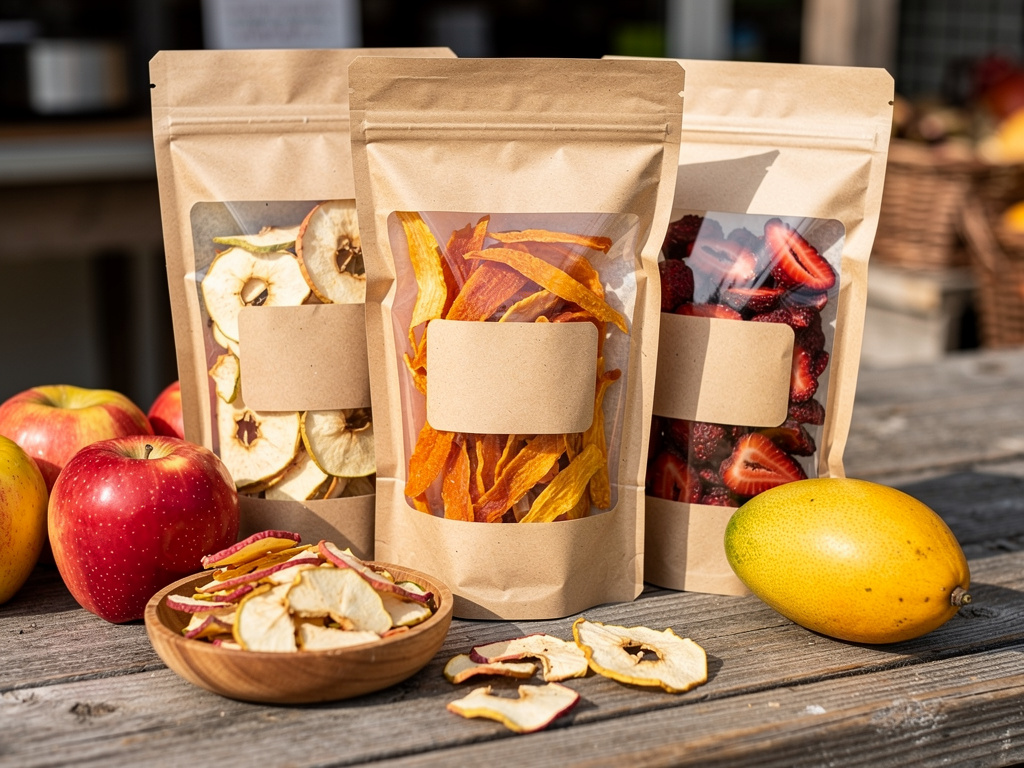


The short version: Sell a 4-ounce bag of home-dried apples or mango for $9, pineapple for $8, dried bananas for $5 and peaches for $11, and put strawberries in a 2-ounce bag for $8. Dried fruit is expensive because most of the fruit you buy is water: it takes about 6.7 pounds of fresh apples, and about 9.5 pounds of strawberries, to make one pound of dried fruit. At the 2023 grocery prices USDA publishes, the apples alone in a 4-ounce bag cost about $3.11. A $9 apple bag pays you about $20 an hour only when you get apples for around 50 cents a pound. If you buy them at the grocery store, charge $11 or more, which pays about $19 an hour on our assumed 2.5-hour batch.
Checked September 23, 2026: dried fruit prices on Walmart.com, mariani.com, madeinnature.com and nuts.com, pouch and label prices on Walmart.com, Excalibur's dehydrator page, Harvest Right's freeze dryer page, the U.S. Energy Information Administration's June 2026 electricity prices, USDA Economic Research Service fruit prices (2023 data, updated December 9, 2025), water content from USDA FoodData Central, Clemson Cooperative Extension's fruit drying guide, a live pull of Homegrown's catalog, and the pricing pages of Homegrown, Square and Etsy. Honest bounds: fresh fruit costs more in 2026 than those 2023 averages, the batch time below is our assumption rather than a measurement, dried fruit sold from home falls under cottage food rules that differ by state (verify your state's current rules before your first sale), Homegrown customers create an account to place a first order, and Homegrown has no timed drop or countdown release.
Your first bags of dried apples sold out by 10 a.m. Now a regular wants mango, a friend asks about strawberries, and you are staring at a $6 price tag you guessed at wondering if it was too low.
It probably was. Grocery shelves make dried fruit look cheap: Walmart's Great Value 6-ounce bag of dried mango costs $4.37. That shelf price was set by a company drying fruit on a scale no home kitchen can match. Your price has to cover the pounds of fresh fruit that shrink into each bag, the hours your dehydrator runs, and your own time at the cutting board. This guide builds that price from numbers checked the day it was written.
Sell a 4-ounce bag of home-dried fruit for $5 to $11 depending on the fruit, which works out to about $1.25 to $2.75 an ounce. Cheap, heavy fruit like bananas sits at the bottom. Fruit that loses most of its weight, like strawberries and peaches, sits at the top. Apples and mango land in the middle at $9.
Here is the price ladder a part-time dried fruit vendor can start from:
Scroll sideways to see every column.
| Fruit | Bag | Suggested price | Per ounce | Fruit in the bag (2023 grocery average) | Pouch and label | Supplies total |
|---|---|---|---|---|---|---|
| Apples | 4 oz | $9 | $2.25 | $3.11 | $0.35 | $3.46 |
| Mango | 4 oz | $9 | $2.25 | $2.49 | $0.35 | $2.84 |
| Pineapple | 4 oz | $8 | $2.00 | $1.87 | $0.35 | $2.22 |
| Bananas | 4 oz | $5 | $1.25 | $0.76 | $0.35 | $1.11 |
| Peaches | 4 oz | $11 | $2.75 | $4.61 | $0.35 | $4.96 |
| Strawberries | 2 oz | $8 | $4.00 | $3.64 | $0.35 | $3.99 |
The prices are our recommendation. Fruit cost uses USDA Economic Research Service average grocery prices for 2023 (published December 9, 2025) and the fresh-to-dried weight math shown further down. The pouch is a 4-ounce kraft stand-up pouch at $13.14 for 50 and the label is an Avery 2-inch round label at $9.97 for 120, both loaded from Walmart.com product pages that day. Electricity and your time are covered in their own sections below.
Three things back those numbers:
If you are still choosing a dehydrator, learning to condition fruit so it does not mold, or figuring out labels, start with the companion guide on how to sell dried fruit from home, which covers equipment and the first steps. This guide picks up the one question that guide answers in a single table: what to charge, fruit by fruit, and why.
Yes, by the pound dried mango cost about 7 times as much as fresh mango in 2023, and dried pineapple about 12 times as much as fresh, because you are paying for the fruit that dried away. USDA's Economic Research Service found that in 2023 fresh mangoes averaged $1.46 a pound at U.S. grocery stores, while dried mango averaged $10.11 a pound. Fresh pineapple averaged 67 cents a pound, and dried pineapple averaged $7.95.
The price gap has six causes, and every one of them shows up in your kitchen too:
There is a fair point to share with customers who flinch at the price. USDA also measures fruit prices per serving, using a unit it calls a cup equivalent, the amount that counts as one cup of fruit in the federal diet guidelines. By that measure dried mango cost $1.27 a serving in 2023 against 75 cents for fresh mango, and dried apricots cost $1.24 a serving against $1.49 for fresh. Per serving, dried fruit is closer to fresh fruit than the per-pound price makes it look.
It takes about 5 to 11 pounds of fresh fruit, as you buy it, to make one pound of dried fruit, depending on how much water the fruit holds and how much of it you trim away. Bananas are the easiest at about 5 pounds. Pineapple is the hardest at about 11, because half of its weight is peel and core before the drying even starts.
Swipe across to read the whole table.
| Fruit | Water in the fresh fruit | Weight trimmed away | Pounds you buy per pound dried | Dried fruit from 1 pound bought |
|---|---|---|---|---|
| Apples | 86.7% | 10% | 6.7 | 2.4 oz |
| Mango | 83.5% | 29% | 6.8 | 2.3 oz |
| Strawberries | 91.0% | 6% | 9.5 | 1.7 oz |
| Bananas | 74.9% | 36% | 5.0 | 3.2 oz |
| Pineapple | 86.0% | 49% | 11.2 | 1.4 oz |
| Peaches | 88.9% | 4% | 7.5 | 2.1 oz |
Water content is USDA FoodData Central's figure for each raw fruit (apples without skin, yellow peaches, all pineapple varieties). Weight trimmed away is the inedible share USDA's Economic Research Service uses in its 2023 fruit prices. The drying target is the 20% moisture Clemson Cooperative Extension's "Drying Fruits" fact sheet recommends for home-dried fruit. All loaded September 23, 2026.
Pounds of fresh fruit you buy for 1 pound dried
Source: our calculation from USDA FoodData Central water content, USDA Economic Research Service trim figures (2023 data) and Clemson Cooperative Extension's 20% moisture target, loaded September 23, 2026.
Those numbers line up with Homegrown's how-to guide, which gives 2 to 3 ounces of dried apples from a pound of fresh ones, and the math above lands at 2.4 ounces. You can run the same math for any fruit in four steps:
The fastest way to check your own recipe is a kitchen scale. Weigh the fruit when you bring it home and weigh the dried fruit before it goes in bags. After two or three batches you will know your own ratio, and it will beat any table, including this one.
On September 23, 2026, dried fruit from the stores and brands checked for this guide cost 50 cents to $3.49 an ounce. The low end is Walmart's own Great Value sweetened pineapple, $2.97 for 6 ounces. The high end is a 2-ounce bag of Great Value freeze-dried strawberries, which is a different product covered later in this guide. Organic bags in the table ran from 83 cents an ounce for nuts.com's organic bananas to $2.16 for Made in Nature.
Slide the table to see every price.
| Product | Size | Price | Per ounce | Where |
|---|---|---|---|---|
| Great Value Sweetened Dried Pineapple | 6 oz | $2.97 | $0.50 | Walmart.com |
| Great Value All Natural Banana Chips | 6 oz | $3.48 (out of stock that day) | $0.58 | Walmart.com |
| Mariani Tropical Mango (sweetened) | 16 oz | $9.99 | $0.62 | mariani.com |
| Great Value Dried Philippine Mango | 6 oz | $4.37 | $0.73 | Walmart.com |
| Great Value Unsweetened Dried Mango Strips | 12 oz | $8.97 | $0.75 | Walmart.com |
| Mariani Sweetened Dried Pineapple Bites | 6 oz | $4.99 | $0.83 | mariani.com |
| nuts.com Organic Dried Bananas | 6 oz | $4.99 | $0.83 | nuts.com |
| Great Value Organic Dried Mango Strips | 5 oz | $4.98 | $1.00 | Walmart.com |
| nuts.com Organic Dried Mango | 13 oz | $16.49 | $1.27 | nuts.com |
| nuts.com Organic Dried Apples | 7 oz | $8.99 | $1.28 | nuts.com |
| bettergoods Organic Dried Strawberries | 5 oz | $6.97 | $1.39 | Walmart.com |
| Mariani Sweetened Dried Strawberries | 3.5 oz | $6.49 | $1.85 | mariani.com |
| nuts.com Organic Dried Strawberries | 7 oz | $13.99 | $2.00 | nuts.com |
| Made in Nature Dried Apple Rings (organic) | 3 oz | $6.49 | $2.16 | madeinnature.com |
| Made in Nature Dried Pineapple (organic) | 3 oz | $6.49 | $2.16 | madeinnature.com |
| Great Value Freeze Dried Strawberry Fruit Crisps | 2 oz | $6.97 | $3.49 | Walmart.com |
Every price was loaded on the store's or brand's own product page on September 23, 2026. Walmart prices are for products sold by Walmart.com. Brand-site prices leave out shipping, which the shopper pays on top. For a national average, USDA's Economic Research Service put 2023 grocery prices at $10.11 a pound for dried mango (63 cents an ounce), $7.95 for dried pineapple and $8.63 for dried apricots.
Mariani sells a 3.5-ounce bag of sweetened dried strawberries for $6.49 on its own site. At $1.85 an ounce it is a fair benchmark for the shopper who wants a treat rather than a bargain. Your 2-ounce bag at $8 costs that shopper $4.00 an ounce, which is why strawberries are the hardest fruit to price well, and why the section on buying fruit cheaper matters most for them.
Three lessons come out of that table. First, the store brand sets a floor you cannot meet. Great Value dried mango at 73 cents an ounce costs barely more than the 62 cents of grocery mango inside each ounce of yours, before the pouch, the power or your time. Second, organic and premium bags at $1.85 to $2.16 an ounce are your real neighbors on price. That makes $2.25 an ounce a fair price to ask a shopper who already buys those bags, for fruit dried by someone they can talk to. Third, read the labels: several of the cheapest bags are sweetened, the Great Value banana chips list coconut oil as well as sugar, and added sugar and oil are cheap weight. Unsweetened home-dried fruit is a different product, so say so on your sign.
In a live pull of the Homegrown catalog on September 23, 2026, 2,629 products were listed by 298 vendors. Only 4 were dried or freeze-dried fruit snacks, from 3 vendors: Country Apple Orchard Farm Stand's Dried Apple Chips at $6.99, made from the orchard's own Haralson apples; Grandpa's Timeless Goodies' Freeze Dried Strawberries and Freeze Dried Strawberries with Bananas at $8 each; and Hideaway Creations' Dehydrated Fruit, which lists apples, oranges, strawberries and pineapple. None of the four listings states a bag weight. The same orchard also sells an Apple Granola at $8.95 made with its dried apples, which is one more way to use fruit that dried a little too hard to bag.
A 4-ounce bag of dried apples costs about $3.73 in fruit, packaging and electricity when you buy apples at the average grocery price, and about $1.46 when you pay 50 cents a pound. The fruit is almost the whole bill. The pouch, the label and the power together come to about 62 cents.
Scroll right for both columns.
| Cost line | What it costs to buy | Grocery apples | Apples at 50 cents a pound |
|---|---|---|---|
| Fresh apples, 1.67 pounds per 4-ounce bag | $1.86 a pound (USDA 2023 average) or 50 cents (our example) | $3.11 | $0.84 |
| 4-ounce kraft stand-up pouch with a window | $13.14 for 50 | $0.26 | $0.26 |
| 2-inch round label | $9.97 for 120 | $0.08 | $0.08 |
| Electricity, share of a 9-hour dehydrator load | See the next section | $0.28 | $0.28 |
| Cost per bag before your time | $3.73 | $1.46 |
Pouch and label prices come from Walmart.com product pages checked September 23, 2026 (Muka 4-ounce kraft pouches, 50 count; Avery 2-inch round labels, 120 count). The grocery apple price is the 2023 U.S. average from USDA's Economic Research Service. The 50-cent price is our example for orchard seconds or apples from your own trees, not a quoted price. A lemon juice or ascorbic acid dip to keep apples from browning costs a few cents a batch and is left out.
A few things the table shows:
If you already sell other shelf-stable snacks, the same cost build works for them too. The granola pricing guide runs the numbers for a product where oats, not fruit, set the price, and a bag of dried fruit next to a bag of granola is a natural pairing at one table.
A 600-watt dehydrator costs about 66 cents to $5.28 a load to run at the average U.S. home electricity price, from 6 hours for the fastest apples to 48 hours for peach halves. Apples and bananas sit at the low end. Strawberries, pineapple and peaches, which dry for a day or longer, sit at the high end.
The U.S. Energy Information Administration's monthly table of electricity prices put the average home price at 18.34 cents per kilowatt-hour in June 2026, up from 17.47 cents a year earlier. To turn that into a cost per load, multiply the dehydrator's watts by the hours, divide by 1,000, and multiply by your price per kilowatt-hour. Excalibur's 6-tray Select Digital dehydrator is rated at 600 watts, with 9.6 square feet of drying space, and was listed at $199.99 on September 23, 2026. At 9 hours, it uses 5.4 kilowatt-hours, or 99 cents.
Swipe across for the cost per bag.
| Fruit | Clemson's dehydrator time | Hours used here | Cost per load | Dried fruit from a 6-pound load | Power per bag |
|---|---|---|---|---|---|
| Apples | 6 to 12 hours | 9 | $0.99 | 14.4 oz | $0.28 per 4 oz |
| Bananas | 8 to 10 hours | 9 | $0.99 | 19.3 oz | $0.21 per 4 oz |
| Strawberries | 24 to 36 hours | 30 | $3.30 | 10.2 oz | $0.65 per 2 oz |
| Pineapple | 24 to 26 hours | 25 | $2.75 | 8.6 oz | $1.28 per 4 oz |
| Peaches | 36 to 48 hours for halves | 36 | $3.96 | 12.8 oz | $1.24 per 4 oz |
| Mango | Not in Clemson's table | Time your own | Not figured | 14.1 oz | Not figured |
Drying times come from Clemson Cooperative Extension's "Drying Fruits" fact sheet (HGIC 3084), which notes that slices dry faster than halves. Cost per load assumes a 600-watt dehydrator drawing its full rating the whole time at 18.34 cents per kilowatt-hour, the U.S. home average for June 2026 from the Energy Information Administration, loaded September 23, 2026. The 6-pound load, about a pound of sliced fresh fruit per tray, is our assumption; weigh your own.
What this means for your prices:
Time one full batch from the moment you wash the fruit to the moment the last bag is labeled, then divide the pay you want by the bags you filled. For dried fruit this is the step that decides whether a $9 bag is a business or a favor, because the hands-on work is slow and the yield is small.
The example batch. Say you buy 12 pounds of apples, enough for two full 6-pound loads. At 6.7 pounds per pound dried, that makes about 28.7 ounces of dried apples: seven 4-ounce bags and a snack for you. Say the hands-on work takes 2.5 hours. That time is our assumption, not a measurement, so time your own. Here is what that batch pays:
Slide the table to see the hourly pay.
| Apples bought at | Bag price | 7 bags bring in | Fruit | Power | Pouches and labels | Card fees | Left for 2.5 hours | Per hour |
|---|---|---|---|---|---|---|---|---|
| $1.86 a pound (grocery) | $9 | $63.00 | $22.33 | $1.98 | $2.42 | $2.69 | $33.58 | $13.43 |
| $1.86 a pound (grocery) | $11 | $77.00 | $22.33 | $1.98 | $2.42 | $3.05 | $47.21 | $18.89 |
| 50 cents a pound | $9 | $63.00 | $6.00 | $1.98 | $2.42 | $2.69 | $49.91 | $19.96 |
Card fees use Square's free-plan rate for a tapped or swiped card, 2.6% plus 15 cents, from Square's fee page on September 23, 2026. Power is two 9-hour loads at 99 cents each. The 2.5 hours and the 50-cent apples are our example numbers.
With grocery-store apples, a $9 bag pays you about $13 an hour, and even $11 falls short of $20. With 50-cent apples, the same $9 bag pays almost exactly $20 an hour. That is the real answer to what dried apples should cost: the price follows the fruit. If you cannot get cheap fruit, charge $11 or more, or put the same fruit in a 3-ounce bag.
At the suggested prices and 2023 grocery fruit costs, mango leaves the most per bag, $5.78 before power, then apples at $4.88, and strawberries and bananas leave the least, $3.00 and $3.40. Those numbers are before your time, so the fruits that take the longest to prep give back some of that edge.
Scroll sideways for every fruit.
| Fruit and bag | Price | Supplies | Power | Card fee | Left per bag before your time |
|---|---|---|---|---|---|
| Mango, 4 oz | $9 | $2.84 | Not figured | $0.38 | $5.78 before power |
| Apples, 4 oz | $9 | $3.46 | $0.28 | $0.38 | $4.88 |
| Peaches, 4 oz | $11 | $4.96 | $1.24 | $0.44 | $4.36 |
| Pineapple, 4 oz | $8 | $2.22 | $1.28 | $0.36 | $4.14 |
| Bananas, 4 oz | $5 | $1.11 | $0.21 | $0.28 | $3.40 |
| Strawberries, 2 oz | $8 | $3.99 | $0.65 | $0.36 | $3.00 |
Supplies and power come from the tables above. Card fee is Square's free-plan in-person rate of 2.6% plus 15 cents, checked September 23, 2026. Fruit costs are USDA Economic Research Service 2023 grocery averages, so a lower price on your fruit raises every number in the last column.
Here is how each fruit plays at a market table:
Sell most dried fruit in 4-ounce bags, strawberries in 2-ounce bags, and offer an 8-ounce bag at a small discount per ounce for regulars. Four ounces is enough for a real snack and keeps most prices under $10, which is easy to decide on at a market table. Two ounces keeps strawberries under $10 too.
Here is how the three sizes work for dried apples:
Two 4-ounce bags use two pouches and two labels, about 69 cents. One 8-ounce bag uses one 8-ounce pouch at 36 cents ($17.87 for 50 on Walmart.com, September 23, 2026) and one label at 8 cents, about 44 cents. That 25-cent saving, about 5 cents less in card fees than two $9 bags rung up on one payment, and half the bagging time win back only part of the $2 break on the big bag. Before your time, one $16 bag leaves about $1.70 less than two $9 bags paid together, which is the price of keeping a customer who buys every week.
Whatever size you pick, weigh every bag on a kitchen scale and print the weight on the label. Shoppers compare ounces, not bag sizes. How much fits in a pouch depends on how thick you cut the fruit, so a pouch that looks full is not a weight, and the only number that tells your customer what they are paying for is the net weight.
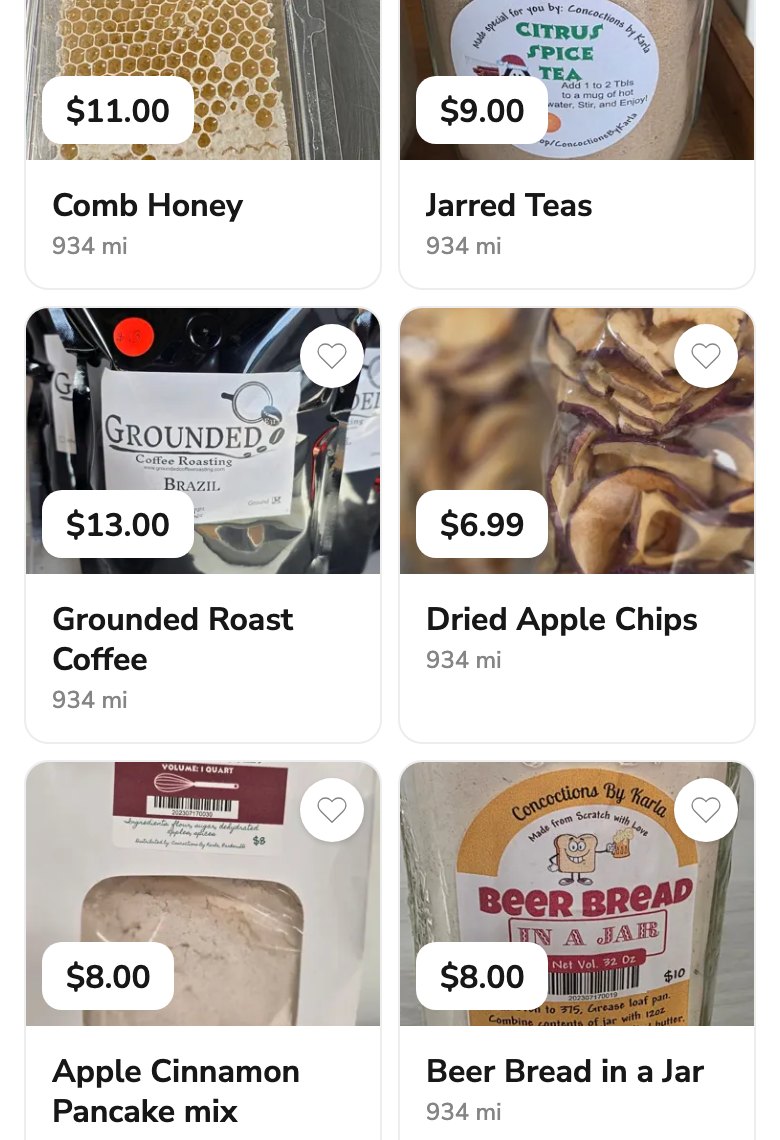
The orchard in that screenshot dries its own Haralson apples and sells the chips at $6.99, next to its honey, jams and a granola made from the same dried apples. Growing the fruit is exactly the cheap-fruit advantage the example batch above rewards.
Cutting what you pay for apples from $1.86 to 50 cents a pound drops the cost of a 4-ounce bag from $3.73 to $1.46, more than any price change you could make at the table. Because fruit is 68% to 93% of your supply cost, where you buy it matters more than what you charge.
Places to find fruit for less:
The grocery prices in this guide are USDA Economic Research Service averages for 2023, the latest year it has published (updated December 9, 2025). Fresh fruit very likely costs more at your store in 2026. Use your own receipt, not the table, before you set a price, and check it again each season.
One more rule: do not pass a lucky fruit price straight to your customers. If you got strawberries at a u-pick for a third of the grocery price, keep your $8 bag. The cheap berries are what make the price pay for your time, and next season you may pay full price again.
Yes, freeze-dried strawberries cost about two and a half times as much per ounce as dried strawberries in one side-by-side check on Walmart.com, and the machine a home vendor needs to make freeze-dried fruit costs far more than a dehydrator. On September 23, 2026, Walmart.com sold 2 ounces of Great Value freeze-dried strawberries for $6.97, or $3.49 an ounce. The same day, it sold 5 ounces of bettergoods organic dried strawberries for the same $6.97, or $1.39 an ounce.
The equipment gap is the bigger story for a home vendor. Harvest Right's smallest Home Freeze Dryer was listed at $1,895 on its own site on September 23, 2026, against $199.99 for Excalibur's 6-tray dehydrator. That is more than 9 times as much to buy before a single bag is made.
What that means for your prices:
On Homegrown, Grandpa's Timeless Goodies lists freeze-dried strawberries at $8, with no bag weight stated. If you are thinking about a freeze dryer, the guide to selling freeze-dried candy from home covers freeze-dried candy, the other product vendors make with the same machine.
Fees take 38 cents to $1.31 from a $9 bag of dried fruit, depending on where the customer pays. The low end is a card reader at your table. The high end is Etsy, where only 52 cents of the $1.31 is card processing; the rest is Etsy's own transaction and listing fees, and you would also be shipping the bag.
Here is the full fee stack on one $9 bag, and on a month of 50 bags, on the ways a dried fruit vendor is most likely to take payment:
Swipe across for every fee in the stack.
| Platform | Monthly plan | Trial | Platform fee | Card processing | Customer pays on a $9 bag | You pay on a $9 bag | You pay in a month of 50 bags at $9 |
|---|---|---|---|---|---|---|---|
| Homegrown | $10 billed annually ($12.50 billed monthly) | 7 days, not charged until day 8 | None, 0% commission | 2.9% + $0.30, paid by you | $9.00 plus tax | $0.56 plus the plan | $38.05 ($28.05 in fees plus $10) |
| Square Free, card reader at your table | $0 | None needed on the free plan | None | 2.6% + 15 cents | $9.00 plus tax | $0.38 | $19.20 |
| Square Free, online checkout | $0 | None needed on the free plan | None | 3.3% + 30 cents | $9.00 plus tax | $0.60 | $29.85 |
| Etsy | $0 (a one-time shop setup fee may apply) | None | 6.5% transaction fee plus $0.20 listing fee | 3% + $0.25 | $9.00 plus shipping and tax | $1.31 before shipping | $65.25 |
We checked every fee on each company's own page (findhomegrown.com/signup, Square's fee help page, and the fees section of etsy.com/sell) on September 23, 2026. Card processing is figured on the $9 price; charged on a total with tax or shipping it runs a few cents higher, and Etsy's 6.5% also applies to what you charge for shipping. The Etsy row counts the 20-cent listing fee once per sale. The Square card reader row assumes you already own a reader. Etsy's advertising fees are not included.
Two ways to keep fees from eating small dried fruit sales:
If you are thinking about Etsy for shipping dried fruit out of state, Homegrown's breakdown of Etsy fees for food sellers walks through every line, including the 6.5% Etsy takes on the shipping you charge.
Take dried fruit orders before you buy the fruit, so a 12-pound apple run becomes seven bags that are already paid for. Unsold bags are the quiet cost behind every table above. Dried fruit keeps for months, but a bag on your shelf is fruit, power and hours you paid for and have not been paid back.
Homegrown gives you an online storefront where your regulars order and pay for dried fruit before your drying day. It costs $10 a month billed annually ($12.50 month to month) with no percentage fees beyond standard payment processing of 2.9% plus 30 cents, which you pay and your customer does not. You list apples, mango and strawberries as separate products, with the 4-ounce and 8-ounce bags as their own listings, and customers choose pickup or delivery, whichever you offer. You see the order count before you go to the orchard, so you buy 12 pounds of apples for seven orders instead of guessing.
Compare that with the other two ways dried fruit vendors usually take orders. Tracking text messages and a spreadsheet costs nothing, but it leaves you chasing payment and counting bags by hand. Etsy takes 6.5% plus a 20-cent listing fee and 3% plus 25 cents for processing on every sale, which is $1.31 on a $9 bag before the 6.5% it also takes on any shipping you charge. Square's free plan is cheaper per card payment, but its online checkout still runs 3.3% plus 30 cents.
Homegrown is not the right fit for every dried fruit vendor. It does not dry, weigh or label anything for you, and it does not set your prices. Customers create a Homegrown account the first time they order. There is no timed drop or countdown release, so you cannot open a surprise batch at a set hour. Your storefront also appears on the Homegrown marketplace, but plan on most orders coming from people you send to your own link. If your whole business is one market table with cash, a card reader may be all you need.
If pricing each fruit is the part that has been stopping you, you can set up a Homegrown storefront, list your first three fruits at the prices from this guide, and send the link to the regulars who keep asking what you are drying next.
Charge stores and cafes about half to 60% of your retail price, so a $9 bag wholesales for $4.50 to $5.40, and only do it when your fruit is cheap. That matches the 40 to 50 percent off retail that our how-to guide gives as the usual wholesale discount.
Here is why cheap fruit decides whether wholesale works:
The honest read is that wholesale dried fruit only pays once your time per bag drops: a bigger dehydrator, an apple peeler-corer, fruit you grow yourself. Until then, sell retail and keep store accounts for the season when you have more fruit than regulars. The guide to wholesale pricing for food products shows how to build a wholesale price sheet from your retail price when you get there.
A vendor who sells 60 four-ounce bags of dried apples at $9 over a season keeps about $429 before counting time, if the apples cost 50 cents a pound. With grocery apples at $11 a bag the same 60 bags keep about $410. The hours are what separate a hobby from a side income.
Scroll right to see the season math.
| Bags in a season | Apples at 50 cents, $9 bag: brings in | Kept before your time | Apples at $1.86, $11 bag: brings in | Kept before your time | Hands-on hours |
|---|---|---|---|---|---|
| 20 bags | $180 | $143 | $220 | $137 | About 7 |
| 60 bags | $540 | $429 | $660 | $410 | About 21 |
| 150 bags | $1,350 | $1,073 | $1,650 | $1,024 | About 54 |
Per bag at $9 with 50-cent apples: 84 cents of fruit, 35 cents of pouch and label, 28 cents of power and a 38-cent card fee leave $7.15. Per bag at $11 with grocery apples: $3.11 of fruit, the same 35 and 28 cents, and a 44-cent card fee leave $6.83. Each piece is rounded to the cent, so these pieces add to $6.82; the table uses the unrounded amounts. Card fees use Square's in-person rate checked September 23, 2026. Hours use this guide's assumption of 2.5 hours per seven bags.
Divide what you kept by the hours and the 50-cent column pays about $20 an hour, the grocery column about $19. That is the pattern this whole guide keeps finding: the right dried fruit price is the one that pays your time after the fruit, and the fruit price moves more than anything else.
The most expensive mistake is pricing by the weight of the bag instead of the weight of the fresh fruit, which leaves a $6 bag of dried apples made from grocery-store apples paying you about $5 an hour for the example batch in this guide. Here are the six mistakes that come up most:
Drying your own fruit is cheaper only when the fresh fruit is cheap. At 2023 average grocery prices, the fresh mango in an ounce of home-dried mango costs about 62 cents, while Great Value dried mango sold for 73 cents an ounce on Walmart.com on September 23, 2026. Add the pouch, the electricity and your time and the store bag usually wins on price. Home-dried fruit wins on taste, freshness and knowing exactly what is in it.
Charge about $32 to $44 a pound for home-dried apples, mango, pineapple and peaches sold retail, which is $2.00 to $2.75 an ounce. Bananas sit lower at about $20 a pound, and strawberries higher at about $64. Those prices cover the 5 to 11 pounds of fresh fruit that go into each dried pound, plus packaging, power and your time. Few shoppers buy a full pound at once, so most vendors sell dried fruit in 4-ounce and 8-ounce bags and let the per-ounce price do the work.
Sell fruit leather for about $2 to $4 a strip, or $5 to $8 for a 3-pack, which are the prices Homegrown's guide to selling dried fruit from home suggests. Fruit leather uses puréed fruit instead of slices, so trimming and slicing time drops, and the strips work well as a low-price add-on next to your 4-ounce bags of dried fruit.
Yes, in most states dried fruit is one of the shelf-stable foods allowed under cottage food laws, which let you sell food made in your home kitchen directly to customers. The rules on sales caps, labels, registration and where you can sell differ from state to state. Check the current rules with your state agriculture or health department before your first sale.
Clemson Cooperative Extension says most dried fruits keep for one year at 60°F and six months at 80°F when packed in airtight containers and stored somewhere cool, dry and dark. Condition the fruit in sealed jars for 7 to 10 days before bagging so the moisture evens out. For selling, date each bag and rotate stock so the oldest bags go first.
Sell dried fruit by the bag, with the net weight printed on each label. A fixed bag price such as $9 for 4 ounces is faster at a market table than weighing out each order, and the printed weight lets careful shoppers compare your price per ounce with the bags they see at the store.
More on pricing and selling dried fruit and snacks:
Dried fruit pays when the price covers the fresh fruit, not the bag. If you are ready to take orders before your next drying day, you can start your Homegrown storefront and list your first bags at the prices you worked out here.



