
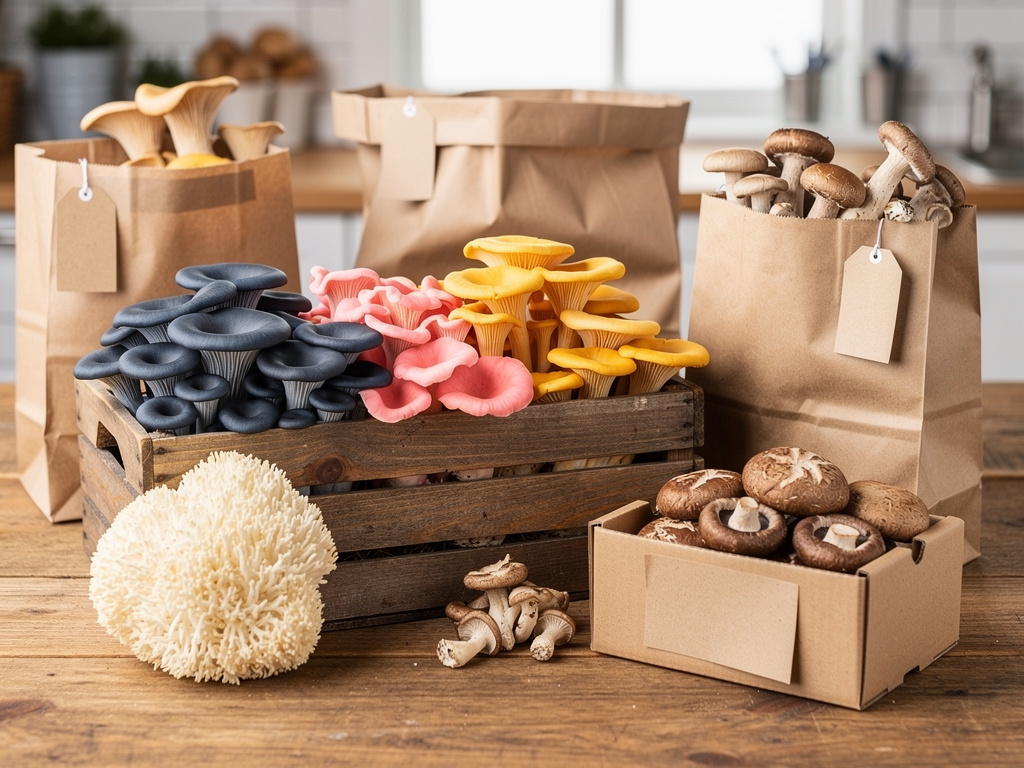


The short version: Mushrooms sell in seven places: a farmers market booth, your own storefront link with pickup, restaurants, grocery stores and co-ops, another farm's CSA or farm stand, a food hub, and online shipping for dried mushrooms and grow kits. A pound of oyster mushrooms at $16 costs you $0.76 in card processing through your own storefront link and $0.57 through a Square card reader at the booth, while a restaurant or store pays closer to $11.62 a pound, the wholesale average Cornell Small Farms found when it surveyed specialty mushroom growers in 2021. Fresh mushrooms do not ship well, so most part-time growers do best with one weekly in-person channel and one pre-order link, then add a restaurant once the harvest is predictable.
Checked September 22, 2026: Homegrown is $10 a month billed annually or $12.50 billed monthly, $0 platform fee and 0% commission, card processing 2.9% + $0.30 paid by the vendor, with 7 days before the first charge on day 8 (findhomegrown.com/signup). Square, Shopify, Etsy, Local Line and Barn2Door rates in this post come from each company's own pricing page the same day. Honest bounds: your customer creates a Homegrown account to place a first order, there is no countdown or timed release feature, and your storefront is listed on the Homegrown marketplace but most orders will come from the link you hand out yourself.
You pulled nine pounds of blue oyster off your grow tent this morning, and within a few days most of it will be soft, wet and unsellable. Mushrooms are one of the best-paying things a home grower can sell by the pound, and one of the worst at waiting for a buyer to show up.
So the question is not only where people buy mushrooms. It is which of those places can take a pound today, what each one pays after fees, and how many days each one gives you between the harvest and the sale. This guide covers seven places a part-time grower actually sells, priced against one pound of oyster mushrooms at $16.
Fresh cultivated mushrooms sell in seven places, and a grower producing 15 to 40 pounds a week can run two or three of them without hiring help. Each one trades price for time in a different way.
To find the nearest of each, USDA's Local Food Directories let you search by location and, on September 22, 2026, listed 7,148 farmers markets, 2,002 CSAs, 480 food hubs and 4,692 on-farm markets. Grocery stores, co-ops and restaurants you find the old way: walk your own town and read the menus and the produce signs.
About two thirds of the growers in Cornell's survey also sold value-added products, and dried mushrooms were the most common one. That matters for where you sell, because the pound you cannot sell fresh within a few days of harvest can still become a dried product with its own channel, as long as your state's processing rules allow it.
If you are still sorting out the growing setup, the varieties and the packaging, the companion guide on how to sell mushrooms you grow at home covers that ground. This article starts where that one stops: you have mushrooms on the shelf and need them sold within a few days.
Start with the channel that matches what you already have and how steady your harvest is, not the one with the highest price per pound. A grower with a reliable 20 pounds a week is ready for a chef. A grower whose flushes swing between 4 and 14 pounds is not.
Scroll sideways to see every column.
| What you have right now | Start here | Add second | Why that order |
|---|---|---|---|
| Uneven flushes, under 10 pounds a week | Your own storefront link with porch pickup | A farmers market | Pre-orders let you sell only what you actually harvested, and nothing is promised to a buyer who plans a menu around it |
| A market booth you already pay for | Your own storefront link | One restaurant | The booth built the customers; the link lets them order before Saturday so you harvest to the order |
| A steady 20+ pounds a week | One or two restaurants | A farmers market | Chefs pay less per pound but take the volume on a fixed day, with no floor time |
| A friend who runs a vegetable farm | Their CSA as an add-on | Your own storefront link | Their members already pick up weekly; you ride on a pickup that exists |
| More harvest than you can move fresh | Dried mushrooms or grow kits online | A co-op or food hub | Dried product buys you months; a hub takes volume in one drop |
Wholesale price comparisons use Cornell's grower survey averages, published April 3, 2023.
The trap is opening three channels in the same month. A chef, a store and a market all want you on a fixed day with a fixed amount, and a grower who promises all three from one uneven tent ends up shorting the chef, which is the one buyer who will not come back.
A farmers market pays full retail, among the highest prices per pound of any fresh channel, and costs you the most time to earn it. Booth space runs $20 to $75 a week at most markets, and a full season of 20 to 25 weeks often costs $400 to $800 up front, as broken down in our guide to the real cost of selling at farmers markets.
Cornell Small Farms saw the same pattern with forest-grown shiitake: growers averaged about $15 a pound at farmers markets and about $13 through grocery stores, restaurants and farm stands.
Run the arithmetic on a $40 booth. At $16 a pound, you cover the table with two and a half pounds sold, and every pound after that is yours before card fees. Bring 15 pounds and sell 12, and the booth fee is the small number. The 3 pounds that go home unsold are the big one, $48 of mushrooms that will not survive to next Saturday.
What the booth gives you that no other channel does:
A market day is also the hardest day on your mushrooms. A tray in July sun can lose its look by noon, and pink oyster, the variety that draws the crowd, has the shortest shelf life of the common ones. Keep the display small and refill it from a cooler behind the table, harvest the morning of the market, and count how many pounds come home for six Saturdays before deciding the booth is working.
The other honest limit is that a booth exists one day a week. The customer who loved Saturday's lion's mane cannot buy it again on Tuesday, and on Tuesday you may be staring at a fresh flush with nowhere to put it.
Mushrooms need an order that exists before you cut them, and for a part-time grower the simplest way to collect that order is a pre-order link, like Homegrown's at about $10 a month. Homegrown is $10 per month billed annually, or $12.50 billed monthly, with no percentage fees beyond standard payment processing of 2.9% + $0.30, which is $0.76 on a $16 pound. The first 7 days are not billed, so nothing is charged until day 8.
For mushrooms specifically, four things earn the $10: listing each variety by weight and price so nobody messages you to ask, taking orders and payment before harvest day so you cut to the order, setting pickup at the market or your porch cooler, and getting the page live in about 15 minutes.
Compare that to where mushroom growers usually land first:
Honest bounds, so you decide with the whole picture. Your customer creates a Homegrown account to place a first order. There is no countdown or timed release feature. Your storefront appears on the Homegrown marketplace, but plan on most orders coming from the link you text, print and hand out yourself. Homegrown does not send wholesale invoices, run net-30 terms for a restaurant, or ship fresh mushrooms, and it does not grow a single cluster for you.
In a live pull of the Homegrown catalog on September 22, 2026, the marketplace held 2,584 products from 293 vendors. Thirty-eight listings matched mushroom names: 21 fresh mushroom listings from 8 vendors, 8 grow kits, spawn plugs and garden blocks from 3 vendors, 6 dried or processed mushroom products from 4 vendors, and 3 prepared meals that use mushrooms. Where the listing states a weight, fresh mushrooms ran from $15 a pound for blue oyster to $24 a pound for lion's mane and chestnut. These are listing prices, not sales figures.
If your regulars already text you on Thursday asking what came off the tent, that is the whole case for a link. Set up a storefront, list your mushrooms by variety and weight, and take the orders before harvest day so every pound you cut already has a name on it.
You sell to restaurants with a sample box, a one-page price list by the pound, and a fixed delivery day you never miss. Chefs pay less than market shoppers, since wholesale buyers paid about 73% of the direct price in Cornell's survey, but they take a 5 to 7 pound box at a time and reorder every week.
The University of Kentucky's Center for Crop Diversification notes that restaurants generally prefer 5- to 7-pound boxes, while shoppers buy in 3-, 5- or 7-ounce containers, and it lists fine dining, Asian and French kitchens and even pizza shops among the buyers. Plan your harvest around that box size.
Here is the same $16 pound through three ways of selling it:
Scroll sideways to see every column.
| How the pound sells | What you keep per pound | Who sets the day | When you get paid |
|---|---|---|---|
| A shopper at your booth, card reader | $15.43 after the $0.57 card fee | You | At the sale |
| A regular through your storefront link | $15.24 after the $0.76 card fee, before the $10 plan | You, by the pickup time you set | At the order |
| A chef at the Cornell wholesale average | About $11.62, no card fee | The chef's menu | On delivery or on 15 to 30 day terms |
At $16 retail, the Cornell ratio puts your chef price near $11.62 a pound, or $4.38 less than a shopper pays. Over 50 pounds a month, that is $219 you give up in exchange for a buyer who takes a known quantity on a known day. The trade makes the most sense for part of the harvest, not all of it, so one lost account never takes the whole week's sales with it. The full pitch, the timing and the invoice terms are in our guide on how to sell food to local restaurants and cafes, and one log-grown shiitake grower quoted by Cornell Small Farms pitched 15 restaurants and landed 12, losing the other 3 on price.
Locally owned grocery stores, food co-ops and specialty grocers do buy mushrooms from small growers, at wholesale prices near 73% of retail and on a fixed weekly delivery. National chains almost never do, because their produce is bought centrally.
What a store buyer asks for before saying yes:
Asian and specialty grocers deserve a separate visit. They already sell king oyster, enoki and shiitake, their shoppers know how to cook them, and a fresher local king oyster is an easy case to make.
A food hub is the step past individual stores. It buys from several small farms and resells to restaurants, schools and grocers, so you deliver 30 pounds to one dock instead of 5 pounds to six back doors. The hub keeps a margin between what it pays you and what it charges, so ask for its grower price list before counting on it. A market booth also gives a co-op buyer a way to check your name before the first order.
Yes, and it is the easiest wholesale-style channel to start, because a vegetable farm with 60 CSA members already has a weekly pickup and a customer list. If 15 of those members add a half pound a week, that is 7.5 pounds you owe every pickup day, known before you start a single block. You supply a mushroom add-on share, the farm sells it to members, and you deliver one box on the pickup day.
How the arrangement usually works:
Cornell Small Farms' harvest-to-market guide notes that CSA sign-ups come in late winter and early spring, which brings in cash before the mushrooms grow. On another farm's CSA that cash lands with the farm, so ask the host farm to pay you for the season's add-on shares when members sign up, or the early cash stays with them. The honest limit is that you are selling under someone else's name, and the member's relationship stays with the farm. Keep your own label on the bag so members can find you when the share ends.
Do not ship fresh mushrooms, because a $16 pound sealed in a box for two days turns into a refund. They sweat and bruise in transit, and one refund plus the overnight shipping wipes out the profit on several good orders. Online shipping works for three products: dried mushrooms, mushroom powders and grow kits.
Where each shipped product fits:
Etsy is the natural place to find strangers for these. On a $16 product, Etsy charges $0.20 to list, a 6.5% transaction fee ($1.04) and 3% + $0.25 to process the payment ($0.73), which is $1.97 in total. The transaction and processing fees also apply to the shipping you charge, so with $5 shipping the fees come to about $2.45: $0.20, plus 6.5% of $21 ($1.37), plus 3% of $21 + $0.25 ($0.88). It also charges a 15% Offsite Ads fee when a sale comes from an ad Etsy ran for you. The search traffic is real, and the fee repeats on every reorder from a customer who already knows you.
Check the rules before you dry anything to sell. Washington's agriculture department spells out that mushrooms which are sliced, mechanically dried or powdered for sale need a food processor license, while fresh whole mushrooms sold as a raw crop do not. Your state may draw that line differently, so ask your own state's agriculture department before you list a dried product anywhere.
Fees on a $16 pound of mushrooms run from $0.57 to $1.97 on the direct channels, and a restaurant or store sale costs you $4.38 a pound in price instead of fees. Over 50 pounds a month the spread is the difference between $28.30 and $137.20 in platform costs. Every row below shows the full stack: monthly plan, what you pay before the first bill, the platform fee, card processing, and the two totals that matter.
Scroll sideways to see every column.
| Place | Subscription | Before the first bill | Platform fee | Card processing | What the customer pays | Fee on one $16 pound | 50 pounds ($800) in a month |
|---|---|---|---|---|---|---|---|
| Your own link (Homegrown) | $10/mo billed annually, $12.50 billed monthly | 7 days, no charge until day 8 | $0, 0% commission | 2.9% + $0.30, vendor pays | $16.00 | $0.76 | $48.20 including the plan |
| Square free plan, online | $0/mo | Nothing to pay up front | $0 | 3.3% + 30 cents online | $16.00 | $0.83 | $41.40 |
| Square reader at the booth | $0/mo | Nothing up front for the plan; Square hardware starts at $59 | $0 | 2.6% + 15 cents in person | $16.00 | $0.57 | $28.30 |
| Shopify Basic | $29/mo paid yearly, $39 paid monthly | 3 days at no cost, then $1/month for 3 months | $0 on Shopify Payments, 2% on an outside gateway | 2.9% + 30 cents standard cards, 3.5% + 30 cents premium cards ($0.86 on a $16 pound) | $16.00 | $0.76 | $67.20 on yearly billing |
| Local Line Core | $87/mo billed annually, $109 billed monthly | 7 days, no card required | $0, no commission, no setup fee | 2.9% + $0.30 by card, 1.0% by ACH | $16.00 | $0.76 | $125.20 on annual billing |
| Barn2Door Entrepreneur | $99/mo billed yearly, $119 billed monthly | One-time $399 set-up fee | $0 | 2.9% + $0.30 fixed | $16.00 | $0.76 | $137.20 on yearly billing, plus $399 once |
| Etsy (dried or kits, shipped) | None required | Nothing up front, a one-time shop set-up fee may apply | 6.5% transaction fee plus $0.20 per listing | 3% + $0.25 | $16.00 plus the shipping you set | $1.97 | $98.50 |
| Restaurant, store or food hub | None | None | None, the buyer pays a wholesale price | None, paid by check or transfer on their terms | About $11.62, the wholesale price | About $4.38 less per pound in price | About $219 less than selling direct |
Every rate was read off the company's own pricing page on September 22, 2026: findhomegrown.com/signup, squareup.com/us/en/pricing, shopify.com/pricing, localline.co/pricing, barn2door.com/pricing and etsy.com/sell. Square's paid plans run $49 and $149 a month per location. Barn2Door's page lists Entrepreneur at $99 a month billed yearly and $119 billed monthly; the table uses the yearly price, like every other row. The wholesale row uses Cornell's survey average of $11.62 a pound against a $16 direct price; it is a lower price, not a fee. The Etsy row leaves out shipping; Etsy charges its transaction and processing fees on the shipping price too, about $2.45 in fees on a $16 product with $5 shipping.
Read the last two columns together. Per pound, the Square booth reader is the cheapest option in this table. Per month, your own storefront link at $48.20 sits between Square online at $41.40 and Shopify Basic at $67.20, and the two farm platforms cost more per month because they bundle wholesale price lists, subscriptions and farm-website tools a 20-pound grower may never use. The wholesale row looks worst, and still wins for many growers on the hours: four short weekly delivery runs against four 6-to-10-hour Saturdays at a booth.
Direct buyers paid an average of $15.99 a pound for specialty mushrooms in Cornell's 2021 grower survey, and wholesale buyers paid $11.62. Variety moves the price too: oysters sat lowest at $14.18 and lion's mane near the top at $17.22, a $3.04 spread, against the $4.37 gap between direct and wholesale.
What shoppers paid per pound, by mushroom type
Source: Cornell Small Farms Program, "Smart Marketing for Specialty Mushrooms," April 3, 2023, reporting a January 2021 survey of US specialty mushroom growers. Average direct-to-consumer prices per pound. "Other specialty" includes wine cap, pioppino, maitake, lobster, chanterelle and similar, many of them foraged or very specialized.
What that means for picking a channel:
Lucky Thicket & Co lists fresh blue oyster mushrooms at $15 a pound or $8 a half pound, and lion's mane and chestnut mushrooms at $24 a pound or $13 a half pound, all for porch pickup from a cooler, pulled live from the Homegrown catalog on September 22, 2026. The half-pound price is the Cornell advice in practice: a smaller tag, like the $8 half-pound quarts one grower Cornell quotes switched to when a $16-a-pound sign sold slowly. The porch cooler is the channel in practice: the customer orders ahead, and the grower does not have to stand at a table to make the sale (all three listings were out of stock on the day we checked).
Fresh cultivated mushrooms sold whole are among the least regulated foods you can sell, and the rules only tighten when you sell to a business, dry or powder the mushrooms, or sell anything you found in the woods. This section covers the rules that change by channel, not every rule. Verify your state's current rules with its agriculture department before you commit to any channel, because states differ and update them.
The channel-by-channel list:
Cornell's "other" group, which mixes foraged species like chanterelles and lobster with specialized cultivated ones like maitake and pioppino, averaged $19.40 a pound direct, the highest of any group, and the foraged ones carry the strictest rules. If you sell anything you did not grow from purchased spawn, check your state's wild mushroom rule before you list it, because your state may regulate foraged sales on their own, and a restaurant or store that buys them from an unapproved source is in violation of the Food Code.
Most fresh cultivated mushrooms keep 5 to 10 days refrigerated in paper, and each channel spends a different share of that window. The channel that sells on harvest day gives you the most room; the channel that holds stock on a shelf eats most of it.
Shiitake holds up longest among the common varieties and pink oyster the shortest. Put the long keepers in the channels with the most days between harvest and plate, and keep the fragile ones for pre-orders and the booth.
Pick one channel and give it seven days, rather than opening three and shorting all of them. Every place in this guide can be started with one steady variety, 10 pounds and a free afternoon.
Keep a notebook of pounds harvested, pounds sold and pounds composted for each channel. After four weeks the numbers tell you where the next pound should go.
Growers who have sold for a few seasons plan the harvest around orders, not the other way around, and they keep a second channel ready for the surplus. That planning starts at setup: a straw farm trial funded by USDA's SARE program measured 29 to 41 pounds of oyster mushrooms per 100 pounds of dry straw, the kind of number the guide on starting a mushroom farm turns into a weekly bag schedule. The habits are small and they compound.
Close pre-orders the night before harvest and cut exactly what was ordered plus 10%. The extra tenth covers a heavy scale and the neighbor who texts late. A grower who used to fruit 36 pounds for 30 pounds of orders and now starts blocks for 33 stops composting 3 pounds, about $48 a week at $16 a pound.
The listed fees are the smallest cost in every mushroom channel, and the real bill is hours and spoilage. A market Saturday runs 6 to 10 hours once you count harvesting, packing, driving, setup, selling and teardown, which is more than the $40 table fee and about $7 in card fees on 12 pounds sold, combined, at any sensible hourly rate.
The costs nobody prints:
Cost each channel at your own hourly rate before you judge it. A wholesale run that moves 25 pounds in two hours often beats a 10-hour Saturday that moves 15 pounds at a higher price.
For a part-time grower, the best pair is a weekly in-person channel plus a pre-order link. Direct sales at markets, CSAs and farm stands averaged $15.99 a pound for specialty mushrooms in Cornell's 2021 survey, and Cornell's shiitake guide says farmers markets pay the highest price of any venue, about $15 to $20 a pound. A pre-order link lets regulars order before you harvest so nothing spoils. Add a restaurant once your weekly harvest is steady enough to promise a fixed box every week.
In Washington, for example, the state's fact sheet says fresh cultivated mushrooms in their natural state need no special license beyond the federal produce rule, and it names restaurants among the places they can be sold. Your state may treat them the same way, though a business license and liability insurance often are needed. Small farms selling to restaurants may need to show the farm name and address under the federal produce rule's qualified exemption. Rules differ by state, so verify your state's current requirements with its agriculture department before your first delivery.
Restaurants and other wholesale buyers paid an average of $11.62 a pound in Cornell Small Farms' 2021 survey of specialty mushroom growers, about 73% of the $15.99 direct price. Chefs usually buy 5- to 7-pound boxes on a fixed weekly day. Cornell's article text gives variety prices for direct sales only: oysters averaged $14.18 a pound and lion's mane $17.22.
You can sell mushrooms online for local pickup or delivery, and you can ship dried mushrooms, powders and grow kits, but shipping fresh mushrooms rarely works because they sweat and bruise in transit. On Etsy, a $16 dried product costs $1.97 in listing, transaction and processing fees, or about $2.45 once Etsy's fees are also taken on $5 of shipping. A local pre-order storefront costs $10 a month plus 2.9% + $0.30 per order and fits fresh mushrooms picked up the day they are harvested.
Locally owned grocery stores, food co-ops and Asian or specialty grocers often buy from small mushroom growers, while national chains rarely do because they buy centrally. Expect to deliver the same weight on the same day every week, in shelf-ready packaging with your farm name, and to wait 15 to 30 days for payment. Start with one store and prove you can supply it before adding a second.
Unsold fresh mushrooms can go at a wholesale price to a restaurant, co-op or food hub you already supply, within a day or two of harvest. After that, drying them is the usual fallback, but only where your state allows it without a processing license. The better fix is fewer unsold pounds: start blocks to match your orders, close pre-orders before harvest, cut to the order, and send any extra to your second channel. Every pound composted at $16 is the most expensive fee in the business.
Five guides that pick up where this one stops, from growing the mushrooms to pricing a restaurant order.
Mushrooms pay well by the pound and forgive nothing on timing, so the channel that wins is the one where the order exists before the harvest. If your regulars already ask what is coming off the tent this week, give them a place to claim it: open a storefront, list your varieties by weight, cut what has been ordered, and send the rest to your second channel.



