
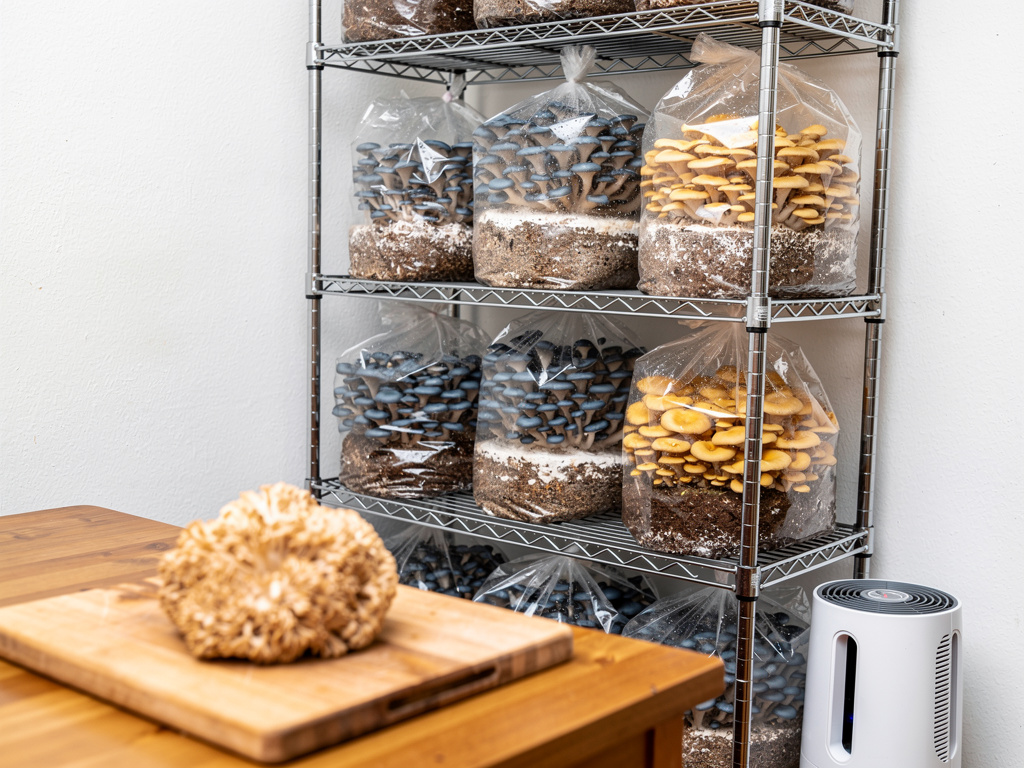


The short version: You can learn to grow mushrooms in a spare room or garage for a few hundred dollars on bought blocks, and reaching a straw farm takes about $745 to $845 in North Spore gear and blocks in all, before spawn, straw and a legal-for-trade scale. Bought fruiting blocks cost $18 each in North Spore's 8-pack ($34.99 for a single block), or $9 to $36 per pound of first flush (the first round of mushrooms from a block) at the 8-pack price, so treat them as practice. Growing oyster mushrooms on straw is the cheapest real farm, and a Northeast farm trial measured 18 to 41 pounds of mushrooms per 100 pounds of dry straw depending on how the straw was treated: 29 with hot-water pasteurization and 41 with lime. Fresh mushrooms are covered produce under the federal Produce Safety Rule, but a farm whose produce sales average under $34,324 a year is not covered, and in the two states we checked, selling by the pound needs a legal-for-trade scale. Homegrown mushroom farms that sell by the pound charge $10 to $24 a pound.
Checked on North Spore's product pages, FDA's inflation-adjusted cut-off table and findhomegrown.com/signup, September 28, 2026: equipment prices, the $34,324 line and Homegrown's $10 a month plan (billed annually, or $12.50 billed monthly) come from those pages. Rules vary by state, so check with your state department of agriculture. Homegrown customers create an account to place their first order, and Homegrown has no drops feature.
Most guides to starting a mushroom farm are either a hobby tutorial that ends at your first harvest or a big-picture business plan with profit numbers nobody can source. If you want to turn a shelf of oyster mushrooms into a small farm that sells 20 to 40 pounds a week, you need the middle part. That means what to buy, what it costs today, how many pounds it really makes, and which rules start to apply once you sell.
This guide prices a starter farm from one live supplier catalog, uses a measured US farm trial for yield, and uses the prices real mushroom farms charge on Homegrown. It is written for a part-time grower with a spare room, not a company with a warehouse.
Starting a mushroom farm takes four things: a clean space you can keep at 85 to 95% humidity, a reliable way to make or buy colonized substrate, a weekly buyer, and the paperwork for selling produce in your state. The space and gear cost less than most people expect. The hard part is producing the same weight every week without contamination.
Here is a simple order a new farm can follow:
This page is about building the farm. If you already grow and want the selling side, the guide on how to sell mushrooms you grow at home covers varieties, prices, packaging and sales channels. The two pages are meant to be read together.
A mushroom farm is different from a home grow in one way that matters: it has to produce a set weight every week for people who are counting on it. A home grower can lose a batch to green mold and shrug. A farm that promised 5 pounds to a restaurant on Thursday cannot.
That changes how you work:
The good news is that the gear barely changes. A farm is mostly a home grow run on a calendar, with more bags and a buyer at the end of the week.
Blue oyster is the best first crop for a new mushroom farm because it colonizes quickly, fruits at 55 to 65°F and grows on cheap straw. Add one higher-priced species, usually lion's mane or chestnut, once your oyster harvest is steady. Match each species to the temperature of the room you actually have, not the one you wish you had.
The fruiting temperatures below come from NCAT's 2026 guide. They explain why a garage farm often switches species with the seasons.
Swipe the table sideways to see all three columns.
| Species | Ideal fruiting temperature | What that means for a small farm |
|---|---|---|
| Blue oyster | 55 to 65°F | Fits a cool basement or a garage in spring and fall |
| Pink oyster | 70 to 85°F | The summer crop when blue oyster struggles |
| Lion's mane | 60 to 68°F | Needs steady humidity or it forms small dense blobs |
| Shiitake | 60 to 70°F | Slower, usually grown on sawdust blocks or logs |
| Chestnut | 60 to 70°F | Fruits at ordinary room temperature |
Temperatures from NCAT's "Mushroom Cultivation" publication (April 2026), Table 2, loaded September 28, 2026.
A simple rule: one species you can grow every week beats five species you grow now and then. Chefs and regular customers buy consistency.
A small farm can produce mushrooms in three practical ways: buy fruiting blocks that are already colonized, grow on pasteurized straw, or make sterilized sawdust blocks. Each one trades money for skill in a different way. A sensible path is to start with the first, earn with the second, and move to the third when you add lion's mane or shiitake.
NCAT's spawn table shows the difference in cleanliness. It recommends 5 to 10% spawn by weight for pasteurized straw, where competitors survive, and 2 to 5% for sterilized sawdust, where they do not.
A one-tent test setup costs $343.97 at North Spore's prices on September 28, 2026, a straw room's gear costs $499.96 before spawn, and a sterilized sawdust setup costs $1,154.97 before pellets and spawn. Every price below was loaded from North Spore's product pages that day. Local items like straw, a barrel and a burner are left out because their prices depend on where you live.
Swipe sideways to see the full cost of each path.
| Path | What you buy | Up-front total | Ongoing supply cost | Best for |
|---|---|---|---|---|
| Bought blocks, one tent | BoomRoom II Martha tent and rack $99.99, Myco-Mister Mini humidifier $64.99, FAE Fan Mini $34.99, 8 fruiting blocks $144.00 | $343.97 | $18.00 per block | Learning to fruit before you sell |
| Pasteurized straw room | Two BoomRoom II tents $199.98, Myco-Mister II tower humidifier $199.99, FAE Fan II $99.99 | $499.96 | $34.99 per 6 lb bag of grain spawn, plus straw bought locally | Oyster mushrooms, starting at a small weekly weight |
| Sterilized sawdust lab | All American 1941X sterilizer $849.99, NocBox still air box $74.99, 100 filter-patch grow bags $229.99 | $1,154.97 | $14.99 per 10 lb of soyhull pellets, $14.99 per 10 lb of hardwood pellets, $34.99 per bag of grain spawn | Lion's mane, chestnut, shiitake, king oyster |
We checked every price on North Spore's product pages on September 28, 2026. Totals are the listed products added together, before tax and shipping. The straw row already includes two fruiting tents, which hold 10 shelves with a 20-pound limit on each, or about 200 pounds of bags in all. That is room to start, not room for a 30-pound week: a 30-pound week starts from about 103 pounds of dry straw that gets much heavier once soaked, and if you keep bags for a second flush they hold shelf space for another 7 to 14 days (NCAT's rest period between flushes), though NCAT notes many commercial growers harvest only the first flush, so add shelving or tents as your weekly weight grows. The sawdust row does not, so a sawdust farm also needs a tent, humidifier and fan: the first row without the blocks is $199.97, for $1,354.94 in all.
You can see the live spawn prices on North Spore's grain spawn page, where each organic grain spawn bag listed that day was $34.99. North Spore's spec sheet for blue oyster says one bag weighs about 6 pounds and inoculates 100 to 130 pounds of pasteurized straw. That is soaked straw, since straw comes out of pasteurization wet and NCAT states spawn rates by the weight of wet substrate. So one bag does not cover a 30-pound week: the 103 pounds of dry straw that week needs (worked out in the next section) gets much heavier once soaked and takes more than one bag of spawn, which makes spawn a weekly cost.
Costs that no equipment list shows:
A small farm on treated straw can expect roughly 18 to 41 pounds of fresh oyster mushrooms from every 100 pounds of dry straw depending on how the straw is treated, based on a measured Northeast farm trial: 29 pounds with hot-water pasteurization, 41 with lime, and 18 to 20 with fermentation or wood ash. Bought blocks yield 0.5 to 2 pounds on the first flush, according to North Spore. Those two numbers decide whether your farm makes money.
The straw figure comes from a trial funded by USDA's Sustainable Agriculture Research and Education program (SARE) at Fungi Ally in Hadley, Massachusetts, which compared four ways of treating straw across six oyster strains. It measured biological efficiency, which is the weight of fresh mushrooms harvested divided by the weight of dry substrate. Average results were:
Here is what that means in pounds. To harvest 30 pounds a week, you need about 73 pounds of dry straw a week at 41% (30 divided by 0.41 is 73.2) or about 103 pounds at 29% (30 divided by 0.29 is 103.4). Plan your space and your straw supply around 103 pounds of straw (the 29% result) until your own records prove the 41% one. The same trial found lime the cheapest of the four treatments as well as the highest-yielding.
Bought blocks look very different. At $18.00 a block in North Spore's 8-pack ($34.99 for a single block) and 0.5 to 2 pounds on the first flush, the first flush costs you $9.00 to $36.00 a pound in blocks alone. Frontier Farms sells a pound of blue oyster on Homegrown for $16. At $16 a pound a block needs about 1.1 pounds to cover its $18 cost (18 divided by 16 is 1.125), so a 0.5-pound first flush loses money and only a strong first flush, or a second flush, covers it. They are tuition, and cheap tuition, but not a business model.
A working grow room is a cleanable space with steady temperature, 85 to 95% humidity during fruiting, gentle fresh air and indirect light for about 12 hours a day. NCAT says 500 to 1,000 lux is enough light for most species. You do not need a building, just a room you can keep clean and stable.
Keep the floor washable and bring nothing from the garden into the room. NCAT says inoculation is the step most likely to bring in contamination. At commercial scale it advises doing the work under a laminar flow hood or a HEPA-filtered clean bench in a dedicated room, wiping benches and tools with alcohol, and wearing clean gloves, a mask and a hair cover. At spare-room scale, a still air box like the NocBox in the sawdust setup is the small version of that clean bench.
The way to get a steady weekly harvest is to start the same number of bags on the same day every week, so a new batch is always colonizing while an older one fruits. NCAT says bags usually take one to three weeks to colonize, and many setups give one to three flushes. A staggered schedule turns that uneven timing into a steady supply.
A simple weekly rhythm looks like this:
Size your weekly batch from your own averages, not a supplier's best case. Here is how the math works: if you want 30 pounds a week and your records show each bag averages 3 pounds across all its flushes, start 10 bags every Monday. If 1 bag in 10 is lost to contamination, start 12, because each bag you start then averages 2.7 pounds and 30 divided by 2.7 is 11.1. That extra bag costs far less than a short order.
Write the schedule on the wall of your grow room. NCAT's advice is to post your room targets and cleaning steps where anyone helping you can follow the same routine.
Fresh cultivated mushrooms are produce, so the main federal rule is FDA's Produce Safety Rule, and mushrooms are named in its list of covered produce at 21 CFR 112.1. A farm is not covered if its produce sales averaged under $34,324 a year over the previous three years, which is FDA's inflation-adjusted figure for 2023 to 2025. A spare-room farm selling 30 pounds a week at $16 a pound grosses $24,960 a year (30 times 16 times 52), which is under that line. The line works out to about $660 a week in produce sales ($34,324 divided by 52), which is about 41 pounds a week at $16 or 27.5 pounds at $24. So a 30-pound week of lion's mane or chestnut at Lucky Thicket's $24 a pound grosses $37,440 a year (30 times 24 times 52), which is over it.
Above the line, a farm can still qualify for a lighter set of rules, called the qualified exemption:
State rules sit on top. Washington's agriculture department, in the fact sheet on selling mushrooms in its 2019 small-farm handbook, says that beyond any Produce Safety Rule requirements, no special inspection or license is needed to sell fresh cultivated mushrooms in their natural state. Slicing, mechanical drying, canning or freezing turns them into a processed food with food processing requirements.
The same Washington fact sheet says the Produce Safety Rule requires raw mushrooms to be packed in a way that prevents Clostridium botulinum toxin from forming. That binds farms the rule covers, and it is good practice for everyone, which is one reason growers use paper bags and vented boxes instead of airtight plastic. In Washington, dried powders, tinctures and other processed mushroom products need a WSDA Food Processor License, and other states have their own processing rules. Verify your state's current rules with your state department of agriculture before you sell anything beyond fresh mushrooms.
Usually yes: in both of the 2 states we checked, a scale used to sell by weight must be certified as legal for trade. Washington's agriculture department says commercial scales need a National Type Evaluation Program certificate of conformance, and scales marked "not legal for trade" are not suitable for sales. Washington also requires every scale used for sales to be registered each year through the state Department of Revenue's Business Licensing Service. Illinois's farmers market rules also require a certified scale and annual inspections.
What that means for a new farm:
Three of the mushroom farms on Homegrown list set half-pound and one-pound sizes. Set sizes also make pre-orders simpler, because every order is a known weight.
A new mushroom farm should sort out 5 things before the first market: a business license, a business structure, liability insurance, a simple record system and a separate bank account. None of this is specific to mushrooms, but a farmers market application may ask for some of it, such as proof of liability coverage.
Records pay off the first time something goes wrong. When a chef says Thursday's box went slimy early, a lot code tells you which batch, which substrate and which week to look at.
Yes, a small farm can apply for a USDA Farm Service Agency microloan, which covers up to $50,000 for operating costs with a repayment term of up to seven years. The FSA microloan fact sheet says the program was built for new, niche, and small to mid-sized family farms, like specialty crop growers. Operating microloans cap the interest rate at 5% for beginning and veteran farmers, while ownership microloans use FSA's regular farm ownership rate.
Things to know before you apply:
A spare-room farm may not need a loan. The straw path's gear is under $500. A loan makes more sense when you move to a dedicated building, a larger sterilizer or a walk-in cooler, and by then you will have a year of sales records to show.
The 7 of 8 mushroom farms on Homegrown that list a one-pound size charge $10 to $24 for a pound of fresh mushrooms (the eighth lists no weight), and 4 of the 8 also sell something made from their growing, like spawn plugs, grow blocks or powder. Those are real listings from real small farms, which makes them a useful price check for a new farm.
In a pull of the Homegrown catalog on September 28, 2026 (2,770 products from 311 vendors), 25 listings of fresh cultivated specialty mushrooms came from 8 vendors, and the one-pound options ran from $10 to $24. We matched mushroom species words in each product's name, description and category, then read every listing from each matching vendor and kept only fresh cultivated mushrooms, leaving out kits, spawn, powders, seasonings, meals and 2 wild-foraged listings. 4 of the 8 farms also sell a second product: Hohosh Family Farm lists spawn plugs at $15 for about 100, Frontier Farms a $25 Mushroom Garden Block, Majestic Caps a $13 lion's mane powder, and one newer farm a $30 grow kit.
One pound of fresh blue oyster mushrooms on Homegrown
Source: Homegrown catalog pull, September 28, 2026, the one-pound blue oyster option at each of the 4 farms that list one.
A few patterns stand out in those listings:
A mushroom farm needs customers to order before harvest day, because fresh mushrooms have a short shelf life and you should only pick what is already sold. A pre-order link with a cutoff tells you on Wednesday night exactly how many pounds of each species to cut on Friday. The question is which tool runs that link without eating your margin.
Homegrown is $10 a month billed annually ($12.50 billed monthly) with no percentage fees beyond standard payment processing. You list each species in half-pound and one-pound sizes, customers order and pay ahead, and you harvest exactly what sold. Real-time inventory tracking stops you from overselling a small lion's mane flush, and local delivery zones let you deliver orders within a set radius of 1 to 25 miles. Compare that with Local Line, a farm platform whose Core plan is $87 a month billed annually, or Barn2Door at $99 a month billed yearly plus a $399 set-up fee. Both are full farm platforms, and Local Line's Core plan includes 2 price lists and invoicing. Square's free plan costs $0 a month but charges 3.3% + 30¢ on online orders.
Scroll sideways to see every column.
| Platform | Monthly plan | Trial | Platform fee | Card processing | Customer pays on a $20 order | Farm pays on a $20 order | Farm pays in a month of 50 orders at $20 |
|---|---|---|---|---|---|---|---|
| Homegrown | $10 billed annually ($12.50 monthly) | 7 days, no charge until day 8 | None | 2.9% + $0.30, paid by the farm | $20.00 | $0.88 plus the plan | $54.00 ($56.50 on monthly billing) |
| Square Free plan, online orders | $0 | Not needed on the free plan | None | 3.3% + 30¢ | $20.00 | $0.96 | $48.00 |
| Square Free plan, card reader at the booth | $0 | Not needed on the free plan | None | 2.6% + 15¢ in person | $20.00 | $0.67 | $33.50 |
| Local Line Core | $87 billed annually ($109 monthly) | 7 days, no card required | None | 2.9% + $0.30 (1.0% on ACH bank payments) | $20.00 | $0.88 plus the plan | $131.00 ($153.00 on monthly billing) |
| Barn2Door Entrepreneur | $99 billed yearly ($119 monthly), plus a one-time $399 set-up fee | None shown on its pricing page | None listed | 2.9% + $0.30 | $20.00 | $0.88 plus the plan | $143.00 ($163.00 on monthly billing), plus the $399 set-up fee in the first month |
We checked each platform's own pricing page on September 28, 2026: findhomegrown.com/signup, squareup.com/us/en/pricing, localline.co/pricing and barn2door.com/pricing. Card processing is figured on the $20 price. Square rows leave out the cost of a card reader and Square's paid plans.
Homegrown is not the right fit for every part of a mushroom farm. It does not send restaurant invoices or keep separate wholesale price lists, and Local Line does both. Homegrown does not price by weight yet (it is on the roadmap), so list fixed half-pound and one-pound sizes. Customers create a Homegrown account to place their first order, and there is no drops or countdown release feature. Your storefront is listed on Homegrown's marketplace, but plan on most orders coming from people you send to your own link. Card processing is paid by the farm, with no option to pass it to the customer.
If your first harvests are selling out at the market and regulars keep asking whether you will have lion's mane this week, that is the moment for a pre-order link. Start your Homegrown storefront, list your species by the half pound and the pound, and send the link to your first ten customers before Friday's harvest.
NCAT's advice is to add a second fruiting space once you can hit a weekly target with clean product and on-time delivery, and it notes that many growers add specialized gear only after they prove their weekly sales, which means growing to your buyers, not to your space. NCAT puts it plainly in its 2026 guide: the best time to grow is when you already have a buyer. Mycoterra Farm, the case study in NCAT's guide, met the Big Y grocery chain through a local-food nonprofit before it could supply the stores, and kept that relationship alive until production caught up.
NCAT's case study of Mycoterra Farm shows the path. Founder Julia Coffey started in a basement closet in Westhampton, Massachusetts, preparing sawdust bags eight at a time in one pressure cooker. They sold so fast that she doubled capacity two weeks later, and output later reached 500 to 600 pounds a month from two backyard greenhouses. By 2016 she had outgrown the basement and moved into a former equestrian center, with a $12,000 autoclave, a large commercial sterilizer. Mycoterra later entered 52 Big Y grocery produce departments.
Habits from NCAT's guide and the Mycoterra case study:
Your first 90 days should prove three things in order: that you can fruit mushrooms reliably, that you can produce a set weight every week, and that people will buy that weight every week. Skipping ahead to scale before the second proof is an easy way to waste money.
Once blue oyster is steady, lion's mane or chestnut is the natural second crop, and the microgreens guide is worth a look if you want a second fast indoor crop for the same customers.
A one-tent test setup with 8 fruiting blocks costs $343.97 at North Spore's prices on September 28, 2026. The gear for a pasteurized straw room costs $499.96 before spawn and straw, and a sterilized sawdust setup costs $1,154.97 before pellets and spawn. Depending on the path, starting gear runs from $343.97 to $1,354.94 for a sawdust setup with its own fruiting tent, and then you pay for spawn and substrate every week.
It can be, if you make your own substrate and sell what you grow before you harvest it. Bought blocks cost $9 to $36 per pound of first flush at North Spore's 8-pack price, while Homegrown mushroom farms that sell by the pound charge $10 to $24 a pound, so bought blocks only pay on a strong flush, and preparing your own straw or sawdust is how you bring the per-pound cost down for every batch. Contamination loss, unsold mushrooms, your own hours and electricity decide whether a mushroom farm is profitable.
A spare room, basement corner or insulated garage is enough to start a mushroom farm. One Martha tent fits on a few square feet of floor, which is enough to learn on. NCAT's 2026 guide says a small indoor setup might target 20 to 40 pounds of fresh mushrooms a week, and that takes more shelf space than one tent, since each BoomRoom II tent has 5 shelves that hold up to 20 pounds apiece. You need a separate clean area for mixing and inoculating, away from the fruiting tent.
Blue oyster is the easiest mushroom for a new farm. It colonizes pasteurized straw quickly, fruits at 55 to 65°F according to NCAT, and forgives beginner mistakes. Pink oyster is the warm-weather alternative, fruiting at 70 to 85°F.
In Washington, the one state we checked on licensing, no special license is needed for fresh cultivated mushrooms beyond any Produce Safety Rule requirements, a business license and, if you sell by the pound, a legal-for-trade scale registered each year with the state. Washington's agriculture department says no special inspection or license is needed for fresh cultivated mushrooms in their natural state, while mechanically dried, sliced or frozen mushrooms need a food processor license. Confirm your own state's rules with its agriculture department before your first sale.
Mushrooms are covered produce under 21 CFR 112.1, but a farm is not covered if its produce sales averaged under $34,324 a year over the previous three years, FDA's figure for 2023 to 2025. Farms whose total food sales averaged under $686,476 a year, and that sell mostly to consumers and to restaurants and stores in their state or within 275 miles, may qualify for a lighter set of rules. Check the current figure each year, because FDA says it intends to update it at the beginning of April.
Starting the farm is only half of a mushroom business, and selling the 20 to 40 pounds a week is the other half. These five guides pick up where this one leaves off: what to charge per pound, which of 7 sales channels pays best after fees, how to turn spawn you already make into a second product, and what insurance a farmers market will ask to see before it gives you a stall:
Start with one $343.97 tent to learn on and one weekly buyer, and grow only when that buyer wants more. Fruit a few bought blocks in one tent to learn the room, then move to straw and grain spawn so each pound costs less than you sell it for. Start the same number of bags every week, and keep records on every batch. Get your license and a legal scale before your first market. Grow only as fast as your buyers do. A second tent or a second species is easy to add once you know you can sell what the first one grows.
When the weekly harvest is steady, give your regulars a way to order before you pick. Set up your Homegrown storefront, list your first species by the half pound and the pound, and close orders the night before harvest so nothing goes to the compost pile.



