
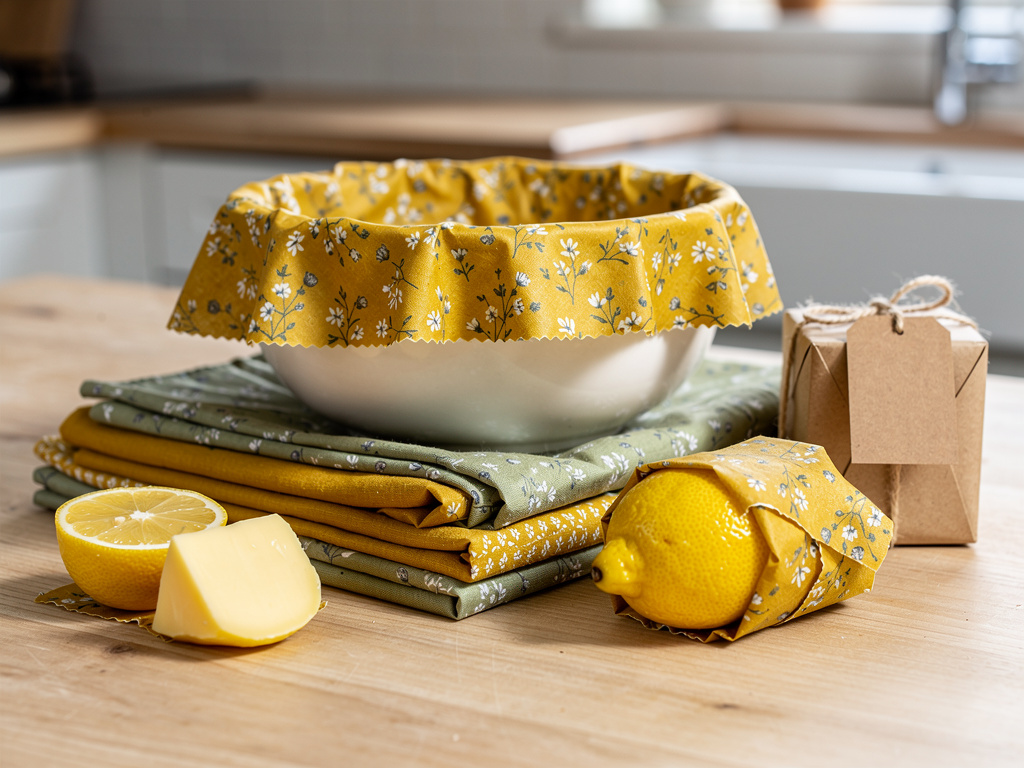


The short version: You can sell beeswax wraps from home without a food permit in most places, because a wrap is a household product and not food, but you still need your local business basics and you collect sales tax where your state taxes household products. Price them against the brand shoppers already know: Bee's Wrap charged $19.99 for its 3 pack of small, medium and large wraps on October 15, 2026, which works out to 5.74 cents a square inch, so a homemade set of the same three sizes at $18 sits just under it. Keep your label to what the wrap does, because the FTC's Green Guides want proof behind "eco-friendly" and "compostable," and the EPA treats a germ-killing claim as a pesticide claim. Sell locally first, since the cheapest USPS Ground Advantage retail parcel price was $8.40, nearly half the price of an $18 set, unless the set mails flat as a $2.27 First-Class large envelope.
Checked on October 15, 2026: Bee's Wrap's product pages and FAQ, USPS Price List Notice 123 (effective October 4, 2026), 16 CFR 260.1, 260.4, 260.7 and 260.9, 40 CFR 152.15, 16 CFR 1200.2, the Texas Comptroller's sales tax page, and the pricing pages of Homegrown, Etsy, Shopify, Square and Venmo. City and county rules for a home business differ, so verify your state's and city's current rules before your first sale. Homegrown customers create an account to place their first order, and Homegrown's signup page lists pickup and local delivery, not shipping.
A neighbor saw the wrap folded over your salad bowl at a potluck and asked where you bought it. Then a coworker wanted a set for her sister. Now you have a pile of cotton remnants, a block of wax and a question: can a few sets a week turn into a small side business you run from your kitchen table?
It can, and wraps are friendlier to a home business than most products. They do not spoil, they weigh almost nothing, and one set fits in an envelope. This guide skips the recipe (our beeswax products guide already walks through it step by step) and covers the selling side: the words you can and cannot print, the sizes to make, the price per square inch, what shipping really costs, and the cheapest way to let local buyers order.
Most home wrap businesses need no food permit, because a beeswax wrap is a reusable cover for food, not something anyone eats. Cottage food laws exist for jam, bread and cookies made in a home kitchen. A wrap sits outside them, the same way a cutting board or a dish towel does.
That does not mean zero paperwork. A home wrap business usually still runs into the same basics as any other craft business:
Our guide on whether you need a license to sell crafts goes deeper on the registration and tax side, state by state.
We did not find a federal rule that requires a home beeswax wrap business to register or get approval before selling, but some states and cities have their own rules for products that touch food, and home business rules vary by city. Call your city clerk and your state revenue department before your first sale, and verify your state's current rules each year.
Stick to claims you can prove about the wrap itself, like its size, its ingredients and that it can be washed and reused for up to about a year. The FTC's Green Guides set out the FTC's current views on environmental marketing claims. They do not bind sellers on their own, but under 16 CFR 260.1 the FTC can take action under the FTC Act against an environmental claim that goes against them. Wraps are sold almost entirely on environmental promises, so the guides apply to almost every listing.
Three wrap claims run into the Green Guides most directly:
Safer wording that still sells:
Calling a wrap antibacterial or antimicrobial can turn it into a pesticide in the EPA's eyes, and selling an unregistered pesticide is against federal law. Some wrap descriptions online use it, because beeswax and some oils are said to resist germs.
The rule sits in 40 CFR 152.15. It says "no person may distribute or sell any pesticide product that is not registered," and it counts a product as a pesticide when the person selling it "claims, states, or implies" that it can be used for "preventing, destroying, repelling, or mitigating any pest." The EPA's list of pests in 40 CFR 152.5 includes "any fungus, bacterium, virus" or other microorganism, except those on or in people and animals, and those in or on processed food, drugs and cosmetics. Germs on a wrap's own cloth are not on that list of exceptions, so a claim that the wrap kills them lands on the pesticide side.
There is a narrow exemption for treated articles in 40 CFR 152.25, but it covers a product treated with a registered pesticide "to protect the article or substance itself," like paint that resists mildew. It does not cover a claim that the wrap protects your family. Germs in or on processed food fall under the exception above, so a claim about your cheese or bread is not cleanly an EPA pesticide claim, but leave it off the label anyway along with the rest of the list below.
Words to keep off your label, listing and booth sign:
"Breathable" and "keeps cheese from drying out" describe what a wrap does without promising to kill anything. On an $18 set, those plain words cost you nothing, while a single antibacterial line puts the whole listing on the wrong side of a federal rule.
A wrap printed and sold for kids can count as a children's product, and children's products need third-party lab testing and a written Children's Product Certificate before you sell them. That testing is a cost you pay before you sell a single wrap.
Under 16 CFR 1200.2, a children's product is "a consumer product designed or intended primarily for children 12 years of age or younger." The CPSC looks at four factors, including your own label and how the product is shown "in its packaging, display, promotion, or advertising." The CPSC's children's products page then says these products "are required to undergo third-party testing and to have a written Children's Product Certificate."
So the same sandwich wrap can be sold two ways:
A label that says "not for children" does not settle it either, because the CPSC weighs all four factors. If you want a kids' line someday, price the lab testing first. Until then, sell a $10 sandwich wrap as a kitchen product for everyone.
Start with the three sizes shoppers already know, small (7 by 8 inches), medium (10 by 11) and large (13 by 14), sold as singles and as a set of three. Bee's Wrap uses those exact sizes, so a buyer can compare yours on the spot, and its FAQ ties each size to a food.
Slide the size table left to see when to add each one.
| Size | Inches | What it covers (Bee's Wrap FAQ) | Bee's Wrap price, Oct 15, 2026 | Add it when |
|---|---|---|---|---|
| Small | 7 by 8 | Avocados, lemons, onions and other small produce | Sold in the 3 pack, not alone | From day one, inside your set |
| Medium | 10 by 11 | Cheese, vegetables and cut fruit | $6.99 single | From day one |
| Large | 13 by 14 | Sandwiches, bowls and leftovers | $7.99 single | From day one |
| Sandwich wrap with tie | 13 by 13 | A sandwich, then a placemat | $9.99 | Once singles sell |
| Bread wrap | 17 by 23 | Artisan and homemade loaves | $14.99 | When bakers or bread buyers ask |
| Cut-to-size roll | 14 by 53 | Large dishes and odd shapes | $24.99 | Later, for repeat buyers |
Sizes, prices and uses come from Bee's Wrap's product pages and FAQ, loaded October 15, 2026. Bee's Wrap also sold vegan wraps made with candelilla wax, soy wax and coconut oil, but both vegan singles were sold out that day.
Three sizes plus a set is plenty for a first season. Every extra size is another fabric cut, another photo and another option in your listing, so add the sandwich wrap, bread wrap and roll only after buyers ask for them by name.
Price small and mixed sets at about 5 to 6 cents a square inch and bread-size sheets at about 3.5 to 4 cents, which is where most of Bee's Wrap's own prices landed on October 15, 2026; its roll and 20-large bulk pack ran lower. Dividing price by area lets you price any size you cut without guessing, and it shows you where a single wrap is quietly priced higher than a set.
Here is Bee's Wrap's line, worked out per square inch:
Swipe the price table to see the cents per square inch.
| Bee's Wrap product | Total area | Price | Cents per square inch |
|---|---|---|---|
| Single medium (10 by 11) | 110 sq in | $6.99 | 6.35¢ |
| Medium 3 pack | 330 sq in | $19.99 | 6.06¢ |
| Sandwich wrap with tie (13 by 13) | 169 sq in | $9.99 | 5.91¢ |
| Assorted 3 pack (S, M, L) | 348 sq in | $19.99 | 5.74¢ |
| Single large (13 by 14) | 182 sq in | $7.99 | 4.39¢ |
| Large 3 pack | 546 sq in | $21.99 | 4.03¢ |
| Bread wrap (17 by 23) | 391 sq in | $14.99 | 3.83¢ |
| Queen Bee Pack, 25 medium | 2,750 sq in | $99.99 | 3.64¢ |
| Cut-to-size roll (14 by 53) | 742 sq in | $24.99 | 3.37¢ |
| Queen Bee Pack, 20 large | 3,640 sq in | $99.99 | 2.75¢ |
Prices from Bee's Wrap's online store, loaded October 15, 2026. Area is width times length, added up for packs. Cents per square inch is price divided by area.
Bee's Wrap price per square inch (cents)
Source: Bee's Wrap online store, October 15, 2026, five products from the table above.
What that means for your own price list:
Being a little under the national brand works for a local vendor, because your buyer saves on shipping too. Pricing far under it, like $10 a set, tells shoppers something is missing.
Supplies for one set of three wraps came to $3.58 to $4.03 in our beeswax products guide, using supplier prices loaded October 12, 2026. That guide lists the fabric, wax, pine rosin and jojoba oil line by line, with the Utah State University Extension recipe.
At an $18 price, that leaves $13.97 to $14.42 per set before your time, packaging and any selling fees. Here is where the rest of a typical home set goes:
Cut every set from the same fabric so the three pieces match, then turn the leftover strips into small 7 by 8 inch wraps. A 58 by 36 inch yard fits 4 large, 5 medium and 8 small wraps, so it makes 4 full sets with 1 medium and 4 smalls left over. Sell the extra smalls as $3 singles, which is 5.4 cents a square inch, right in line with your set.
Check every wrap against the same 6 points before it goes in a set, because one sticky, flaking or patchy wrap is a likely reason a buyer never reorders. Wraps that work are your best ad, since buyers use them every day in front of their families.
Keep one wrap from each batch in your own kitchen and use it for 4 weeks. That is the fastest way to learn whether a recipe change actually held up in daily use, not just on the drying rack.
A care card should fit 5 lines: what is in it, how to use it, how to wash it, what to avoid and how long it lasts. The care facts below come from Bee's Wrap's FAQ, loaded October 15, 2026, so your card matches what the national brand tells its own buyers.
Put these on your card:
Add your business name and a way to reach you, like your storefront link or a QR code. A buyer who loves the set needs a simple way to order the next one.
Show a wrap in use in your first photo and the size of each piece in your second, because a flat square of printed cotton does not explain itself. Shoppers who have never used a wrap need to see it hold a shape.
A photo set that works for most listings:
Your first 2 photos do most of the work, so spend your time there. In the description, lead with the sizes in inches and what each one covers, then the ingredients, then the care lines from your card. Skip the claims from the label section above. "Covers a 9 inch bowl" will sell more wraps than "eco-friendly" ever will, because it answers the question the buyer actually has. Put the price per set, like $18 for three, in the first line too, so nobody has to message you to ask.
Sell locally first, because USPS Ground Advantage retail postage for a small package ran $8.40 to $10.20 on October 15, 2026, which is 47% to 57% of an $18 set. A set of three wraps is light (Bee's Wrap's store data gives its 3 pack a weight of 79 to 80 grams, under 3 ounces), so weight is not the problem. The minimum parcel price is.
Slide the postage table to see every zone.
| Distance (USPS zone) | Ground Advantage retail, up to 8 oz | Share of an $18 set |
|---|---|---|
| Zone 1 (nearby) | $8.40 | 47% |
| Zone 2 | $8.55 | 48% |
| Zone 4 | $8.80 | 49% |
| Zone 6 | $9.50 | 53% |
| Zone 8 | $10.20 | 57% |
| Zone 9 (farthest) | $10.20 | 57% |
From USPS Price List Notice 123, effective October 4, 2026, the USPS Ground Advantage retail parcels table, loaded October 15, 2026. Labels bought through a shipping service or marketplace can be priced differently.
A set folded flat can go much cheaper as a First-Class Mail large envelope: the same notice lists $2.27 up to 3 ounces and $2.56 up to 4 ounces, for an envelope up to 15 by 12 inches and 3/4 inch thick. The notice also says a large envelope that is "rigid, nonrectangular, or not uniformly thick" pays parcel prices, so a set that bulges or ships in a box goes back to the Ground Advantage table above.
If a set has to go as a parcel or in a box, shipping still makes sense in three cases:
Summer heat is the other risk. Bee's Wrap's FAQ warns that heat softens the wax coating, so a package left in a hot mailbox can arrive with its wax softened.
A good starting mix for a home wrap vendor is 3 places: a pickup link for neighbors, one in-person table a month, and one or two local shops. Wraps are easier to sell when people can touch them, and local buyers skip the $8.40 postage.
Places to try, roughly in order of effort:
If you already sell bread, honey or cheese, add wraps to that same table or storefront. A buyer picking up a sourdough loaf is the easiest bread wrap sale you will ever make.
Yes, but you only keep about $5 a set if a shop pays you half of an $18 retail price, so wholesale works best once your batch time is fast. Zero-waste and refill shops are a natural fit, because their customers already shop for plastic wrap replacements.
Here is that example worked out with the supply cost above:
Each shop sets its own terms, so ask before you quote. Some buy outright at a wholesale price, and others take products on consignment and pay you a share after each sale. Get the terms in writing either way: the split, how often they pay, and who absorbs a damaged or faded set.
A shop order is still worth it for reasons beyond the margin. One order moves a whole batch in a single handoff, and the shop's shelf puts your wraps in front of buyers you would never reach from your porch. Print your storefront link on the care card so a buyer who wants a bread wrap the shop does not carry can order it from you directly.
On a $20 wrap set picked up locally, you pay $0.48 through a Venmo business profile, $0.88 on Homegrown or Shopify and $0.96 on Square's free plan, and the same $20 set costs $2.35 in Etsy fees before shipping, all before any monthly plan. Over 50 orders a month, the gap between the cheapest and the most expensive row is $93.50 in fees.
Swipe left for the full fee stack on every row.
| Way to take orders | Monthly plan | Trial | Platform or listing fee | Card processing | Customer pays on a $20 order | Vendor pays on a $20 order | Vendor pays in a month of 50 orders at $20 |
|---|---|---|---|---|---|---|---|
| Texts or Instagram messages, paid through a Venmo business profile | $0 | None needed | None | 1.9% + $0.10 per payment, paid by the vendor | $20.00 | $0.48 | $24.00, plus every order typed up by hand |
| Etsy | $0 (Etsy Plus is an optional $10 a month) | None needed (a one-time set-up fee may apply) | $0.20 listing fee for each item sold (one set here) plus a 6.5% transaction fee ($1.30) | 3% + $0.25 through Etsy Payments ($0.85), paid by the vendor | $20.00 plus shipping | $2.35 | $117.50 |
| Square Online, Free plan | $0 (Square Plus is $49 a month per location) | None needed | None | 3.3% + 30¢ online, paid by the vendor | $20.00 | $0.96 | $48.00 |
| Shopify Basic | $29 billed yearly ($39 monthly) | 3 days, then $1 a month for 3 months | None with Shopify Payments | From 2.9% + 30¢ online, paid by the vendor | $20.00 | $0.88 plus the plan | $73.00 ($83.00 on monthly billing) |
| Homegrown storefront | $10 billed annually ($12.50 monthly) | 7 days, no charge until day 8 | None, 0% commission | 2.9% + $0.30, paid by the vendor | $20.00 | $0.88 plus the plan | $54.00 ($56.50 on monthly billing) |
Every price comes from the company's own page, loaded October 15, 2026: Venmo's fees page, Etsy's Fees and Payments Policy and Etsy Payments Policy, Square's online store plans page, Shopify's pricing page and Homegrown's signup page. The math is figured on the $20 price with no shipping or sales tax. Etsy's Payments Policy says shops agree to ship what they sell, and on a shipped order its 6.5% transaction fee and its payment fee also apply to the shipping charge. An Etsy order that came through Etsy's Offsite Ads adds a 15% fee for a shop under $10,000 a year in sales that has not opted out, or 12% once a shop passes $10,000.
The shipped Etsy order is where the stack really grows. An $18 set plus $8.40 shipping is a $26.40 order, and Etsy's fees on it come to about $2.96: the $0.20 listing fee, 6.5% of $26.40 ($1.72), and 3% of $26.40 plus $0.25 ($1.04).
The Venmo row is cheapest on paper, but each order is a message, a payment request and a note about which print and which pickup day. At 50 orders a month, that is 50 threads to track by hand.
If people near you already ask for your wraps, the simplest fix is one link where they pick a set, pay and choose a pickup day without a single message. Homegrown gives you that storefront for $10 per month billed annually with no percentage fees beyond standard payment processing (2.9% + $0.30, paid by you and never added to your buyer's total), which is $0.88 on a $20 set.
How it compares for a wrap vendor selling locally:
The parts that fit wraps:
The honest limits: customers create a Homegrown account to place their first order. Homegrown's signup page lists pickup and local delivery, not shipping, so buyers in other states are still an Etsy or Shopify job. Your storefront is listed on Homegrown's marketplace, but plan on most orders coming from people you send to your own link. You can build your beeswax wrap storefront during the 7-day trial, with no charge until day 8.
Not yet: a pull of the Homegrown catalog on October 15, 2026 found 0 beeswax food wraps among 2,927 products from 324 vendors. Three products mention beeswax, and none of them is a wrap.
We pulled all 2,927 products from 324 vendors on October 15, 2026, and read every name, description and option that mentioned beeswax, bee wax, wax, wrap, food wrap, reusable, plastic-free or zero waste. The only beeswax products were 3: a block of pure beeswax from the farm's own hives at Country Apple Orchard Farm Stand ($3 for 2 ounces, $4 for 3 ounces, sold in store), lotion bars from D&D Bees ($7) and a 4-pack of lip balm from Mixtapes and Tallow ($16). The other listings that said "wrap" were foods or serving ideas (lettuce, tortillas, steak "for wraps"), a soap that lets you "wrap yourself" in its scent, and two knitted pieces. The closest kitchen product was a reusable linen bread bag from Country Rise Bread Works ($15). Bakery products were 1,536 of the 2,927, or 52%.
That cuts both ways. A wrap vendor who lists today has the category to themselves, and more than half the catalog is bread and baked products, the exact food a bread wrap is made for. It also means nobody is shopping Homegrown for wraps yet, so your first orders will come from the people you hand your link to.
If you keep bees or already sell honey, candles or soap, adding a wrap set to that storefront is a small test with no new setup. A buyer picking up a jar of honey can add a set to the same order.
Plan on a reorder about a year after the first sale, since Bee's Wrap's FAQ says a wrap lasts up to one year with regular use and proper care. A beeswax wrap wears out on a schedule, which gives a small vendor a natural repeat purchase without any extra selling.
Ways to earn that second order:
Repeat buyers are also your best photographers. Ask a regular for a picture of a wrap that made it through a year, and use it on your listing with her permission.
You can usually sell beeswax wraps from home without a food permit, because a wrap is a household product and not food. Many home vendors still need a sales tax permit in states with a sales tax, a business name registration if they use one, and sometimes a city home occupation permit. Verify your state's and city's current rules before your first sale.
A set of three wraps in the common small, medium and large sizes (7 by 8, 10 by 11 and 13 by 14 inches) priced at $16 to $20 sits right around the national brand. Bee's Wrap charged $19.99 for that same set on October 15, 2026, or 5.74 cents a square inch. At $18, a homemade set is 5.17 cents a square inch and still keeps about $14 after supplies.
No. Under the EPA's rule at 40 CFR 152.15, a product sold with a claim that it prevents or destroys pests, including germs, counts as a pesticide, and pesticides must be registered before they are sold. Describe what the wrap does instead: it covers bowls, molds to cheese and bread, and washes in cool water.
Shipping a single set as a parcel rarely pays, because USPS Ground Advantage retail postage for a package under 8 ounces ran $8.40 to $10.20 on October 15, 2026, about half the price of an $18 set. A set folded flat in a First-Class Mail large envelope cost $2.27 to $2.56 for 3 to 4 ounces, as long as the envelope stays flexible and uniformly thick. Parcel shipping works better for bundles over $35 to $40 or for holiday gifts. For neighbors and coworkers, local pickup keeps the full price in your pocket and the buyer's.
A lightweight, tightly woven 100% cotton is the usual choice, and Bee's Wrap uses organic cotton in its wraps. Prewash it, cut it with pinking shears, and keep every piece in a set from the same fabric. A synthetic thread or trim rules out a compostable claim, and even an all-cotton wrap needs the scientific evidence the FTC's Green Guides ask for before you print the word.
With regular use and proper care, a beeswax wrap lasts up to about a year, according to Bee's Wrap's FAQ. Hand washing in cool water and keeping it away from heat makes it last longer. That one-year life is why beeswax wraps from home make a good repeat product: a buyer who liked the first set is ready for a new one the next fall.
These guides cover the parts of a beeswax wrap business this one only touches, from the recipe and supply list to the paperwork and the platform choice. Each one was live on findhomegrown.com/blog on October 15, 2026, and together they cover the 3 jobs this guide leaves out: making the wraps, registering the business and choosing a platform for shipped orders.
The fall and holiday months are when wraps sell as gifts, so a pickup link set up in October has a full season ahead of it. Make your first 10 sets in matching prints, write a care card that only promises what a wrap does, and price the set at $16 to $20. Then send one link to the people who already asked. Ten sets at $18 is $180 in sales, and every set that goes home with a dated care card is a reorder waiting for next fall.
A Homegrown storefront for your beeswax wraps costs $10 a month billed annually, takes card payments at 2.9% + $0.30 per order with no commission, and handles sales tax on the products that need it. Your neighbors pick a set and a pickup day, and you see a list of what to bring to the door. When a coworker asks for a bread wrap in March, you add it as a new option instead of starting another message thread.



