
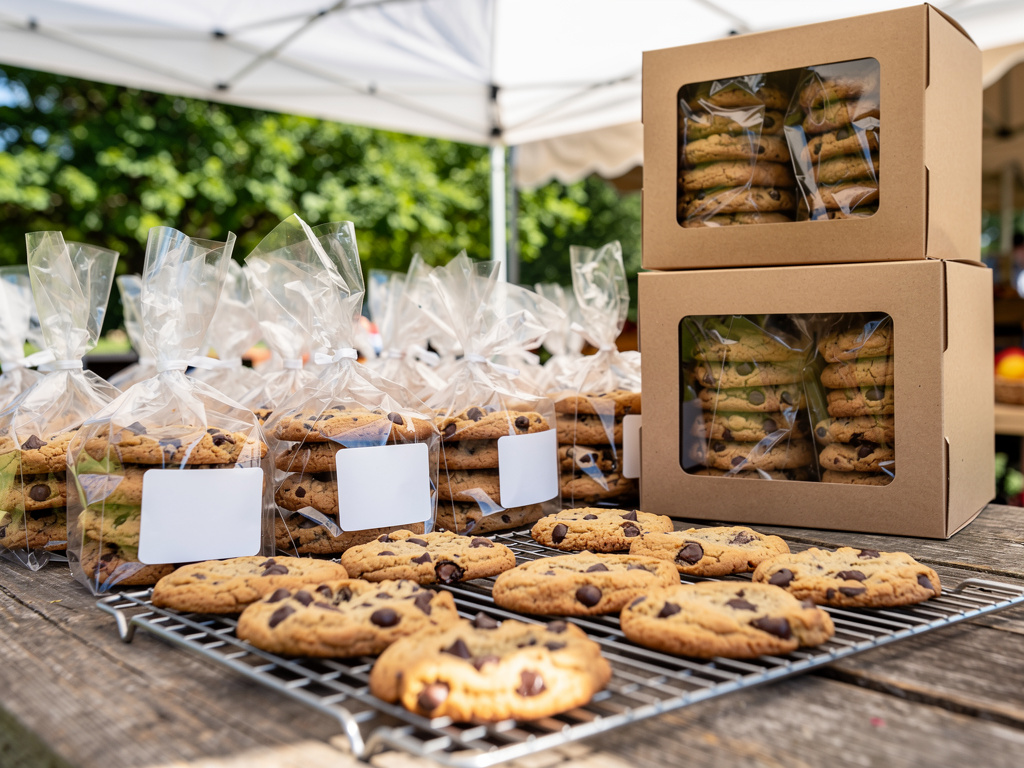


The short version: In this cookie income report, one home baker sells chocolate chip cookies at three real metro Detroit farmers markets in September 2026: four Thursdays in Westland, two Saturdays in Ypsilanti and two Sundays in Birmingham. She sells $2,310 of cookies, $336 of it as dozens pre-ordered for pickup at her booth, and keeps $1,281.65 after ingredients, packaging, card fees, booth fees, insurance, driving and the $10 Homegrown plan. That works out to $13.72 for each of the 93.4 hours the month took, before taxes. Birmingham cost the most to get into and still paid best per hour, while the Thursday evening market in Westland paid worst because nearly a third of the cookies she brought there went home.
Checked on October 14, 2026: booth fees and market rules come from each market's 2026 vendor documents, supply prices from Walmart.com and WebstaurantStore, and every card and platform fee from each company's own pricing page, all loaded that day. The cookie counts, how many sold and the hours are a stated model, not one real baker's books. Homegrown customers create an account to place their first order, and Homegrown has no drops feature.
If you sell cookies at one farmers market, the next question is usually whether a second and a third would pay. This income report follows one month of doing exactly that. It covers three real markets near Detroit, each with its own fee rules and each with a different crowd, and it tracks every cookie, every fee and every hour.
You will see what each market cost to get into, how many cookies went home unsold, what the card reader took, and which market paid best for the time. If you want the bigger picture across a full year first, our breakdown of how much farmers market vendors make runs the USDA numbers by market day and by season.
One thing up front: the baker in this report is a model, not a real person's ledger. The prices, fees and market rules are real and dated. The cookie counts and hours are our assumptions, so swap in your own.
In this model, one month of cookies at three farmers markets brought in $2,310 in sales and left $1,281.65 after every cash cost. That is about 55 cents kept from each dollar of sales. Across 93.4 hours, it pays $13.72 an hour before taxes.
Here is the whole month in one table, market by market.
Scroll sideways to see hours and pay per hour.
| Market | Market days | Sales | Costs | Kept | Hours | Kept per hour |
|---|---|---|---|---|---|---|
| Westland (Thursday evening) | 4 | $708.00 | $301.44 | $406.56 | 35.2 | $11.55 |
| Ypsilanti (Saturday morning) | 2 | $612.00 | $269.52 | $342.48 | 22.2 | $15.43 |
| Birmingham (Sunday) | 2 | $990.00 | $447.39 | $542.61 | 32.0 | $16.96 |
| Homegrown plan and weekly admin | None | $0.00 | $10.00 | minus $10.00 | 4.0 | Not counted per market |
| The whole month | 8 | $2,310.00 | $1,028.35 | $1,281.65 | 93.4 | $13.72 |
Model built for this post on October 14, 2026. Every price and fee was loaded that day. Cookie counts, how many sold and the hours are our assumptions. "Kept" is before income tax and self-employment tax.
Three things stand out before the details:
No, she is a model built for this post, and we say so because a made-up diary would be worse than useless to you. We built one realistic home baker in Westland, Michigan, who sells under Michigan's cottage food law. Then we put her at three markets whose 2026 rules we could read and quote, for eight market days in September 2026.
Here is what is real and what we assumed:
The point of the model is the method. Every line can be swapped for your own number, and the last section shows how.
She sold at the Westland Farmers & Artisan Market on Thursdays, the Ypsilanti Farmers Market on Saturdays and the Birmingham Farmers Market on Sundays. Their booth fees ran from $15 to $40 a day, and each one asked for something different beyond the fee.
Swipe left to see each market's other rules.
| Market | Day and hours | Booth fee she paid | Other fee choices | What else the market asks for |
|---|---|---|---|---|
| Westland Farmers & Artisan Market, Wayne County | Thursdays 3 to 7 p.m., setup from 1 p.m. | $60 for four Thursdays, paid at once ($15 a day) | $20 a day paid a week ahead, $25 paid the day of market, $250 for the season | Every cottage food product pre-packaged and fully labeled before the market opens |
| Ypsilanti Farmers Market, Downtown | Saturdays 9 a.m. to 1 p.m. | $15 a day, two days | $12 a day when you pay for four or more markets at a time | Liability insurance, a copy of your sales tax ID, arrive an hour early, stay all four hours, accept eligible market tokens, turn in a sales tally each day |
| Birmingham Farmers Market, Oakland County | Sundays 9 a.m. to 2 p.m., setup from 7 a.m. | $40 a week, two weeks | A 20% discount for six or more weeks paid by April 15 | $1,000,000 liability insurance, a copy of your Michigan sales tax license, a tent, and a permit for samples |
Read on each market's 2026 vendor document on October 14, 2026: the Westland 2026 Vendor Application, the Ypsilanti Farmers Markets 2026 policies and the Birmingham Farmers Market Rules and Regulations (revised January 29, 2026).
Westland and Ypsilanti name cottage food vendors in their 2026 documents, and Birmingham lists baked goods among the items it sells; each market approves its own vendors, and Westland takes three of each type of vendor. Michigan's agriculture department says you can sell up to $50,000 a year of cottage foods, cookies included, with no license, registration or inspection, and every label must say "Made in a home kitchen not inspected by the Michigan Department of Agriculture and Rural Development." The same one-pager lets a cottage food baker take orders online only for sale or delivery within Michigan, and only if she gives the buyer a chance to talk with her before the sale; the pre-orders in this model come from customers she met at her booth. The full label list and the rest of the rules are in our guide to Michigan's cottage food law.
Rules differ by state and by market, and they change. Verify your state's current rules and read your own market's vendor packet before your first sale.
Her September 2026 had eight market days: every Thursday in Westland plus one weekend market each week, Ypsilanti and Birmingham taking turns. Pre-order pickups at the booth grew from none in the first week to four dozen on the last Sunday.
The walk-up sales stay flat on purpose. We did not want the model to assume a market grows in one month. The only thing that grows is the pre-order line, because customers who met her at the booth scanned her code and ordered next week's dozen ahead.
She charged $3 a cookie and $24 for a dozen, the middle prices home bakers list on Homegrown, and $15 for a half dozen, inside the catalog's usual range but below its middle of about $18. Pricing to the catalog keeps the model honest, because a made-up price can make any month look good, and the low half-dozen price keeps this month on the cautious side.
Her menu was the same at all three markets:
In a pull of the Homegrown catalog on October 14, 2026 (2,924 products from 322 vendors, 1,538 of them in Bakery), 39 vendors listed a full dozen cookies and the middle price was $24, with half of them between $16 and $33. 31 vendors listed a half dozen, with a middle price of about $18 and half of them between $12 and $22, and 23 listed a single cookie with a stated count, with a middle price of $3.
The rule behind the count: Bakery and ready-to-eat listings with cookie, snickerdoodle, shortbread or cinnadoodle in the name or the description, plus the same bakers' other cookie listings, each one read by hand, with the pack size read from the size options, the name or the description. We left out minis, jumbo cookies named as such, sandwich cookies and cream pies, custom decorated cookies, bars, brownies and brookies, kits, cookie dough and assortment boxes, and took one price per vendor for each pack size. Single cookies listed without a stated count were left out, so the 23 single-cookie vendors are an undercount.
What 39 Homegrown vendors charge for a dozen cookies
Source: Homegrown catalog pull, October 14, 2026, 39 vendors, one price per vendor. Most of the 12 vendors at $30 and up sell chocolate chip dozens, one of them sourdough and one palm-size; the rest sell gluten-free, organic or stuffed cookies.
Our cookie selling guide counted 43 bakers selling by the dozen at a typical $22 on September 30, against 39 here; the guide's count kept pizzelle, this one leaves out pizzelle, minis and custom decorated cookies, and the two were pulled two weeks apart, so treat $22 to $24 as the going rate. A dozen at $24 works out to $2 a cookie, a third less per cookie than a single at $3. That gap is why the dozen box matters at a booth: it turns one $3 impulse buy into one $24 sale.
One batch of King Arthur Baking's classic chocolate chip cookie recipe cost $6.29 at Walmart.com prices on October 14, 2026. She portions it into 16 cookies of about 2 1/2 ounces, so each cookie costs about 39 cents in ingredients.
Slide the table left to see the cost of each ingredient.
| Ingredient (King Arthur recipe) | Amount per batch | Walmart.com price | Cost per batch |
|---|---|---|---|
| Semisweet chocolate chips | 340 g (2 cups) | $9.38 for 36 oz, Great Value | $3.12 |
| Vanilla extract | 2 teaspoons | $9.76 for 4 fl oz, Great Value | $0.81 |
| Unsalted butter | 113 g (8 tablespoons) | $3.06 a pound, Great Value | $0.76 |
| Vegetable shortening | 92 g (1/2 cup) | $7.97 for 48 oz, Crisco | $0.54 |
| Light brown sugar | 142 g (2/3 cup) | $2.87 for 32 oz, Dixie Crystals | $0.45 |
| Granulated sugar | 131 g (2/3 cup) | $2.97 for 4 lb, Great Value | $0.21 |
| All-purpose flour | 240 g (2 cups) | $1.97 for 5 lb, Great Value | $0.21 |
| Egg | 1 large | $2.47 for 18, Great Value | $0.14 |
| Salt, baking soda, vinegar | 3/4 tsp, 1 tsp, 1 tsp | Morton salt, Great Value soda and vinegar | $0.04 |
| One batch, 16 cookies | About 1,130 g of dough | None | $6.29 |
Recipe from King Arthur Baking's Classic Chocolate Chip Cookies page (36 small cookies as written); prices from Walmart.com search results, all loaded October 14, 2026. Each row is rounded to the cent, so the rows add to $6.28; the unrounded batch is $6.286, or $0.393 a cookie.
The chocolate chips are half the batch: $3.12 of $6.29. The vanilla is next, at 81 cents, more than the butter. If you are looking for the line that moves your cost, it is the mix-ins, not the flour.
Across the month she baked 1,196 cookies, about 75 batches, for $469.87 in ingredients. The model costs every cookie at the chocolate chip price, which is the high end of a typical menu, so a snickerdoodle-heavy table would cost a little less. To build this number for your own recipes, the cost per dozen cookies breakdown walks through it line by line.
Packaging added $93.74 for the month, about 4% of sales. Westland's application requires every cottage food product to be pre-packaged and fully labeled before the market opens, so nothing could sit loose on a tray.
Here is what each format cost her, using prices loaded October 14, 2026:
Packaging is small next to ingredients, but it is the part people forget. A single cookie's bag and label cost about a third as much as the cookie inside it.
244 of the 1,196 cookies she baked went home unsold, about one in five. Their ingredients and packaging cost $114.27, and in this model every one of them counts as a loss.
The leftovers were not spread evenly:
Leftovers are the line that turns a cheap booth into an expensive one. Westland's booth cost $15 a day, but its unsold cookies cost $49.08 over four Thursdays, close to the $60 she paid for all four booth days. In real life you might freeze dough instead of baking it, or sell day-old cookies at a discount, but you cannot count on either until you have tried it.
Bake for the market you have, not the one you hope for. When the model brings 26 singles, 3 half dozens and 1 dozen to Westland, close to what actually sold, the month keeps $44.86 more and frees about three hours of baking. Write down what you brought and what you carried home after every market; after three weeks the right number is obvious.
Card fees took $117.77 for the month: $103.82 on Square for walk-up sales and $13.95 on Homegrown for the 14 pre-ordered dozens. The model rings every walk-up sale on a card, one cookie, bag or box at a time, so this is the high end; cash sales would cost less.
On Square's free plan, Tap to Pay on her phone costs 2.6% + 15 cents per in-person sale. Small sales pay a bigger share because of the fixed 15 cents. Here is the Square fee on each size she sells:
Pre-orders run through an online checkout instead, and every online option has its own fee stack. Here is what a $24 pre-ordered dozen costs on each, with every fee shown.
Scroll sideways to see every option's full fee stack.
| Option | Monthly plan | Trial | Platform fee | Card processing | Customer pays on a $24 dozen | Baker pays on a $24 dozen | Baker pays in a month of 50 orders at $24 |
|---|---|---|---|---|---|---|---|
| Homegrown | $10 billed annually ($12.50 billed monthly) | 7 days, no charge until day 8 | $0 (0% commission) | 2.9% + $0.30, paid by the baker | $24.00 | $1.00 plus the plan | $59.80 ($62.30 billed monthly) |
| Square Free, online store | $0 | No trial (free plan) | None | 3.3% + 30¢ online, paid by the baker | $24.00 | $1.09 | $54.60 |
| Square Free, in person at the booth | $0 | No trial (free plan) | None | 2.6% + 15¢, paid by the baker | $24.00 | $0.77 | $38.70 |
| Hotplate, default | $0 | No subscription | 5% + $0.55, paid by the customer | 2.9% + $0.30, paid by the baker | $25.75 | $1.00 | $49.80 |
| Hotplate, baker covers the fee | $0 | No subscription | 5% + $0.55, paid by the baker | 2.9% + $0.30, paid by the baker | $24.00 | $2.75 | $137.30 |
Checked on Homegrown's signup page, Square's pricing page and Hotplate's pricing page on October 14, 2026. Hotplate's pricing page says you can pay its fee yourself or pass it to customers, "your choice"; its post "What Hotplate does" says it charges the fee to your customer and that 80% of its chefs keep that default. Card processing is figured on the $24 price.
At 50 pre-orders a month, Square's free online store costs the baker a few dollars less than Homegrown, and Hotplate's default costs her less again while her customer pays $1.75 more per dozen. The booth reader is the cheapest of all. Apart from Hotplate with the baker covering its fee, these options run from $38.70 to $59.80 a month at 50 orders with Homegrown billed annually, a gap of about $21, or up to $62.30, a gap of about $24, if you pay Homegrown monthly; the bigger money is in the leftovers above.
Birmingham paid best per hour at $16.96, ahead of Ypsilanti at $15.43, and Westland paid least at $11.55. Here is every line, market by market.
Swipe sideways to see all three markets side by side.
| Line | Westland, 4 Thursdays | Ypsilanti, 2 Saturdays | Birmingham, 2 Sundays |
|---|---|---|---|
| Walk-up sales | $564.00 | $564.00 | $846.00 |
| Pre-ordered dozens picked up | $144.00 (6 dozen) | $48.00 (2 dozen) | $144.00 (6 dozen) |
| Ingredients | $154.00 | $124.15 | $191.72 |
| Bags, boxes and labels | $31.76 | $25.16 | $36.82 |
| Square card fees | $31.46 | $29.36 | $43.00 |
| Homegrown card processing | $5.98 | $1.99 | $5.98 |
| Booth fees | $60.00 | $30.00 | $80.00 |
| Driving at 76 cents a mile | $18.24 (24 miles) | $45.90 (60.4 miles) | $76.91 (101.2 miles) |
| Liability insurance, split between the two markets that require it | $0.00 | $12.96 | $12.96 |
| Kept | $406.56 | $342.48 | $542.61 |
| Hours (market day plus kitchen) | 35.2 (23.3 + 11.9) | 22.2 (12.6 + 9.6) | 32.0 (17.4 + 14.6) |
| Kept per hour | $11.55 | $15.43 | $16.96 |
Model built October 14, 2026. Market-day hours include setup, selling, teardown and the drive. Kitchen hours count 24 minutes per batch of 16 cookies, 30 seconds to bag and label a single and 2 minutes per box. The $10 Homegrown plan and 4 hours of weekly admin sit outside the three columns.
A long Birmingham day runs about 8 hours and 41 minutes from leaving home to getting back: arrive at 7:30, sell from 9 to 2, take down after 2 because the rules forbid it sooner, and drive 43 minutes each way. A Westland Thursday is about 5 hours and 50 minutes. Birmingham still wins, for three reasons:
The booth fee was not the deciding cost at any of the three. Westland and Ypsilanti both paid $15 a day for a booth, and Ypsilanti still kept $3.88 more an hour. Birmingham paid the most for its booth and kept the most per hour. What separated the three markets was how much sold, not what the booth cost. If you want to find the sales level where a booth starts paying, the break-even guide for a farmers market booth shows the math.
Driving added $141.05 and insurance added $25.92, together about 7% of sales. Both are easy to leave out, and both were real money in this month.
Driving. We priced every mile at the IRS business mileage rate of 76 cents a mile for the second half of 2026, which covers gas, wear and the car's other running costs, not just fuel. Distances come from OpenStreetMap driving routes: 15.1 miles each way from the Westland market to Ypsilanti and 25.3 miles each way to Birmingham. We measured from the Westland market because the model puts her home about 3 miles from it, which is also why each Westland Thursday counts a 6-mile round trip. The two Birmingham Sundays alone cost $76.91 in driving, almost as much as their $80 in booth fees. Our mileage deduction guide covers how to log those miles for your taxes.
Insurance. Birmingham requires every vendor to carry liability insurance of $1,000,000 per occurrence and to name the market as an additional insured. Ypsilanti's 2026 policies require all vendors to carry liability insurance too, without naming an amount. Westland only encourages it. The model buys FLIP's food vendor policy on its monthly option, $25.92, which lists free, unlimited additional insureds, and splits it between the two markets that require it; the annual option starts at $299 a year. One policy covers all three markets once you have it. Compare providers in our farmers market vendor insurance guide.
Usually not: in Michigan, a cookie sold without a napkin or other eating utensil is not taxed as prepared food. Michigan Treasury's Revenue Administrative Bulletin 2026-2 says baked goods, cookies included, fall outside prepared food when they are sold without eating utensils, and it lists napkins as an eating utensil.
That is why the model collects no sales tax. Birmingham still asks every vendor for a copy of a Michigan sales tax license, and Ypsilanti asks for a copy of your sales tax ID, so this baker holds one; we did not count a fee for it.
The exclusion only applies when the cookie is sold without eating utensils, according to Michigan Treasury's bulletin. Make it your practice to hand a napkin over with each cookie and that sale may become taxable prepared food. Under the bulletin's examples, a napkin stack that buyers help themselves to does not count for a seller whose prepared food sales are 75% or less of her food sales, which covers a baker selling only bagged and boxed cookies. Bagged cookies and boxed dozens with no napkin are the safe setup. Ask Michigan Treasury if your table differs, because other states draw this line differently.
If you sell outside Michigan, our plain-language guide to sales tax at farmers markets covers how other states handle food sales.
She should set aside about $196, 15.3% of the $1,281.65 she kept, for self-employment tax, and plan for income tax on top. The IRS says the self-employment tax rate is 15.3%, and you file Schedule SE once your net earnings from self-employment reach $400 for the year.
The tax itself comes in a little lower than the set-aside. Schedule SE taxes 92.35% of your profit, so the self-employment tax on this month works out to about $181.09 ($1,281.65 x 0.9235 x 0.153). After that, the month leaves about $1,100.56, or $11.78 an hour.
Three things change this for a real baker:
The 14 pre-ordered dozens were the only part of the month with no leftovers at all, and Homegrown is built for exactly that: customers order and pay ahead, then pick up at your booth. It costs $10 a month billed annually, with no percentage fees beyond standard payment processing of 2.9% + $0.30 per order.
Here is how it fits the three-market week in this report:
How it compares: Square's free plan costs $0 a month and includes a basic online store at 3.3% + 30 cents per online order, which is a good fit if you already ring up the booth on Square and only take a few pre-orders. Hotplate charges no subscription, adds 5% + 55 cents to your customer's checkout by default and charges you 2.9% + $0.30 card processing, which suits bakers who run timed drops. Homegrown is the better fit when you want one weekly menu with pickup at several markets and a clean $24.00 checkout for your customer.
What Homegrown does not do: it has no card reader, so you still need Square or cash at the booth. Customers create a Homegrown account to place their first order. There is no drops or countdown release feature. Payouts go to your bank by next-day ACH, but 20% of each order is held for 30 days and then released automatically, so a big pre-order week shows up in your bank in two parts. Your storefront appears on the Homegrown marketplace, but plan on most orders coming from the customers you send to your own link.
If your leftovers look like Westland's, set up your pre-order storefront and put the QR code on your table this week. Customers order the dozen ahead, and you bake to the order count instead of a guess.
Doubling the pre-orders would add the most, $248.04, and dropping the weakest market would cost the most, $406.56, though it would raise her hourly pay. Here is each change run through the same model, one at a time.
Move the table sideways to see what each change keeps.
| Change | Kept for the month | Change in what she keeps | What it does to her time |
|---|---|---|---|
| Nothing (the month as reported) | $1,281.65 | None | 93.4 hours, $13.72 an hour |
| Twice as many pre-ordered dozens (28 instead of 14) | $1,529.69 | plus $248.04 | About 4.7 more kitchen hours |
| Drop Westland entirely | $875.09 | minus $406.56 | 58.2 hours, $15.04 an hour |
| Bring to Westland close to what sold (26 singles, 3 half dozens, 1 dozen) | $1,326.51 | plus $44.86 | About 3 fewer kitchen hours |
| Half of walk-up customers pay cash | $1,333.56 | plus $51.91 | No change |
| Charge $22 a dozen instead of $24 | $1,215.50 | minus $66.15 | No change |
| Pay Homegrown monthly ($12.50) instead of annually | $1,279.15 | minus $2.50 | No change |
Each row changes one thing and holds everything else at the September model. Prices and fees as loaded October 14, 2026.
The table says what the earlier sections hinted. Pre-orders move the number most because a pre-ordered dozen keeps about $17.72 after ingredients, a box, a label and the card fee, and none of it gets wasted. Dropping Westland loses money but buys back 35.2 hours, and whether that trade is worth it depends on what else you would do with a Thursday.
Run your own test by writing down six numbers for every market day for four weeks, then putting them in a table like the one above. It takes about ten minutes after each market.
If one market keeps coming in last, try fixing it before you quit it. Bring less, move pre-order pickups there, or lead with your best-selling flavor. Our guide to getting more pre-orders from farmers market customers covers how to turn booth traffic into next week's orders.
In this income report model, one home baker selling cookies at three Michigan farmers markets over eight market days made $2,310 in sales and kept $1,281.65 after ingredients, packaging, card fees, booth fees, insurance, driving and the $10 Homegrown plan. That was $13.72 an hour before taxes. A single weekly market would come in lower; the Thursday market alone kept $406.56 in four weeks.
It can be, but each market has to earn its hours on its own. In the model, the two weekend markets paid $15.43 and $16.96 an hour while the weeknight market paid $11.55, mostly because a third of its cookies went home. Track kept-per-hour for each market for a month before deciding.
Bring roughly what sold last time plus a small cushion, and adjust weekly. In this model, the Sunday market sold 170 of 208 cookies and the Thursday market sold 54 of 80, and cutting Thursday's load to what sold added $44.86 to the month. Pre-orders tell you part of the count before you bake.
About 39 cents in ingredients for a 2 1/2 ounce cookie, using King Arthur Baking's classic recipe and Walmart.com prices on October 14, 2026. A batch costs $6.29 and makes 16 cookies at that size. The chocolate chips are about half that cost, and a bag and label add about 13 cents more per single cookie.
Usually not, if the cookies are sold without eating utensils. Michigan Treasury's Revenue Administrative Bulletin 2026-2 says baked goods, including cookies, are excluded from prepared food when sold without utensils, and it counts napkins as utensils. Some markets, like Birmingham and Ypsilanti, still ask for your sales tax license or ID, so check each market's rules.
Some markets require it and some do not. In this cookie income report, the Birmingham Farmers Market required $1,000,000 in liability insurance, Ypsilanti required liability insurance without naming an amount, and Westland only encouraged it. A food vendor policy from FLIP cost $25.92 a month, or from $299 a year, on October 14, 2026.
These guides go deeper on the numbers in this report:
A month of markets is the best test you can run on a cookie business. Count what you bring, count what comes home, and let the numbers pick your markets. When you are ready for customers to order next week's dozen before you bake it, start your Homegrown storefront.



