
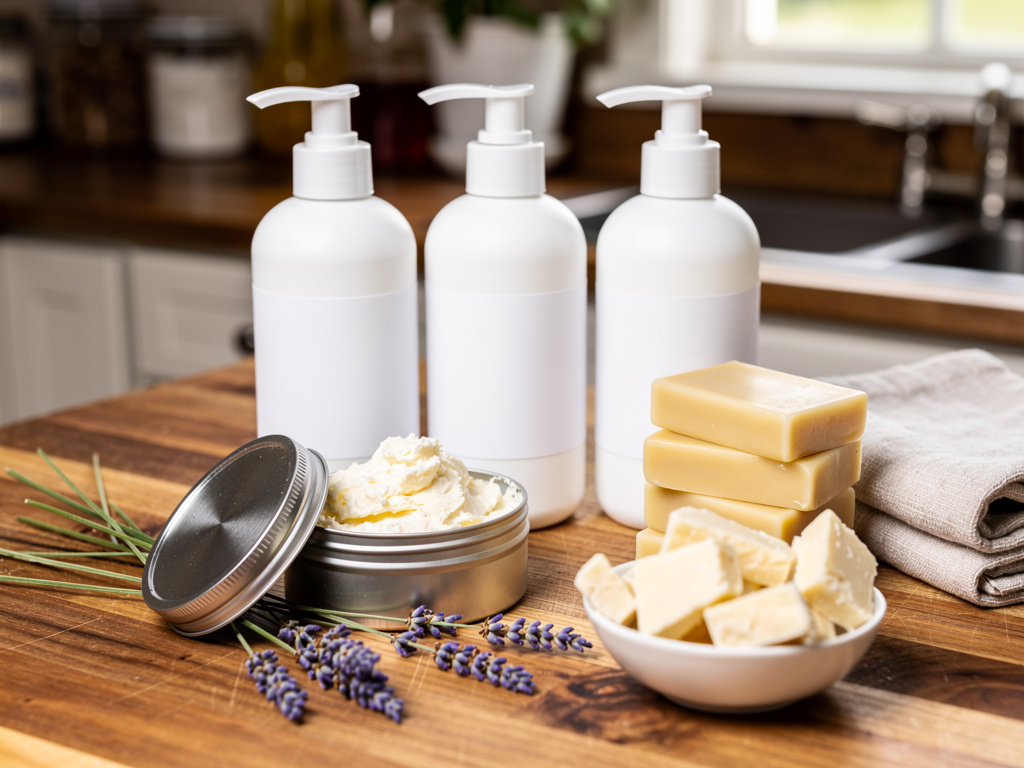


The short version: Homemade lotion made with water keeps only 3 to 5 days in the fridge without a preservative, and Humblebee and Me says water-based products are probably only good for a day or two without one, so an unpreserved bottle is not something you can sell. With a broad-spectrum preservative used at the supplier's rate and pH, a clean lotion in a pump bottle can stay good for months, and we would print a best-by date 6 months after the batch date and make only what you can sell in about 8 weeks. Waterless lotion bars, body butters and tallow balms cannot grow mold the same way and usually keep at least a year, until their oils turn rancid. Goat milk, aloe and herbal lotions spoil fastest, and Bramble Berry puts milk lotion at 2 to 4 weeks in the fridge even with a preservative.
Checked October 13, 2026: FDA's shelf life page, Humblebee and Me's preservative FAQ, Bramble Berry's lotion guide, Lotioncrafter's preservative pages, Pentyl Labs' test price and Homegrown's signup page, with the 6 month and 8 week figures as our own rule and state rules varying, so verify your state's current rules. Homegrown has no drops feature, customers create an account to place their first order, and you should plan on most orders coming from people you send to your own link.
You made a batch of lotion in August, sold half of it, and now a dozen bottles are sitting in a box in the hall closet. A regular wants two for Christmas. Are they still good to sell? With a jar of jam you would check the seal. Lotion gives you fewer clues, and the answer depends almost entirely on one thing: whether there is water in it.
This guide is for people who make lotion and sell it at a farmers market, a craft fair or from their porch. It covers how long each kind of lotion keeps, what the preservative really does, why milk and aloe shorten the clock, how to check pH at the kitchen table, what a lab test costs, what date to print and how to store and display bottles so they stay fresh. If you are still deciding whether to sell lotion at all, start with our guide on how to sell lotion from home, which covers the formula, the cost of a bottle, the label and the 2022 federal cosmetics law. This page picks up where that one stops: once the bottles exist, how long do they last?
A water-based homemade lotion lasts 3 to 5 days in the fridge with no preservative, while the same lotion made cleanly with a broad-spectrum preservative can last months, and a waterless lotion bar or body butter usually lasts at least a year. Those three numbers come from different kinds of spoilage. Water lets mold, yeast and bacteria grow. Oil does not grow mold, but it slowly goes stale, the way a bottle of cooking oil does in the pantry.
No source gives one official number for handmade lotion, because every formula, kitchen and container is different. Marie at Humblebee and Me says she tests each formula she shares, which is her own check over time and not the lab challenge test covered below. She writes that she is "reasonably confident" her water-based lotions will keep for "at least 12–24 months" the way she made and stored them, and then warns that a substitution, a jar instead of a pump, or a warmer house can all shorten it. Her site also says nothing on it "has been designed or tested for large scale manufacturing or re-sale." For a home kitchen that has not paid for a lab test, we use more careful numbers. Here is each kind of lotion a small vendor is likely to sell:
Scroll sideways to see every column.
| Kind of lotion | How long it keeps (source) | What ends it | Best-by we would print |
|---|---|---|---|
| Water-based lotion, no preservative | 3 to 5 days in the fridge; probably only a day or two in general (Humblebee and Me) | Mold, yeast and bacteria | Do not sell it |
| Water-based lotion with a broad-spectrum preservative, in a pump bottle | Months; at least 12 to 24 months for Humblebee and Me's own formulas, made and stored her way | The preservative is overwhelmed, or the oils go rancid | 6 months from the batch date (our rule) |
| The same preserved lotion in an open jar | Shorter, because fingers go in every day (FDA, Humblebee and Me) | Contamination from hands | 3 months from the batch date (our rule) |
| Goat milk lotion | At most 2 to 4 weeks, chilled, even with a preservative (Bramble Berry); Humblebee and Me calls milk impossible to preserve | The milk feeds microbes | The hardest lotion to sell safely. Do not sell it unless that exact formula, with a preservative whose supplier data covers milk, passes a lab challenge test; then print no later than the date your lab's results support, and never past our 6 month pump bottle date. Without the test, Bramble Berry's 2 to 4 weeks chilled is the only figure, so do not sell it. A waterless lotion bar is the simpler product |
| Aloe, hydrosol or herbal-tea lotion | Shorter than plain water lotion, because these count as "water plus additional bacterial temptation" (Humblebee and Me) | The plant matter feeds microbes | Use a purchased, preserved aloe or hydrosol for a quarter to half of the water, never fresh tea, then the preserved lotion dates above (our rule) |
| Lotion bar, body butter or tallow balm (no water) | At least a year (Humblebee and Me) | The oils oxidize and smell like old crayons | 12 months, or the earliest best-by on your oils if that comes first (our rule) |
The "how long it keeps" column comes from Humblebee and Me's preservative and shelf life FAQs and Bramble Berry's lotion formulating guide, read October 13, 2026. The last column is our own rule for a home kitchen without lab data, not a legal requirement.
Our dates are cautious quality estimates, not proof of safety. Here is what they assume:
The rest of this guide explains each row, starting with the one that matters most: water.
Water is what lets microbes grow, so any lotion with water in it behaves like a perishable product unless a preservative protects it, and the lotion formulas we checked are about two thirds to 80% water. Bramble Berry's general lotion formula calls for 70% to 80% distilled water, and the beginner formula in our lotion guide uses about two thirds. Mold, yeast and bacteria get in from the air, your hands, the bottle and the customer's fingers every time they dip into a jar, and in a warm, wet base they multiply.
FDA's own fact sheet for small businesses and homemade cosmetics sets the bar plainly: cosmetics "do not have to be sterile, but they must not contain any harmful microorganisms, and the number of aerobic microorganisms per gram must be low." A lotion that grows mold in a customer's bathroom fails that bar, even if it looked perfect on your table.
Water also hides in places people forget. Each of these counts as water when you think about shelf life:
Oils, butters, beeswax and tallow hold no water. That is why a lotion bar needs no preservative and keeps at least a year, while a pumped lotion without one keeps only days.
No, a fridge buys an unpreserved lotion only 3 to 5 days, which is about how long you would keep leftover soup. That comparison comes from Humblebee and Me's preservatives and shelf life FAQ, which tells readers to think of an unpreserved water-based recipe "like leftover food." Cold slows microbes down. It does not stop them.
The math also works against you as a vendor. The same FAQ points out that even 50 grams (about 1.76 ounces) of lotion "will usually take a couple weeks to use up." A customer who buys a 4 ounce bottle on Saturday is still using it a month later, on a bathroom counter, at room temperature, with damp hands. An unpreserved bottle would spoil long before it ran out.
Here is where the fridge does help:
What it cannot do is replace a preservative in a product someone takes home. If a recipe you found online says "keep in the fridge and use within a week," it is a recipe for personal use, not one to sell.
A broad-spectrum preservative, used at the supplier's rate and in the right pH range, turns a lotion that lasts days into one that can last many months. "Broad-spectrum" means it works against bacteria, yeast and mold together. Three that home lotion recipes often use, with the numbers their suppliers or recipe sites give:
Three habits decide whether the preservative does its job. Use the rate the supplier gives, by weight, on a gram scale. Add it at the temperature the supplier allows. And keep the lotion in the pH range the preservative works in, which the pH section below shows you how to check.
"Natural" preservatives are the most common shortcut that fails. Bramble Berry writes that it has tested some and "haven't found one that's as effective as Optiphen or Phenonip," and suggests a body butter instead if you want an all-natural product. Some natural preservatives also carry a short clock of their own: Lotioncrafter lists Leucidal Liquid at a 12 month shelf life as a raw ingredient, checked October 13, 2026.
Even the right preservative is not a force field. Humblebee and Me notes that preservatives "are not infallible," and that recipes loaded with plant extracts and other "bacteria food" can still spoil. That is why the best-by date we suggest is shorter than what a tested commercial formula might carry.
Vitamin E and rosemary extract slow the oils in a lotion from going rancid, but they do nothing to stop mold or bacteria, so they help a lotion last only once a real preservative is already in it. They are antioxidants. They protect fats from oxygen, which is the slow kind of spoilage, not the fast kind. Humblebee and Me says rosemary seed extract and vitamin E "are not preservatives and will do nothing to extend the shelf life of something that contains water and requires a broad spectrum preservative."
Lotioncrafter sells vitamin E as mixed tocopherols and says it "guards against oxidation and extends your product's shelf life." Its suggested rate for finished products is 0.5% to 1.5% of the oil phase, meaning a share of the oils and butters only, not of the whole bottle. In a lotion that is 20% oil, that works out to about 0.1% to 0.3% of the total weight.
When does rancidity matter in a water-based lotion? More often than people expect. Humblebee and Me points out that "it is completely possible for an oil in your lotion to oxidize (go rancid) before bacterial spoilage sets in," and names hemp seed and flax seed oil as two short-lived oils to watch. Ways to keep the oil side fresh:
None of this replaces the preservative. A lotion with vitamin E and no preservative is still a lotion that grows mold.
A lotion bar, body butter or tallow balm made with no water usually keeps at least a year, and its real limit is the oil in it with the shortest shelf life. Humblebee and Me says "you'll usually get at least a year out of a 100% oil-based product," and the only spoilage to worry about is rancidity, the stale smell some people describe as old crayons or old lipstick.
The simplest way to set a date is to look at your ingredients. Your finished bar cannot outlast the oil that goes stale first. Humblebee and Me counts any oil with less than a year of shelf life as short. Supplier pages give the number: when we checked Lotioncrafter's listings on October 13, 2026, rosehip seed oil carried a 24 month shelf life and was "somewhat subject to oxidation," while meadowfoam oil carried "once opened, 12 months." If your body butter uses an oil you opened 6 months ago and its supplier gives it 12, the bar has about 6 months left, no matter when you melted it.
Waterless products have their own risks:
Our guide on how long homemade soap lasts works through the same rancidity problem for soap bars, and the guide to selling herbal salves at the farmers market covers another waterless product that shares a table with lotion bars.
Milk, aloe, honey, herbs and clays feed microbes, so a lotion made with them spoils faster even with a preservative, and Bramble Berry puts milk lotion at 2 to 4 weeks in the fridge at most. Its guide is blunt: "we don't recommend using milk in lotion." It explains why: "If you leave a carton of milk on the counter, it will go bad eventually. The same will happen to your lotion." It adds that preservatives "don't extend the shelf life of milk."
Humblebee and Me keeps a list of ingredients that speed spoilage. It includes food of any kind (milks, flours, starches, honey, syrup, sugar, nuts), plant matter such as aloe juice and hydrosols, herbs and herbal infusions, and clays. The amount matters too. As Marie puts it, "1% honey is very different from 10% honey."
If you want one of these lotions on your table, here are three ways to lower the risk:
Goat milk lotion is popular at farm stands, and the guide to selling goat milk products locally shows how it fits next to goat milk soap. Treat the lotion as the riskiest product on that table, not the easiest one.
You can check a lotion's pH at home for about 18 cents a test with indicator strips, and the check matters because a preservative like Optiphen Plus works best below pH 6.0. Lotioncrafter sold a box of 100 pH-Fix strips (range 2.0 to 9.0) for $17.95 when we checked on October 13, 2026, and its listing explains how to test a thick product like lotion, which a strip cannot read directly.
If a lotion reads too high for its preservative, the fix is a pH adjuster such as a small amount of citric acid solution, added a drop at a time and checked again. Write down how much you used, so the next batch of the same formula starts closer to the right number.
A pH check takes about 5 minutes. It will not tell you whether the lotion is free of microbes, but it catches the most common reason a correct preservative fails anyway.
Pentyl Labs charges $400 to $500 per formula for a challenge test, and the test is worth it once you plan to sell the same lotion for years, or any lotion made with aloe or botanicals. In a challenge test, a lab adds bacteria, yeast and mold to a sample of your lotion and counts whether the preservative keeps them down over 28 days. When we checked Pentyl Labs on October 13, 2026, its USP 51 test, a common standard for this check, was $400 per sample with a 250 mL sample, a little more than one 8 ounce bottle, and a 6 week turnaround, with plates read at day 14 and day 28. The version that adds a suitability check was $500.
FDA's fact sheet says it "does not require specific tests" for individual cosmetic products, so this is a choice, not a rule. What it buys you is proof. Here is how the cost spreads out over bottles:
One test covers one formula. Change the preservative, the emulsifier or swap water for aloe juice and you have a new formula. Pick the lotion you sell most, lock the recipe, then test it.
Until then, Humblebee and Me describes a slower home check: put a jar of the lotion somewhere warm and bright, where anything that can grow will grow faster, and look at it after 3 months, then 6, then a year. It is not a lab result, but it tells you more than guessing. Lotioncrafter's home microbial test kit, a set of dip slides sold for this kind of check, was on closeout when we checked, discontinued by its manufacturer.
Fill one extra 2 ounce bottle from every batch and set it on the warmest shelf in your house, away from your stock. Look at it every 2 weeks and write what you see next to the batch code. If that bottle still looks, smells and pumps the same after 8 weeks, that is a good sign the batch is holding up, though not proof it is safe, and any change means you pull the batch.
No federal law requires an expiration date on a cosmetic lotion, but FDA says working out the shelf life is your job, and we would print a batch code and a best-by month on every bottle. FDA's page on shelf life and expiration dating of cosmetics says "there are no U.S. laws or regulations that require cosmetics to have specific shelf lives or have expiration dates on their labels," and also that "FDA considers determining a product's shelf life to be part of the manufacturer's responsibility." That page was last updated February 25, 2022, and we read it October 13, 2026.
What we would put on the bottom or back of each bottle:
An SPF claim changes everything. FDA says moisturizers "that are also sunscreens, with 'SPF' labeling, are regulated as both cosmetics and drugs," and drugs "must be tested for stability" under 21 CFR 211 and "are required to have expiration dates printed on the labels." A home kitchen cannot meet that, so leave sun protection off your lotion entirely. Rules vary by state, so verify your state's current rules before your first sale.
In a pull of the Homegrown catalog on October 13, 2026, 15 of the 2,880 products listed by 317 vendors were lotions, creams, body butters or tallow balms sold for skin, from 8 vendors. We searched every product name and full description for lotion, cream, body butter, moisturizer and tallow balm, then searched seven categories, including Health and Wellness, Arts and Crafts, Home Goods and Pantry Goods, for skin, shea, tallow, body butter, cream and moisturizer and read every hit, leaving out salves, body oils, lip balm and scrubs. None of the 15 listings says how long the product keeps or gives a best-by window, one names its preservative, and six have no description beyond the product name. The middle price was $20.00.
A best-by line and a short "keep it cool" note would set a listing apart from all 15 of those lotion listings today. The chart shows what those 15 listings are made from, going by the base each one names.
Homegrown lotion, cream and balm listings by the base they name
Source: Homegrown catalog pull, October 13, 2026, 15 listings from 8 vendors. Bar length is each count divided by the highest count, 10.
A pump bottle or squeeze tube keeps a lotion fresh longer than an open jar, because nobody's fingers touch the lotion that stays behind. FDA's shelf life page lists "dipping fingers into a product" first among the reasons cosmetics break down, and Humblebee and Me suggests "pump-top bottles instead of open jars for lotions." The container you pick changes the date you can honestly print, which is why our best-by rule drops from 6 months in a pump to 3 months in a jar.
Swipe the table to compare every container.
| Container | Do fingers touch the lotion? | Air in the container | Best for |
|---|---|---|---|
| Pump bottle | No | Some, as the level drops | Water-based lotion, the everyday choice |
| Airless pump | No | Very little, a plate rises behind the lotion | Face creams and pricier small bottles |
| Squeeze tube | No | Little | Hand cream and travel sizes |
| Flip-top bottle | No | Some | Thin lotions that pour |
| Open jar | Yes, every use | A lot, each time it opens | Thick creams, with a shorter best-by |
| Tin or kraft tube | Yes, for a tin | Little | Lotion bars and waterless balms |
The finger and pump rows follow FDA's shelf life page and Humblebee and Me's shelf life FAQ, read October 13, 2026. The air and "best for" columns are general packaging guidance, not test results.
If a customer asks for a jar, sell the thicker cream in it and say so on the card: "Use clean, dry fingers or a small spatula." It costs nothing and it keeps water and dirt out of the product.
Finished lotion lasts longest in a cool, dark, steady spot, such as a closet shelf in a closed box, rather than a garage, attic or sunny windowsill. Humblebee and Me sums it up as "Cool & dark = longer shelf life." FDA's shelf life page adds that "temperature changes and exposure to sunlight and air can cause changes in color and texture and may cause the products to smell."
A simple storage setup for a home lotion vendor:
Keep raw ingredients the same way. An opened oil that sits in a hot kitchen cabinet ages faster, and that time comes off the life of every bottle you make with it.
A few hours in a hot car or a sunny booth can shorten a lotion's life, because FDA says heat "can make preservatives break down and cause bacteria and fungi to grow faster." That warning sits on FDA's shelf life page, which tells shoppers not to leave cosmetics "where they are exposed to heat, such as in a hot car." Your stock spends more time in cars than any customer's bottle does.
Market-day habits that protect your stock:
If your stock did sit in a hot car all afternoon, open one bottle from that box at home the next day. Check the texture, the smell and whether it has separated before you sell the rest.
Keep no more than about 8 weeks of lotion on hand, which for a vendor who sells 6 bottles a week is about 48 bottles, and make it in batches of about 12 bottles every 2 weeks. Humblebee and Me advises home formulators to "avoid making more than you can use in a couple of months," and the same logic works for selling: a bottle that leaves your table within 8 weeks still has most of its life ahead of it in the customer's bathroom.
Here is the math for that 6-bottles-a-week vendor:
Smaller, more frequent batches also make every other part of this guide easier. Each batch gets its own code, its own retained bottle and its own pH note, and if something goes wrong you lose 12 bottles, not 48.
The hardest week to plan is the one before the holidays, when a customer suddenly wants six bottles for gifts. Knowing what is already ordered before you make the batch is what keeps you from guessing.
Back to the August batch in the hall closet: by Christmas those bottles are about 4 months old. If it is a preserved lotion in pump bottles, that is inside our 6 month best-by, so the two bottles can still sell if the retained bottle from that batch looks, smells and pumps normally, but your regular gets only about 2 months before the best-by month. The same batch in jars is already past our 3 month date, and an unpreserved batch was done in days.
The freshest lotion is the one you make after the order comes in, and a storefront that takes orders before batch day turns your 8 week rule into a list of exactly what to fill. Homegrown is built for that kind of local order, at $10 a month billed annually ($12.50 monthly) with no percentage fees beyond standard payment processing.
Five parts of a Homegrown storefront suit a product with a short shelf life:
Compare that to the usual alternatives:
What Homegrown does not do: it does not formulate, test or date your lotion, and it does not track batch codes for you, so the notebook stays your job. It is built for pickup and local delivery, so a vendor who mainly ships across the country is better served by Etsy or Shopify. It has no drops or countdown release feature. Customers create a Homegrown account to place their first order. Your storefront is listed on the Homegrown marketplace, but plan on most orders coming from regulars you send to your own link. Card processing of 2.9% + $0.30 is paid by you, not added to the customer's total.
If your regulars already text you for refills, set up a Homegrown storefront for your lotion and make each batch to the orders already in.
Scroll sideways to see every column.
| Way to take orders | Monthly plan | Platform or listing fee | Card processing | Customer pays on a $30 order | Vendor pays on a $30 order | Vendor pays in a month of 50 orders |
|---|---|---|---|---|---|---|
| Homegrown | $10 billed annually ($12.50 monthly); 7-day trial, no charge until day 8 | None, 0% commission | 2.9% + $0.30, paid by the vendor | $30.00 | $1.17 plus the plan | $68.50 ($71.00 on the monthly plan) |
| Square Online (Free plan) | $0 | None | 3.3% + 30¢ online | $30.00 | $1.29 | $64.50 |
| Shopify Basic | $29 billed yearly ($39 monthly); 3 days free, then $1 a month for 3 months | None with Shopify Payments (2% with another provider) | 2.9% + 30¢ online | $30.00 | $1.17 plus the plan | $87.50 ($97.50 on the monthly plan) |
| Etsy, one listing, two bottles | $0 (a one-time shop set-up fee may apply) | $0.20 per bottle sold, plus 6.5% transaction fee | 3% + $0.25 | $30.00 plus shipping | $3.50 before shipping | $175.00 |
We checked every fee on each company's own pricing page on October 13, 2026 (Etsy's processing rate is from its Etsy Payments help page). Fees are figured on the $30 price, two 4 ounce lotions at $15, before sales tax and shipping. Etsy figures processing on the full total with shipping and tax, so its real cost runs a little higher, and Offsite Ads can add 15% on ad-driven sales.
A lotion has gone bad when its color, smell or thickness changes, when you see mold, or when the oil and water separate and will not mix back together. Humblebee and Me lists "viscosity changes, colour changes, scent changes, and the appearance of mould" as signs that the preservative has failed, and adds separation in its preservative FAQ. A stale, old-crayon smell means the oils have oxidized. Marie calls that "inevitable (and not dangerous)," but it is still a bottle to pull.
One warning before the list: a lotion that looks and smells normal can still carry bacteria you cannot see, so these signs tell you when to throw a batch out, never that a batch is safe. Signs to check on a retained bottle, and on any bottle a customer brings back:
What to do when a batch turns:
A spoiled batch of 12 bottles costs about $38 in supplies at the October 8, 2026 prices in our lotion cost guide. A spoiled batch that reaches a customer's skin costs a lot more than that, which is the whole case for small batches, a real preservative and a date on every bottle.
Yes, homemade lotion goes bad over time, though no federal law requires an expiration date on it. A water-based homemade lotion with no preservative keeps for only 3 to 5 days when refrigerated, while one made with a broad-spectrum preservative can last months. Waterless lotion bars and body butters usually last at least a year before their oils turn rancid. Printing a best-by month helps customers know when to use it up.
A homemade lotion made with water and no preservative keeps about 3 to 5 days chilled, according to Humblebee and Me, which says water-based products are probably only good for a day or two without a preservative. That is too short to sell, because a customer takes weeks to use a bottle. Lotion with no water at all, like a lotion bar or body butter, does not need a preservative unless it will get wet in use, like a bar kept in the shower, and keeps at least a year.
Only for lotion you make for yourself and use within a few days. Cold slows microbes but does not stop them, and a customer's bottle lives on a bathroom counter for weeks. Any water-based lotion you sell needs a broad-spectrum preservative used at the supplier's rate and pH, such as Optiphen Plus at 0.75% to 1.5%.
Homemade body butter made with no water usually lasts at least a year, and its limit is the oil in it that goes rancid first. Check the shelf life your supplier gives for each oil and butter, and use the earliest date as the body butter's best-by. Keep it cool, out of the sun and away from wet fingers.
Homemade lotion has gone bad if it changes color, smell or thickness, grows mold, or separates into layers that will not mix back. A stale smell like old crayons means the oils have oxidized. If one bottle from a batch shows any of these signs, pull every bottle with the same batch code.
No, FDA says no US law requires a shelf life or expiration date on a cosmetic, though working out the shelf life is the manufacturer's job. A lotion with an SPF claim is also a drug and must carry an expiration date, which is one reason to keep SPF off homemade lotion. A batch code and a best-by month on each bottle are a good habit even without a rule.
More for vendors who sell lotion and body care next to their food.
Lotion rewards vendors who make it in small batches of about 12 bottles and sell each batch within 8 weeks. The shelf life you can promise depends far more on how you make, pack and store the lotion than on any single ingredient. A short checklist before every batch:
When customers can order ahead, you make each batch for people who are already waiting for it, so no bottle sits in a closet for months. Start your Homegrown storefront and let your regulars reserve their scent before your next batch day.



