

The short version: In this December income report, a part-time home baker sells 84 sourdough loaves and 76 dozen cookies through four porch pickups and two holiday market Sundays, and takes in $2,528. After ingredients, packaging, a $200 market booth, card fees and a $10 ordering page, $1,974.85 is left, which is $18.99 an hour over about 104 hours before taxes. The booth and its application fee, $200 together, cost more than all $196 of the month's ingredients. Pre-orders brought in 63% of the money and kept more of each dollar than the market did.
Checked on October 13, 2026: ingredient prices from the U.S. Bureau of Labor Statistics (August 2026 averages), packaging prices from WebstaurantStore, booth fees from five 2026 holiday market applications, and plan, platform and card processing fees from Homegrown's signup page, Hotplate's pricing page and Square's pricing page. The order counts and hours are a stated model, not one real baker's books. Homegrown customers create an account to place their first order, and Homegrown has no drops feature.
December is the month home bakers plan around, and it is easy to finish it without knowing what was left. The sales feel huge, the kitchen never stops, and the receipts pile up faster than anyone can add them. This income report walks through one home baker's December line by line, with every price checked on October 13, 2026, so you can see where the money goes before your own December starts. If you want the year-round picture first, our guide to how much you can make selling at farmers markets covers a full season of market income.
The December model brings in $2,528 from two products: $1,008 from 84 sourdough loaves at $12 and $1,520 from 76 dozen sugar cookies at $20. Cookies are fewer units but 60% of the money, because a dozen sells for $20 and costs about the same to make as a loaf.
Here is where every dollar came from.
Swipe sideways to see every column.
| Where it sold | Loaves sold | Dozens sold | Sales | Share of the month |
|---|---|---|---|---|
| Four porch pickups (prepaid orders) | 56 | 46 | $1,592 | 63% |
| Two holiday market Sundays | 28 | 30 | $936 | 37% |
| December total | 84 | 76 | $2,528 | 100% |
Model built for this post on October 13, 2026. The loaf price is the median Homegrown catalog price pulled that day, the cookie price sits $1 above that day's dozen-cookie median, and the counts are assumptions for one baker with one home oven.
Three things stand out before any cost comes off:
This is a model, not one real baker's private books: the prices, fees and booth costs behind its $2,528 are real and dated, and the order counts and hours are assumptions we state in full. We did that on purpose. The home baker income reports we found cover a full year or recap a month without dollar figures, and none lists a December's costs line by line. The sample monthly budgets we found do not say where their prices came from.
So this report flips the usual income report. Instead of one person's numbers you cannot check, you get a month where every price has a source and a date:
The baker in this model works a weekday job, bakes in one home oven under their state's cottage food rules, and sells two products. Swap in your own counts, and the rest of the math still works.
The model December has six selling days, four porch pickups plus two market Sundays between December 5 and December 23, and the last pickup alone brings in $560. December 1, 2026 falls on a Tuesday, so the Saturdays are the 5th, 12th and 19th, and the market Sundays are the 13th and 20th.
The weekly caps are the real control in this plan. A porch-only week of twelve loaves is six two-loaf bakes, about four hours of oven time, which fits around a weekday job. Market weeks are heavier: with 16 more loaves for the booth, the oven runs 14 bread bakes, about 9 hours, plus 8 cookie batches. If you are planning a Christmas pickup like the one on the 23rd, the order-window timing in our Thanksgiving pre-order guide carries straight over to December.
The model charges $12 a loaf, the median Homegrown sourdough price on October 13, 2026, and $20 a dozen, $1 above that day's $19 median for a dozen cookies. A median is the middle listing: half of the listings are priced higher and half lower, so $12 is a fair, unglamorous bread price rather than a premium one. The $20 dozen still sits in the middle half of dozen-cookie listings, which ran from $15 to $37.
In a pull of the Homegrown catalog on October 13, 2026, 245 of the 2,930 products listed by 322 vendors were sourdough loaves, from 75 vendors, with a median price of $12 and a range of $6 to $21. We counted a listing as a loaf when it sat in the Bakery category, its name or description said sourdough, and we read it as one full-size loaf, flavored and sandwich loaves included. When a listing came in sizes, we priced it at its full-size option, not its cheaper mini, half, small or baguette option. We left out rolls, cookies, bagels, focaccia, naan, pita, pull-apart bread, croissant loaves, starter, mixes, mini and half loaves, multi-loaf packs, and one listing of store-bought bread resold as an add-on. Using the same category and reading names and descriptions, 42 listings from 19 vendors sold one full dozen cookies at their listed price, with a median of $19 and a range of $7 to $60. A vendor who sells a dozen only as a size option is not in that count.
Sourdough loaf listings on Homegrown by price
Source: Homegrown catalog pull, October 13, 2026, 245 sourdough loaf listings from 75 vendors, full-size loaf price.
Most of the loaves, 144 of 245, sit between $12 and $15.99. If you plan to raise prices for the holidays, our guide to pricing holiday products higher covers how. The model leaves prices flat so you can see a plain December first; the "what changes the total" section further down shows what a $2 change does.
Ingredients for the whole month cost $196: $88 for 88 loaves and $108 for 24 batches of cookies. The 24 batches make 84 dozen: 82 go in boxes and 2 dozen go to samples and breakage. That is 7.8% of sales, less than the $200 the model spends on its market booth.
Slide the table left to see the 2025 prices.
| Ingredient | BLS average price, August 2026 | December 2025, for comparison | Used in |
|---|---|---|---|
| All-purpose flour | $0.548 per lb | $0.554 per lb | Bread and cookies |
| White sugar | $1.024 per lb | $0.985 per lb | Cookies |
| Butter, stick | $4.021 per lb | $4.408 per lb | Cookies |
| Eggs, grade A large | $2.272 per dozen | $2.712 per dozen | Cookies |
U.S. city averages from the Bureau of Labor Statistics average price data, loaded October 13, 2026. Store and region prices differ; plug in your own receipts.
Here is the per-unit math the model uses:
Butter is the swing ingredient. It was $4.408 a pound last December and $4.021 in August 2026, and one batch uses half a pound.
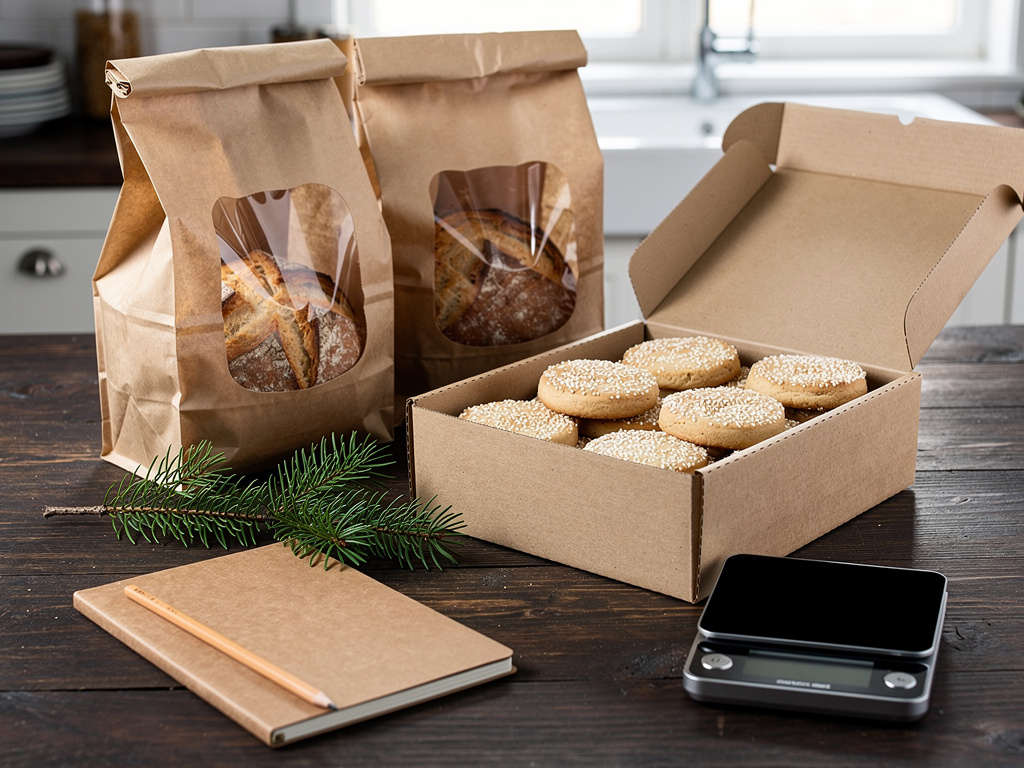
Packaging cost $49.94 for the month: $22.88 for 88 bread bags and $27.06 for 82 cookie boxes. Each loaf went in a Bagcraft 8 by 3 1/2 by 15 inch paper bread bag with a window, $129.99 for 500 at WebstaurantStore, or $0.26 each.
Each dozen went in an 8 by 8 by 2 1/2 inch kraft bakery box with a window, $65.49 for 200, or $0.33 each. One buyer's review of the 8 by 8 size on that listing says they use it for cookies sold by the dozen and that it fits them nicely.
A few packaging choices change this line fast:
For how presentation changes what a cookie box sells for, our guide to selling Christmas cookies and holiday gift sets covers packaging for the season.
The model pays $200 for two market Sundays: a $175 specialty food booth covering December 13 and 20 at the Thompson's Point holiday markets in Portland, Maine, plus a $25 application fee. That one line is bigger than the month's whole ingredient bill of $196.
Booth fees for December 2026 vary a lot. These five come from each market's own 2026 application.
Swipe to see each market's fee and food rule.
| Holiday market | Date | Booth fee | Other fees | Food rule worth knowing |
|---|---|---|---|---|
| Holiday Market in Purcellville, Virginia | Sat Dec 12 | $50, 8 x 8 ft | Online payments add a processing fee | Food and drink category is "pre-packaged only" |
| Mount Pleasant Holiday Market, South Carolina | Sat Dec 12 | $50 | Card payments add 2.7% | "Cottage Law vendors are not accepted" |
| Downtown Parker Holiday Market, Colorado | Sat Dec 5 | $125, handcrafted vendors | $75 corner upgrade | Baked goods are on its list of products |
| Thompson's Point holiday markets, Portland, Maine | Sun Dec 13 and 20 | $175 for both dates, specialty food | $25 application fee; optional $50 booth selection and $25 electrical outlet; certificate of insurance required | Ready-to-eat food is not placed inside; packaged take-home baked goods are |
| Merchantile Market, Scottsdale, Arizona | Sat Dec 12 and Sun Dec 13 | $425 to $775 | $15 application fee, booth selection up to $150, all fees plus tax | Both days required |
Each fee read on October 13 and 14, 2026 from the market's 2026 vendor application. Purcellville's application form is no longer online, so its fee comes from a saved copy of the form. Several deadlines have already passed: Mount Pleasant's was September 12 and Thompson's Point's was July 19.
A cheap booth is no deal if the market will not take your food. The Town of Mount Pleasant's 2026 holiday market application says all prepared food must come from a commercial kitchen approved by the state and that "Cottage Law vendors are not accepted." We used the Thompson's Point fee in the model but did not confirm that market's rules for cottage food. Read the application and your state's cottage food rules before you pay any booth fee.
Each market Sunday in the model sold $468. Take off the $100 booth share, about $16.52 in card fees, and the bread and cookies it used, and each Sunday kept about $300.95.
Card fees took $97.21 of the model's $2,528: $64.17 on 60 Homegrown pre-orders and $33.04 on 58 Square card sales at the market. Add the $10 ordering page and payments cost 4.2% of the month's sales.
Here is the full fee stack for the platforms a home baker usually compares, on one $20 order and on a month of 50 orders.
Scroll sideways to see every platform's full fee stack.
| Platform | Monthly plan | Trial | Platform fee | Card processing | Customer pays on a $20 order | Vendor pays on a $20 order | Vendor pays on 50 orders of $20 |
|---|---|---|---|---|---|---|---|
| Homegrown, annual plan | $10/mo billed annually | 7 days, no charge until day 8 | $0, 0% commission | 2.9% + $0.30, paid by the vendor | $20.00 | $0.88 plus the plan | $54.00 |
| Homegrown, monthly plan | $12.50/mo | 7 days, no charge until day 8 | $0, 0% commission | 2.9% + $0.30, the vendor pays it | $20.00 | $0.88 plus the plan | $56.50 |
| Hotplate, default | $0, no monthly subscription | No paid plan to try | 5% + $0.55, paid by the customer | 2.9% + $0.30, "Chefs pay" | $21.55 | About $0.88 to $0.92 | About $44.00 to $46.25 |
| Hotplate, vendor covers the fee | $0, no monthly subscription | No paid plan to try | 5% + $0.55, paid by the vendor | 2.9% + $0.30, also on the vendor | $20.00 | $2.43 | $121.50 |
| Square Free plan, online order | $0 | Free plan, nothing to try | None | 3.3% + 30¢, paid by the vendor | $20.00 | $0.96 | $48.00 |
| Square Free plan, card tapped at the market | $0 | Free plan, nothing to try | None | 2.6% + 15¢, paid by the vendor | $20.00 | $0.67 | $33.50 |
Checked on Homegrown's signup page, Hotplate's pricing page and Square's pricing page on October 13, 2026. Card processing is figured on the $20 price, except Hotplate's default row, which is a range because Hotplate's two pages differ on what its card fee is figured on. Its post "What Hotplate does" says chefs pay 2.9% of the transaction plus 30 cents, which on the full $21.55 charge is about $0.92. The example on its pricing page charges the chef $1.27 on a $30 order with a $3 tip, within a cent of 2.9% + $0.30 on the order plus tip ($1.26), and that reading gives $0.88 on a $20 order. Hotplate says you can pay its fee yourself or pass it to customers, and its September 2025 post "What Hotplate does" describes passing it to the customer as the default.
The model uses Homegrown for pre-orders and a Square card reader at the market, because Homegrown has no in-person card reader. Homegrown and Hotplate both charge the vendor 2.9% + $0.30 card processing. Square's card reader at the market charges 2.6% + 15¢. Hotplate's default is cheaper for the vendor, because the customer pays its 5% plus $0.55. That is $112.60 of your customers' money across 60 December orders. In this model, Hotplate's default keeps the vendor $6.73 to $10.00 more than Homegrown: the $10 plan saved, minus up to $3.27 in card fees if Hotplate figures them on that $112.60 too.
The baker keeps $1,974.85 of $2,528, or 78 cents of every dollar, before taxes. Here is the whole month in one table, every line with its source.
Swipe left for the source of each line.
| Line | Amount | How it was figured |
|---|---|---|
| Sales | $2,528.00 | 84 loaves at $12, 76 dozen at $20 |
| Bread ingredients | -$88.00 | 88 loaves baked at $1.00 each |
| Cookie ingredients | -$108.00 | 24 batches at $4.50 each |
| Bread bags | -$22.88 | 88 at $0.26 |
| Cookie boxes | -$27.06 | 82 at $0.33 |
| Holiday market booth | -$200.00 | $175 for two Sundays plus a $25 application fee |
| Homegrown plan | -$10.00 | One month of the $10/mo annual plan |
| Homegrown card processing | -$64.17 | 2.9% of $1,592 plus $0.30 on 60 orders |
| Square card processing | -$33.04 | 2.6% of $936 plus 15¢ on 58 sales |
| Left before taxes | $1,974.85 | Sales minus $553.15 in costs |
Every price in this table was checked on October 13, 2026. Ingredient lines include the rounding described in the ingredients section.
Split the month by where it sold and the two halves look different:
The market still earned its place. It put the baker in front of strangers in a month when people are buying gifts, and every one of them is a possible January customer.
Bring what you can sell, not what fills the table. In the model, each market Sunday leaves 2 loaves and 3 dozen cookies unsold, about $7.37 in ingredients and packaging that earns nothing. Pre-sell part of your market stock for pickup at the booth, and you bake to a number instead of a guess.
The model December takes about 104 hours, so the $1,974.85 works out to $18.99 an hour before taxes. These hours are our estimate for one home oven, built from King Arthur's stated times, not a log kept by a real baker.
Spread over four weeks, that is an average of about 26 hours a week on top of a weekday job. The two market weeks run closer to 35 hours each, because they carry the market bake, the booth day and a porch pickup. Oven time is the hard ceiling: you cannot bake bread and cookies in one home oven at the same time.
Set aside about $302.15, which is 15.3% of the $1,974.85, and plan for income tax on top. That set-aside covers the self-employment tax, which comes to about $279 because Schedule SE figures it on 92.35% of your profit. The IRS says the self-employment tax rate is 15.3%, 12.4% for Social Security and 2.9% for Medicare, and that you file Schedule SE when your net earnings from self-employment are $400 or more for the year.
After that set-aside, the model keeps $1,672.70, or $16.08 an hour. Income tax depends on your whole household's income, so nobody can give you one number for it. A few habits make tax time easier:
Our guide to tracking income and expenses for a cottage food business shows a simple monthly setup. Tax rules change and your situation is your own, so check with a tax preparer before you file, and verify your state's current rules for business registration and sales tax.
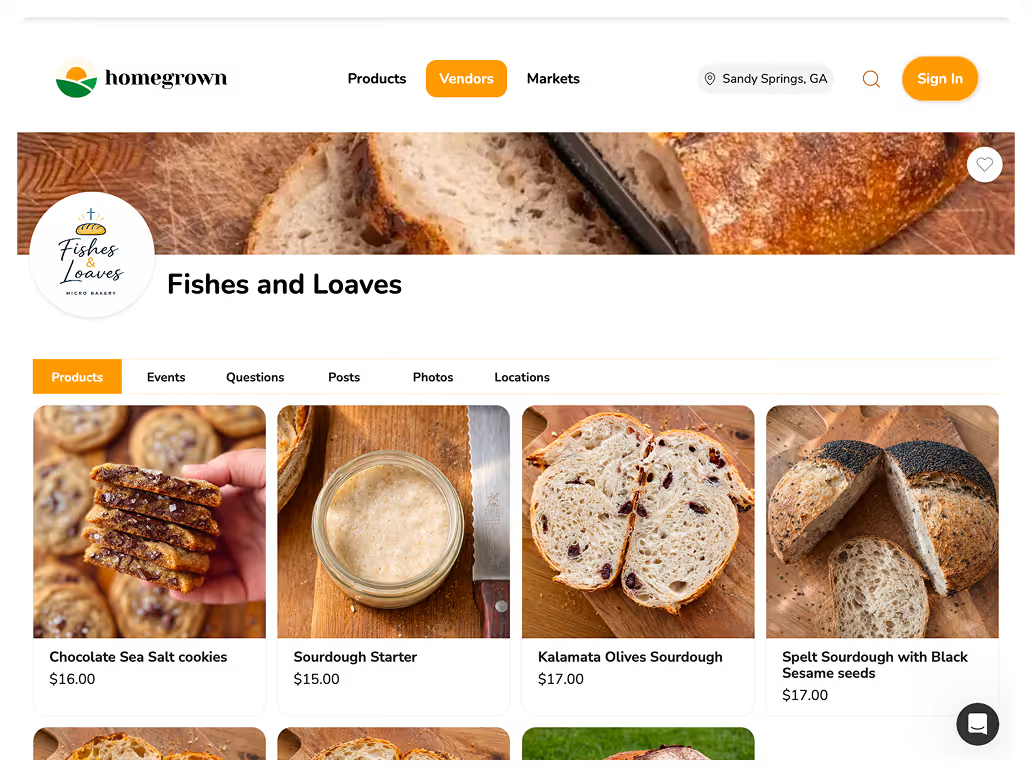
The biggest lesson of this December income report is that pre-orders kept 86 cents of every dollar, and they only work if taking them is easy. When December orders arrive as Instagram messages and Venmo payments, you spend the month matching names to payments and recounting dough. Homegrown gives you one storefront where customers pick a pickup day, pay, and land on your order list. It costs $10 a month billed annually or $12.50 billed monthly, with no percentage fees beyond standard payment processing of 2.9% + $0.30, which you pay.
What it does for a month like this one:
Here is how it compares with what most home bakers weigh it against. Hotplate has no monthly plan and is built for timed drops, and Sarah's Sourdough runs her porch pickups through it; its 5% + $0.55 fee lands on your customer by default, or on you, which makes your cost $2.43 on a $20 order once card processing is added. Square's free plan charges 3.3% + 30¢ on online orders and is the better tool for tapping cards at the table.
Here is what Homegrown does not do. It has no card reader for the market itself, so keep Square or cash for walk-up sales. It has no drops feature and no release date for one. Customers create a Homegrown account to place their first order. Your storefront is listed on the Homegrown marketplace, but plan on most December orders coming from people you send to your own link. If that fits how you sell, set up your December pre-order page and the 7-day trial has no charge until day 8.
Of the five changes tested here, your cookie price moves this December income report the most: dropping a dozen from $20 to $15 cuts what the baker keeps by $369.43. Here is how five changes move the $1,974.85, each with everything else held the same.
Slide the table to see what each change keeps.
| Change | Sales | Kept before taxes | Difference |
|---|---|---|---|
| The model as written | $2,528 | $1,974.85 | $0 |
| Loaves at $10 instead of $12 | $2,360 | $1,811.56 | -$163.29 |
| Cookies at $15 a dozen instead of $20 | $2,148 | $1,605.42 | -$369.43 |
| Homegrown monthly plan instead of annual | $2,528 | $1,972.35 | -$2.50 |
| Hotplate for pre-orders, customer pays its fee | $2,528 | $1,981.58 to $1,984.85 | +$6.73 to +$10.00 |
| Hotplate for pre-orders, vendor pays its fee | $2,528 | $1,872.25 | -$102.60 |
Recalculated on October 13, 2026 with the same counts, costs and fee rates as the main table. Card processing changes with the price, which is why the loaf row is not exactly 84 times $2. The Hotplate default row is a range for the reason given under the fee table.
Price beats platform. The gap between the cheapest and costliest ordering setup is $109.33 to $112.60, while a $5 cut on cookies costs more than three times that. If you are unsure what to charge for bread, our sourdough pricing guide walks through it line by line.
The few home bakers who publish real numbers mostly share a full year, and their totals are far above one December. Sarah Grunewald of Sarah's Sourdough reported that porch pickups brought in $61,000 in her second year of running a microbakery from home, 2024, with net income of about $30,000 after expenses.
That works out to about $5,083 a month in porch sales, twice this model's whole December. Her post credits consistent marketing and customer trust for the jump from $9,000 in porch pickup sales the year before. A few more published notes help set expectations:
The point is not that you should hit $61,000. It is that a real baker's numbers moved year to year, and a December like this model's is a reasonable first season, not a ceiling.
This December income report leaves out seven kinds of cost that vary too much to price for you, and every one of them lowers the $1,974.85. Add your own numbers for each before you trust the total:
One more limit to know: some states cap how much a cottage food business can sell in a year. California, for one, sets a gross annual sales limit for each class of cottage food operation. Our guide to cottage food revenue caps explains how those limits work, so check yours before you plan a December twice this size.
You can build your own December income report in one evening with a spreadsheet and six numbers: price, count, ingredient cost, packaging cost, fees and hours. If a $20 dozen costs you $1.62 in ingredients and a box, you already know most of the answer. Do it before December 1, while you can still change your prices and caps.
When December ends, fill in the actual numbers next to the plan. That comparison is your real income report, and it tells you exactly what to change for next year. For January, our guide to off-season income for food vendors covers what to sell once the holidays end.
In this December income report, a part-time home baker selling sourdough and sugar cookies takes in $2,528 and keeps $1,974.85 before taxes. That comes from six selling days in December at $12 a loaf, the median Homegrown price, and $20 a dozen, $1 above the median. A baker with more oven time, higher prices or a larger customer list can make far more.
In this model, the market booth was the biggest single cost: a $175 booth for two Sundays plus a $25 application fee cost more than all $196 of the month's ingredients. 2026 holiday market booth fees we checked ranged from $50 to $775, before application and other fees.
They can be, but they keep less of each dollar than pre-orders. In this model, market Sundays kept 64 cents of every dollar against 86 cents for pre-orders, because of the booth fee and unsold bread and cookies. They are worth it when they bring in new customers you can turn into pre-order regulars.
On October 13, 2026, the median Homegrown listing for a full dozen cookies was $19, across 42 listings from 19 vendors, with a range of $7 to $60. This model charges $20. In a December income report like this one, dropping that price to $15 cuts what the baker keeps by $369.43.
Yes. The IRS self-employment tax rate is 15.3%, and you file Schedule SE once your net earnings from self-employment reach $400 for the year. Income tax comes on top, so check with a tax preparer about your own situation.
The model in this December income report takes about 104 hours for 84 loaves and 76 dozen cookies across six selling days, an average of about 26 hours a week, with the two market weeks closer to 35 hours. Bread oven time alone is about 29 hours, because the model bakes two loaves at a time.
These five posts pick up where this December income report stops, from a full year of market income to the monthly bookkeeping that turns a model like this one into your real numbers. Each one is live on the Homegrown blog and answers a question this report raises but does not settle.
Your December income report starts with an order page that counts for you. When you are ready, start your Homegrown storefront and open your first holiday pickup before December 1.