
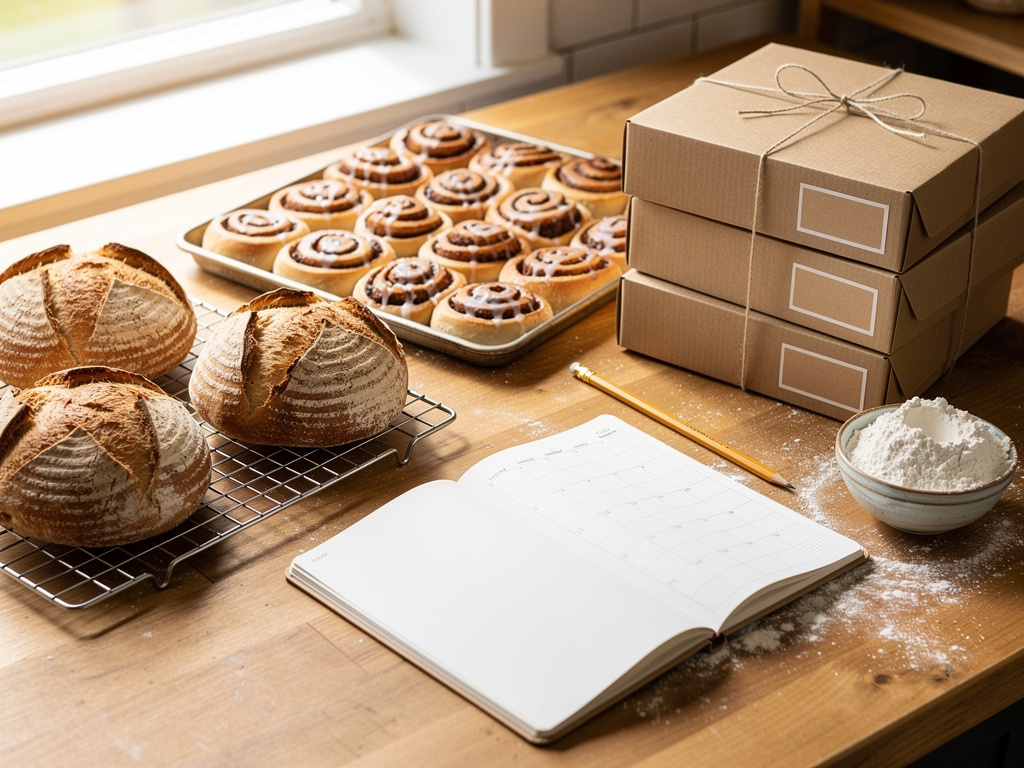


The short version: In the sample week below, a one-person home bakery that fills 30 pre-orders works about 25 hours, and only about 7 of those hours are actual baking. Orders open Sunday, close Wednesday night, get mixed Thursday, baked and picked up Friday, and delivered Saturday morning. The baker collects $844, pays $266.03 for ingredients, packaging, card processing, the ordering page and driving, and keeps $577.97, which works out to $23.35 an hour before taxes. That number moves with your prices, your ingredient costs and your oven hours, and selling $10 loaves instead of $12 takes $48 off the week's sales with no change in hours.
Checked on Homegrown's signup page, Hotplate's pricing page and blog, Square's fee page, Venmo's business fee page and the IRS mileage page, October 13, 2026: every fee, plan price and mileage rate in this post comes from those pages. The week itself is a sample built from stated assumptions, not one real vendor's books. Homegrown customers create an account to place their first order, and Homegrown has no drops feature.
Most people who start a food business from home picture the fun part: a warm kitchen, a rack of loaves, a customer who says it was the best bread they ever had. Nobody pictures Monday's questions or the Tuesday grocery run. This post walks through one full week of a one-person home bakery, day by day, and counts the hours and the week's direct costs so you can see what the job really is before you sign up for it.
In the sample week in this post, a one-person food business runs about 25 hours spread over all seven days, with one long bake day and a dozen short jobs around it. That week has a single 11.5-hour Friday and six shorter days that range from half an hour to four hours. If you are still deciding what to bake, start with the full guide to selling baked goods from home, then come back here to see how the week runs.
Here is the whole week at a glance.
Swipe sideways to see the whole week.
| Day | What happens | Hours |
|---|---|---|
| Sunday | Set the menu, take photos, post, open orders at 6 p.m. | 1.0 |
| Monday | Answer messages and questions about the menu | 0.5 |
| Tuesday | Shop for ingredients (12 miles round trip), feed the sourdough starter | 1.75 |
| Wednesday | Close orders at 8 p.m., write the production list, mix cookie dough, build the levain | 2.0 |
| Thursday | Mix, fold and shape 24 loaves, make and shape cinnamon rolls, chill everything overnight | 4.0 |
| Friday | Bake for 7 hours, pack and label for 1.5, run porch pickup from 4 to 7 p.m. | 11.5 |
| Saturday | Deliver 8 orders (22 miles), clean the kitchen, update the books | 4.0 |
| Total | 24.75 |
Sample week built for this post on October 13, 2026. The hours are estimates for a home kitchen with one oven, not a measured log from a real vendor.
This week follows a home baker who works alone, sells only by pre-order, and fills 30 orders worth $804 in products. There is no farmers market in this week on purpose. If you sell at one, the market Saturday is its own long day, and the hour-by-hour day in the life of a farmers market vendor covers it.
The assumptions behind every number:
Sunday takes about 1 hour: set the menu, take one photo of each product, post them, and open orders at 6 p.m. That hour sets up the whole week, because every decision made Sunday night decides what you bake on Friday.
A good Sunday hour looks like this:
The cap matters most. A cap of 24 loaves means a sold-out week, not a 2 a.m. Friday.
Monday and Tuesday together take just over 2 hours, with 30 minutes of messages on Monday and an hour and 45 minutes of shopping and starter care on Tuesday. These are the quietest days, and they are also where small jobs pile up if you let them.
Monday is mostly questions. Is the sourdough made with whole wheat? Can I pick up Saturday instead? Do the cookies have nuts? Answering them in one 30-minute sitting, instead of the moment each one arrives, is what keeps Monday at half an hour.
Tuesday is the grocery run. The sample baker drives 12 miles round trip and buys for the whole week at once:
Then the sourdough starter gets fed, which takes 15 minutes.
The butter, eggs and milk in that cart are perishables. The FDA's safe food handling guidance says to refrigerate perishables within 2 hours of buying them, and within 1 hour if it is above 90°F outside. We checked that guidance on October 13, 2026. Do the grocery store last, not first, if Tuesday also has other errands.
Orders close Wednesday night at 8 because that leaves exactly one evening to plan and one evening to mix before Friday's bake. Close later and Thursday turns into a scramble. Close earlier and you lose the customers who only remember on Wednesday. For more on picking the hour, see this guide to order cutoff times for a food business.
The 30 minutes after the cutoff turn a list of orders into a plan. The sample baker builds the production list in four steps:
Then comes 1.5 hours of real work: mixing the cookie dough so it can rest in the fridge and building the levain for Thursday's bread. Wednesday ends at about 2 hours total.
Thursday is 4 hours of mixing, folding and shaping, spread across one long evening, so that Friday is only baking. Three of those hours are hands-on sourdough work: mix, rest, fold every 30 minutes, then shape 24 loaves into baskets and slide them into the fridge overnight. The dough rises between those steps for longer than the 3 hours of work, so the evening runs past 4 hours on the clock unless your kitchen is warm. The last hour of work goes to the cinnamon roll dough, made while the sourdough rises, which gets rolled, filled, cut and chilled.
What makes Thursday work:
Friday is the long day, with 7 hours of baking, an hour and a half of packing and labeling, and a 3-hour porch pickup window, or 11 and a half hours in all. It is the only day of the week that feels like a full shift, and it carries almost half the week's hours.
The oven sets the pace. Six bakes of four loaves run about 4.5 hours if each load goes in as soon as the last one comes out, about 45 minutes a load. Waiting 15 to 20 minutes for the oven to fully reheat between loads pushes the loaves closer to 6 hours. The cookies take about 1.5 hours across six bakes, and the rolls take an hour. A second oven would cut Friday by hours. If you hit your cap three weeks in a row, that is the purchase to price out first.
Bake in the order customers will pick up, not the order that is easiest. The 22 porch boxes need to be done by 4 p.m., so they come out of the oven first. The 8 Saturday delivery boxes are baked last and cooled overnight. Bake in order and the 22 boxes go straight from the rack to the porch shelf, with no re-sorting at 3:55 p.m.
Packing takes 1.5 hours for 56 products: 24 loaf bags, 12 roll boxes and 20 cookie boxes, each with a label. Labeling as you pack, not after, keeps a loaf from going into the wrong order.
The porch window runs 4 to 7 p.m. and takes 3 hours, even though only a few minutes of it is actual handing over. Each of the 22 orders goes on a shelf with the customer's name on the box. You stay near the door to answer the bell, fix a mix-up, or take a late text.
To keep the window to 3 hours:
The 3 hours count as work because you cannot leave the house. If 22 pickups feel like too many for one evening, a narrower window, say 4 to 6 p.m., gives you an hour back every Friday.
Saturday takes 4 hours, with two and a half of them on the road delivering 8 orders over 22 miles, then an hour of cleaning and 30 minutes on the books. The $5 delivery fee brings in $40, which covers the miles but pays little for the time behind the wheel.
The IRS business standard mileage rate for July 1 to December 31, 2026 is 76 cents a mile, up from 72.5 cents in the first half of the year, per the IRS table as of October 13, 2026. The rate is a deduction figure, but the IRS sets each year's rate from a yearly study of the fixed and variable costs of operating a car, which gave the 72.5-cent rate for 2026, then raised it to 76 cents on July 1 because fuel prices went up. Either way, it works as a stand-in for what each mile costs you, not just the gas. At 76 cents, Saturday's 22 miles cost $16.72, and the week's 34 miles cost $25.84. Card processing takes another $1.16 from the $40 in delivery fees, so those fees cover all 34 miles of the week's driving with $13.00 left over, before your time. For more on routes and fees, see this guide to running local food delivery as a one-person operation.
Tips for a shorter route:
After the last drop-off, the week closes with one hour of cleaning and 30 minutes of bookkeeping. Skip the books for a few months and you end up rebuilding them from bank statements at tax time.
The 30-minute close-out:
Those five lines take less time each week than one shoebox of receipts takes in April.
The IRS says to keep tax records for 3 years in most cases, with longer periods in a few situations listed on that page (read October 13, 2026). If you sell from home, this guide to cottage food taxes and Schedule C explains where those numbers end up.
About 13 of the week's 25 hours go into making food, and the other 12 go to packing, shopping, handing orders over, cleaning and admin. The exact split is 12.75 hours of mixing, shaping and baking out of 24.75. That split is the reason a "quick weekend bake" turns into a part-time job.
On a phone, slide the table left to see each task.
| Task | Hours | Share of the week | Where it happens |
|---|---|---|---|
| Mixing, shaping and baking | 12.75 | 52% | Tuesday starter feed, Wednesday dough, Thursday mixing, Friday baking |
| Handing orders over | 5.5 | 22% | Friday porch window, Saturday delivery |
| Selling and admin | 2.5 | 10% | Sunday menu and post, Monday messages, Wednesday list, Saturday books |
| Packing and labeling | 1.5 | 6% | Friday afternoon |
| Shopping | 1.5 | 6% | Tuesday |
| Cleaning | 1.0 | 4% | Saturday |
Shares are each task's hours divided by 24.75 and rounded, so they add to 100%. Sample week, October 13, 2026.
Three things stand out:
In this sample week, the vendor collects $844 and keeps $577.97 after the week's direct costs, or $23.35 for each of the 24.75 hours. That is before income tax and self-employment tax, which depend on your total income for the year. It also leaves out costs that do not show up week to week, like the extra electricity for 7 hours of oven time, a mixer or second oven, insurance and any state permit fee, so set those aside from the $577.97 too.
Move the table sideways to see how each line is figured.
| Line | Amount | How it is figured |
|---|---|---|
| Product sales | $804.00 | 24 loaves at $12, 12 roll packs at $18, 20 dozen cookies at $15 |
| Delivery fees | $40.00 | 8 deliveries at $5 |
| Collected | $844.00 | Products plus delivery fees |
| Ingredients | -$165.00 | Sample costs: $1.50 a loaf, $4.50 a roll pack, $3.75 a dozen cookies |
| Packaging | -$39.40 | 24 bags at $0.40, 12 boxes at $1.00, 20 boxes at $0.75, 56 labels at $0.05 |
| Card processing | -$33.48 | 2.9% of $844 plus $0.30 on each of 30 orders, on Homegrown |
| Ordering page | -$2.31 | One week of Homegrown's $10 a month plan billed annually ($120 / 52) |
| Driving | -$25.84 | 34 miles at the IRS rate of 76 cents a mile |
| Kept | $577.97 | $844.00 minus $266.03 in costs |
Fees and the mileage rate were checked on Homegrown's signup page and the IRS mileage page on October 13, 2026. Ingredient and packaging costs are round sample numbers; price your own from your receipts.
Your own number will move with three things: your prices, your ingredient costs and how many hours the oven forces on you. A vendor who sells $10 loaves instead of $12 loses $48 of that week right off the top, with no change in hours. If you are unsure what to charge, start with the guide on how to price baked goods.
On the same $804 of products and 30 orders, what the vendor pays in fees that week ranges from $18.28 to $89.02 depending on how orders are taken. The difference comes from who pays the service fee and whether there is one at all.
Scroll sideways to see every fee column.
| How orders are taken | Monthly plan | Trial | Service or platform fee | Card processing | Customer pays on a $20 order | Vendor pays on a $20 order | Vendor pays in the sample week (30 orders, $804) |
|---|---|---|---|---|---|---|---|
| Homegrown | $10 billed annually ($12.50 billed monthly) | 7 days, no charge until day 8 | None, 0% commission, no shopper fee | 2.9% + $0.30, paid by the vendor | $20.00 | $0.88 plus the plan | $34.63 ($32.32 processing + $2.31 of the annual plan) |
| Hotplate, default | $0 | No plan to try | 5% + $0.55 on the subtotal, paid by the customer | 2.9% + $0.30, the vendor pays it, figured here on the order plus the service fee | $21.55 | $0.92 | $33.96 (customers pay $56.70 in service fees on top) |
| Hotplate, vendor covers the fee | $0 | No plan to try | 5% + $0.55 on the subtotal, paid by the vendor | 2.9% + $0.30, also on the vendor | $20.00 | $2.43 | $89.02 |
| Square Free plan, online payments | $0 | No plan to try | None | 3.3% + $0.30, vendor-paid | $20.00 | $0.96 | $35.53 |
| Venmo business profile, direct payments | $0 | No plan to try | Seller fee of 1.9% + $0.10, the whole fee | Included in the 1.9% + $0.10 | $20.00 | $0.48 | $18.28, with every order tracked by hand in messages |
We checked these on Homegrown's signup page, Hotplate's pricing page, Square's fee page and Venmo's business fee page on October 13, 2026. Hotplate says the vendor can pay its fee or pass it on, and its own blog says 80% of its vendors keep the default, where the customer pays. Card processing is figured on the order price, except on Hotplate's default row, where it is figured on the order plus the customer's service fee because Hotplate's blog says processing is 2.9% of the transaction plus 30 cents. That reading adds $1.64 across this week. Hotplate's pricing page shows a different result: its worked example charges $1.27 in processing on a $37.60 customer total, less than the $1.39 that 2.9% + $0.30 of the whole total would be, so the default row may be up to $1.64 high. This table leaves out the $40 in delivery fees so every row compares the same $804. With delivery fees included, Homegrown processing for the week is the $33.48 in the money table above.
Venmo is the cheapest line, and the hours explain why the cheapest line is not always the cheapest week. Thirty orders taken in messages means 30 conversations to read, 30 payments to match to names, and a production list you build by scrolling. That is the Monday and Wednesday work in this post, done by hand.
The parts of this week that eat time without making food, like Monday's questions, Wednesday's tally and Friday's pickup sorting, are exactly the parts an order page can carry for you. Homegrown is $10 a month billed annually, or $12.50 billed monthly, with no percentage fees beyond standard payment processing of 2.9% + $0.30 per order, which the vendor pays.
How it maps onto this week:
Compare that to Hotplate, which has no monthly plan but, by default, adds 5% + $0.55 to each customer's subtotal, or $56.70 on this sample week, while the vendor still pays 2.9% + $0.30 in card processing. Venmo with Instagram messages costs the least in fees, at 1.9% + $0.10 with processing built in, but every count and every payment match is yours to do by hand.
The honest bounds: Homegrown does not bake, pack or drive for you. Customers create a Homegrown account to place their first order. There is no drops feature with a countdown release, no text or email blast to your customer list yet, and no card reader for in-person sales. Your storefront is listed on the Homegrown marketplace, but plan on most orders coming from people you send to your own link. If that trade fits your week, you can set up a Homegrown storefront with a 7-day trial and no charge until day 8.
After a few weeks, the changes worth trying first are a shorter menu, an earlier cutoff, and dropping the jobs that do not pay. In the sample week, 17.75 of the 24.75 hours happen outside the oven, and those are the hours these changes reach. Faster baking can only touch the other 7.
In a pull of the Homegrown catalog on October 13, 2026, the 318 vendors with active listings had 2,886 products between them, and the median vendor listed 7. 231 of the 318, or 72.6%, listed 10 or fewer. We counted every active listing by the vendor who posted it, across all categories. The catalog does not show who runs each shop or how big its team is, so this is a count of menu size, not of one-person businesses.
Homegrown vendors by number of products listed
Source: pull of the Homegrown catalog, October 13, 2026, 2,886 products from 318 vendors, counted by vendor.
The changes worth trying:
A slow week does not cut the hours in half, because about 8 of the 24.75 hours stay the same no matter how many orders come in. Sunday's hour, Monday's messages, Tuesday's 1.5-hour grocery run, Wednesday's tally, the 3-hour porch window, the hour of cleaning and the 30 minutes of books happen at 15 orders or at 30.
That has two sides:
This is why a cap matters in both directions. A cap protects Friday in a busy week, and a short menu protects your hourly rate in a slow one. If the weeks start to blur together, the guide to preventing food vendor burnout lists the warning signs, and the post on setting boundaries in your food business covers days off and message hours.
A one-person home bakery filling about 30 pre-orders a week takes roughly 25 hours, based on the sample week in this post. Only about half of that is mixing and baking. The rest is shopping, packing, handing orders over, cleaning and admin.
In the sample week, a home baker collects $844 from 30 orders and keeps $577.97 after ingredients, packaging, card processing, the ordering page and driving. That works out to $23.35 an hour before taxes. Your number depends on your prices, your costs and how many hours your oven needs.
Bake day is the busiest day. In the sample week, bake day and pickup day are both Friday, which takes 11.5 of the 24.75 hours: 7 hours of baking, 1.5 hours of packing and a 3-hour pickup window.
Close orders early enough to leave one evening to plan and one evening to prep before bake day. For a Friday bake, a Wednesday night cutoff works well. For bread, close at least one evening before mixing day, since the levain is built the night before you mix and has to be sized to the order count.
Yes, if the business fits into evenings and one long day. In the sample week, the weekday jobs take 30 minutes to 4 hours each, and the long day is Friday. If you also hold a full-time job, moving bake day and pickup to Saturday puts the long day on the weekend, so plan on Saturday for baking and pickup plus Sunday morning for delivery, or drop delivery to keep it to evenings plus one long day.
Delivery is worth it only if the fee covers the drive and your time. At the IRS rate of 76 cents a mile for the second half of 2026, 22 miles of delivery costs $16.72, so a $5 fee on 8 stops covers the miles and the $1.16 of card processing on those fees and leaves $22.12. Spread over the 2.5 hours on the road, that is about $8.85 an hour, well under the week's $23.35, so set a radius and a minimum order before you offer it.
These five posts answer the questions this sample week raises next, from days off to cutoff times.
A week like this runs smoother when the orders, the counts and the pickup times live in one place instead of in your messages. When you are ready to try it, start your Homegrown storefront and open your first order window this Sunday.



