
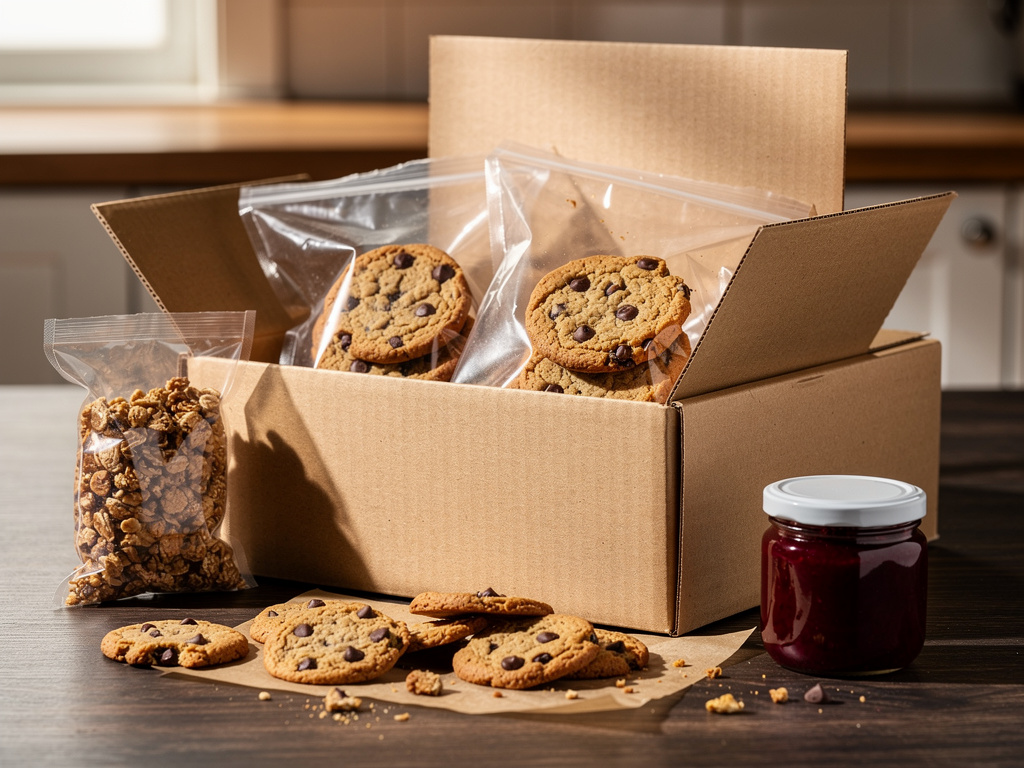


The short version: Price a shipped subscription box on the average postage for where your subscribers actually live, then check that the farthest subscriber still leaves you a profit. Right now a 3-pound box sent USPS Ground Advantage on a commercial label costs $9.04 to the nearest zone and $16.30 to zone 8, across the country, and the same box costs $11.80 to $23.15 at the post office counter. Keep the packed box at or under 1,728 cubic inches, a 12-inch cube, because since July 12, 2026 USPS bills anything bigger by its size divided by 139 when that is more than its real weight. Add the box, cold packs, packing time and, for perishable food, USPS's $7.50 Ground Advantage or $15 Priority Mail handling fee, then either build that full cost into one price or charge shipping on its own line and offer a lower price for local pickup. Before any of it, check your state's cottage food rules, because some states, Texas for one, require cottage food sold online to be delivered in person.
Checked October 14, 2026: USPS prices come from its price list, Notice 123, effective October 4, 2026, which includes a temporary holiday increase that USPS says ends January 17, 2027. The dimensional weight rule comes from the USPS mailing standards (DMM 133 and 123), and the Texas rule from the Texas DSHS cottage food page. Homegrown is $10 a month billed annually or $12.50 billed monthly, with 0% commission and 2.9% + $0.30 card processing that you pay (findhomegrown.com/signup). Shopify and Subbly prices come from their pricing pages the same day. Honest bounds: Homegrown does not ship boxes, print labels or renew orders automatically. It handles pickup and local delivery, customers create a Homegrown account to place a first order, there is no drops feature, and your storefront is listed on the marketplace, but plan on most orders coming from people you send to your own link.
You priced your monthly cookie box at $40, and the first month felt great. Then you added up the postage receipts. The box to your aunt two towns over cost $9. The one to a college friend in another time zone cost almost twice that. Same box, same cookies, same price, and on that second box you barely broke even.
That is the shipping trap in a subscription box. The price is one number, but the cost to mail it changes with every address, and you pay it again every single month. A mistake of $3 a box sounds small until it repeats 12 times for every subscriber on your list.
This guide walks through the shipping side of the price with real USPS numbers loaded on October 14, 2026: what a box costs to mail by distance, the new box-size rule, the holiday surcharge running right now, a worked $45 example, and the pickup option that skips postage entirely. If you want the whole cost picture beyond shipping, start with how to price a subscription box for margin, then come back here for the postage math.
Shipping eats subscription box profits because the postage for one box can swing by $7 or more depending on where it goes, while your price stays the same for everyone. On a 3-pound box, postage can be a third of a $45 price before you count the box, the cold packs or your time.
Three things make shipping harder to price in a subscription than in a one-time order:
Most guides stop at "shipping is expensive." The rest of this one puts real numbers on it, so you can see exactly where a box price breaks. Every figure below is for a box that weighs 3 pounds packed. Your box will weigh something different, so swap in your own weight from the same tables.
A 3-pound box costs $9.04 to $16.30 to mail by USPS Ground Advantage with an online label, and $11.80 to $23.15 for the same service at the post office counter, depending on how far it goes. Priority Mail, the faster service, runs $9.85 to $21.42 on a commercial label and $12.95 to $28.10 at the counter in zones 1 to 8.
Commercial prices are the lower prices USPS charges when you buy postage online through a shipping label service instead of at the counter. Label services such as Pirate Ship offer discounted USPS postage without charging a monthly subscription, according to Pirate Ship's rates page. For a box you mail every month, the counter is the most expensive way to ship it.
Scroll sideways to see every column.
| Service, 3-pound box | Zone 1 (nearby) | Zone 4 | Zone 5 | Zone 8 (far away) |
|---|---|---|---|---|
| Ground Advantage, counter price | $11.80 | $14.20 | $15.70 | $23.15 |
| Ground Advantage, commercial label | $9.04 | $10.07 | $12.12 | $16.30 |
| Priority Mail, counter price | $12.95 | $15.65 | $19.05 | $28.10 |
| Priority Mail, commercial label | $9.85 | $13.08 | $17.41 | $21.42 |
| Medium Flat Rate Box, any zone | $25.80 counter, $22.02 commercial | same | same | same |
All prices come from USPS Notice 123, effective October 4, 2026, which we loaded on October 14, 2026. They include the temporary holiday increase that USPS says runs until January 17, 2027.
Ground Advantage with a commercial label is the cheapest option in this table for every zone, and the gap between the counter and a label is widest far away: $2.76 at zone 1, $6.85 at zone 8. If your packed box is small, USPS also sells commercial Ground Advantage by size: a box up to 0.3 cubic foot, about an 8-inch cube, costs $8.79 to zone 1 and $15.22 to zone 8, and label services such as Pirate Ship compare the size price with the weight price for you.
USPS prices a box by zone, which is the distance from your post office to your subscriber's, and the same 3-pound box costs 80% more to the farthest zone than to the nearest. USPS describes zones as running from zone 1, close to you, to zone 9, very far away, and Priority Mail and Ground Advantage are both priced that way.
Here is what one 3-pound box costs on a Ground Advantage commercial label, zone by zone, from USPS Notice 123:
What a 3-pound box costs to mail, zone by zone (Ground Advantage, commercial)
Source: the USPS price list in effect since October 4, 2026, loaded October 14, 2026. Commercial prices, 3-pound box, holiday increase included.
Notice where the jump happens. Zones 1 through 4 sit within about a dollar of each other. Zone 5 adds $2.05 over zone 4, and zones 6 through 8 keep climbing. So a subscriber list that is mostly local and regional is cheap to serve, and a few far-away subscribers can pull your average up fast.
To find the zone for any subscriber, enter your ZIP code in the USPS domestic zone chart on postcalc.usps.com. The first three digits of the subscriber's ZIP code tell you the zone. Do this once for every address on your list before you set a price, not after the first month's receipts.
Dimensional weight is a size-based weight USPS charges for any box over 1,728 cubic inches, and since July 12, 2026 it equals length times width times height divided by 139, with each side rounded up to the whole inch. You pay for whichever is higher, the real weight or the size weight.
The rule sits in the USPS mailing standards for Ground Advantage dimensional weight, DMM 133 for counter prices and DMM 283 for commercial labels, and Priority Mail uses the same 139. It matters for food boxes because insulation makes boxes big and light. Here is how common box sizes come out:
That 13-inch cube is the trap. Packed with cookies and a cold pack it might weigh 5 pounds, but USPS bills it as 16. On Priority Mail at the counter to zone 5, that is $41.85 instead of $24.20, or $17.65 more for one extra inch on each side.
Measure the box after it is packed and taped, with the cold packs inside, not the flat box from the supplier. Rounding works against you: a side that measures 12 and a quarter inches counts as 13. If your packed box lands at 12 x 12 x 12 or smaller, you never pay for size, only for weight.
A Flat Rate box makes sense only when your box is heavy and most subscribers live far away, because the Medium Flat Rate Box costs $25.80 at the counter and $22.02 on a commercial label no matter the distance. For a 3-pound box, a commercial Ground Advantage label costs less than the Medium Flat Rate Box in every zone, $9.04 to $16.30.
Flat Rate pricing feels safe because it is one number. That is its whole appeal for a subscription: you know exactly what every box will cost. But you pay for that certainty. The Medium Flat Rate Box comes in two shapes at the same price, 11 x 8-1/2 x 5-1/2 inches or 13-5/8 x 11-7/8 x 3-3/8 inches inside, so it only beats weight pricing when you fill that space with something dense, like jars.
Run the comparison on your own box this way:
For most cookie, granola and snack boxes under 5 pounds, weight pricing on a commercial label is the cheaper choice.
The shipping cost of one box is the postage plus everything that exists only because the box travels: the box itself, insulation, cold packs, filler, tape, the label and your packing time. Leave any of these out and your price is short by the same amount every month.
Here is the full list to price, one box at a time:
Packing time is the one most home vendors skip. It also changes the most between a shipped box and a pickup box, because a box that is handed over in person can skip the insulation, the extra padding and the label. If you want help pricing the cold-chain part, our guide to box and insulation choices for shipping perishable food walks through the packaging options.
Your real average shipping cost is the postage for each subscriber's zone, added up and divided by the number of subscribers. For the 20-subscriber example below, that is $11.52 a box on a commercial label and $15.61 at the counter.
Follow these steps once, then repeat them whenever your list changes by a few people:
Here is the example list worked out for a 3-pound box on Ground Advantage:
Swipe the table to see the counter prices.
| Zone | Subscribers | Commercial label each | Commercial total | Counter price each | Counter total |
|---|---|---|---|---|---|
| Zone 1 | 3 | $9.04 | $27.12 | $11.80 | $35.40 |
| Zone 2 | 3 | $9.06 | $27.18 | $12.50 | $37.50 |
| Zone 4 | 5 | $10.07 | $50.35 | $14.20 | $71.00 |
| Zone 5 | 4 | $12.12 | $48.48 | $15.70 | $62.80 |
| Zone 7 | 3 | $14.91 | $44.73 | $19.70 | $59.10 |
| Zone 8 | 2 | $16.30 | $32.60 | $23.15 | $46.30 |
| All 20 | 20 | $11.52 average | $230.46 | $15.61 average | $312.10 |
The subscriber list is an example. Prices are USPS Notice 123 Ground Advantage prices for 3 pounds, effective October 4, 2026, loaded October 14, 2026.
The counter costs $4.08 more per box on this list, $81.64 a month across 20 subscribers. At today's holiday prices, that is $979.68 over 12 months you can keep by printing labels at home. Once prices roll back on January 17, 2027, the gap is $78.74 a month, or $944.88 a year.
Build shipping into one price when most subscribers sit in nearby zones, and charge it on its own line when your list is spread across the country. Either way, the number you charge has to cover your average postage and survive your farthest subscriber.
Here are the four ways small vendors handle it, with a $45 box as the example:
Swipe sideways for all four columns.
| Approach | What the subscriber sees | Your risk | Works best when |
|---|---|---|---|
| Shipping built into the price | One price, $45, "shipping included" | Far subscribers cost more than you planned | Most of your list is in zones 1 to 4 |
| Flat shipping charge | $34 box plus $12 shipping, $46 total | You cover the gap on zone 5 to 8 boxes | Your average postage is steady and known |
| Shipping by zone | $34 box plus the real postage, $9 to $16 | Low, but checkout looks less tidy | Your list is spread across the country |
| Local pickup or delivery price | $34 box, picked up or dropped off | No postage risk at all | You have customers within driving distance |
The $9 to $16 postage range is the Ground Advantage commercial price for 3 pounds, checked on USPS's October price list on October 14, 2026.
A common setup is two prices: a shipped price and a lower local price. That keeps the far-away subscribers profitable and gives your neighbors a reason to pick up. If your local subscribers are the bigger group, a Homegrown storefront lets you sell the pickup box with set pickup days and a delivery radius, so those boxes never touch postage at all.
A $45 box with $9 of product, $3 of packaging, $5 of packing time and the $11.52 average postage leaves $14.87, a 33% margin, but only $10.09 on a box mailed to zone 8. Here is the full math, so you can swap in your own numbers.
The product, packaging and packing figures are example numbers. The postage is the real average from the 20-subscriber list above, and card processing is figured at 2.9% + $0.30, the standard online card rate Homegrown, Shopify and Stripe each list.
Swipe the table to see the pickup column.
| Cost per box | Average subscriber, $45 | Zone 1 subscriber, $45 | Zone 8 subscriber, $45 | Local pickup, $34 |
|---|---|---|---|---|
| Product | $9.00 | $9.00 | $9.00 | $9.00 |
| Packaging | $3.00 | $3.00 | $3.00 | $3.00 |
| Packing time, 15 minutes at $20 an hour | $5.00 | $5.00 | $5.00 | $5.00 |
| Postage, 3-pound Ground Advantage commercial | $11.52 | $9.04 | $16.30 | $0.00 |
| Card processing, 2.9% + $0.30 | $1.61 | $1.61 | $1.61 | $1.29 |
| Total cost | $30.13 | $27.65 | $34.91 | $18.29 |
| Profit per box | $14.87 (33%) | $17.35 | $10.09 | $15.71 (46%) |
Postage is the October 2026 USPS commercial price we checked on October 14, 2026. Product, packaging and packing time are example figures; use your own.
Look at the last column. The pickup box sells for $11 less and still earns more than the zone 8 box, because it skips $9 to $16 of postage. Keeping the same $3 of packaging is generous, too. A box handed over in person can often use a plain bag or a cheaper box.
Now the zone 8 column. At $10.09 profit the box still works, but there is not much room. One damaged box sent twice, or a postage increase, and that subscriber is close to free. And if USPS treats your cookies as perishable, add the $7.50 handling fee to every shipped column, which drops the zone 8 profit to $2.59 and the average to $7.37.
Work backward from your margin: add up every cost except card processing, add $0.30, then divide by 1 minus 2.9% minus the margin you want. For the $45 cookie box, a 30% margin needs $42.95, a 35% margin needs $46.41, and a 40% margin needs $50.47.
Here is that math written out for the example box, using the $11.52 average postage:
The step most people skip is the last one. An average protects your total, but each far-away subscriber is a box of its own. If your zone 8 boxes come out under your floor, raise the price, set a shipping charge for those zones, or limit shipping to the zones where the math works.
If you also sell one-off boxes and want to offer free shipping above an order size, the same cost numbers feed our guide to the math behind a free shipping threshold.
Price on holiday rates because USPS raised Priority Mail and Ground Advantage prices on October 4, 2026 and plans to keep them up until January 17, 2027, which covers every holiday box you will send this year. On a 3-pound box with a commercial label, the increase is $0.40 in zones 1 to 4 and $0.55 for Ground Advantage in zones 5 to 9.
USPS announced the temporary holiday price change in August. At the counter the jump is bigger: $0.50 in zones 1 to 4, and $0.75 for Ground Advantage and $1.00 for Priority Mail in zones 5 to 9, for boxes up to 3 pounds. Flat Rate boxes went up $1.00 at the counter, and the Large Flat Rate Box went up $2.10.
On the 20-subscriber example, the holiday increase adds $9.35 a month across the 20 boxes, or about $0.47 a box, raising the average from about $11.06 to about $11.52 once each is rounded. That sounds small. But it lands right when holiday boxes get heavier and gift subscriptions bring in far-away addresses.
The prices in this guide include the temporary holiday increase, checked on USPS Notice 123 on October 14, 2026. USPS says they roll back on January 17, 2027, but it also changes prices at other times of year. Look up Notice 123 again before you set or change a subscription price, and plan for a box you priced in summer to cost more to mail in December.
Perishable boxes cost more to ship in four ways: they need insulation and cold packs, they usually need a faster service, the insulation often pushes the box past 1,728 cubic inches into size-based pricing, and USPS adds a handling fee to every perishable box. On a 3-pound box to zone 5, choosing Priority Mail over Ground Advantage adds $5.29 in postage on a commercial label, or $12.79 once the perishable handling fee is counted ($32.41 against $19.62).
Here is how each one changes your price:
The choice between gel packs and dry ice changes both weight and rules, so read our comparison of dry ice and gel packs for frozen food shipping before you price a frozen box.
If the cold-chain cost makes the shipped price too high, that is useful information. It often means the perishable box belongs in your local pickup or delivery tier, and the shipped tier sticks to shelf-stable products like cookies, granola and jam.
A subscription box made in a home kitchen under cottage food rules often cannot go in the mail, so check your state's rule before you price shipping at all. In our state-by-state read of 25 states' cottage food rules, only 3, Arkansas, North Dakota and Pennsylvania, let a home vendor sell across state lines under their own law. Inside the state, 12 of the 25 allow mail or parcel carriers, and 5, Minnesota, Nevada, New Jersey, Texas and Washington, ban mail and parcel carriers for food made for people.
In Texas, for example, the Texas DSHS cottage food page says cottage food may be sold online when the operator, an employee or a household member personally delivers it to the consumer. A box sold online and dropped in the mail does not meet that.
Texas DSHS, checked October 14, 2026: cottage food sold online must be personally delivered by you, an employee or a household member, and the label information has to be posted on your website before you take payment. That makes a mailed cottage food subscription box a problem in Texas, while a pickup or local delivery box can fit the rule.
Here is what to check for your own state:
If your state allows only in-person handoffs, the $9.04 to $16.30 of postage in this guide never applies, and your pricing work moves to the pickup tier. Our state-by-state guide to whether you can ship cottage food covers the shipping rule in each state. Rules change, so verify your state's current rules with your state agency before you mail anything.
A pickup or local delivery tier protects your margin by removing postage, which in the example is $9.04 to $16.30 a box, and often the insulation and label too. In the $45 example, the $34 pickup box earns $15.71, more than the $14.87 average shipped box.
That is where Homegrown fits. Homegrown is $10 a month billed annually ($12.50 billed monthly), with no percentage fees beyond standard payment processing, and it handles the local handoff of a box you sell by subscription: set pickup days, including patterns like the first and third Saturday, and local delivery within a radius you choose from 1 to 25 miles, for a flat fee you keep, minus card processing. You can list a small and a large box as variants with their own prices.
In a pull of the Homegrown catalog on October 14, 2026, 9 of the 2,914 listings, from 5 of the 321 vendors, used the word subscription or subscribe in the name or description, and we read every one. The food and treat ones are handed off locally: Backyard Bounty's $35 Bakery Subscription Box is picked up on the first and third Saturday, Barkin' Paws offers its $25 monthly dog treat box by pickup or delivery within 20 miles, and Cove Kitchen delivers its sourdough loaves locally. Press It Juice Bar sells a separate prepaid Monthly Juice Club from $64 that, in its own words, does not automatically renew.
Here is how Homegrown compares with two tools built for shipped subscriptions, on a $45 box:
Scroll sideways to see the full fee stack.
| Platform | Monthly plan | Trial | Platform fee | Card processing | Ships and auto-renews? | Customer pays on a $45 order | Vendor pays on one $45 order | Vendor pays in a month of 20 boxes at $45 |
|---|---|---|---|---|---|---|---|---|
| Homegrown | $10 billed annually ($12.50 monthly) | 7 days, no charge until day 8 | None, 0% commission | 2.9% + $0.30, paid by the vendor | No. Pickup and local delivery; customers place each order | $45, plus any local delivery fee you set | $1.61 plus the plan | $42.10 ($44.60 on the monthly plan) |
| Shopify Basic with the free Shopify Subscriptions app | $29 billed yearly ($39 monthly) | 3 days free, then $1 a month for 3 months | None with Shopify Payments (2% with another provider) | 2.9% + 30¢ online | Yes, ships and auto-bills | $45, plus any shipping you charge | $1.61 plus the plan | $61.10 ($71.10 monthly) |
| Subbly | $621 billed yearly, shown as $51 a month ($69 monthly) | 3 days free, then $1 a week for 4 weeks | 1% + 12¢ per transaction on Stripe (1.25% on other gateways) | Charged by your payment provider, for example Stripe at 2.9% + 30¢ | Yes, built for subscription boxes | $45, plus any shipping you charge | $2.18 plus the plan | $95.25 ($112.50 monthly) |
Checked on findhomegrown.com/signup, Shopify's pricing page, the Shopify Subscriptions app page, Subbly's pricing page and Stripe's pricing page on October 14, 2026. Monthly totals are figured before rounding each order, and Subbly's yearly plan is figured at $621 divided by 12, or $51.75 a month. Postage is not included for any row. Card processing is the standard online rate: Shopify charges 3.5% + 30¢ on premium cards online, and Stripe adds 1.5% for international cards and 0.5% for manually entered cards.
If you ship nationwide every month, Shopify with its subscription app or Subbly is the better fit, because both charge cards on a schedule and handle shipped orders. If most of your subscribers live nearby, you would be paying every month for shipping and auto-billing you would not use. Homegrown does not ship boxes, does not print labels and does not renew orders on its own, so each month the customer places the order. Customers also create a Homegrown account to place a first order, there is no drops feature, and you should plan on most orders coming from people you send to your own link.
If your numbers look like the example, with a local pickup box out-earning the far-away shipped one, you can set up your Homegrown pickup and delivery storefront and sell the local tier this week, with 7 days and no charge until day 8.
The most expensive shipping mistake is pricing on the postage to your nearest subscriber, which on a 3-pound box can be $7.26 less than the cost to a zone 8 subscriber. The rest are smaller, but they repeat every month.
Watch for these:
One more: offering one price to everyone and then quietly eating the loss on far addresses. If you do not want to charge zone-based shipping, you can still say no. Limiting a shipped box to the zones where the math works is a fair rule, and subscribers understand it.
If subscribers ask to pause in a busy month, that changes your postage count too, and our guide to letting subscribers skip a week shows how to handle it without losing them.
Charge at least your average postage across your subscriber list, and make sure your farthest subscriber still leaves a profit. For a 3-pound box on a USPS Ground Advantage commercial label, postage runs $9.04 to $16.30 by zone as of October 2026, plus USPS's $7.50 handling fee if the box counts as perishable. A flat shipping charge near your average works when your average postage is steady, shipping by zone suits a list spread across the country, and a lower local pickup price works for nearby customers.
Including shipping in the subscription box price works well when most subscribers live in zones 1 to 4, where a 3-pound box costs $9.04 to $10.07 to mail on a commercial label. If your list includes many far-away subscribers, a separate shipping charge protects your margin. Either way, the total has to cover postage, packaging and packing time.
For most food boxes under 5 pounds, USPS Ground Advantage on a commercial label bought online is the cheapest of the USPS options compared here. A 3-pound box costs $9.04 to the nearest zone and $16.30 to zone 8 under the October 4, 2026 prices. The Medium Flat Rate Box costs $22.02 on a commercial label, so it only wins for heavy, dense boxes going far.
Yes. Since July 12, 2026, USPS bills any box over 1,728 cubic inches at length times width times height divided by 139, if that is more than the real weight. A 13-inch cube is billed as at least 16 pounds even when it weighs 5. Keeping a packed box at 12 x 12 x 12 inches or smaller avoids it.
Check your postage every time USPS changes its prices and whenever your subscriber list changes by a few people. USPS put a temporary holiday increase in place from October 4, 2026 to January 17, 2027, so a box priced in summer costs more to ship in December. Give subscribers notice before a price change takes effect.
Yes, and it is often the highest-margin box you sell. In a $45 example, a $34 pickup version earns $15.71 a box, a 46% margin and more than the $14.87 average shipped box, because it skips $9 to $16 of postage, while the same box mailed to the farthest zone earns $10.09. Homegrown is built for that local tier, with pickup days and local delivery, but it does not ship boxes.
These pages answer the questions that come right before and after pricing your shipping. Start with the first one if you have not added up your full cost per box yet, and read the second before you mail a single box made in a home kitchen. The last two cover the local subscription and one-off orders, the two places where shipping math works differently:



