


The short version: Most storefronts charge nothing to set up. The farm and hub platforms often do, and it changes the comparison in a way subscription prices hide. Barn2Door charges a one-time setup fee of $399, $499, or $599 depending on tier, on top of an annual subscription. Local Food Marketplace bundles a Launch Package worth $499 to $1,499 free with annual billing, and spreads that cost across your first six months if you pay monthly. So a setup fee is a year-one-only cost, which means you have to compare first-year total and steady-state annual separately, and the answer can be different in each.
Split cleanly by category, which tells you something about what the fee is for.
Charges one:
Does not, or does not publish one:
The pattern is that general storefronts do not charge setup and farm or hub platforms often do. That is not arbitrary. Standing up a hub with twenty producers, distribution days, and split payouts genuinely is a project. Standing up a shop with twelve products is an evening.
The key is separating year one from every year after.
Take Barn2Door Entrepreneur at $119 a month billed annually, with the $399 setup:
Now compare against GrazeCart Starter at $89 a month, or $1,068 a year, with setup not published:
And against a general storefront at $144 a year:
The setup fee roughly doubles the first-year gap in that last comparison. If you only ever looked at monthly prices, you would underestimate year one by 28%.
By how long you realistically expect to stay, which is the calculation nobody does.
A $399 setup fee spread over your expected tenure:
So the fee is either a significant cost or a rounding error depending entirely on whether you stay. Which means a setup fee punishes switching, and that is partly what it is for: a vendor who has paid $399 to be set up is measurably less likely to leave in year two.
That is not sinister, and it is worth being conscious of. Ask yourself honestly whether you expect to be on this platform in three years, and use that number rather than an optimistic one.
The same discipline applies to every structural cost in this category: work out the number for your own situation rather than reacting to the headline. Our guides to tracking income and expenses and profit margin benchmarks cover where a one-off like this should sit against everything else you spend.
Worth asking specifically, because the answer varies enormously and it is rarely itemised.
Things it might include:
For a hub with hundreds of members and years of history, that is genuinely worth $499. For a vendor with twelve products, most of it is work you could do in an evening and would rather do yourself, because you learn the system in the process.
So the question to ask is not "is the fee reasonable" but "which of these do I actually need, and could I do it myself?" If the answer is that you would do most of it yourself anyway, the fee is buying convenience rather than capability.
Six questions, and the fourth is the one people forget.
Question four catches people out. A one-time fee that reappears when you upgrade is not really one-time, and that is worth establishing before you grow into it rather than after.
Question two matters because a setup fee is paid before you know whether the platform works. If it is non-refundable, you are betting $399 on a demo, which is a reason to be more demanding in that demo rather than less.
Question five is worth pressing on for a practical reason: onboarding usually requires work from you, and nobody mentions how much. Product data, photographs, prices, customer lists, delivery zones, and tax settings all have to come from somewhere, and that somewhere is generally you sitting at a laptop assembling files. A paid onboarding that still needs three evenings of your time is a different proposition from one that does not, and asking exactly what you have to supply is how you find out which you are buying.
Same effect, different label, and worth catching.
Local Food Marketplace's SNAP implementation is a one-time $999. That is a setup fee for a specific capability, and it should be evaluated as one: if SNAP acceptance brings twenty members spending $500 a season, it repays in the first year and costs nothing thereafter. If it brings three, it does not.
Barn2Door's add-ons include a POS device at $59 one-time, reimbursed after $1,000 in sales within six months, and a Custom Farm Logo at $499. The first is effectively free if you sell anything; the second is a design service priced like a setup fee.
Barn2Door Academy charges $99 a class, with one, two, or unlimited free classes depending on tier. Training priced per session is a real cost if you need it and zero if you do not.
Barn2Door's Marketing Toolkit is a further $39 a month, which is $468 a year and larger than several complete storefront subscriptions. That is not a setup fee, but it belongs in the same year-one total, because it is the kind of line that gets agreed during onboarding and then runs indefinitely without anyone revisiting it.
The general habit: read the whole pricing page, including the add-on list, and total the things you would realistically buy in year one rather than the plan card alone.
Sometimes, and it cuts both ways.
A fee can signal genuine implementation work. Platforms serving hubs, co-ops, and multi-farm operations have real setup complexity, and a company charging for it is being straightforward rather than hiding the cost in a higher subscription.
It can also signal a sales-led motion, where the fee funds an onboarding team that exists partly because the product needs one. A product that requires $499 of assisted setup is telling you something about how easy it is to use unaided.
The useful test is the free trial. Platforms charging setup fees frequently do not offer one: Barn2Door advertises no free trial, using a demo-based signup instead, and Local Food Marketplace publishes no trial either. That combination, a fee to start and no way to try, means your entire evaluation happens in a sales conversation.
If that is the situation, go in with your requirements written down first, and ask to see your own hardest case configured rather than a generic demo. Our guide to calculating the real cost per item is a reasonable model for the discipline: work out your own numbers before anyone shows you theirs.
Four situations, and they are more specific than "when you can afford it."
And when it is not worth paying, which is most small vendors:
If you are in that last group and the platform will not waive the fee, there is a reasonable middle path: ask whether you can start on a self-serve tier and pay for onboarding later if you need it. Some will say yes. A no is also useful information, since it tells you the fee is a commitment device rather than a service you are choosing.
The alternative is simply to do it yourself and see how far you get. A free trial with your real products in it settles in an evening whether the configuration was ever going to need $399 of help, and most small catalogs do not.
Set it against a sensible benchmark, too. A reasonable all-in software cost for a small food business, subscription plus card processing, lands around 4% to 6% of revenue. A $399 one-off on a business doing $12,000 a year is 3.3% of revenue on its own, before any subscription, which is why it needs a deliberate decision rather than an assumption.
The SBA's guidance on managing your finances is a reasonable framework for treating a one-off like this properly rather than as an afterthought, and setup fees are generally deductible business expenses like any other ordinary cost, which the IRS's Publication 535 guidance covers.
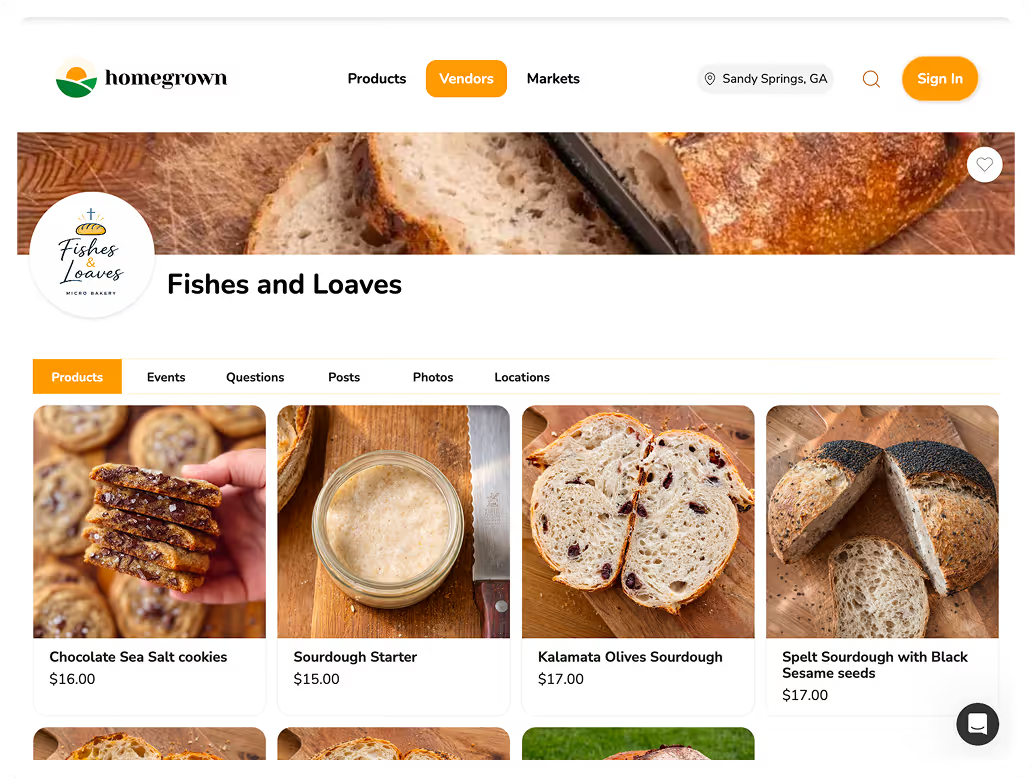
If your setup genuinely is twelve products and a pickup schedule, Homegrown is $10 a month billed annually with no setup or onboarding fee, 0% commission, and 2.9% plus $0.30 processing published up front, and it handles pickup at each place you sell with its own schedule and cutoff, local delivery with a radius and a route, and sales tax calculated, filed, and remitted in all 50 states. The honest bounds: there is no bulk product import, no migration service, and no onboarding help, which is exactly why there is nothing to charge for. If you are moving hundreds of members and years of history, that absence is a real gap and a platform with a paid Launch Package is doing something this does not. You can set your own catalog up in a trial and find out in an evening whether you needed help.
Every platform below shows the same four commercial facts, because a table that lists one platform's transaction fee and not another's is not a comparison. "Not published" means exactly that: the company does not state it publicly.
| Platform | One-time cost before you sell anything | Subscription (annual) | Free trial | Platform fee | Card processing |
|---|---|---|---|---|---|
| Barn2Door | $399 to $599 one-time setup, on top of the plan | $119/mo + $399 one-time setup | No free trial, demo only | $0 commission | 2.9% + $0.30 processing |
| Local Line | No setup fee published | $79/mo Core ($950/yr) | 7-day free trial, no card required | $0 platform fee | 2.9% + $0.30 processing |
| GrazeCart | Setup fee not published | $89/mo Starter, rest unpublished | No trial published | Platform fee not published | Processing not published |
| Homegrown | No setup fee | $10/mo billed annually | 7-day free trial | $0 platform fee (0% commission) | 2.9% + $0.30 processing |
| Shopify | No setup fee, but apps and a theme often cost | $29/mo Basic | 3-day trial, then $1/mo for 3 | 2% platform fee if not on Shopify Payments | from 2.9% + $0.30 processing |
| Square Online | No setup fee | Free tier; paid from $29/mo per location | 30-day trial on paid plans | $0 platform fee | 3.3% + $0.30 free tier, 2.9% + $0.30 paid |
Barn2Door charges a one-time $399, $499, or $599 depending on tier. Local Food Marketplace bundles a Launch Package worth $499 to $1,499, free with annual billing. GrazeCart and CSAware publish nothing either way.
Substantially in year one. Barn2Door Entrepreneur is $1,827 in year one against $1,428 after, so comparing monthly prices alone underestimates the first year by 28%.
Amortise it over how long you realistically expect to stay. A $399 fee is $399 a year if you stay one year and $80 a year if you stay five, so the answer depends entirely on your tenure.
Data migration, configuration of zones and schedules, some design work, training, and a dedicated contact. Ask for the itemised list, because for a small catalog most of it is work you could do yourself in an evening.
Local Food Marketplace includes its Launch Package free with annual billing and spreads the cost over your first six months on monthly. Ask whether annual billing waives yours, since it often does.
Sometimes. A platform requiring assisted setup is telling you something about using it unaided, and platforms charging setup fees frequently offer no free trial, which means your whole evaluation happens in a sales conversation.
When you have a small catalog and one pickup point, when you are unsure the platform fits, or when you expect to reassess within a year, since the fee lands entirely in that year.
Most storefronts charge nothing to set up. The exceptions are farm and hub platforms, where Barn2Door's $399 to $599 and Local Food Marketplace's $499 to $1,499 Launch Package are real numbers that subscription comparisons hide.
Compare first-year total and steady-state annual separately, because a platform can be the more expensive choice in year one and the cheaper one from year two. Barn2Door Entrepreneur is $1,827 then $1,428, and only one of those numbers appears on a pricing page.
Then amortise honestly. A $399 fee is $399 a year if you leave after twelve months and $80 a year if you stay five, which means setup fees quietly punish switching. Decide how long you actually expect to stay before deciding whether the fee is small.