

MyPorch is a well-built tool for one specific person: a cottage baker running weekly porch pickup who wants batch ordering and automatic compliant label printing. If that's you, it's a reasonable choice and its free tier makes it nearly costless to try.
People look for alternatives for three reasons, and they're all legitimate. They don't only sell baked goods. They need customers, not just an order form. Or they've hit the 10-order ceiling on the free plan and want to compare before committing.
The short version: If you sell more than baked goods, or you need discovery rather than just order handling, Homegrown is $10/mo billed annually or $12.50 monthly with 0% commission, a local marketplace listing, sales tax handled in all 50 states, and both pickup and delivery. If you want zero cost above 10 orders and don't mind manual reconciliation, Google Forms plus a payment app still works. If you want a hype-driven drop model with a large built-in audience, Hotplate is the fee-based option. If you're doing quoted custom cake work rather than batches, Bakesy's invoice model fits better than any batch tool. All figures came off each company's own site in August 2026.
Worth being precise about, because it determines whether you need an alternative at all.
MyPorch centers on the batch cycle: you open a batch, set a hard cutoff, customers order and pay through Stripe, the storefront locks itself at the cutoff, and you print labels and a bake list.
Its pricing is a free plan capped at 10 orders per calendar month, then $12/mo for Baker with unlimited orders, or $24/mo for Bakehouse, which adds SMS reminders, custom domain support, and advanced analytics. No platform transaction fee on any tier.
Its genuine standout is label printing. MyPorch generates cottage food labels including your state's required disclaimer, ingredients, allergens, and net weight, and snapshots each label at order time so a later recipe change doesn't alter your compliance record. Nothing else on this list does that automatically, and we're not going to pretend otherwise.
Its limits are equally clear. It's built for bakers specifically. It has no marketplace, so it works only on customers you already reached. And it doesn't list sales tax handling as a feature.
They don't only sell baked goods. The product, the workflow, and the branding all assume bread and pastry. If you sell jam, honey, soap, salsa, produce, or prepared meals, or if your product line drifts over time as most do, a bakery-specific tool becomes a constraint.
Order tools don't bring customers. A storefront link only converts people who already found you. If your problem is that not enough people know you exist, a better order form doesn't help, and it's an easy problem to misdiagnose because "I need a better system" is a more comfortable conclusion than "I need more customers."
The 10-order free ceiling. Genuinely generous as free tiers go, and also the point where people start comparing paid options rather than defaulting.
No sales tax handling. Many states tax prepared food, and baked goods can fall on either side of the grocery exemption depending on how they're sold. Finding that out eight months in is expensive. See do I need a business license for cottage food.
Pickup-centric design. If your city restricts customer traffic at a residential address, which is a common zoning constraint, delivery isn't optional for you.
$10/mo billed annually or $12.50 monthly, 0% commission, 2.9% + $0.30 processing, 7-day trial.
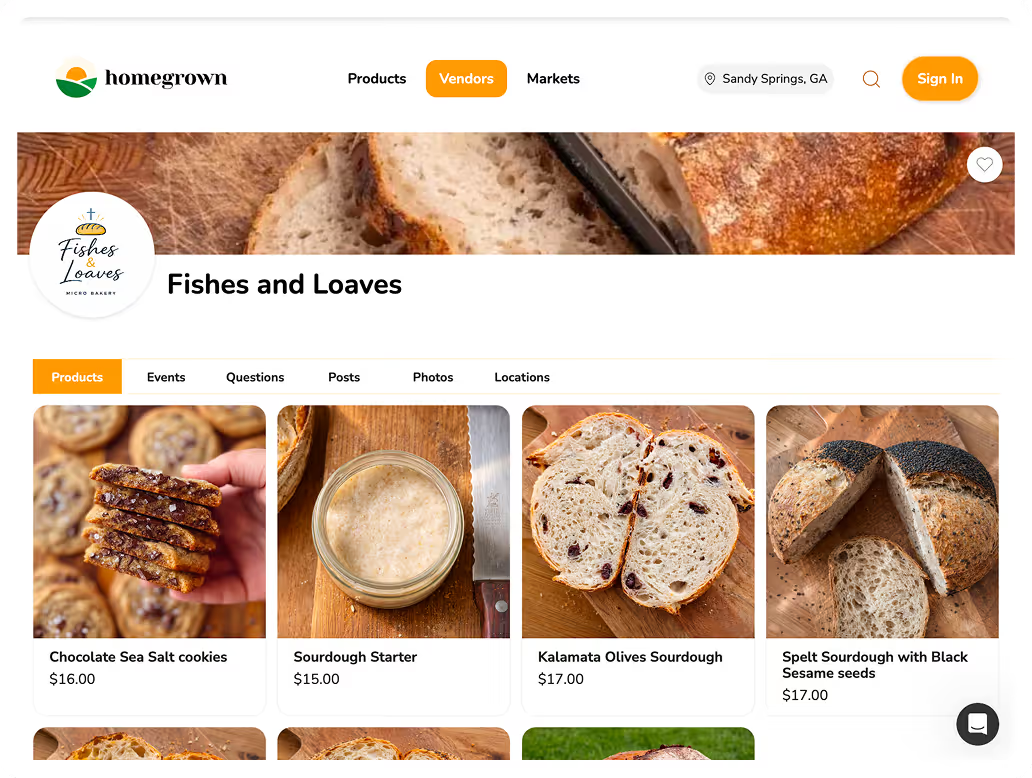
Homegrown is a storefront plus a local marketplace. You get a link with your products and prices for pickup or delivery, and you're also listed where nearby customers browse for local vendors they haven't met yet. That second part is the structural difference from every order-taking tool: it's a customer acquisition channel, not just a way to handle demand you already have.
It also calculates and remits sales tax in all 50 states, handles pickup and delivery, and serves the full range of small local food producers rather than bakers specifically.
Better than MyPorch if: you need discovery, you sell more than baked goods, you deliver, or you want sales tax handled.
Worse than MyPorch if: automatic compliant label printing is your main pain, or you want a permanently free tier. Homegrown gives you an accurate bake and order list but you build the labels yourself, working from the cottage food label checklist.
The full side-by-side is in Homegrown vs MyPorch.
Free, and it works better than people expect at low volume.
A form collects orders, a spreadsheet holds them, and Venmo or Cash App takes payment. Most home bakers start here and it's a legitimate starting point, not a failure.
Where it breaks is specific and predictable. A form doesn't track quantity, so two people can order the last loaf and both get confirmations. Payments arrive in a different system than orders, with names that don't always match, so you reconcile by hand every week. And there's no audit trail when a customer remembers ordering two of something and you have one written down.
That reliably falls apart somewhere between ten and twenty orders a week.
Better than MyPorch if: you're at three orders a week and want zero cost with zero commitment.
Worse than MyPorch if: you're above ten orders a week, since MyPorch's free tier covers that same range with actual quantity tracking.
Hotplate runs a drop model built around scarcity and timed releases, with a large existing user base. It charges a per-order fee rather than a flat subscription.
The trade-off is structural: a per-order fee means your platform cost scales with your success. At 30 orders a week that adds up in a way a flat $10 or $12 does not, which is the arithmetic in what 5% platform fees cost at $2k a month.
Better than MyPorch if: the hype-drop mechanic fits your product and you value the built-in audience.
Worse than MyPorch if: you sell steadily rather than in bursts, or you're at volume where per-order fees exceed a flat subscription.
See Hotplate alternatives and Homegrown vs Hotplate.
$9.99/mo Standard or $17.99/mo Premium, 30-day trial, 3.9% + $0.30 through Bakesy Secure Payments.
Bakesy is a custom-order desk rather than a batch tool. A customer describes what they want, you quote it, you send a branded invoice. That's exactly right for a three-tier wedding cake and exactly wrong for someone who wants two dozen cookies on Friday.
Better than MyPorch if: most of your revenue is quoted custom work rather than a repeating batch menu.
Worse than MyPorch if: you run a weekly batch. Bakesy's speed limit is how fast you reply; a batch tool's is how fast you bake.
Note the processing rate, which is a full point above the roughly 2.9% that most checkouts charge. The Federal Reserve's published interchange fee data explains why 2.9% is close to the industry floor. See Bakesy alternatives and Homegrown vs Bakesy.
If you take card payments at a booth with Square, the free online tier adds ordering with no new processor relationship.
It isn't built for food at all, which shows up as missing pickup-window logic, no batch cutoff, and no cottage food labeling. The free plan also carries real limits worth reading before you rely on it. See Square Online's hidden costs on the free plan.
Better than MyPorch if: Square is already your in-person processor and you want one system.
Worse than MyPorch if: you need batch cutoffs, pickup windows, or anything cottage-food-specific.
Powerful, general-purpose, and priced accordingly. For a home baker selling 20 loaves a week it's substantial overhead in both cost and setup time for capability you won't use, and the food-specific pieces still need apps. See Shopify's real cost for a cottage food business.
| Monthly | Platform fee | Marketplace | Cottage food labels | Sales tax | |
|---|---|---|---|---|---|
| MyPorch | Free to 10 orders, then $12–$24 | None | No | Automatic | Not listed |
| Homegrown | $10 annual / $12.50 monthly | 0% | Yes | Manual | All 50 states |
| Google Forms | $0 | None | No | Manual | You handle it |
| Hotplate | $0 base | Per-order fee | Its own audience | No | Varies |
| Bakesy | $9.99–$17.99 | $0 | No | No | Varies |
| Square Online | $0 free tier | Varies by plan | No | No | Square handles some |
Verify current figures on each company's own pricing page before deciding. All of these change.
Comparing subscription lines is the easy part and usually the least important. Four costs move the real number more.
Processing, which is almost always the bigger line. At $14,400 a year in sales across 360 orders, a 2.9% + $0.30 rate is about $526. The subscription at $10 a month is $120. Processing is four times the subscription, so a single percentage point of difference outweighs any subscription gap on this page. MyPorch routes through Stripe Connect and doesn't publish a rate on its pricing page, so check Stripe's published pricing for what you'd actually pay. Bakesy publishes 3.9% + $0.30 on its own payments, a full point above the roughly 2.9% most checkouts charge.
Your own time. A free tool that costs you two hours a week reconciling payments is not free. At any reasonable value on your time, two hours a week is well over a thousand dollars a year, which buys a decade of any subscription here. This is the calculation that makes "free" the most expensive option for most people past the earliest stage, and it's the same logic laid out in how to price baked goods: unpaid coordination time is the number home bakers most consistently ignore.
Tier creep. Check which features sit above the tier you're quoting. MyPorch's SMS reminders and custom domain are $24, not $12. Bakesy's inventory management, automated reminders, and logo removal are $17.99, not $9.99. Compare the tier you'd actually use rather than the headline price.
Switching later. Every platform you leave costs you something on the way out, and the asset to protect is your customer list. Before committing, check whether you can export it and in what form. A platform that makes your list hard to take with you has raised your switching cost deliberately, and that's worth knowing on day one rather than year two. See who owns your customer list on a food platform.
If your orders are already flowing and labels are the recurring annoyance: stay on MyPorch. Automatic compliant labeling is a real advantage and nothing else here matches it.
If you can bake more than you're selling: the bottleneck is discovery, and no order tool fixes that. Homegrown's marketplace listing is the piece that addresses it.
If you sell more than baked goods: MyPorch isn't built for you, and that's a design decision on their part rather than an oversight.
If you're under ten orders a month: MyPorch free or a Google Form both cost nothing. Use the time to work on demand instead of tooling.
If you're doing quoted custom work: Bakesy's invoice model fits better than any batch tool, though it's worth reading why custom orders keep a home bakery stuck before you build a business around them.
It depends on why you're leaving. For customer discovery alongside ordering, Homegrown at $10/mo billed annually adds a local marketplace and sales tax handling in all 50 states. For staying at zero cost, a Google Form plus a payment app works up to about ten orders a week. For quoted custom cake work, Bakesy's invoice model fits better than any batch tool.
MyPorch's own free plan covers 10 orders per calendar month, which is more generous than most. Below that, a Google Form plus Venmo or Cash App costs nothing but doesn't track quantity, so overselling and manual payment reconciliation are the trade-offs.
Not among the options here. Automatic state-disclaimer label generation is MyPorch's clearest differentiator. Other platforms give you an order list you build labels from. Our cottage food label checklist covers every required element and the state-specific disclaimer wording.
Homegrown, which serves the full range of small local food producers including jam, honey, soap, produce, and prepared meals. MyPorch's product, workflow, and branding all center on cottage bakers specifically.
Free for up to 10 orders per calendar month, then $12/mo for Baker with unlimited orders, or $24/mo for Bakehouse, which adds SMS reminders, custom domain support, and advanced analytics. No platform transaction fee on any tier. Payments run through Stripe Connect.
Usually wait for a natural break, and protect your customer list either way. Export it before you move and know what each platform lets you take with you. See how to export your customer list before switching and how to tell customers you changed ordering platforms.
Briefly, during a transition, and it's a reasonable way to test. Running both indefinitely means two sets of records and two places for an order to hide, which is the coordination problem you were trying to solve. Pick one within a few weeks. See how to test a platform with real customers.
Ignore the feature grids, including the one above. Put five real products on whichever platform you're considering, send the link to three regulars, and count how many orders arrive without a single message exchanged.
Then, two weeks later, check whether any orders came from people you never sent the link to. That second number is the one that separates an order tool from a sales channel, and it's the whole question if your problem is demand rather than admin.
Start a Homegrown storefront on a 7-day trial, or read the full Homegrown vs MyPorch comparison first.
*Figures for all platforms were taken from each company's own published pages in August 2026. Pricing changes; verify before deciding.*