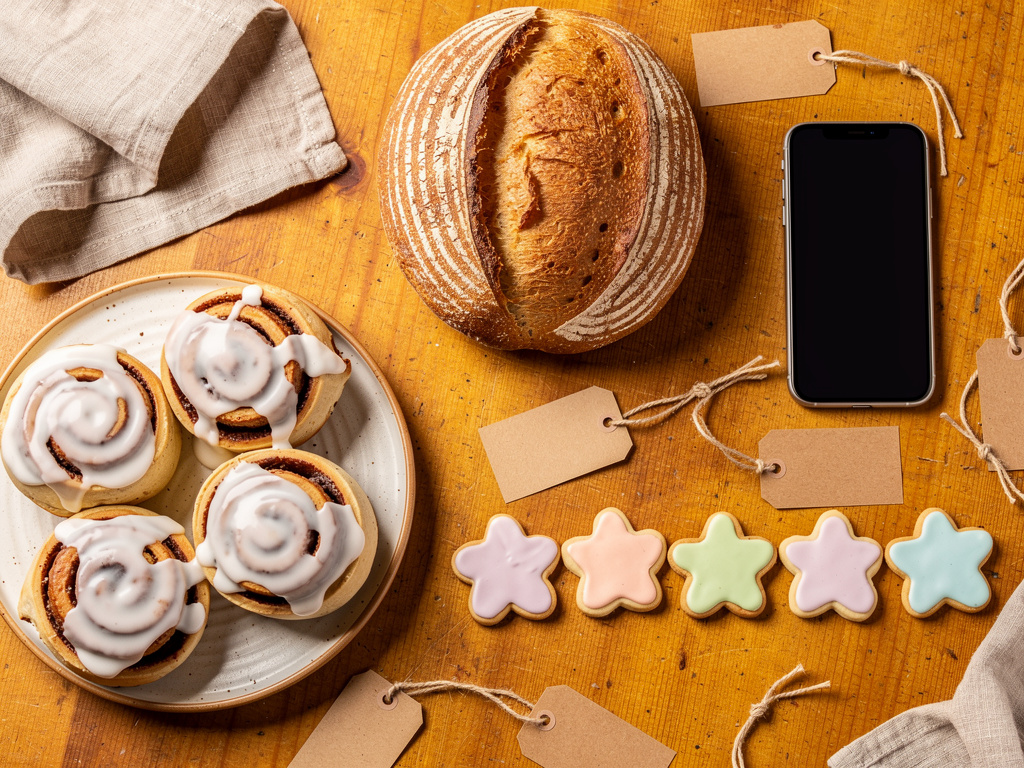


The short version: A bakery can put up to 5 hashtags on an Instagram post or Reel, so the best set names what is in the photo, where people can pick it up, and who it is for. Use one or two product tags like #SourdoughBread or #DecoratedCookies, one or two town tags, and one community tag like #CottageBakery. Big tags like #Bakery bury a small account fast, and tags like #GlutenFree or #Organic are claims with federal definitions behind them. Hashtags only bring people to your profile, so the link in your bio has to let them order.
Checked on Instagram's Help Center page on hashtags, October 13, 2026: "You can use up to 5 tags on a post." Homegrown's numbers were checked on findhomegrown.com/signup the same day: $10 a month billed annually ($12.50 billed monthly), 0% commission, 2.9% + $0.30 card processing paid by the vendor. Customers create a Homegrown account to place a first order, and there is no drops (timed release) feature.
You pull a tray of cinnamon rolls out of the oven, snap a photo, and then stare at the caption box. Which hashtags? How many? The old trick of pasting a block of 30 tags from your notes app does not work anymore. Instagram cut the limit to 5, and a comment that goes over it will not even post.
That makes every tag count. This guide is for the home baker or small bakery that sells by pre-order, at a Saturday farmers market, or from the porch. It gives you hashtags sorted by what you actually bake, a set of 5 for each kind of post, the local tags that reach people who can pick up, and two common tags that can get a baker in trouble. Your caption still does the selling, so pair this with our list of Instagram captions for a bakery. If you sell more than baked treats at your booth, the 50 best hashtags for farmers market vendors covers jam, produce and market-day tags.
A bakery can use up to 5 hashtags on one Instagram post or Reel. Instagram's Help Center page on hashtags says "You can use up to 5 tags on a post," and if you include more than 5 on a single photo or video, "your comment won't post." We loaded that page on October 13, 2026.
The old limit was 30. Instagram announced the change in December 2025 and rolled it out to accounts a little at a time, so some bakers saw it before others. Here is what the 5-tag rule means day to day:
Going from 30 slots to 5 is 83 percent fewer tags per post, so the tags that only padded the block are the first to go.
Lots of hashtag lists online still say "use up to 30" or "use 5 to 15." They were written before December 2025. If a page tells you to paste more than 5, it is out of date. We checked the current limit on Instagram's Help Center on October 13, 2026.
A hashtag is a label that puts your post on a public page with every other post that used the same tag. Someone who taps #CinnamonRolls sees that page, and your post can show up there next to bakers from everywhere. Instagram's Help Center page on hashtag search results says the order of posts on those pages may depend on when the post was shared, how people engage with it, and whether it meets Instagram's Recommendation Guidelines.
That tells you three practical things about hashtags for a home bakery:
Hashtags are not a reach button. They help the right people find a post they would want anyway. A clear photo of a scored sourdough loaf with the price and pickup day in the caption will usually beat a blurry photo with perfect tags. Think of tags as the sign on your booth, not the bread on the table.
Home baking is a crowded field. Of the 318 vendors in our October 13, 2026 Homegrown catalog pull, 189 vendors list bakery products, and that is one small marketplace. Those numbers do not measure Instagram, but they show how many home bakers are posting the same loaves and cookies you are.
A good starting set of 5 bakery hashtags gives each slot one job: two say what is in the photo, two say where to get it, and one says who it is for. It is a starting point, not a rule Instagram publishes. The mix keeps every tag honest and gives you a shot at both people browsing a product and neighbors browsing their town, and you can test it against your own orders (see the tracking section below). Build each set in five steps:
Three saved sets, rotated, mean each set comes back about once every 10 days at two posts a week, and you never post the same 5 back to back.
Write tags in CamelCase, which means a capital letter at the start of each word: #CottageBakery instead of #cottagebakery. Instagram reads both the same way, but people using screen readers hear the words separately. More on that in the branded hashtag section below.
Sourdough and bread tags are crowded with home bakers, so pair one bread tag with a town tag on every post. Bread is also the biggest bakery group on Homegrown by product count: about 532 bread and sourdough listings in our October 13, 2026 pull, from 111 vendors, the same number of vendors that listed cookies.
In a pull of the Homegrown catalog on October 13, 2026, 1,500 of the 2,889 products (52%) were listed in the Bakery category, from 189 of the 318 vendors. The word "sourdough" showed up in the name or description of 461 bakery products from 83 vendors. We sorted bakery products by name first, then description, then the vendor's name, and moved fudge, granola, candy and pasta to their own group. About 1 in 10 still landed in the wrong group when we checked samples by eye, so treat the chart below as close, not exact.
Homegrown vendors listing each kind of bakery product
Source: Homegrown public catalog pull, October 13, 2026, 1,500 Bakery products from 189 vendors. A vendor who sells two kinds is counted in both bars.
Pick one or two of these bread tags per post, based on what is in the frame:
If you are still getting your bread business set up, our guide to selling sourdough bread from home covers pricing, rules and where to sell.
The best cookie hashtags name the style of cookie, because a person craving a decorated sugar cookie is not looking for a chocolate chip one. Cookies tie bread for the most vendors of any bakery product on Homegrown (111 vendors each in our October 13, 2026 pull), so a plain #Cookies tag puts you in a very long line.
Choose by what the photo shows:
Seasonal shapes get their own tags too. A tray of iced pumpkins in October can carry #HalloweenCookies, and a December box can carry #ChristmasCookies. Swap the seasonal tag in for a general one; do not stack both.
Cake hashtags work best when they name the occasion, because a cake customer is usually planning a party, not browsing for fun. A person with a 1-year-old's birthday coming up searches like a planner. In our October 13, 2026 pull, 45 Homegrown vendors listed cakes or cupcakes, fewer than half the number selling bread.
Useful cake tags:
On a custom cake post, put the lead time in the caption ("order 7 days ahead") and use one occasion tag plus one town tag. That pairing reaches the neighbor who needs a cake by Saturday, which is the only person who can actually order it.
Cinnamon rolls, pastries and muffins are breakfast bakes, so their tags should pair the bake with a morning or a day of the week. In our October 13, 2026 pull, 55 vendors on Homegrown listed cinnamon rolls or pastries and 50 vendors listed muffins or quick breads. That makes them a good fit for a post the night before a market or pickup morning.
Cinnamon roll and pastry tags:
Muffin and quick bread tags:
A muffin post on a Thursday night with #BlueberryMuffins, #BananaBread, #[Town]FarmersMarket, #[MarketName] and #BakedFromScratch tells a local follower exactly what to grab first at your booth.
Pie customers often order for a holiday table, so a pie baker should save a holiday set and post it 2 to 3 weeks before the order cutoff. Pies are the smallest bakery group on Homegrown in our pull, at 23 vendors.
Tags to rotate:
A Thanksgiving set might be #PumpkinPie, #ThanksgivingPies, #[Town]Bakery, #[Town]Eats and #PieOrders. That is 5 tags, each one doing a different job.
Holiday pie orders also need a hard cutoff, because a pie baker can only fit so many in the oven. Put the cutoff day in the first line of the caption and post a reminder 2 days before it, with the same set of tags so people who saw the first post see it again.
Local hashtags are the most valuable slots for a bakery that sells by pickup, because only people nearby can collect a loaf on Saturday. A follower in another state may like the photo, but a follower 10 minutes away can order it. Start with these templates and swap in your real names, with no spaces:
Instagram's Help Center says numbers work inside a hashtag but spaces and special characters like $ and % do not. So #5DollarLoaf works and #$5Loaf does not.
Before you trust a town tag, search it and look at the 10 most recent posts. A good one shows local people, local places and local events. A bad one shows spam, a city with the same name in another country, or nothing posted in months. A town with a common name, like Springfield or Franklin, often needs the state added: #SpringfieldMOEats instead of #SpringfieldEats.
Then look at what the busiest vendors at your farmers market and your market's own account put on their posts. The town and market tags that keep showing up are the ones your customers already follow.
Once those local tags start bringing neighbors to your profile, they need a way to order that does not start with a DM. A Homegrown storefront gives you one link for your bio where a local customer can pick a loaf, choose a pickup day and pay, for $10 a month on annual billing with no percentage fees beyond standard payment processing.
Each kind of bakery post needs a different set of 5, because a sold-out post and a custom cake post are trying to reach different people. The table below gives a starting set for 7 common posts. Swap the bracketed words for your town and market, and post the weekly menu about 3 days before your order cutoff.
Scroll sideways to see every column.
| Post | What it is for | Product tags (2) | Local tags (2) | Who it is for (1) |
|---|---|---|---|---|
| Weekly menu | Show this week's bakes and the order cutoff | #SourdoughBread #CinnamonRolls | #[Town]Bakery #[Town]Eats | #HomeBakery |
| Pre-orders open | Get orders in before bake day | #CookieOrders #CookieBox | #[Town]Bakery #ShopLocal[Town] | #CottageBakery |
| Sold out | Show demand, point to next week | #SourdoughLoaf #CrumbShot | #[Town]Eats #[County]SmallBusiness | #MicroBakery |
| Market day | Bring people to your booth | #CinnamonRolls #Scones | #[Town]FarmersMarket #[MarketName] | #HomeBakery |
| Custom cake | Book orders with a lead time | #CustomCakes #BirthdayCake | #[Town]Bakery #[Town]Eats | #CakeOrders |
| Behind the scenes | Show how you make it | #BreadScoring #SourdoughBread | #[Town]Bakery #[State]CottageFood | #BakedFromScratch |
| Holiday pre-order | Fill a holiday order list early | #PumpkinPie #ThanksgivingPies | #[Town]Bakery #[Town]Eats | #PieOrders |
Starting sets, not rules. Each row is 5 tags, Instagram's limit per post as stated on its Help Center page on hashtags, checked October 13, 2026. Replace any tag that does not match the photo.
A few habits make the table work better:
#GlutenFree and #Organic are two of the most common bakery hashtags with federal definitions behind them, so only use them when your bake meets the definition. A hashtag on a post that sells a product reads like a promise to the customer. A person with celiac disease who orders because of #GlutenFree is trusting that tag with their health.
Cottage food rules are set by each state, and labeling rules for home-baked products differ from state to state. The federal definitions above were loaded on eCFR on October 13, 2026. Verify your state's current rules before you tag or label anything gluten-free or organic.
In our catalog pull, 58 Homegrown bakery products from 21 vendors mention gluten-free or "GF." If you are one of them and you bake in a dedicated gluten-free kitchen, the tag can be a real draw. If you are not, leave it off.
A branded hashtag is worth it once regulars start posting your bakes, because it collects their photos on one page you can share. Before that, it is a tag only you use, and it takes a slot that a town tag could fill. For a new bakery account, town tags come first.
If you make one, set it up in four steps:
CamelCase is about more than looks. Iowa's state accessibility training tells writers to capitalize each word in a hashtag so a screen reader says each word clearly. Delaware's Government Information Center gives the same advice in its social media accessibility guide: screen readers read each capitalized word individually when a hashtag uses CamelCase.
Put your hashtags at the end of the caption, after the price, pickup day and order link line. Instagram's Help Center says you can add hashtags in the caption or the comments of your post, and you can add them later by editing the caption. Either way, caption and comment tags appear to share the one limit of 5.
Here is how that plays out on each kind of post:
Reels are another way to reach people who do not follow you yet. Our guide to short videos for a food business covers how to film a clip in under 5 minutes on a day you are already baking.
Yes, posts from a public professional account can show up on Google and Bing. Instagram's Help Center page on search engine indexing says it allows search engines to index photos and videos from public reels and posts uploaded since January 1, 2020, from accounts that are public, professional (a business or creator account), and run by someone over 18. We loaded that page on October 13, 2026.
That changes how you write the words around your tags:
Instagram's own search works on keywords too. Its Help Center says you can search Instagram "using keywords to find photos and videos, hashtags, accounts, audio, tags, and places." So the caption words matter inside the app as well.
A hashtag gets someone to your profile, and your bio link decides whether they order or leave. If your bio says "DM to order," a new customer has to start a conversation with a stranger, ask the price, ask about pickup and then send a payment app request. Many will not. A link that opens a menu with prices, pickup days and a checkout turns that hashtag visit into an order.
That is the problem Homegrown is built for. Homegrown is $10 a month billed annually ($12.50 billed monthly) with no percentage fees beyond standard payment processing, and it gives you one storefront link for your Instagram bio. Customers pick their loaf or dozen, choose a pickup day, and pay by card. Here is how that compares with the tools bakers usually point Instagram followers to:
Scroll sideways to see every column.
| Platform | Subscription | Trial | Platform fee | Card processing | Customer pays on a $20 order | Vendor pays on a $20 order | Vendor cost, 50 orders in a month |
|---|---|---|---|---|---|---|---|
| Homegrown (billed annually) | $10/mo | 7 days, no charge until day 8 | $0, 0% commission | 2.9% + $0.30, paid by vendor | $20.00 | $0.88 | $54.00 |
| Homegrown (billed monthly) | $12.50/mo | 7 days, no charge until day 8 | $0, 0% commission | 2.9% + $0.30, paid by vendor | $20.00 | $0.88 | $56.50 |
| Hotplate (default, fee passed to customer) | $0 | No subscription to try | 5% + $0.55, paid by customer | 2.9% + $0.30, paid by vendor | $21.55 | $0.88 | $44.00 (customers pay $77.50 in fees) |
| Hotplate (baker pays the fee) | $0 | No subscription to try | 5% + $0.55, paid by vendor | 2.9% + $0.30, paid by vendor | $20.00 | $2.43 | $121.50 |
| Etsy | $0 (a one-time set-up fee may apply) | None | $0.20 listing fee + 6.5% transaction fee | 3% + $0.25, paid by vendor | $20.00 plus any shipping | $2.35 | $117.50 |
We checked these on October 13, 2026: findhomegrown.com/signup, Hotplate's pricing page and its post "What Hotplate does" (which says the fee is charged to your customer by default and 80% of chefs keep that default), and Etsy's Fees & Payments Policy and Etsy Payments page. Processing is figured on the $20 subtotal. Etsy's listing fee renews at $0.20 after each sale of a multi-quantity listing, so the table counts one $0.20 per order. Etsy also charges a 15% Offsite Ads fee on any order it attributes to its ads (shops under $10,000 a year in sales can opt out; shops over that pay 12% and cannot). Hotplate's own pricing example charges $1.27 processing on a $30.00 subtotal, more than 2.9% + $0.30 of $30 ($1.17), so its real processing cost per order can run a little higher than the table shows.
Each of those tools fits a different baker. Instagram DMs have no platform fee, but you track every order and payment by hand, and the payment app can take its own cut: Venmo charges 1.9% + $0.10 on a payment sent to a business profile (its fee page, checked October 13, 2026). Hotplate has no subscription, and its default adds $1.55 to a $20 checkout for your customer, or $2.43 per order comes out of your pocket if you cover the fee yourself; it is also built around timed drops. Etsy is built mainly around shipped orders, not a Saturday porch pickup for a neighbor who found you through #[Town]Bakery.
What Homegrown gives a baker who is getting found on Instagram:
Now the honest bounds. Homegrown does not pick or post your hashtags, schedule your Instagram posts, or grow your following. Your storefront is listed in the marketplace, but plan on most orders coming from people you send to your own link. Customers create a Homegrown account to place a first order. And there is no drops feature, meaning no countdown or timed release, and no date to share for one. If the Instagram side is working and the ordering side is not, you can set up your Homegrown storefront in about 15 minutes and put the link in your bio before your next post.
The simplest test is to run one hashtag set for 4 posts, then a second set for 4 posts, and compare how many new customers each brought in. Likes and views are nice, but a bakery runs on orders. Here is a low-effort way to track it:
Judge a hashtag set on at least 4 posts, not 1. One post can flop because of the weather, a holiday weekend or a bad photo. Four posts over two weeks smooths that out, and the town tag that brought 3 new pickup orders is worth more than the product tag that brought 300 likes from another state.
A costly bakery hashtag mistake is spending your 5 slots on tags that reach people who can never order, like bakers in other countries or other home bakers. Other bakers are a fun community, but they rarely buy your bread. These habits waste your 5 slots:
The best Instagram hashtags for a bakery name what is in the photo, where customers can get it, and who it is for. A set like #SourdoughBread, #CrumbShot, #[Town]Bakery, #[Town]Eats and #HomeBakery covers all three in Instagram's limit of 5. Swap the product tags to match each post and keep the town tags.
No. Instagram's Help Center says you can use up to 5 tags on a post, and a comment that would push a post past 5 will not post. The limit has been rolling out since December 2025 and covers both posts and Reels, so old advice to use 20 or 30 tags no longer applies.
Put them in the caption, at the end, after the price and pickup details. Instagram allows hashtags in either place, but a comment that takes the post past 5 won't post, so a first comment does not add any slots. Keeping them in the caption also keeps everything in one place when you edit an old post.
Yes, as labels. A hashtag puts your post on a public page with every other post using that tag, and Instagram says the order on those pages may depend on how recent the post is and how people engage with it. Small local tags tend to work better for a home bakery than huge ones, because your post is likely to stay near the top longer and it reaches people who can pick up.
Only if the bake meets the FDA definition in 21 CFR 101.91, which bars gluten grains like wheat and requires any gluten that gets in to stay under 20 parts per million. Many home kitchens bake with wheat flour too, which makes that hard to promise. Your state's cottage food labeling rules may add their own limits, so check them before you tag.
A sourdough micro bakery can rotate #SourdoughBread, #SourdoughLoaf, #CrumbShot, #BreadScoring and #MicroBakery as product and community tags, and keep two slots for town tags. In our October 13, 2026 Homegrown catalog pull, 83 vendors mentioned sourdough in their bakery listings. Plenty of bakers sell sourdough, so the town tag is what tells a local customer you are the one they can pick up from.
Hashtags are one part of an Instagram post that sells. Each of these posts covers another part, from the caption under the photo to the link in your bio, and all of them are written for vendors who sell by pre-order or at a farmers market:
Pick one set of 5 from the table above, swap in your town, and use it on your next 4 posts. Write the price and pickup day in the first line, put the tags at the end, and make sure the link in your bio lets a new customer order without messaging you. Then count first-time orders for two weeks and change one tag.
You do not need to post every day for this to work. Two good posts a week, each with a set of 5 that fits the photo and two town tags, will put your bakes in front of more neighbors than a daily post with 5 random tags. Keep the sets that bring first orders and drop the rest.
If the order link is the missing piece, start your Homegrown storefront. It is $10 a month billed annually with 0% commission, the 7-day trial has no charge until day 8, and your next hashtag visitor can order a loaf the same day they find you.