


The short version: Hotplate and Bakesy solve two different problems. Hotplate runs timed drops, where you open a window, customers order during it, and you bake to the order count. Bakesy manages custom orders, where a customer describes the cake they want and you send back an invoice. Hotplate charges no subscription and takes 5% plus $0.55 per order, added to your customer's checkout total by default, while you separately pay 2.9% plus $0.30 in card processing. Bakesy charges $9.99 or $17.99 a month, takes no per-order platform fee, and routes card payments at 3.9% plus $0.30, a full point above Hotplate's card rate. If you sell the same products on a schedule, Hotplate's model fits. If every order is a conversation, Bakesy's does. If you want customers to order and pay any day of the week, Hotplate closes between drops, and Bakesy only lets them pay on the spot on its $17.99 Premium plan.
Checked September 14, 2026: Every price below comes from each company's own pages: Hotplate's pricing page and its own explainer, Bakesy's pricing page, payments guide and help center, and Homegrown's signup page. Prices change, so look at both pricing pages again before you sign up.
This guide runs both fee stacks through the same 25 orders, lays out what each tool does and what it leaves to you, and shows where a Homegrown storefront fits if your customers need to order on any day of the week.
Hotplate sells a set menu in scheduled drops that open and close, and Bakesy turns custom order requests into invoices. They are not two versions of the same product. They are different tools that happen to share an audience.
Hotplate is built around the drop. You schedule a release window, say Thursday at 7pm for Saturday pickup. Customers see a countdown, order during the window, and the window closes. You get an order count and a prep list, then you bake exactly that. Hotplate's pricing page states the model plainly: no subscription, no setup cost, no contract, everything included.
Bakesy is built around the custom order. A customer fills out an order form describing what they want. You review it, price it, and send a branded invoice. Bakesy's feature list starts with a shop website, then order forms, invoices, galleries, availability, and automated receipts. It is built for a baker who quotes work one job at a time.
That difference settles most of this comparison before price enters it:
The fastest way to settle it is not reading either pricing page again but running a short trial during your two slowest weeks. Load five of your real products into a storefront and see which half of this trade you feel first.
The Hotplate app works in four steps, according to Hotplate's own explainer. You build a drop with a menu, inventory, pickup places and pickup times, and you schedule when orders open and close. Right before orders open, Hotplate texts your subscribers a link. Customers watch a short countdown, add products to a cart that lets go of them if the customer takes too long, pick a pickup time and pay. Hotplate then builds your prep list and order tickets and sends pickup reminders.
Hotplate also builds the website for your storefront, and its homepage says customers can check out with a credit card, cash, or Venmo or Zelle. You can cap inventory per product, per customer or per pickup time, and a sold-out product gets a waitlist. For Hotplate on its own, see our Hotplate review and alternatives.
Bakesy is both. You run your business from the Bakesy app on your phone, and Bakesy's help center says subscriptions are billed through the App Store or Google Play. The app builds a Bakesy Shop, which Bakesy describes as your website and online ordering platform, and the Standard plan can connect your own domain. Customers send an order request from the shop. For the products you pick, the Premium plan adds instant checkout, so a customer can pay without waiting for an invoice. Our Bakesy Standard vs Premium breakdown goes plan by plan.
Here is the full stack on both, plus a third option for reference. Every row shows the same four things, because a platform fee quoted without its processing fee attached is not a real number.
Swipe sideways to see all three columns.
| Hotplate | Bakesy | Homegrown | |
|---|---|---|---|
| Subscription | $0/mo, there is no plan to buy | $9.99/mo Standard, $17.99/mo Premium | $10/mo billed annually, or $12.50/mo billed monthly |
| Free trial | None needed, nothing to subscribe to | 30-day free trial | 7-day free trial |
| Platform fee | 5% + $0.55, added to the customer's subtotal by default | $0 | $0, 0% commission |
| Card processing | 2.9% + $0.30, paid by you | 3.9% + $0.30 through Bakesy Secure Payments | 2.9% + $0.30 |
Two rows in that table deserve more than a glance.
Hotplate's 5% plus $0.55 lands on your customer, not on you, unless you choose otherwise. Hotplate's own pricing page walks through a $30 order: the customer sees a $2.05 fee added at checkout, and you separately pay $1.27 in card processing. That $1.27 is more than 2.9% plus $0.30 on the $30 subtotal alone, which comes to $1.17, and the page does not say what else the rate is charged on. The math in this guide applies each card rate to the order subtotal, so your real Hotplate processing may run a little higher. You can absorb the fee instead. That is a real choice with a real cost, and it is the largest single variable in this comparison.
Hotplate's fee never applies to tips or sales tax, and you can change how it splits between you and your customer. In its September 2025 explainer, Hotplate said 80% of its chefs keep the default split, where the customer pays the fee and the chef pays card processing.
Bakesy's 3.9% sits a point above Hotplate's and Homegrown's card rate. Hotplate and Homegrown both charge 2.9% plus $0.30 for card processing. Bakesy's payments page states 3.9% plus $0.30 for Bakesy Secure Payments and notes the method is optional. Bakesy also lets you accept Venmo, PayPal, Zelle, or Cash App with no Bakesy fee, but then you are arranging and chasing payment by hand, which is most of what a platform exists to remove.
Bakesy Secure Payments is only available in the US, and Bakesy pays it out to your bank every two business days.
For what card acceptance costs underneath all of this, the Federal Reserve publishes average debit card interchange fees by payment card network under Regulation II. Interchange is the part of each card sale that goes to the bank that issued the card. For debit cards from covered banks, Regulation II caps it at $0.21 plus 0.05% of the sale, plus a $0.01 fraud prevention adjustment, and the Fed's 2024 table shows an average of $0.37 on a $47.24 dual-message debit sale, or 0.79%. Regulation II covers debit cards only, and interchange is only one piece of a card rate. A platform charging 3.9% takes a full point more of each sale than one charging 2.9%.
Hotplate charges 5% of the order subtotal plus $0.55 on every order, shown to your customer by default, and you pay 2.9% plus $0.30 in card processing. On a $20 order that means a $1.55 fee for your customer, the same average Hotplate's pricing page quotes, and $0.88 in processing for you. Hotplate's own example order shows the whole checkout: a $30.00 subtotal, a $2.05 Hotplate fee, a $3.00 tip and $2.55 in sales tax at 8.5%, for a $37.60 customer total.
Bakesy pricing comes down to two plans, Standard at $9.99 a month and Premium at $17.99 a month, each with a 30-day free trial, plus card processing of 3.9% + $0.30 on payments through Bakesy Secure Payments. Standard includes:
Premium adds these on top of Standard:
All three prices can change. This guide checked Hotplate's pricing page, Bakesy's pricing page, Bakesy's payments guide and Homegrown's signup page. The Federal Reserve publishes debit card interchange data under Regulation II, and the IRS keeps a guide to business expense resources.
Look at each company's own page again before you choose. Last verified September 14, 2026.
Take a baker doing 25 orders a month at a $20 average order, so $500 in monthly sales. That is an example, so swap in your own order count and average to run the same math.
Hotplate, fee passed to the customer
Hotplate, fee absorbed by you
Bakesy Standard
Homegrown, annual billing
Here are the same 25 orders side by side, with Bakesy Premium and Homegrown's monthly plan added.
Swipe sideways to see every column.
| 25 orders of $20 | You pay a month | Platform fee added to your customers' checkouts | All fees on $500 in sales |
|---|---|---|---|
| Hotplate, fee passed to customers | $22.00 | $38.75 | $60.75 |
| Hotplate, fee absorbed by you | $60.75 | $0.00 | $60.75 |
| Bakesy Standard, cards through Bakesy | $36.99 | $0.00 | $36.99 |
| Bakesy Premium, cards through Bakesy | $44.99 | $0.00 | $44.99 |
| Homegrown, yearly plan | $32.00 | $0.00 | $32.00 |
| Homegrown, monthly plan | $34.50 | $0.00 | $34.50 |
The break-even between Hotplate-with-absorbed-fees and Bakesy Standard sits at roughly seven orders a month. Below that, Hotplate wins even when you eat the fee. Above it, Bakesy Standard is cheaper, and the gap widens with every order.
Here is where that seven comes from. At a $20 average order, absorbing Hotplate's fee costs you $2.43 an order ($1.55 plus $0.88 in processing), while Bakesy Standard costs $1.08 an order in processing plus the $9.99 plan. That $1.35 gap covers the plan by the eighth order. Bakesy Premium at $17.99 takes until the fourteenth order.
If you pass Hotplate's fee to your customers, Hotplate is the cheapest card checkout on this page for you in this guide's 25 order example, and it stays cheaper for you than either Bakesy plan at any volume. Hotplate's own $30 example charges you about $0.10 more in processing than this guide's math. If every order ran like that, Hotplate would cost you about the same as Homegrown's $10 yearly plan at around $3,000 a month in sales. It is also the only option where your customer pays about 7.75% more than your listed price on a $20 order. Whether that is a good trade depends on your buyers, and it is worth testing rather than assuming. Platform fees and card processing are business expenses either way. The IRS stopped updating Publication 535 after its 2022 edition, and its guide to business expense resources now points to the current rules.
To set prices that still pay you after these fees, Homegrown's free pricing calculator starts from your material cost per unit, your time, your hourly wage, packaging and overhead, then suggests a price with a margin built in.
In a Hotplate vs Bakesy feature check, Hotplate includes all of its tools at $0 a month and makes its money from the per-order fee, while Bakesy splits its tools between the $9.99 Standard plan and the $17.99 Premium plan and adds 3.9% + $0.30 card processing on payments through Bakesy. The table below lists what each company's own pages say.
Swipe sideways to see both columns.
| Feature | Hotplate | Bakesy |
|---|---|---|
| How customers order | During a drop window you schedule, after a short countdown | An order request form, then your invoice. Premium adds instant checkout |
| Monthly plan | $0 | $9.99 Standard or $17.99 Premium |
| Fees on each order | 5% + $0.55 to your customer by default, plus 2.9% + $0.30 card processing to you | $0 platform fee, plus 3.9% + $0.30 on payments through Bakesy Secure Payments |
| Ways customers pay | Credit card, cash, or Venmo or Zelle | Cards through Bakesy, or Venmo, Cash App, PayPal, Zelle and Apple Cash that you mark paid by hand |
| Texts and reminders | Texts when a drop opens, plus pickup reminders | Automated customer reminders on Premium |
| Sellouts | Caps per product, customer or pickup time, plus a waitlist | A max quantity per product and a limit on orders per day |
| Discount codes | Included | Premium |
| Messaging customers | A built-in inbox | Outside the app, per Bakesy's help center |
| Sales tax | Added at checkout; filing is yours | Added to an invoice; filing is yours |
| Delivery | Pickup windows | A delivery fee on the invoice; the delivery itself happens outside Bakesy |
| Your customer data | Download your customer list at any time | An order history download, emailed to you |
| Marketplace | Says it is not a consumer marketplace | No marketplace mentioned on the pages checked |
The payments row and the messaging row are the easiest to miss. On Bakesy, a Venmo or Zelle payment gets marked paid by hand, and every conversation with a customer happens somewhere else, such as text or Instagram.
Choose Hotplate if you sell a set menu on a schedule and Bakesy if you quote custom orders, then let the cost math settle a close call. Work the decision in this order.
If your answers split between a set menu and custom cakes, price out two tools against one storefront that takes the set menu every day while you quote the cakes yourself.
Hotplate is the stronger tool when demand is bursty and supply is capped.
Hotplate's own sales guide puts a number on that first point: on average, chefs see about 1 in 10 of their text subscribers place an order from a drop, so a list of 500 subscribers usually brings about 50 orders.
Hotplate's weakness is the flip side of its strength. Between drops, you are closed. A customer who finds you on a Tuesday has nothing to buy. If a meaningful share of your sales come from people discovering you and ordering right then, that closed window is lost revenue, and catching those orders means running a drop tool alongside a pre-order system that stays open.
The tie-breaker: if your product sells out in under an hour, Hotplate is doing something for you that a standard storefront will not. Scarcity is its whole design.
Bakesy fits a baker who prices each order from a request form, and its Standard plan costs $9.99 a month plus 3.9% + $0.30 card processing when customers pay through Bakesy. Bakesy is the stronger tool when every order is a negotiation.
Bakesy's weakness is that its shop is built around order requests and invoices. Bakesy's own pages describe the Bakesy Shop as your website and online ordering platform, and none of the pages checked for this guide mention a marketplace, so it does not put your shop in front of people who have never heard of you. It also gates a lot behind Premium at $17.99: tips, instant checkout, the revenue dashboard, inventory management, automated customer reminders, and hiding the Bakesy logo on your shop and invoices. Price the tier you will actually need, not the one in the headline. Our fuller look at order management tools for home bakers covers where each of these categories starts and stops.
Both tools are narrow on purpose, which leaves the same four gaps.
Those gaps are exactly where a general storefront fits, and they are worth pricing before you commit to a tool that solves one workflow beautifully and ignores the rest.
Sales tax is the gap with money attached. Hotplate's own checkout example adds 8.5% sales tax on top of the order, and filing and paying that tax is still your job on either platform.
If your real problem is that you want one link customers can order from any day, for pickup or delivery, without a drop window and without an invoice conversation, that is a different product than either of these.
Homegrown is $10 a month billed annually, or $12.50 billed monthly, with 0% commission and 2.9% plus $0.30 card processing, the same processing rate Hotplate charges and a full point below Bakesy's. You get a standalone storefront on your own link, pickup at the places you actually sell, local delivery with a radius you set and a flat fee you keep, less card processing, a route to run on delivery day, and sales tax calculated and remitted in all 50 states. The trial runs seven days and nothing is charged until day eight.
Set against these two specifically: Hotplate runs a timed drop better than Homegrown does, because Homegrown does not have drop windows or hard per-release quantity caps. Bakesy handles a complicated custom cake quote better, because Homegrown does not have custom-order request forms. What Homegrown does that neither of them is built around is staying open between those moments, handling the tax filing, and charging the same subscription with 0% commission whether you sell $200 or $2,000 in a week, with 2.9% plus $0.30 card processing on each order either way. You can see what the storefront looks like before committing to anything.
In a pull of the Homegrown catalog on August 14, 2026, 876 of the 1,804 products listed were in the bakery category, from 122 of 219 vendors. By product name, 262 of those bakery listings mentioned sourdough, 174 a cookie, 150 bread or a loaf, 72 cake, 44 muffins and 39 cinnamon rolls. Only 7 had custom in the name. These are listings, and they are not sales figures.
Homegrown bakery listings, by a word in the product name
Source: Homegrown catalog pull, August 14, 2026. One listing can match more than one word.
A menu of loaves and cookies like that is the kind a storefront can keep open all week, while a custom cake still starts with a conversation. Your storefront is also listed in the Homegrown marketplace automatically, but plan on bringing your own customers with your link.
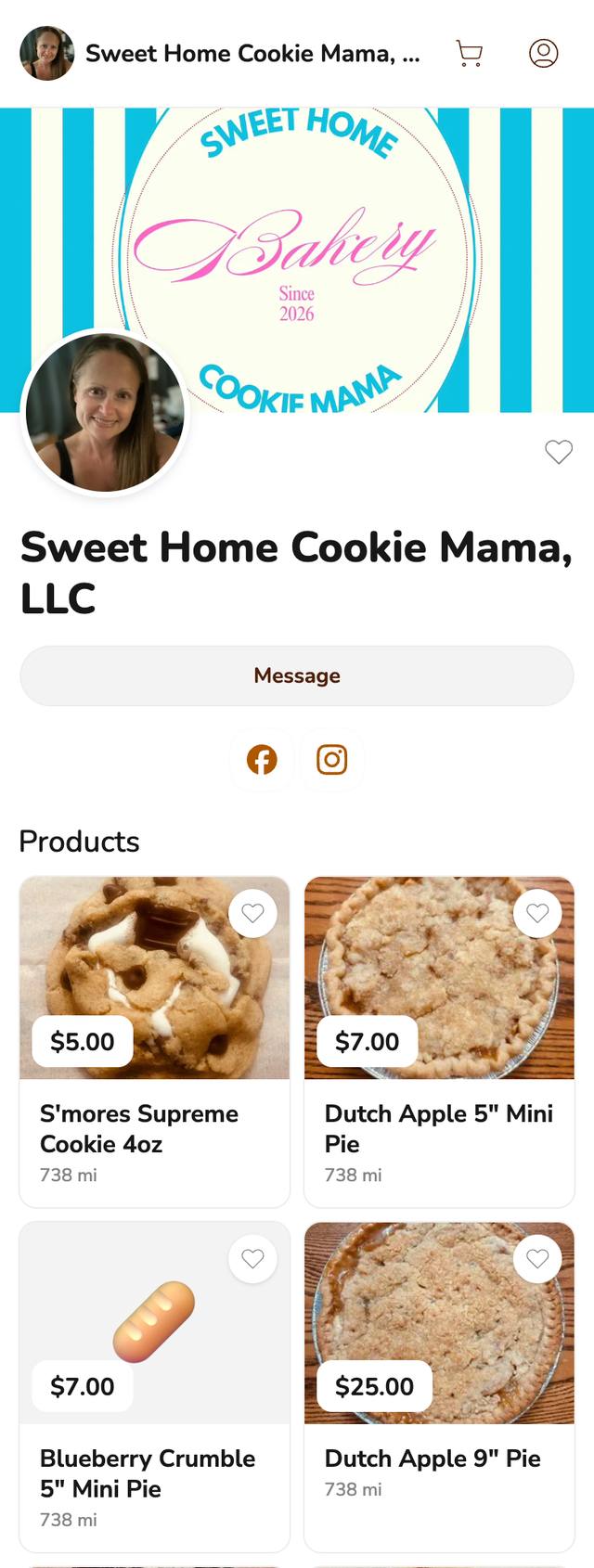
If you would rather see the whole category than these three, our cottage food platform comparison puts every major tool side by side using the same fee disclosure as the fee tables in this guide. For a wider list, see the best platforms for selling baked goods online and the best platforms to sell food from home.
Test either one with five products, ten regulars and your two slowest weeks, then track what each order really costs. Do not migrate your business to find out. Run a controlled trial.
Bakesy gives you 30 days free, which is enough for two full cycles. Hotplate has nothing to trial because there is no plan to buy, so your test costs only the fees on real orders.
Both let you take your records with you. Hotplate says you can download your list of customers whenever you want, and Bakesy's help center describes an order history download that it emails to you.
There is no plan to buy and no setup cost, so it is free to start. It is not free to use. Hotplate takes 5% plus $0.55 per order, added to your customer's subtotal by default, and you separately pay 2.9% plus $0.30 in card processing on every card order. At $500 a month in sales across 25 orders, that is roughly $22 out of your pocket and $38.75 out of your customers' pockets.
No. Bakesy is $9.99 a month for Standard or $17.99 for Premium, with a 30-day free trial. There is no per-order platform fee, but card payments through Bakesy Secure Payments run 3.9% plus $0.30, which is higher than the 2.9% plus $0.30 that Hotplate and Homegrown charge. Bakesy Secure Payments card processing is optional and only available in the US.
It depends on your volume and on who pays Hotplate's fee. If you pass Hotplate's 5% plus $0.55 to your customers and take cards on both, Hotplate is cheaper for you at any volume. If you absorb it, with $20 orders Bakesy Standard becomes cheaper from about the eighth order a month and Premium from the fourteenth, and bigger orders get there sooner. The gap grows from there. In a Hotplate vs Bakesy check at 25 orders of $20, with card processing counted, you pay $22.00 on Hotplate with the fee passed on, $60.75 with it absorbed, and $36.99 on Bakesy Standard.
Nothing stops you from running a drop tool for scheduled releases alongside a separate tool for custom quotes. You will be paying two sets of fees, maintaining two product lists, and reconciling two payout streams, so it is worth checking whether one storefront covers both jobs well enough first.
Neither files it for you. Hotplate can charge sales tax at checkout and a Bakesy invoice can include it, but filing and paying the tax stays with you. That is manageable if you sell in one state at a farmers market, and it gets complicated quickly if you ship or sell across state lines.
Not really. Hotplate's explainer says directly that it does not run a marketplace for shoppers, and no Bakesy page we read mentions one. Both assume you are bringing your own audience from Instagram, a text list, or a farmers market booth. Plan how you will find customers for a home baking business either way, because no platform on this page will do it for you.
Ask before you sign up, and test the export during your trial rather than at the moment you want to quit. Your customer list is the one asset that has to survive a platform change, and being able to download it is worth more than most features you will compare. On Hotplate, the customer list itself can be downloaded. On Bakesy, the help center describes an emailed order history file.
It depends on how your orders arrive. The Hotplate vs Bakesy choice comes down to drops against custom orders: Hotplate fits a set menu released on a schedule to a text list, and Bakesy fits cakes and cookie sets you price one request at a time. If you sell both ways, compare the cost of running two tools with a single storefront that stays open.
Pick Hotplate if you sell in scheduled drops and your customers will not blink at a fee at checkout. Pick Bakesy if every order is a custom quote and you want an invoice workflow more than a shop. Pick neither if what you actually need is a storefront that stays open, handles your sales tax, and charges the same subscription every month regardless of how good a week you had.
At 25 orders of $20 a month, the fee math in this guide comes to $22.00 for you on Hotplate with its fee passed on, $36.99 on Bakesy Standard and $32.00 on Homegrown's yearly plan, with card processing counted in each.
If that last one describes your situation, you can start a Homegrown storefront and have it live in about fifteen minutes. List your products, share the link with a few regulars, and see real orders before you decide anything.



