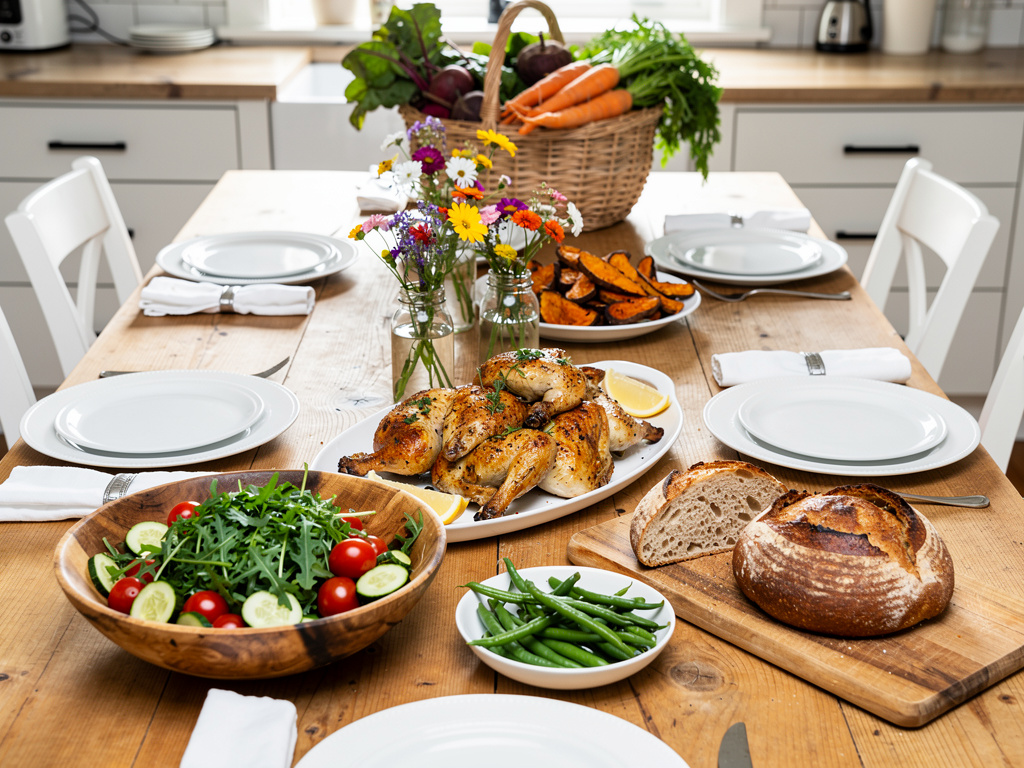


The short version: A farm-to-table dinner from your home kitchen for friends who pay nothing is usually just a dinner party, though a free marketing dinner for your customers may still need your county's OK. Charging for a plated dinner usually takes a special permit or a licensed kitchen, because cottage food laws like California's cover shelf-stable products, not meals. California lets opted-in cities and counties permit home kitchens that serve up to 30 meals a day and 90 a week to guests at your table, while Utah's home kitchen permit bans eating on site, so a seated dinner does not fit it. In our 12-guest example built from real Homegrown listings, the food came to $227.49, or $18.96 a plate. Order from farms 1 to 3 weeks ahead, buy only inspected meat for a paid dinner, and give every guest a way to order your products the next week.
Checked October 14, 2026: California Health and Safety Code §113825, Utah Code §26B-7-416, 9 CFR 303.1 on eCFR, FDA's safe food handling page, USDA's Local Food Directories, Eventbrite's, Square's and Venmo's fee pages, and Homegrown's prices on findhomegrown.com/signup. Rules change by state and county, so verify your state's current rules with your county health department. Homegrown customers create an account to place their first order, and Homegrown has no drops or timed-release feature.
A farm-to-table dinner at home is one long table, food from farms you can name, and a kitchen that smells like roast chicken by six o'clock. For a small vendor it can be more than a nice night. A grower who feeds 12 neighbors her own greens, or a baker who serves his sourdough beside a local farm's chicken, walks away with 12 people who now know exactly what that food tastes like.
The hard parts are not the decorations. They are the questions most dinner-party guides skip: can you charge for it, where the meat has to come from, how far ahead farmers need your order, how much food to buy and what it really costs per plate. This guide covers all of that with real rules checked on October 14, 2026, and a cost table built from real Homegrown listings from farms and local shops. If you want to run paid dinners every month, our guide to running a supper club as a side business covers the recurring business side.
A farm-to-table dinner at home is a meal you cook in your own kitchen from food you bought straight from local farms, served to guests at your table, usually as one set menu for 8 to 16 people. The "farm-to-table" part means you can name where the food came from: the chicken from one farm, the greens from another, the bread from a baker at your farmers market.
For a small vendor, it usually takes one of three shapes:
Which shape you pick decides almost everything else in this guide, from the permit to where you buy your meat. The free dinner is the simplest place to start. It costs you the food and a long day in the kitchen, and it still puts your products in front of a table of people who are paying attention.
The rest of this guide walks through each decision in order: the money question first, then the meat, then finding farms, ordering, cooking for a crowd and pricing.
You can charge for a dinner cooked at home only where a law allows a home kitchen to serve meals, such as California's home kitchen permit in counties that opted in, because cottage food laws like California's cover shelf-stable products, not plated meals. California's own law defines cottage food products as "nonpotentially hazardous foods," and a roast chicken dinner is the opposite of that.
Here is how the paths compare, checked October 14, 2026:
Swipe the table sideways to compare all five paths.
| Path | Can guests pay? | Can guests eat at your table? | Limits | Source |
|---|---|---|---|---|
| Free dinner party | No, nobody pays | Yes | Ask your county about "suggested donations" before you take one | Your county health department |
| Cottage food permit | For your shelf-stable products, not for a meal | Not as a meal service | Shelf-stable foods only in California | Cal. Health and Safety Code §113758 |
| California microenterprise home kitchen permit (MEHKO) | Yes | Yes | 30 meals a day, 90 a week, $100,000 a year adjusted for inflation, only in opted-in cities and counties | Cal. Health and Safety Code §113825 |
| Utah microenterprise home kitchen permit | Yes | No, eating on site is banned | Same-day food, or up to 72 hours with temperature logs, sold directly to consumers | Utah Code §26B-7-416 |
| Licensed kitchen or venue | Yes | At the venue | Whatever the venue's permits and your caterer or food license allow | Your county health department |
We read California's and Utah's statutes on October 14, 2026. MEHKO stands for microenterprise home kitchen operation, California's name for a small home restaurant permit. Other states have their own rules or none, so verify your state's current rules before you sell a seat.
Under Health and Safety Code §113825, a permitted home kitchen may serve guests on site, must prepare, cook and serve food the same day, and may not make its own butter, cheese or ice cream, serve raw oysters or serve raw milk. It also cannot be a catering business. A county or city has to opt in first; the California Department of Public Health says no permit can be issued until it does.
Utah Code §26B-7-416 says "the operator may not allow consumption of the operator provided food onsite." A Utah home kitchen permit fits a take-home farm supper box, not guests eating at your table. The same section bans raw milk and shellfish like oysters, clams and mussels, and requires you to tell customers your kitchen may not meet every commercial kitchen rule.
If your state has no home kitchen meal law, a paid dinner usually moves to a licensed kitchen: a commissary kitchen you rent by the hour, a catering license, or a farm or restaurant that hosts you. Our comparison of a commissary kitchen vs a home kitchen covers what renting one costs, and the MEHKO laws guide explains how to apply in California.
The free route is a dinner where nobody buys a seat: you invite 8 to 12 regulars, cook a menu built around your own products and the farms you buy from, and treat the night as marketing. You pay for the food, about $227 in our 12-guest example, and you get three hours with people who now know your products by taste.
It works well for vendors who already sell something guests can order the next week. A few examples:
Keep it honest about money. A private dinner for friends where nobody pays is usually just a dinner party. A free dinner your business hosts for customers is less clear, because the FDA Food Code that many states base their food rules on, in its definition of a food establishment (section 1-201.10), covers serving food "regardless of whether there is a charge for the food," so ask your county about that one before you send invitations. A "suggested donation," a pay-what-you-want jar or a raffle ticket can turn it back into a sale in the eyes of a health department, so ask your county before you add any of them.
If you sell your packaged products at the end of the night, those sales still follow your cottage food permit. That usually means labels, the sales venues your state allows, and any sales cap.
For a paid dinner, buy meat that went through a USDA- or state-inspected plant, because beef, pork, lamb or goat from a custom-exempt processor is legally for your household and nonpaying guests only. That rule catches hosts who bought a quarter of a steer from a neighbor and planned to serve it to paying guests.
Here is how it works. When you buy a share of an animal and a local shop cuts and wraps it for you, that is often "custom exempt" processing. Federal rule 9 CFR 303.1 says that meat is "exclusively for use, in the household of such owner, by him and members of his household and his nonpaying guests and employees," and the packages are marked "Not for Sale."
What that means for your dinner:
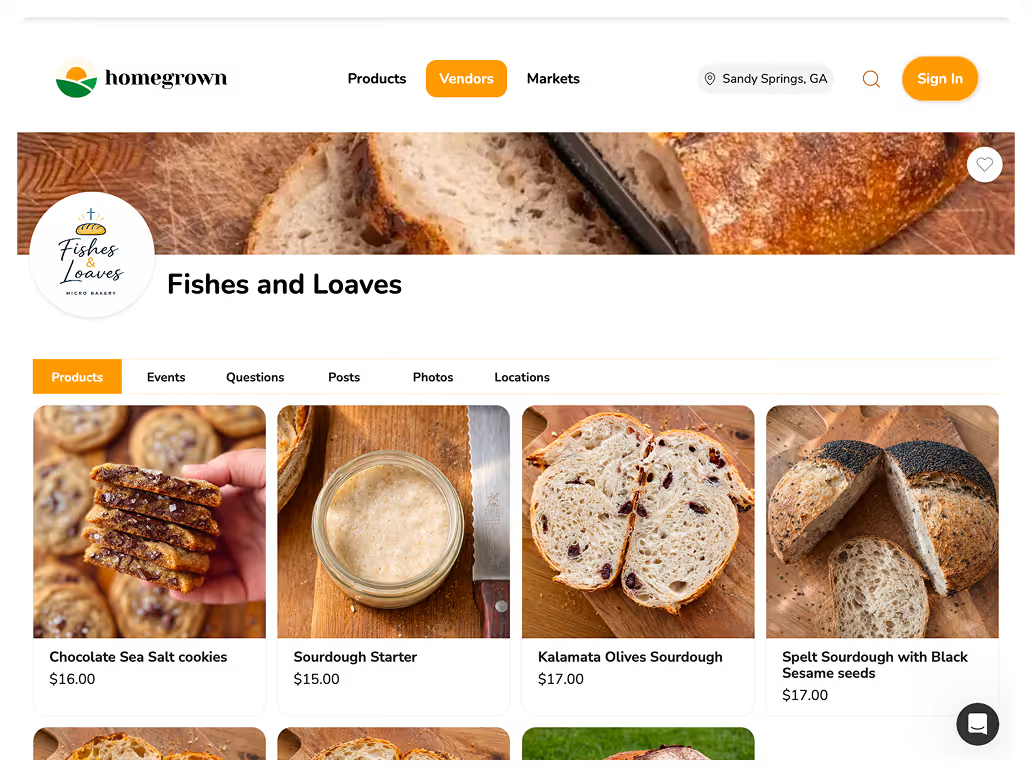
Many small farms on Homegrown list cuts and whole birds you can buy one at a time. In our October 14, 2026 pull, 106 listings from 15 vendors were meat, poultry or seafood, from ground beef to pastured whole chickens.
Start with the farmers market vendors you already know, then use USDA's Local Food Directories, which listed 7,148 farmers markets, 4,692 on-farm markets and 2,002 CSAs when we checked on October 14, 2026. A CSA, or community supported agriculture share, is a weekly box you buy from one farm in advance.
The places to look, best first:
In a pull of the Homegrown catalog on October 14, 2026, 285 of the 2,916 products listed by 322 vendors were ingredients you could cook a dinner from: 133 vegetables, herbs, mushrooms and fruit from 26 vendors, 106 meat, poultry and seafood listings from 15 vendors, and 46 egg and dairy listings from 23 vendors. Our rule: we counted every listing in the vegetables, fruit, meat and poultry, eggs and dairy, and seafood categories, added 2 fresh mushroom listings filed under other categories, and dropped listings whose names matched processed or shelf-stable foods, baked goods, grazing boards, live animals, live microgreen trays, dog bones, tallow, and deposit or pre-order placeholders. The count includes sellers who resell other farms' food and cured meats like sausages and franks, so read it as a count of ingredients for sale, not a count of farms.
Dinner ingredient listings on Homegrown, by group
Source: Homegrown catalog pull, October 14, 2026, 285 of 2,916 listings, counted by category with exclusions matched by name.
Give your farmers 1 to 3 weeks of notice: 3 weeks for meat and whole birds, about 1 week for produce amounts, and a final count 2 days out. Small farms harvest and process on their own schedule, and a grower cannot cut 12 heads of lettuce on Saturday if you ask on Friday night.
Here is a timeline that works for a Saturday dinner:
Keep the menu card loose until the day before. "Market greens with cherry tomatoes" survives a farmer swapping arugula for mizuna. "Arugula salad" does not.
Build the menu around one protein, two vegetable sides, one salad, bread and a fruit dessert, and let each farm supply one dish, so a single missing crop never sinks the whole dinner. Four or five courses is plenty for a home kitchen.
Here is the October menu we priced in this guide, with the listing behind each dish:
Swipe left on the menu table for the swap column.
| Course | Dish | Listing we priced (October 14, 2026) | Easy swap if it is not available |
|---|---|---|---|
| Bread | Sourdough with salted butter | South Fork Farm sourdough loaf; Harvest House Foods salted butter | Any sourdough loaf from a baker at your farmers market |
| Salad | Arugula, cherry tomatoes and cucumber | Eco Sun Farms arugula; Harvest House Foods cherry tomatoes grown by Blue Coyote Farm; ZachsGarden cucumbers | Any salad mix, mizuna or chopped kale |
| Main | Roast chicken with shallots | Currier Family Farm pastured whole chickens; South Fork Farm shallots | Pork loin chops or a beef roast from an inspected plant |
| Sides | Roasted sweet potatoes; green beans | Kaufman Family Farms sweet potatoes; South Fork Farm green beans | Butternut or kabocha squash; Swiss chard |
| Dessert | Apple crisp with cream | Aliken Beach Farm Gravenstein apples; Harvest House Foods fresh cream from Full Bushel Farm | Pears or a late apple like Fuji in the same crisp. Gravensteins are an early apple that does not keep well, so ask the farm whether they are still picking. |
Vendors and prices come from Homegrown listings we pulled on October 14, 2026. Farms near you will price differently, so treat this as a price example, not a shopping list.
A few menu rules that make the night easier:
For 12 guests, plan about three 4 to 5 pound whole chickens, 5 pounds of sweet potatoes, 3 pounds of green beans, 4 bunches of greens, 2 loaves of bread and 12 apples for dessert. Those are the amounts behind our cost table, and they leave a little extra for seconds.
How the numbers break down per guest:
These are our planning numbers, not a rule. After your first dinner, write down what came back to the kitchen on each platter and adjust the next order by that amount.
Our 12-guest farm-to-table dinner came to $227.49 in food, or $18.96 a plate, using real Homegrown listings on October 14, 2026, plus a $15 allowance for pantry staples. Your number will move with your region and your menu, but the method holds.
Swipe left on the cost table for quantities and totals.
| Item | Listing we priced | Price each | Quantity | Cost |
|---|---|---|---|---|
| Sourdough | South Fork Farm, sourdough loaf | $10.00 | 2 | $20.00 |
| Butter | Harvest House Foods, salted butter, 8 oz | $10.00 | 2 | $20.00 |
| Arugula | Eco Sun Farms, arugula bunch | $3.50 | 4 | $14.00 |
| Cherry tomatoes | Harvest House Foods, pint grown by Blue Coyote Farm | $5.00 | 2 | $10.00 |
| Cucumbers | ZachsGarden, Marketmore slicing cucumber | $2.00 | 3 | $6.00 |
| Whole chickens | Currier Family Farm, pastured, 4 to 4.99 lb | $27.00 | 3 | $81.00 |
| Sweet potatoes | Kaufman Family Farms, 5 lb bag | $19.49 | 1 | $19.49 |
| Green beans | South Fork Farm, 1 lb | $2.00 | 3 | $6.00 |
| Shallots | South Fork Farm, each | $1.00 | 4 | $4.00 |
| Apples | Aliken Beach Farm, Gravenstein, 1/3 to 1/2 lb each | $2.00 | 12 | $24.00 |
| Cream | Harvest House Foods, fresh cream from Full Bushel Farm, your own jar | $8.00 | 1 | $8.00 |
| Pantry staples | Flour, oats, sugar, oil, salt, lemons (our allowance) | $15.00 | 1 | $15.00 |
| Total | $227.49, or $18.96 a plate |
Farm prices are the listed Homegrown prices on October 14, 2026. The listings add up to $212.49; the $15 pantry line is our own allowance, not a listing. $227.49 divided by 12 guests is $18.96.
The chicken is the biggest line at $81.00, or 36% of the food. If you need a lower plate cost, ask two or three farmers to price the main course before you pick it, because that one line moves the total more than every vegetable on the table combined ($81.00 for the chicken against $59.49 for the salad, sides and shallots).
Food is not the only cost. Budget for flowers, candles, napkins and printed menu cards (we plan $40 for those), and count your hours: we plan on about 14 hours from the first farm call to the last dish.
Plan the menu so the main course is the only dish roasting in the last hour before dinner, and rewarm the sides while it rests, because a home oven fits only a pan or two per rack and a dinner for 12 needs at least five dishes. The classic home-kitchen jam is three dishes fighting for one oven at 5:30.
A setup that works in a normal kitchen:
If you sell baked goods from home already, you know your oven's hot spots. Rotate pans halfway through, and do not trust the dial without an oven thermometer when you are cooking for 12 people at once.
Cook poultry to 165°F, steaks and roasts to 145°F with a 3-minute rest, keep your fridge at 40°F or below, and refrigerate leftovers within 2 hours of cooking, or within 1 hour if it is above 90°F outside. Those numbers come from the FDA's safe food handling guide, checked October 14, 2026.
Cooking for 12 is where home cooks get into trouble, because food sits out longer than it does on a weeknight. The habits that matter most:
If you host paid dinners, your county may also require a food safety certificate before it issues a permit. Our guide to food safety rules for home food businesses covers the basics most counties expect.
The California Department of Public Health's MEHKO requirements page still listed 60 meals a week and $50,000 in yearly sales when we checked on October 14, 2026. The statute itself, amended in 2023, says 90 meals a week and $100,000 a year adjusted for inflation. Go by the statute and your county's own page.
Price a seat at no less than your food, extras and time divided by your guest count, which came to $51.46 a seat in our example before any ticketing fees. That floor assumes $227.49 in food, $40 in table extras and 14 hours of your time valued at $25 an hour, all divided by 12 guests. For a paid dinner, confirm with the farm that the chickens were processed under inspection before you count them here; if they were not, price an inspected bird instead. Do the same with the cream and butter: ask whether they were made from pasteurized milk, because California's home kitchen law bans serving raw milk products.
The math, step by step:
At a $65 seat, 12 guests bring in $780, which is $162.51 above that floor. If you sell seats through Eventbrite, its pricing page on October 14, 2026 listed a 3.7% + $1.79 service fee per paid ticket and a 2.9% payment processing fee per order, and it says ticket fees are paid by your buyers by default unless you choose to cover them. On a $65 seat, that is $4.20 in service fee plus $1.89 in processing on a one-ticket order. If you cover both on all 12 seats, that is $73.08, leaving $89.43 above your floor.
Sell seats in advance and set a clear refund date. You buy food to a headcount, so a guest who cancels the day before costs you a plate of food you already paid for.
The dinner sells your food for one night, and the guests who order again next week are where a small vendor earns the money back, so hand every guest a link to order before they leave. A card by each plate with a QR code and one line about your products does more than a speech at dessert.
Homegrown is built for that next step. It costs $10 a month billed annually ($12.50 billed monthly) with 0% commission, plus 2.9% + $0.30 card processing per order that you pay, not your customer. Your guests scan the code on their menu card and order your bread, eggs or greens for pickup at your next market day, your farm stand or your porch. You can set pickup windows for each location, set how much lead time you need before each pickup, and list a one-time event with its own date and place that comes off your storefront automatically after it passes.
Here is how it compares with Square Online and Venmo, the two alternatives this table prices on the same $20 order:
Move the fee table sideways to read the full fee stack on each row.
| Platform | Monthly plan | Trial | Platform fee | Card processing | Customer pays on a $20 order | Vendor pays on a $20 order | Vendor pays in a month of 50 orders at $20 |
|---|---|---|---|---|---|---|---|
| Homegrown | $10 billed annually ($12.50 monthly) | 7 days, no charge until day 8 | None, 0% commission | 2.9% + $0.30, paid by the vendor | $20.00 | $0.88 plus the plan | $54.00 ($56.50 on the monthly plan) |
| Square Online, Square Free plan | $0 | None needed on a $0 plan | None listed | 3.3% + 30¢ online, paid by the vendor | $20.00 | $0.96 | $48.00 |
| Venmo business profile, orders by message | $0 | None needed | None | 1.9% + $0.10 per payment, paid by the vendor | $20.00 | $0.48 | $24.00 |
Checked October 14, 2026, on findhomegrown.com/signup, Square's online store plans page and Venmo's fees page. Card processing is figured on the $20 price before tax: 2.9% of $20 is $0.58 plus $0.30 is $0.88; 3.3% of $20 is $0.66 plus $0.30 is $0.96; 1.9% of $20 is $0.38 plus $0.10 is $0.48.
Venmo is the cheapest per order, and it is fine for a handful of regulars. The cost shows up in your time: every order is a text thread, and you track quantities, payments and pickup times by hand. Square's Free plan costs a little less than Homegrown at 50 orders and suits vendors who already run a Square reader at market. Homegrown fits a vendor who wants one link for pre-orders with pickup times, a running count of what is left, and a customer list that stays yours.
To be clear about the limits: Homegrown is not a ticketing or seat reservation tool, and it will not get you a permit or tell you whether your county allows paid dinners. Customers create a Homegrown account to place their first order, and there is no drops or timed-release feature. Your storefront is listed on the Homegrown marketplace, but plan on most orders coming from people you send to your own link, starting with the 12 people at your table.
If you are planning a farm-to-table dinner this season, set up the link before you print the menu cards. Start your Homegrown storefront with a 7-day trial (no charge until day 8), add the products your guests will taste at dinner, and put the QR code on every place card.
Invite one of your farmers, keep the table to 12 to 16 guests, cook the menu once before the night, and send a thank-you message the next morning with a photo and your order link. The idea under all four is the same: plan the morning after the dinner as carefully as the dinner itself.
The habits worth copying:
Put your ordering link on a card at every plate and send the same link in a thank-you text the next morning. Then count the orders that come in during the next 7 days. If 3 of 12 guests order, that is 3 new regulars for about $227 in food, about $76 each, and you can judge the next dinner against what a new regular is worth to you.
The costliest first-dinner mistake is charging for seats without the permit your state requires, and the easiest one to fall into is fixing a menu before asking farmers what they will have, about 10 days out. Both are easy to avoid once you know about them.
The full list to watch for:
Fix these and your first farm-to-table dinner will feel calm from the kitchen side, which is the side your guests never see but always notice.
Usually not for a private dinner with friends where nobody pays. A free dinner you host to market your business is less clear, because many state food codes cover serving food whether or not you charge for it, so ask your county about that one too. Once guests pay for a seat, you need a permit that covers serving meals, such as California's home kitchen permit in counties that opted in. Ask your county health department before you take any money, including a "suggested donation."
Not in California. Its cottage food permits cover shelf-stable products like bread, cookies and jam, and California's law defines cottage food products as "nonpotentially hazardous foods." A plated farm-to-table dinner with chicken, cream and cooked vegetables is a meal service, so in California it needs a meal permit or a licensed kitchen. Other states can differ: Wyoming's Food Freedom Act (W.S. 11-49-103) lets a producer sell homemade food that needs refrigeration directly to an informed customer, though it bars most meat sales, so a dinner built around chicken you bought from another farm would not qualify. Check your own state's law before you sell a seat.
A permitted California home kitchen, called a MEHKO, may serve up to 30 meals a day and 90 a week, with up to $100,000 a year in sales adjusted for inflation, under Health and Safety Code §113825 as checked on October 14, 2026. Your county can set a lower limit based on your kitchen, and it cannot set a higher one.
Not as a seated dinner under Utah's home kitchen permit. Utah Code §26B-7-416 says the operator "may not allow consumption of the operator provided food onsite," so the permit fits take-home meals, not guests at your table. For a seated paid dinner in Utah, look at a licensed venue or a rented commercial kitchen.
Start with your food, extras and time divided by your guest count. In our example, $227.49 in food, $40 in extras and 14 hours at $25 an hour came to $51.46 a seat for 12 guests, before ticketing fees. Price above that floor, and only once you hold the permit your county requires.
Reserve meat and whole birds about three weeks ahead, confirm produce amounts about one week ahead, and give final counts two days before. Small farms plan harvests and processing days in advance, so a last-minute order for a farm-to-table dinner may leave you filling gaps from the grocery store.
These 5 guides cover what comes before and after a single farm-to-table dinner, from the permit to the weekly reorder. Two cover the paid side: running dinners as a recurring business and getting California's home kitchen permit. One covers a lighter format, the walk-in pop-up, for vendors who want guests to shop rather than sit for 3 hours. The last two cover what happens after the dinner, when the job is turning 12 happy guests into people who order every week.
A farm-to-table dinner from your home kitchen gives 12 people one great night with your food, and the step that pays it back is handing those guests a way to keep buying it. In our example the food cost $227.49. The guests who fell for your bread, your greens or your eggs are worth more than that if they can order again next Saturday.
Most guests will not remember your business name a week later. They will remember the card by their plate, the photo you texted the next morning and the bread they took home. Make each of those carry the same link.
Give them that link before they leave. A Homegrown storefront costs $10 a month billed annually, with 0% commission and 2.9% + $0.30 card processing that you pay. Put the code on every menu card, set a pickup time at your next market or your farm stand, and let your dinner guests become your regulars.