
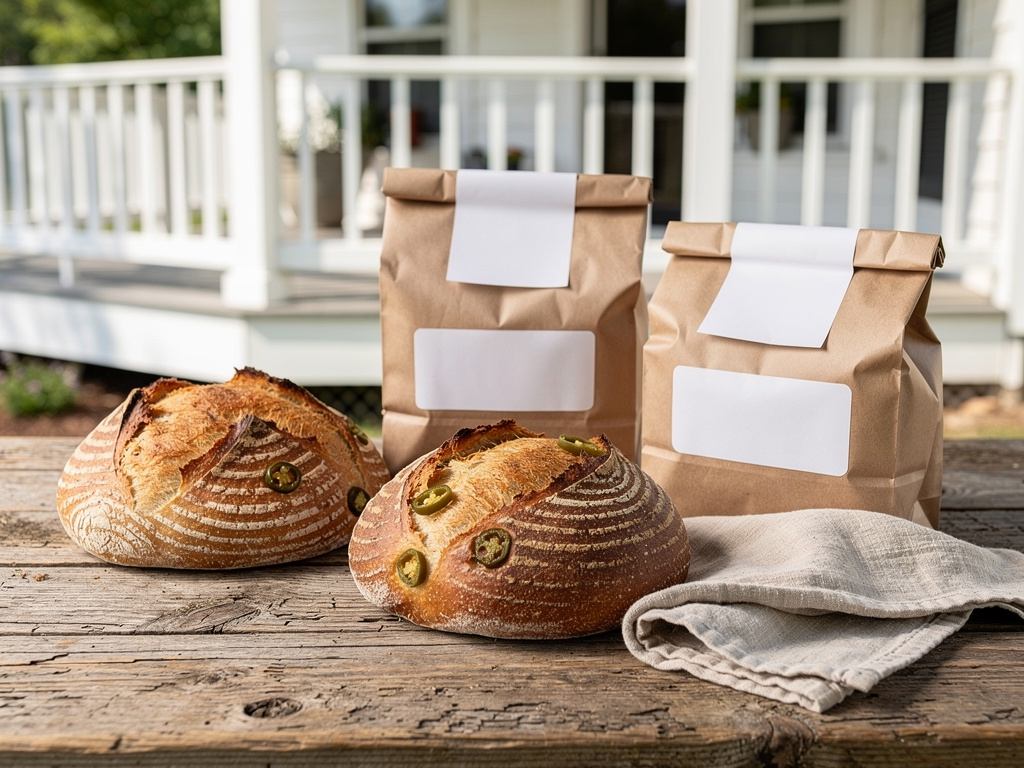


The short version: For most Texas home bakers selling sourdough for local pickup, Homegrown is the best platform: $10 a month billed yearly, no commission, and 2.9% + $0.30 card processing, which comes to $54.00 a month on $1,000 of loaf sales (fifty $20 orders). Texas cottage food law lets you sell sourdough from home and take orders online, but each online order has to be handed to the customer in person by you, your employee or someone you live with, so shipping an online order is out and pickup or your own delivery is in. Hotplate fits bakers who run timed weekly drops and are fine with customers paying its 5% + $0.55 fee, Square Online fits bakers who already take cards with Square at a market booth, and Etsy fits almost no Texas sourdough baker because it charges $0.20 in listing fees for each loaf plus 6.5% and 3% + $0.25 on every sale. Castiron, once a common pick, has shut down.
Checked October 13, 2026: the Texas Department of State Health Services (DSHS) cottage food page, the text of Senate Bill 541 and Chapter 437 of the Texas Health and Safety Code, the Texas Comptroller's sales tax pages, and the pricing pages of Homegrown, Hotplate, Etsy, Square and Shopify. Honest bounds: Homegrown customers create an account to place a first order, Homegrown has no timed drop or countdown release, and your storefront is listed on Homegrown's marketplace but most orders will come from people you send to your own link. Verify Texas's current rules with DSHS before you sell.
If you want Texas customers to order your sourdough ahead for pickup, you can set up a Homegrown storefront and try it free for 7 days.
The best platform to sell sourdough in Texas for most home bakers is Homegrown, which gives you an online storefront for $10 per month (billed yearly) with no per-listing fees, no per-sale commission and no fee added to your customer's total. Card processing of 2.9% + $0.30 per order is the only other cost, and you pay it, not your customer.
Texas has a broad cottage food law. Since September 1, 2025, a home kitchen can make almost any food except meat, seafood and a short list of others, and sell up to $150,000 a year of it. The right platform lets you use that room without paying a marketplace a cut of every loaf, and without breaking the one Texas rule that trips up bakers who sell online: the hand-off. Our Texas cottage food law guide covers the whole law. This page covers the platform choice, plus the parts of the law that decide which platforms work at all.
We loaded every price, fee and rule below on October 13, 2026, from the company's or the state's own page.
Texas cottage food law allows sourdough bread made in your home kitchen, sold straight to the people who eat it, with no license from your city or county. The law calls a home baker a "cottage food production operation," and the Texas DSHS cottage food page explains what changed when Senate Bill 541 took effect on September 1, 2025.
Here is what that means for a sourdough baker, in plain terms:
The current DSHS cottage food page is Texas Cottage Food Production on dshs.texas.gov, which we loaded on October 13, 2026. The statute itself is Chapter 437 of the Texas Health and Safety Code.
The steps to get legal before your first online order are short:
This article is about the platform decision. Read the law, confirm your menu fits it, then use the sections below to pick the tool that takes the orders.
A Texas customer can order and pay online and then pick the loaf up at your house, as long as you, an employee or someone in your household hands it to them in person. The law does not require you to drive it to them. It requires a person from your operation to do the hand-off, and it rules out shipping an online order.
The exact words matter here. Section 437.0194(b) of the Health and Safety Code, as rewritten by SB 541, says a cottage food operation may sell through the Internet "only if" the consumer buys online from the operation "and the operator or operator's employee or household member personally delivers the food to the consumer." The DSHS page says the same thing: "The operator, an employee, or a household member personally delivers the food to the consumer."
That rule never names a place. The law's definition of a cottage food operation says it "delivers products to the consumer or cottage food vendor at the point of sale or another location designated by the consumer." So handing an online order to the customer at your front door meets the words of the law, and so does meeting them at a farmers market or driving it to their house.
Shipping an online order is out because of the hand-off rule, and it was out under the old law too. Before SB 541, the section covered sales "through the Internet or by mail order," and even then the operator had to deliver the food personally; SB 541 added employees and household members. SB 541 struck "or by mail order," so the section now covers only online orders, and it no longer says anything about mail order. If you want to ship any other kind of order, ask DSHS first. The same bill raised the yearly income limit from $50,000 to $150,000.
Swipe sideways to see all three columns.
| How the online order reaches the customer | Fits the Texas rule? | Why |
|---|---|---|
| Customer picks it up at your door and you hand it over | Yes | You personally deliver it, at the point of sale |
| Your spouse or teenager hands it over while you are at a market | Yes | A household member counts |
| You meet the customer at a farmers market booth | Yes | A location the customer picked, handed over by you |
| You drive it to the customer's house | Yes | Personal delivery by the operator |
| A paid helper you employ delivers it | Yes | An employee counts |
| A cooler on the porch with no one home | Unclear; ask DSHS first | No person from your operation delivers it to the consumer |
| A delivery app driver or courier | No | Not you, an employee or a household member |
| USPS, UPS or FedEx, even inside Texas | No | A carrier is not you, your employee or a member of your household |
From Section 437.0194(b) and Section 437.001(2-b)(D) of the Texas Health and Safety Code (as amended by SB 541) and the DSHS cottage food page, all loaded October 13, 2026. The cooler row is our cautious reading of "personally delivers," not a DSHS ruling.
If you picture porch pickup as a cooler you leave out for a time window, know that Texas law requires that someone from your operation "personally delivers" the food. A cooler with no one home is not a person handing over the loaf, so be home for your pickup window, or have someone in your household there. If you want an unattended pickup box, email DSHS at foodestablishments@dshs.texas.gov first. We read the statute on October 13, 2026; DSHS has not published a ruling on unattended pickup that we could find.
This is also why the platform matters. A tool that only ships, or that sends orders to a courier, does not fit Texas cottage food sold online. A tool built around pickup windows and your own delivery does.
Your storefront must show the customer your label information before they pay. Texas law says that before the operator "accepts payment for the food," the operator must provide all required labeling information "by posting a legible statement on the operation's Internet website." Your home address can wait until after payment, but it, or your DSHS number, has to be on the label of the loaf itself.
The DSHS page lists what the label must include:
On a storefront, the easy way to meet the before-payment rule is to put the label text in every listing. On Homegrown that means the allergen and ingredient fields on each product, plus the private residence sentence in the description. Hotplate, Square and Shopify listings also have description fields that can hold it. Whatever you use, check that a customer can read all of it on their phone before the checkout button. A menu of 10 flavors means the label text goes on 10 products, so write it once and paste it into each.
Loaves too large for normal packaging can skip the package, but then the label details go on an invoice or receipt instead. Most sourdough goes in a bag, so label the bag. Our cottage food labeling requirements guide has label layouts you can copy.
A pepperoni or bacon sourdough loaf is off a Texas cottage food menu, because SB 541 excludes "meat, meat products, poultry, or poultry products." A cream cheese filled loaf may count as a food that needs refrigeration, which Texas allows but with extra steps.
Texas calls a food that needs refrigeration a "time and temperature control for safety food," or TCS food. The law's definition names "baked goods that require refrigeration, including cream or custard pies or cakes." It also says a food is not TCS just because it uses a TCS ingredient, if "the final food product does not require time or temperature control." The law does not name cheese breads either way. If you are not sure whether a loaf needs the fridge, such as one with a soft cream cheese swirl, ask DSHS before you sell it.
If a loaf is a TCS food, the law requires you to:
TCS foods also cannot be sold at wholesale to a cottage food vendor or donated, per the DSHS page.
In a pull of the Homegrown catalog on October 13, 2026 (2,924 products from 321 vendors), 8 vendors listed a sourdough product with meat (pepperoni, bacon, ham, pancetta or corned beef) in its name or in a flavor option, and 4 vendors listed a cream cheese or cheesecake sourdough loaf. We counted on product names and flavor names, then read each listing. We do not know which states those vendors are in, and some may bake in licensed kitchens. Under Texas cottage food law, the meat flavors come off the menu and the cream cheese loaves need a DSHS check first.
A Texas sourdough baker needs six things from a platform: room for a long flavor list, more than one pickup spot, set pickup times, sell-out limits, a place to post label details before payment, and an in-person hand-off. The first four come from how sourdough sells. The last two come from Texas law.
These six needs are the lens for every platform below.
We ranked six platforms Texas sourdough bakers use or ask about, on cost at a typical month of sales and on how well each fits the six needs above. Every price was loaded from the company's own page on October 13, 2026. On fifty $20 orders a month, what you pay, card processing included, ran from about $44.00 to $46.25 for Hotplate's default, with your customers paying $77.50 more, up to $127.50 for Etsy. The full fee table is in the next section.
This is Homegrown's own blog, and Homegrown is one of the six, so here is exactly how we ranked them:
On cost alone, Square's Free plan beats Homegrown by $6.00 a month at fifty $20 orders ($48.00 against $54.00), and Hotplate's default costs you less than both because your customers pay its fee. We still rank Homegrown first for a pickup baker because it is built around point 1 with no fee on point 2, and because Square's extra 0.4% of each order overtakes Homegrown's $10 above $2,500 in monthly online sales. If cost at low volume matters more to you than pickup tools, Square Free is a fair choice.
Homegrown is the best fit for a Texas sourdough baker who sells for pickup, because it is built around the exact thing Texas law requires: an order paid online and handed over in person. You list your loaves, set pickup spots and times, share one link, and customers order and pay ahead. It costs $10 per month billed yearly ($120 up front) or $12.50 billed monthly, with no percentage fees beyond standard payment processing of 2.9% + $0.30 per order, which you pay. There is a 7-day trial, and your card is not charged until day 8.
Compare that with Hotplate and Etsy. On Hotplate your customer pays a 5% + $0.55 fee on top of the loaf, $1.55 on a $20 order, and you still pay card processing. On Etsy you pay $0.20 per loaf in listing fees, 6.5% per sale and 3% + $0.25 processing, about $2.55 on the same $20 order. On Homegrown the customer pays $20.00 and you pay $0.88.
Here is what Homegrown includes, per its signup page on October 13, 2026:
Pros:
Cons (honest bounds):
Best for: Texas home sourdough bakers who sell at one or two farmers markets and take pre-orders for home pickup or their own delivery during the week. The full baking-to-selling workflow is in our guide to how to sell sourdough bread from home, and the national comparison of the best platform to sell sourdough online covers bakers in every state.
If your Texas orders live in text threads today, a storefront with pickup windows turns them into one list of who is picking up what, and when. Start your 7-day Homegrown trial and pay nothing until day 8.
Hotplate is the strongest pick for bakers who sell in "drops," which its pricing page defines as "a preorder window with a clear start and end time," with a countdown before orders open. There is no subscription. By default your customer pays Hotplate's fee of 5% of the subtotal + $0.55, and you pay card processing of 2.9% + $0.30.
Hotplate's pricing page says the fee split is "your choice," and its own post "What Hotplate does" says "we charge a fee to your customer" and "80% of Hotplate chefs keep the default as-is." On a $20 order in the default setup, your customer pays $21.55 and you pay about $0.88 to $0.92 in card processing. Hotplate's own pricing example puts the card fee on the order and tip, not on its own fee. If you choose to cover the fee yourself, you pay about $2.43 on the same order.
Pros:
Cons:
Best for: Texas sourdough bakers with an audience that already waits for a weekly drop, who are fine with customers seeing a fee at checkout. Our Hotplate alternative breakdown compares it with Homegrown line by line.
Etsy is the wrong fit for nearly every Texas sourdough baker, because its fees stack on every loaf and its strength, reaching buyers across the country, is the one thing Texas cottage food cannot use. An Etsy order is an online order, and Texas requires an online cottage food order to be handed over in person, so every Etsy order would still need an in-person hand-off.
Etsy's fee policy, loaded October 13, 2026, charges $0.20 to list each product, and listings expire after four months. When a listing with stock left sells, Etsy renews it for another $0.20, so you pay about $0.20 for every loaf sold. On top of that comes a 6.5% transaction fee and, for a US bank account, payment processing of 3% + $0.25 per order. A one-time set-up fee may apply when you open a shop.
Pros:
Cons:
Best for: Almost no Texas sourdough baker. A baker who also sells shippable products made in a licensed kitchen is the exception. Our Etsy fees breakdown for food vendors shows the full math.
Square Online is a good fit if you already take cards with Square at a Texas farmers market, because your online orders and booth sales land in one account. Its Free plan costs $0 a month per location and charges 3.3% + $0.30 per online card payment and 2.6% + $0.15 per in-person tap, dip or swipe. Square Plus is $49 a month per location and lowers online processing to 2.9% + $0.30.
On a $20 online order, Square Free costs you about $0.96, which beats Homegrown's yearly plan until your online sales pass $2,500 a month. Above that, Square's extra 0.4% of each order costs more than Homegrown's $10.
Pros:
Cons:
Best for: Texas sourdough bakers already committed to Square hardware at their booth.
Castiron is closed: on October 13, 2026, its old address, castiron.me, loaded an unrelated online casino page, so do not sign up for anything there. It used to be a common pick for home bakers who took custom cake orders.
Its strength was custom order forms, which matter more for custom cakes than for a weekly sourdough menu. If custom cakes are a big part of your Texas business, look for an order-request tool built for them; Bakesy, for example, lists custom order forms and invoicing on its site (we could not load its prices on October 13, 2026). For a sourdough menu, the platforms above fit better.
Shopify is a full online store builder, and for a Texas baker selling 30 or 40 loaves a week for pickup, it is more than you need. Its Basic plan costs $29 a month billed yearly or $39 billed monthly, and online card payments through Shopify Payments cost from 2.9% + 30¢. If you use a different payment provider, Basic adds a 2% transaction fee.
At fifty $20 orders a month, Shopify Basic costs from $73.00 on the yearly plan or from $83.00 on the monthly plan, against Homegrown's $54.00. Shopify's Help Center explains how to set up pickup in store and local delivery for online orders, with no plan requirement beyond a location that fulfills online orders, but you set up the store, the theme and the pickup rules yourself.
Pros:
Cons:
Best for: Texas sourdough bakeries that have moved into a licensed commercial kitchen and ship bread, which takes them outside cottage food law.
On a month of fifty $20 sourdough orders ($1,000 in loaf sales), Homegrown costs you $54.00 on the yearly plan, Square's Free plan $48.00, Hotplate's default setup about $44.00 to $46.25 plus $77.50 paid by your customers, Shopify Basic from $73.00, and Etsy about $127.50. Each total includes card processing. The cheapest option for you is not always the cheapest for your customer, so the table shows both.
Scroll sideways to see all eight columns.
| Platform | Monthly plan | Trial | Platform or service fee | Card processing | Customer pays on a $20 order | You pay on a $20 order | You pay in a month of 50 orders |
|---|---|---|---|---|---|---|---|
| Homegrown, billed yearly | $10 ($120 a year) | 7 days, no charge until day 8 | $0, 0% commission | 2.9% + $0.30, paid by you | $20.00 | $0.88 | $54.00 |
| Homegrown, billed monthly | $12.50 | 7 days, no charge until day 8 | $0, 0% commission | 2.9% + $0.30, paid by you | $20.00 | $0.88 | $56.50 |
| Hotplate, default (fee passed to customer) | $0 | None needed | 5% + $0.55, paid by the customer | 2.9% + $0.30, paid by you | $21.55 | $0.88 to $0.92 | $44.00 to $46.25 (your customers pay $77.50 more) |
| Hotplate, you pay the fee | $0 | None needed | 5% + $0.55, paid by you | 2.9% + $0.30, paid by you | $20.00 | $2.43 | $121.50 |
| Etsy | $0 (a one-time set-up fee may apply) | None needed | 6.5% per sale, plus $0.20 per loaf in listing fees | 3% + $0.25, paid by you | $20.00 | $2.55 | $127.50 |
| Square Online, Free plan | $0 per location | None needed | $0 | 3.3% + $0.30 online, paid by you | $20.00 | $0.96 | $48.00 |
| Square Online, Plus plan | $49 per location | 30 days at no charge, per Square | $0 | 2.9% + $0.30 online, paid by you | $20.00 | $0.88 | $93.00 |
| Shopify Basic, billed yearly | $29 | 3 days, then $1 a month for 3 months, per Shopify | $0 with Shopify Payments (2% with another provider) | From 2.9% + 30¢ online, paid by you | $20.00 | From $0.88 | From $73.00 |
| Shopify Basic, billed monthly | $39 | 3 days, then $1 a month for 3 months, per Shopify | $0 with Shopify Payments (2% with another provider) | From 2.9% + 30¢ online, paid by you | $20.00 | From $0.88 | From $83.00 |
Every fee comes from the company's own page, loaded October 13, 2026: Homegrown's signup page, Hotplate's pricing page and its post "What Hotplate does", Etsy's Fees and Payments Policy, Square's online store plans and Shopify's pricing page. Shopify's card rate and totals say "from" because that page lists 2.9% + 30¢ for standard cards and 3.5% + 30¢ for premium cards, which include business cards and American Express. A $20 order is two $10 loaves; Etsy's listing fee is counted as $0.20 per loaf sold. Hotplate's default card fee is shown as a range: $0.88 if it is figured on the $20 order alone, and $0.92 if it is figured on everything the customer pays, Hotplate's fee included. Hotplate's own pricing example puts the card fee on the order and tip, not on its own fee. Month totals use unrounded fees, so 50 times a rounded fee can differ by a few cents. Sales tax is left out because Texas does not tax bread sold without plates or utensils. Etsy's Offsite Ads fee (15%, or 12% for larger shops) is not included.
What you pay in a month of fifty $20 sourdough orders
Source: each platform's pricing page, loaded October 13, 2026. Hotplate's default bar is drawn at the high end of its range, $46.25, and leaves out the $77.50 your customers pay in its fee. Totals include card processing. Bars are each total divided by Etsy's $127.50.
Cost is only part of it. Here is how the six compare on the needs that come from Texas law and from how sourdough sells:
Swipe left to compare all six platforms.
| Need | Homegrown | Hotplate | Etsy | Square Online | Castiron | Shopify Basic |
|---|---|---|---|---|---|---|
| Status on October 13, 2026 | Open | Open | Open | Open | Closed | Open |
| Fee per flavor or listing | None | None | $0.20 per listing and per loaf sold | None | Closed | None |
| Fee added to the customer's total | No | Yes by default (5% + $0.55; you pay card processing) | No | No | Closed | No |
| Pickup times the customer picks | Yes, per location | Yes, per drop | Not built in | Pickup is offered; set the times up yourself | Closed | Pickup is offered; set the times up yourself |
| Built around | Pickup and local delivery | Timed drops for pickup | Shipping | General online store | Closed | General online store |
| Timed drop with countdown | No | Yes | No | Not a listed plan feature | Closed | Not a listed plan feature |
| Best fit for Texas sourdough | Pre-orders for market, porch and delivery hand-offs | Weekly drops with a waiting audience | Almost no fit | Bakers already on Square at the booth | None | Licensed bakeries that ship |
From each company's own pages, loaded October 13, 2026. "Not built in" and "not a listed plan feature" mean we did not find the feature on the pages we loaded, not that no app or workaround exists.
A plain sourdough loaf on Homegrown is listed at $10.50 at the median, across 48 vendors, in our catalog pull of October 13, 2026. The range ran from $5 to $15, and 33 of the 48 vendors priced their plain loaf between $10 and $12.
We pulled all 2,924 products from 321 vendors on October 13, 2026. 489 products from 88 vendors mention sourdough in the name, the description or a flavor or size option. For prices, we kept bakery listings whose names say plain, classic, original, traditional, country, rustic or simply "sourdough bread" or "sourdough loaf," dropped mini, half, sandwich, bagel and flavored loaves, and took each vendor's lowest full plain loaf. That left 48 vendors. These are listing prices from vendors in many states, not sales, and not only Texas.
What that means for a Texas baker:
Our sourdough pricing guide walks through ingredient cost per loaf, and our guide to how long homemade sourdough lasts helps you set a pickup window that keeps the crust right.
You can sell Texas cottage food sourdough anywhere the customer gets it in person from you, your employee or anyone in your household: from home, at farmers markets and farm stands, at events, and through online orders you deliver or hand over in person. You can also sell at wholesale to a cottage food vendor registered with DSHS, who can resell it at farmers markets and farm stands, and also in restaurants and retail stores. A store or restaurant can buy from you at wholesale only if it signs the contract and registers with DSHS as a cottage food vendor.
The full list from the DSHS page and the statute, loaded October 13, 2026:
Not allowed for an online order: shipping by mail or parcel service, or delivery by an app or courier. Not allowed at all: selling at wholesale to a store or restaurant that has not registered with DSHS as a cottage food vendor. For any other kind of shipped order, ask DSHS first. If you are also thinking about a booth, our Texas farmers market vendor permit guide covers what markets ask for.
At the Round Rock Farmers Market's full-time rate of $35 a market day, your first four $10 loaves pay for the booth. Take pre-orders for market pickup during the week, and those four loaves are sold before you set up your tent.
The Round Rock Farmers Market runs Saturdays, 10 AM to 2 PM, year-round, at Rock Creek Center, 2111 IH-35 N in Round Rock, per the market's site on October 13, 2026. It is run by Farmer George Farmers Markets, and its vendor standards say cottage food bakers are taken as annual vendors only.
Here is what the market standards page on Farmer George's site lists for a baker, loaded October 13, 2026:
The market's page also says it is planning a new Sunday market, "COMING 2026!" Its cottage food summary still names an older $50,000 income limit; the current Texas limit under SB 541 is $150,000.
Looking for sourdough at Round Rock or Pflugerville as a shopper? The market's site says its bakers include "scratch-made sourdough bread," but it does not publish a vendor list. We could not confirm a current Pflugerville market schedule on October 13, 2026: the City of Pflugerville's market page returned "page not found," and Farmer George's site listed only Round Rock. Check with the market before you go.
For a baker selling at Round Rock, a storefront with the market as one pickup location and your home as another lets regulars pre-order for Saturday and pick up at your door midweek.
For most Texas home sourdough bakers who take pre-orders for market pickup and home pickup, Homegrown at $10 a month billed yearly is the best fit. The other platforms each win one narrower case:
If you are a typical Texas home sourdough baker selling at a farmers market or from your door, Homegrown is the best platform: a flat monthly cost, no per-flavor fees, multiple pickup locations, and set pickup times that keep loaves out of the Texas heat.
Look for nine things before you commit: no per-flavor fees, multiple pickup spots, set pickup times, sell-out limits, room for label text, an in-person hand-off, a flat cost, no fee on the customer unless you want one, and fast setup. Run any platform through this checklist:
Yes. Texas cottage food law, as expanded by Senate Bill 541 on September 1, 2025, lets a home kitchen make any food except meat and poultry products, seafood, ice products, low-acid canned goods, CBD or THC products and raw milk products, so sourdough bread is allowed. You can sell up to $150,000 a year directly to consumers, with a food handler course and a proper label. Check the current rules on the Texas DSHS cottage food page before you price or scale your business.
Not with the state for plain sourdough. DSHS registration is required only if you sell foods that need refrigeration, or if you want a DSHS number on your label instead of your home address. You do need an accredited food handler course, and your city or county cannot require a permit or charge a fee for direct sales under Texas law.
Square Online's Free plan is the cheapest for you among the platforms that add no fee to your customer's total: on fifty $20 orders a month it costs $48.00 in card processing, against $54.00 on Homegrown's yearly plan. Homegrown's yearly plan becomes the cheaper of the two once your online sales pass $2,500 a month ($3,125 on the monthly plan). Hotplate's default setup costs you less (about $44.00 to $46.25), but your customers pay $77.50 more in its fee, so the best platform to sell sourdough in Texas on cost depends on who you want paying.
A sourdough loaf sold without plates or eating utensils, and not heated, is not taxable in Texas. The Texas Comptroller's sales tax guide for restaurants says "Tax is not due, however, on bakery items (regardless of size, whether whole pies, for example, or individual portions) when sold without plates or eating utensils." Homegrown collects and remits sales tax for you on Homegrown orders and leaves qualifying food untaxed. If you also sell taxable products, or serve slices with a fork and plate, ask a Texas tax professional what you owe.
Yes. Homegrown supports multiple pickup locations in one storefront, each with its own days and times, so you can list "Saturday at the Round Rock Farmers Market" and "Wednesday pickup at my door in South Austin" side by side. Customers see every pickup option and choose the one that works for them. Every Texas online order still has to be handed over in person by someone from your household or business.
Use Hotplate if your business depends on a countdown drop right now; Homegrown does not have a drops feature with a countdown, and there is no release date for one. Use Homegrown if you mix drops with everyday ordering or want no fee added to your customer's total; you can still cap quantities and announce each week's menu yourself. On a $20 order, Hotplate's default adds $1.55 for the customer, while Homegrown adds nothing and you pay $0.88 in card processing.
A Texas cottage food label needs your business name, your address or DSHS registration number, the product name, any major allergens (wheat for nearly every sourdough loaf), and the statement "THIS PRODUCT WAS PRODUCED IN A PRIVATE RESIDENCE THAT IS NOT SUBJECT TO GOVERNMENTAL LICENSING OR INSPECTION." Foods that need refrigeration also need the date made and a safe handling statement. For online orders, the label details must be posted on your storefront before the customer pays, whichever platform you use.
Six more Homegrown guides answer what Texas sourdough bakers usually ask after choosing a platform: what the law allows, what to charge, how long a loaf stays fresh, and what a market booth takes.
Your Texas sourdough deserves a platform built for the way Texas bakers sell: a Saturday market, pickups at your door, a long flavor list and a hand-off in person. Homegrown is $10 a month billed yearly, with no commission and no fee on your customer. Start your 7-day Homegrown trial, with no charge until day 8.



