

The short version: Do not migrate orders that are already placed. Fulfil every one of them on the old platform, then close it. The reason is blunt: you usually cannot refund an order on a platform you have cancelled, and refunds are processed through the account that took the payment. Chargebacks arrive later still, sometimes months after collection, and defending one needs an account you can log into. So the rule is not "cancel after the last order," it is cancel after the last dispute window has closed, which is a different and much later date.
Because an order is not just a record, it is a payment.
Moving the *information* to a new system is easy. What you cannot move is the transaction sitting behind it: the charge belongs to the merchant account that processed it, and so does the ability to refund it, adjust it, or respond to a dispute.
So a migrated order looks fine and is hollow. If that customer cancels, you can hand them cash, but you cannot reverse the original charge from the new platform. The refund has to happen where the money came in.
The practical consequence: let open orders finish where they started. It is less tidy than a clean cutover, it means running two things briefly, and it avoids every problem described below.
Wider than most people assume, and this is where the timeline comes from.
Category three is the one that sets your cancellation date. Categories one and two might be finished in a fortnight. A dispute window runs considerably longer, and it starts from the transaction rather than from when you decided to move, so your last busy week is the one that matters.
Our guide to handling a customer chargeback covers what defending one involves, and the short version is that it requires evidence and an account to submit it through.
Later than feels necessary, and the date is set by disputes rather than by orders.
A workable sequence:
Step four is the one people skip because the platform is sitting there costing money for something that feels finished. It is not finished. A chargeback on an order from your last week, arriving two months later, is answerable if the account is live and expensive if it is not.
If the old platform has a free tier, this is straightforward: downgrade rather than cancel and the cost is zero. Square Online, Cottage CMS, Big Cartel's Gold plan, and StandScout all have free tiers, which makes the waiting period free. Where there is no free tier, you are paying one or two more months for insurance, and it is usually worth it.
The genuinely hard case, and worth planning separately.
A subscription has a saved payment method attached, and card tokens belong to the processor and merchant account they were created under. They never transfer. That means every subscriber has to actively re-subscribe on the new platform, and some proportion will not.
The sequence that loses fewest people:
Do not simply stop the old subscriptions and announce a new signup. That converts a customer relationship into a marketing task, and marketing tasks convert at a fraction of the rate. A subscriber who has been paying you every month for a year deserves a message with their name on it, and will usually move if they get one.
Our guide to handling subscription cancellations covers the customer-facing side, and the same care applies when the cancellation is your idea rather than theirs.
Nothing, ideally, because nothing changes for them.
If you fulfil open orders on the old platform, the customer's experience is unaffected: they ordered, they collect, it is done. The switch is invisible to them, which is exactly right.
Where you do need to say something:
The principle: customers should not have to understand your migration. Every sentence you write explaining it is a sentence that creates a question they did not have.
The scenario that catches people, and it has a workable answer.
Someone collects in your final week on the old platform, then asks for a refund a fortnight later, by which point you have moved everything.
If the old account is still live, you refund there. If you cancelled, your options are worse: you may be able to refund through the payment processor directly if you hold that relationship, or you can pay them back another way.
That last route works and it is not equivalent. It leaves no record against the original transaction, so if they later dispute the charge, the evidence that you refunded them lives in a bank transfer rather than in the payment record. Our guides to refund policy for food vendors and refunds and complaints on informal sales cover the wider question of doing this well.
Which is the whole argument for keeping the old account open a little longer than feels necessary.
The rule that survives every platform combination: refund on the platform that took the payment, always, even after you have moved. A refund issued anywhere else looks like a second unrelated transaction to the card network and to your customer's statement.
Worth clearing before you switch, because they follow you otherwise.
Most vendors have a small tail of orders that are technically open and practically dead: someone who paid in March and never collected, a custom order that stalled after a deposit, a cancellation you agreed to verbally and never processed.
A migration is the natural moment to close them, because leaving them behind on a platform you are about to cancel means they become unresolvable. Work through the list and, for each one:
Our guides to no-shows on large prepaid orders and last-minute cancellations cover how to handle each case fairly.
The one to prioritise is anything with money attached that you might owe back. An unresolved deposit on a cancelled platform is a customer who cannot be refunded and a conversation you will have anyway, just later and worse. Clear those first, then everything else can wait.
If the new platform is where these orders would have lived, set it up and take a real order through it before you start closing anything down, so the overlap window has somewhere functional to overlap with.
Small, easily handled, occasionally annoying.
Before you cancel anything:
The FDIC's consumer resource center is a plain-language reference for how deposits behave, and Treasury's ACH guidance covers the bank-transfer rails most payouts run on. Neither is exciting, and both are useful the first time a payout does not arrive when you expected it to.
An overlap, not a cutover. Concretely:
The temptation is to compress this, because paying for two platforms feels wasteful. It is roughly $10 to $30 a month for a couple of months, against the cost of being unable to refund a customer or defend a chargeback. That is cheap insurance.
There is a second reason for the overlap that has nothing to do with disputes: the new platform will have something wrong with it. A cutoff set to the wrong day, a product missing a photograph, a delivery radius that excludes a street it should include. Every migration has two or three of these, and they surface in the first real order week rather than in testing.
An overlap means those get fixed while a working system is still standing behind you. A hard cutover means they get fixed while customers are trying to order, which is how a switch that was going fine turns into a bad fortnight.
If your new platform is the part still being set up, taking one real order through a trial before your announced date is what makes week 0 real rather than theoretical. The overlap only protects you if the new side genuinely works.
Occasionally an annual plan lapses or an account is closed on someone else's schedule. Plan for it.
That last point is worth internalising. A platform's retention policy is not your retention obligation. If it keeps two years of orders and your obligation runs longer, closing the gap is your job, and a dated export in a folder you control does it.
Every platform below shows the same four commercial facts, because a table that lists one platform's transaction fee and not another's is not a comparison. "Not published" means exactly that: the company does not state it publicly.
| Platform | Open orders during a move | Subscription (annual) | Free trial | Platform fee | Card processing |
|---|---|---|---|---|---|
| Shopify | Orders stay in the admin while the plan is active | $29/mo Basic | 3-day trial, then $1/mo for 3 | 2% platform fee if not on Shopify Payments | from 2.9% + $0.30 processing |
| Square Online | Order history stays in the Square dashboard | Free tier; paid from $29/mo per location | 30-day trial on paid plans | $0 platform fee | 3.3% + $0.30 free tier, 2.9% + $0.30 paid |
| Etsy | Open orders must be fulfilled on Etsy | No subscription | n/a | $0.20 listing + 6.5% commission | 3.0% + $0.25 processing |
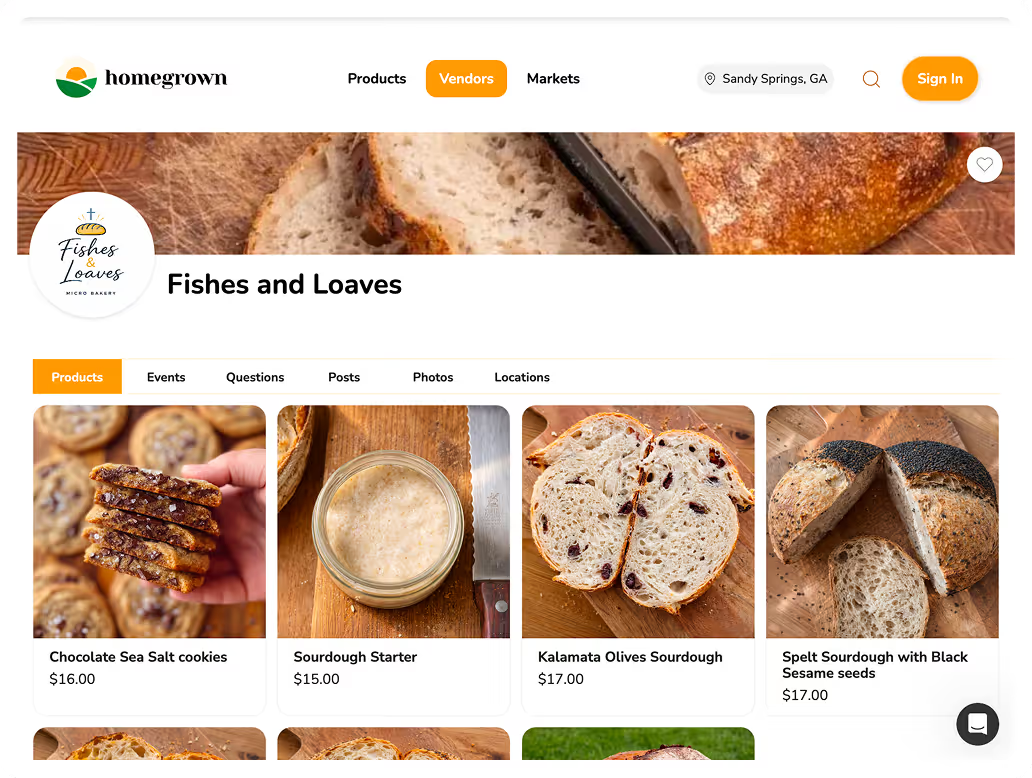
| Homegrown | Finish the open ones, start new ones on the new store | $10/mo billed annually | 7-day free trial | $0 platform fee (0% commission) | 2.9% + $0.30 processing |
| Big Cartel | Order history retained while subscribed | Platinum $12/mo ($144/yr) | 7-day free trial | $0 platform fee | Your own provider, so 2.9% + $0.30 typical |
| Cococart | Retention after cancellation not published | $19/mo store, $59 Pro | 7-day free trial | Platform fee not published | Processing not published |
No. Fulfil them where they were placed. The payment lives in the old merchant account, so refunds and disputes have to be handled there, and a migrated order record has no transaction behind it.
After the dispute window on your last transaction has passed, not after your last order is collected. Chargebacks can arrive well after delivery, and defending one requires an account you can log into.
Usually not through the platform. You may be able to act through the payment processor if you hold that relationship, or pay the customer another way, which works but leaves no record against the original charge.
They have to actively re-subscribe, because saved card details belong to the processor and merchant account that created them and never transfer. Tell them individually, give a deadline and one link, and keep the old subscription running until they have moved.
Generally no. If you fulfil open orders on the old platform, nothing changes for them. Only confirm arrangements where collection falls after your changeover date, so a new link does not confuse anyone.
Usually two to three months. Downgrade to a free tier if the old platform has one, which makes the wait cost nothing. Where there is no free tier, a couple of months is cheap insurance.
Export everything first, including order-level detail with transaction references, and keep your own payment records. You may still be able to act through the payment processor directly even after the storefront is gone.
Do not migrate open orders. Fulfil them where they were placed, because the payment lives in that merchant account and so does your ability to refund, adjust, or defend it.
The date that matters is not your last order, it is the end of the dispute window on your last transaction. Chargebacks arrive late, and answering one needs an account that still works. If the old platform has a free tier, downgrade rather than cancel and that wait costs nothing.
The only genuinely hard case is subscribers, because saved cards never transfer between merchant accounts. Move them individually, by name, with a deadline and one link, and keep the old recurring charge running until they have. Treat that as a customer conversation, not an announcement, because that is what determines how many of them you keep.