


The best pickup schedule for a home food vendor is one window, one location, one day per week. That is it. Customers choose from a single pickup window (like Saturday 9 AM to noon), you have everything packaged and ready, and the entire pickup process takes 1 to 2 hours. The most common mistake is offering too much flexibility — letting customers pick up "whenever works for them" — which turns pickup into an all-day, all-week obligation that consumes your schedule and your kitchen.
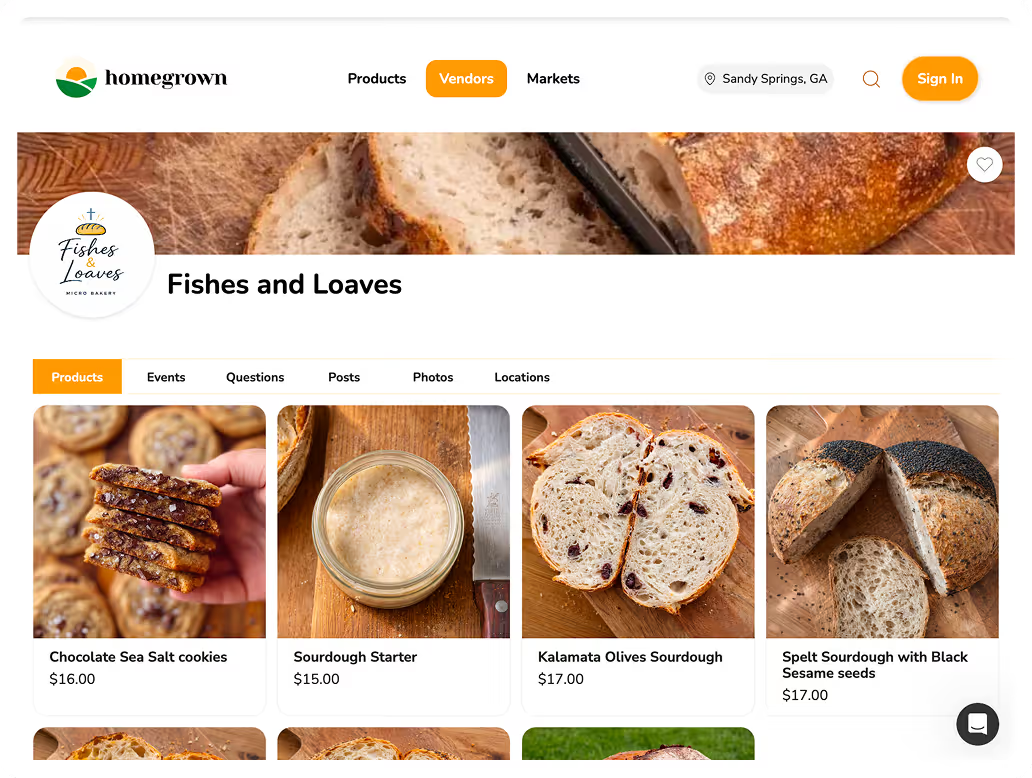
The short version: Set one pickup day per week with a 2 to 4 hour window. All orders must be picked up during that window. No exceptions, no custom times, no "can I grab it Tuesday instead?" Communicate the pickup schedule clearly at the time of order, send a reminder the day before, and have everything labeled and organized before the window opens. An ordering platform like Homegrown ($10 per month) lets customers choose their pickup time during checkout and sends automatic reminders, so you never have to coordinate pickup through DMs or texts. Start with one window per week. Add a second only when demand consistently exceeds what one window can handle.
Pickup becomes a full-time job when you do not set boundaries. Here is how it happens:
You start by telling customers "pick up whenever works for you." Monday, someone comes at 8 AM. Tuesday, someone comes at 6 PM. Wednesday, two people come at different times. Thursday, someone asks if they can grab it during their lunch break. By Friday, you have been available for pickup 5 days straight and your kitchen has been a staging area all week.
Every flexible pickup moment costs you:
The vendors who enjoy their food business are the ones who contain pickup into a defined window. The vendors who burn out are the ones who let pickup expand to fill every available hour.
The ideal schedule depends on how you sell, but the principle is the same: fewer windows, shorter windows, consistently.
If you sell at a farmers market, make your market day your pickup day. Customers who pre-ordered pick up at your booth alongside walk-in customers. This consolidates everything into one location and one time period.
Example: Saturday 9 AM to noon at Riverside Market. Pre-orders are labeled and set aside behind your display. Walk-in customers browse your available products. By noon, you are packed up and done for the week.
If you do not sell at a market, set one home pickup window per week. Choose a day and time that works for your schedule and your customers' schedules.
Example: Saturday 10 AM to 1 PM, porch pickup at your home address. Orders are packaged, labeled with customer names, and set out on your porch or a table near your door. Customers pull up, grab their labeled order, and go. Some vendors do not even interact with customers during pickup — the orders are ready and the process is self-serve. Check your state's wording before you go fully hands-off, since Texas asks that online cottage food orders be personally delivered, a point covered in the guide to self-serve porch pickup as a sales channel.
If one window does not accommodate your order volume or your customers' schedules, add a second. A common split:
Wednesday 4 to 6 PM (after-work pickup for weekday customers) and Saturday 9 AM to noon (weekend pickup for market customers).
Two windows should be your maximum. Three or more windows means you are running a retail store schedule from your home, which defeats the purpose of cottage food simplicity.
Pick the day that aligns with your production schedule. If you bake on Thursday and Friday, Saturday pickup is natural. If you produce on Tuesday and Wednesday, Thursday pickup works.
Choose a time window that is:
Your pickup schedule should be visible before the customer places their order. On your ordering page, list the available pickup windows. The customer selects their window during checkout. There is no ambiguity about when pickup happens.
With DM ordering, every customer requires 2 to 3 back-and-forth messages just to confirm pickup details — multiply that by 20 orders and you have spent an hour coordinating logistics that should take zero time. Venmo and Cash App move money but include no pickup information in the receipt. Google Forms capture the order but do not let the customer choose pickup or a delivery window or receive a reminder. Homegrown costs $10/month with no percentage fees beyond standard payment processing (2.9 percent plus $0.30 per transaction) and lets you set your pickup locations and times once. Every customer who orders sees the available windows and selects one during checkout. The system sends an automatic confirmation with pickup details and a reminder the day before. Homegrown does not handle late-arrival conversations for you, but it lets you offer pickup or local delivery and eliminates the scheduling coordination that was eating your time so you can focus on enforcing a clean, simple pickup window.
If you take orders through DMs, include pickup details in every order confirmation: "Pickup: Saturday 10 AM-1 PM at [your address]. I will have your order labeled and ready on the porch."
Thirty minutes before your pickup window, every order should be:
When the first customer arrives, you hand them their labeled order and move on to the next. The entire interaction takes 30 seconds to 2 minutes per customer. Make sure your labels include all Forrager's state-by-state cottage food directory — the label is both a branding opportunity and a legal requirement.
The single most effective way to reduce no-shows is a reminder message the evening before pickup: "Hey [name], just a reminder your order is ready for pickup tomorrow, Saturday 10 AM-1 PM at [address]. See you then!"
If you use an ordering platform, this reminder is sent automatically. If you manage orders through DMs, send reminders manually — it takes 5 to 10 minutes for 20 customers and prevents 1 to 3 no-shows per week.
Set a clear policy: orders not picked up during the window and without prior communication are considered fulfilled. No refunds. For customers who message before the window saying they cannot make it, offer one alternative: "I can hold your order until [specific time]. After that, I cannot guarantee it."
Do not hold orders indefinitely. Do not make special trips to deliver missed orders. Do not offer unlimited makeup windows. Each accommodation you make extends your pickup commitment and teaches customers that your schedule is flexible. It is not.
For more on handling no-shows specifically, see our guide on what to do when a customer pays and does not pick up.
This question will come every week. Here is how to handle it:
Request for a different day: "I can only do pickup during my scheduled window — Saturday 10 AM to 1 PM. If that does not work this week, I can skip your order and you can order again next week when the timing works better."
Request for an earlier time: "Pickup starts at 10 AM — I am still packaging orders before then. I will have everything ready by 10."
Request for a later time: "The pickup window closes at 1 PM. If you can arrive by then, I will have your order ready. After 1 PM, I cannot guarantee availability."
Request for delivery: "I do not do delivery — all orders are pickup only. The address is [address], and I am open Saturday 10 to 1."
These responses are polite, clear, and firm. You are not being difficult — you are running a business with a defined schedule. Every exception you make erodes the boundary that keeps pickup manageable.
The vendors who struggle with this boundary are usually the ones who feel guilty saying no. Remember: your pickup schedule exists to protect your time, your family's space, and your ability to keep running this business long-term. A flexible schedule leads to burnout. A firm schedule leads to sustainability.
Self-serve pickup is the most efficient model for home vendors. Here is how it works:
Self-serve pickup means your 20-customer Saturday pickup takes zero active minutes of your time. You prepared the orders beforehand. Customers grab their labeled bags. You check your dashboard afterward to confirm everyone picked up.
This model works best when all orders are fully prepaid through an ordering platform. If customers still owe money at pickup, you need to be present to collect it — another reason to use a system like Homegrown that collects full payment at order time.
For more on building an efficient weekly selling cycle that includes pickup, see our guide on how to build a weekly drop model. And for managing your overall order volume so pickup stays manageable, see our guide on how to limit orders and take the right ones.
Two to four hours is ideal. Under two hours does not give customers enough flexibility to arrive. Over four hours turns pickup into a half-day commitment. For most home vendors with 10 to 25 orders per week, a three-hour window (like 10 AM to 1 PM) works well.
For most cottage food vendors, pickup is the simpler choice, since delivery adds time, vehicle costs, and logistical complexity. If you do want to deliver, Homegrown lets you turn on local delivery with a set radius, fee, and delivery days so it stays controlled. Each delivery takes 15 to 30 minutes of driving time that you could spend baking. Stick with pickup unless you have a specific reason to deliver (large catering orders, accessibility-limited customers, or a very dense local customer base).
If your housing situation restricts commercial activity, consider alternative pickup locations: a friend's driveway, a nearby park, a church parking lot, or your farmers market booth. Some vendors designate a parking spot at a local business (with permission) as their pickup point. The location matters less than the consistency.
Yes. This is the most efficient approach for market vendors. Pre-ordered customers pick up at your booth during market hours. You handle market walk-ins simultaneously. Everything happens in one location during one time window. Pre-orders are labeled and set aside, so pickup takes seconds per customer.
Move pickup inside to your garage, covered porch, or entryway. Communicate the change the evening before: "Due to rain tomorrow, pickup will be at the garage door instead of the porch. Same time, same orders — just a different spot." Bad weather rarely requires canceling pickup entirely.
No. Daily pickup turns your home into a store and your schedule into retail hours. One day per week is standard. Two is the maximum for high-volume vendors. Every additional pickup day adds preparation time, presence requirements, and mental load that reduces the sustainability of your business.
That is expected. Most customers prefer Saturday mornings. Your three-hour window accommodates everyone arriving at different points within that range. You do not need to assign specific 15-minute slots to each customer. "Saturday 10 AM to 1 PM" is sufficient. If the window gets crowded, extend it by 30 minutes rather than adding a second day.
Politely hold the boundary. If your window starts at 10 AM and someone knocks at 9:30, let them know you are still preparing orders and they are welcome to wait or come back at 10. If early arrivals become a pattern, add a note to your confirmation messages: "Orders are not ready until 10 AM — arriving early does not speed up the process." Being firm on start times protects your prep time and prevents the window from creeping earlier each week.
If you consistently have more than 25 to 30 orders and customers are waiting in line or arriving after the window closes, it is time to add a second window on a different day. A midweek option like Wednesday 4 to 6 PM catches customers who cannot make weekends. Before adding a second day, make sure you have the production capacity to support it — a second pickup window means a second production day, which doubles your kitchen time.
Keep the conversation friendly but brief during busy windows. A warm "So good to see you — your order is right here!" followed by handing them their bag keeps the line moving. If a customer wants a longer conversation, suggest connecting after the window closes or over DM. The vendors who enjoy pickup the most are the ones who protect the window for efficiency while being genuinely warm for the 30 seconds each interaction takes.