


The short version: Seven small caterers' published menus put a 10-mile catering delivery between $17.50 and $75, with $50 in the middle, and three of them charge extra to set up a buffet. Your own number starts with the IRS business rate of 76 cents a mile plus your time, which puts a 12-mile drop-off with setup at about $47 before any food if the job takes 70 minutes and you value your time at $25 an hour. Set your radius where the weekday lunchtime drive to its edge takes 30 minutes or less, decide your delivery minimum and setup price before the first inquiry, and send disposable pans so you never drive back to collect equipment. Drive it yourself when the order needs setup, and use a courier for plain drop-offs, such as DoorDash Drive at $6.99 to $10.99 a trip, though its self-serve signup is open only to restaurants. If a catering marketplace brings you the order, ezCater keeps $60.27 of a $300 order with a $35 delivery fee, against about $10 to $11 of card processing on a flat-fee checkout of your own, such as Homegrown or Square.
Checked on each caterer's menu, ezCater's partner fee page, DoorDash's Drive page, Square's pricing page, the IRS mileage rate page and Homegrown's signup page, September 29, 2026. Holding temperatures, car insurance and sales tax on a delivery charge vary by state, so confirm them with your health department, your insurance agent and your state revenue department. On Homegrown, customers create an account to place their first order, the delivery fee is a flat fee rather than a per-mile rate, and there is no deposit, quote or drops feature.
A catering inquiry usually ends with the same question: "Can you bring it to us?" Say yes without a number ready and you end up guessing on the phone, then driving 40 minutes each way for a fee that did not cover the gas.
This guide gives you the number. It starts with what seven real caterers publish on their own menus, then shows how to work out your own cost per drop-off, how far to go, what to charge for setup, and who should drive. Every caterer and platform price below was loaded on September 29, 2026.
Catering delivery costs more than bakery delivery because the order is bigger, the drop-off has a deadline, and someone often expects you to set it up. A dozen cookies can sit on a porch. A $300 office lunch has to arrive hot, inside a 30-minute window, and be laid out before 20 people walk in.
That changes the fee. Our guide to pricing delivery fees for small food vendors makes the case for $3 to $5 on a $20 to $30 order. On a catering order, that same fee would not pay for the parking. Here is what is different about a catering drop-off:
Price each of those, and the fee stops feeling like a guess.
Small caterers publish delivery fees from $17.50 to $75 for a 10-mile drop-off, and the middle of the seven menus below is $50. We found them through a web search for caterers that print their delivery terms, kept the small and mid-size ones, loaded each page on September 29, 2026, and worked out what each would charge for a 10-mile and a 25-mile address. It is a sample of seven, not a national survey, and distances are as each menu states them.
Scroll sideways to see every caterer's terms.
| Caterer | What the menu says about delivery | 10-mile drop-off | 25-mile drop-off | Setup, service and minimums |
|---|---|---|---|---|
| Eclectic Edibles Catering, Akron, OH | $1.75 a mile from the kitchen, up to 30 miles, $15 minimum fee | $17.50 | $43.75 | Setup usually $20 to $70 extra |
| Michael's Deli, Brookline, MA | $35 flat within a 10-mile radius | $35 | Outside the radius | 12-person minimum, 48 hours' notice |
| Katie's Catering, Suwanee, GA | $50 flat up to 55 miles, $40 more from 55 to 70 miles | $50 | $50 | 10-person minimum |
| Kale Chef Service, Scottsdale, AZ | Zones: $50 for 0 to 10 miles, then $25 more every 5 miles up to $175 for 30 to 35 | $50 | $125 | 23% service fee, 20% gratuity on delivered orders, buffet setup from $295 |
| Amaala's Delightful Kitchen, Atlanta, GA | $75 for drop-off anywhere in metro Atlanta | $75 | $75 inside metro Atlanta | Drop-off with setup from $135 more, 25 guests and $1,200 minimum |
| Rockwoods, Otsego, MN | $75 with buffet setup within 15 miles, $3 a mile beyond | $75 | $105 | $400 order minimum, fee due at booking |
| Imperia, Seattle, WA | $53 within 10 miles, $2 a mile beyond, $10 a toll road, charged again for any pickup of returned equipment | $53 | $83 | $250 food and drink minimum; its payment terms add a 22% on-site service fee to the catering invoice |
Each fee comes from the caterer's own menu page or PDF, loaded September 29, 2026. The 25-mile figures are our arithmetic: 25 x $1.75 for Eclectic Edibles, $75 plus 10 miles at $3 for Rockwoods, $53 plus 15 miles at $2 for Imperia. Kale Chef Service's menu is dated 2025, Imperia's terms come from the 2026 online menu that replaced its 2025-2026 PDF, and the Rockwoods fee includes a one-sided buffet setup.
Delivery fee for a 10-mile catering drop-off
Source: each caterer's published menu, loaded September 29, 2026. Eclectic Edibles is $17.50 ($1.75 a mile), rounded here. Seven caterers.
The spread is wide for a reason. Rockwoods' $75 includes a buffet setup, Imperia's $53 covers only 10 miles before per-mile charges start, and the two lowest fees, $17.50 and $35, buy a drop-off and nothing more.
Caterers do change these numbers: one of the seven menus above is dated 2025, and Imperia replaced its 2025-2026 PDF with a new online menu in 2026 that cut its delivery fee. Treat the table as a picture of what small caterers charged when we loaded the pages on September 29, 2026, not as a price list to copy. Your own cost, worked out below, should set your fee.
A flat fee inside a set radius is the easiest model for a small caterer, and five of the seven menus above use it in some form. The customer knows the number before they call, and you never have to measure a route on the phone.
The models you will see on real menus, with the caterer who uses each one:
For a one or two person business, the flat-fee-plus-per-mile model is the safest start. The flat part covers your loading, setup and the first stretch of driving. The per-mile part protects you from the one customer who is 40 minutes away.
One catering drop-off costs you the round-trip miles at 76 cents each plus your time for driving and setup, before any supplies you leave behind. The IRS business mileage rate for July 1 to December 31, 2026 is 76 cents a mile, up from 72.5 cents for the first half of the year. The IRS uses that rate for business driving deductions, so it is a fair stand-in for what each mile costs you.
Work it out once for a typical job:
The second step is the one people skip when they price only the gas. Your 70 minutes is the biggest cost on the list. Keep a mileage log for every run too, because the same miles are a tax deduction; our guide to the mileage deduction for food vendors shows how to record them.
The two caterers above that state an outer limit stop at 30 and 35 miles, and several charge more once a drive passes 10 or 15 miles. Eclectic Edibles stops at 30 miles, and Kale Chef Service asks you to inquire past 35. Michael's Deli's flat fee covers 10 miles. Katie's Catering is the outlier, with one $50 fee out to 55 miles and $40 more out to 70.
Distance matters less than drive time. Ten miles on a highway is 15 minutes. Ten miles across a downtown at lunchtime, with a loading dock and an elevator at the other end, can be 45. Rockwoods puts a 5-mile delivery limit on one dish, its stone-fired pizza, "for quality purposes," because some food does not travel well.
In a pull of the Homegrown catalog on September 28, 2026, 12 of the 2,778 listings from 312 vendors spelled out a delivery radius, a delivery fee or a price that includes delivery. They came from 7 vendors, and the radii they named were 5, 10, 15 and 20 miles. Two of the seven sold delivery as its own $5 listing, and a flower farm offered free delivery inside one ZIP code. None of the seven offered catering. The rule: we searched every listing's name, description and option names for a stated radius or delivery price, free delivery included, then read each match by hand, and dropped one false match.
To set your own radius, time the drive to the edge of it at 11:30 on a weekday. If that drive takes more than 30 minutes, move the edge in or add a per-mile charge beyond it. Our guide to setting delivery zones and a schedule walks through drawing the lines on a map.
Yes, price setup on its own line, because by our estimate laying out a buffet can take 15 to 30 minutes of your time on top of the drive. Three of the caterers above charge for setup separately, and a fourth builds buffet setup into its delivery fee.
What they charge to go past the doorway:
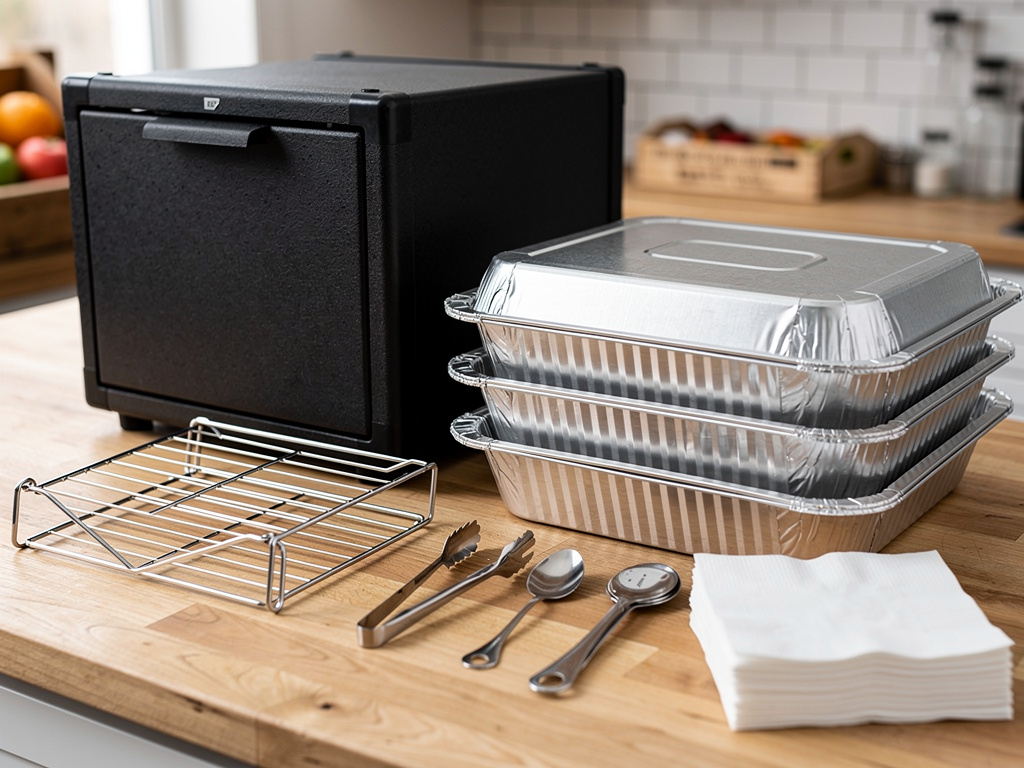
Setup also decides whether you come back. Imperia charges its $53 fee to drop off and charges it again to pick up any equipment that has to be returned. Its menu adds that disposables do not require a pickup. For a small caterer, disposable racks and pans on the invoice are almost always cheaper than a second trip. Our guide to packaging for local delivery covers containers that travel well.
Price the second trip before you promise real serving dishes. At Imperia's rates, a return trip costs a customer another $53. At your own 76 cents a mile, a second 24-mile round trip is another $18.24 plus an hour of your time. A $9.50 disposable chafing set left behind costs less than either.
Set a delivery minimum at the order size where the food profit covers the trip. On the menus in this guide, dollar minimums for delivery start at $150, reach $1,200 for any order at Amaala's Delightful Kitchen, and hit $1,500 on a Saturday at Kale Chef Service. Below that line, the drive eats most of what you made on the food.
The minimums on the menus we loaded:
A home caterer can use the same levers. Keep a weekday minimum low enough for an office lunch of 10, raise it on Saturday when you only have one oven and one car, and charge more for a late or after-hours window. Our guide to setting a minimum order value for delivery covers how to pick a minimum that covers your delivery cost at smaller order sizes.
Hot catering food has to stay at 135°F or hotter and cold food at 41°F or colder from your kitchen to the buffet table, unless you follow a written 4-hour time limit. The FDA Food Code, which most state and county health departments base their rules on, sets those two holding temperatures in section 3-501.16 of its 2026 edition.
The same code lets a food business hold food without temperature control for up to 4 hours, under section 3-501.19. Most food has to start at 135°F or above, or 41°F or below. Ready-to-eat cut fruit and vegetables have their own exception: they can start at 70°F or below if they stay there. The food has to be marked with the time 4 hours later, and it has to be served or thrown out by then. You also need written procedures for it. If you are using the 4-hour rule, the clock starts when the food leaves hot or cold holding, not when the guests arrive.
What that means for your packing:
The FDA Food Code is a model code. Each state adopts its own version, sometimes an older one, and your county permit may add conditions for catering and transport. We read the 2026 edition on September 29, 2026. Ask your health department which version applies to your permit before you rely on the 4-hour rule.
Our guide to cottage food laws by state lists meat, dairy and cut fruit among the foods most state home-kitchen laws leave out, so ask your health department whether your catering menu needs a licensed kitchen.
Often it does not, so call your agent before the first paid delivery. All 3 states whose insurance pages we read on September 29, 2026, Maine, Utah and Texas, tell drivers to check before delivering for pay. Maine's Bureau of Insurance says that most personal auto policies exclude business use, and that a policy with a business use exclusion is unlikely to cover an accident during a delivery. The Utah Insurance Department goes further and names catering, along with pizza delivery, in its list of uses that may need a commercial auto policy or an endorsement on your personal one.
An endorsement is an add-on to the policy you already have. The Texas Department of Insurance says optional delivery coverage added to a personal policy typically costs less than a commercial policy. Either way, the answer depends on your insurer and your state, so ask these questions on the call:
That last question is separate from the car. General liability insurance is the policy for claims like a guest tripping over your cord while you set up. Before you book a setup job, read our guide to general liability insurance for food vendors, since a venue or office building may ask for proof of coverage.
A catering delivery fee is taxable in some states and not in others, and how you write it on the bill can decide which. The 2 states we checked show the split. New York's tax department says delivery charges on your bill are generally taxable when the food or service being delivered is taxable. Idaho's State Tax Commission lists a delivery charge as not taxable when it is separately stated on the receipt and not used to avoid tax on the meal.
Setup and service charges can follow different rules again. So before your first invoice, do three things:
We read the New York and Idaho pages on September 29, 2026. Other states may tax a delivery charge, a setup fee or a service charge differently, and the answer can change with how the invoice is written. Your state revenue department is the one to ask.
Drive it yourself when the order needs setup or a careful hand-off, and use a courier when it is a simple drop-off and you cannot leave the kitchen. A courier costs less per trip than your time, but none of the options below will lay out a buffet the way you would.
Scroll sideways to compare who drives.
| Who drives | What one delivery costs you | Setup at the door | Notice and distance | Tips |
|---|---|---|---|---|
| You, in your own car | 76 cents a mile by the IRS rate ($18.24 for a 24-mile round trip) plus your time | Yes, your way | Your radius, your schedule | Go to you |
| DoorDash Drive On-Demand | $6.99 to $10.99 flat per delivery, no subscription; card processing is still whatever your own checkout charges | Not listed on DoorDash's Drive page | For orders from your own website or app; self-serve signup is for restaurants only, and other businesses need more than 5 locations to be considered | Go to the driver (100%, per DoorDash's Drive page) |
| ezCater Dispatch (ezCater orders only) | $30 on orders up to $300, 10% of the whole subtotal on orders over $300; the customer still pays your delivery fee and you cover any difference | "Basic setup" when noted in the order | Request a driver up to 90 minutes before the order is due | Go to the delivery provider |
DoorDash's Drive On-Demand page and ezCater's partner fee and Dispatch pages were checked on September 29, 2026. The own-car figure uses the IRS rate for July 1 to December 31, 2026.
On an ezCater Marketplace order of $300 where you charge $35 for delivery, Dispatch costs $30. The customer's $35 looks like it covers that, but ezCater also takes its 15% commission and 2.99% processing on the $35, which leaves you $28.70, or $1.30 short, when you request the driver yourself. For a $500 order Dispatch costs $50, and if your fee is still $35, about $21.30 comes out of your side. The cost of a courier is only half the question, though. The other half is who owns the customer, which is the next section.
A catering marketplace keeps far more of a delivered order than your own checkout does. When an office orders $300 of food and pays $35 for delivery, ezCater's marketplace keeps $60.27, while a flat-fee card checkout on your own link keeps about $10 to $11. The difference is that the marketplace found the customer for you. The table puts every fee side by side on that same order.
Swipe the table to see every fee for each platform.
| Platform | Monthly plan | Trial | Commission or platform fee | Card processing | Customer pays ($300 food + $35 delivery) | You pay on that order | You keep | You pay in a month of 8 such orders |
|---|---|---|---|---|---|---|---|---|
| Homegrown | $10 billed annually ($12.50 billed monthly) | 7 days, no charge until day 8 | None (0% commission) | 2.9% + $0.30, paid by you | $335 | $10.02 | $324.98 | $90.16 ($92.66 on monthly billing) |
| Square Free | $0 | No plan to try | None | 3.3% + 30¢ online | $335 | $11.36 | $323.64 | $90.88 |
| Square Plus | $49 per location | 30 days free | None | 2.9% + 30¢ online | $335 | $10.02 | $324.98 | $129.16 |
| ezCater Marketplace | $0, no signup fee | None needed | 15% of food plus your delivery fee | 2.99% of food, delivery fee and tax | $335 | $60.27 | $274.73 | $482.16 |
| ezCater Online Ordering (from your own website) | $0, no signup fee | None needed | 7% of food plus your delivery fee | 2.99% of food, delivery fee and tax | $335 | $33.47 | $301.53 | $267.76 |
| DoorDash Marketplace, Basic plan | $0 | 0% commission for the first 7 days | 15% of the food subtotal on delivery orders | Included in the 15% | $300 plus DoorDash's own delivery and service fees | $45.00 | $255.00 (the delivery fee is DoorDash's, not yours) | $360.00 |
On every row except DoorDash you still make the delivery yourself, and our 12-mile example put that drive at $47.41; on DoorDash Basic a Dasher drives the order, and DoorDash says the 15% covers Dasher logistics. Figured before sales tax. Card processing on every platform here except DoorDash also runs on the tax, so each processing figure runs a little higher once tax is added. We checked ezCater's partner fee page, DoorDash's merchant pricing page, Square's pricing page and Homegrown's signup page on September 29, 2026. DoorDash's pricing page is written for restaurants; its footnote says the partnership plans are for restaurants with 75 or fewer US locations.
Neither kind of platform is wrong. ezCater brings you buyers who are already searching for catering, and for a caterer with spare capacity that reach can be worth 15%. Repeat orders cost you again: an office that liked your lunch can reorder through the marketplace, and you pay the commission each time. Our comparison of in-house delivery and third-party apps walks through that trade.
Once you know your delivery fee, radius and minimum, the next problem is taking orders without quoting them by text every time. Homegrown is $10 a month billed annually ($12.50 billed monthly), with no percentage fees beyond standard payment processing of 2.9% plus $0.30, which you pay. On the $300 tray order above with its $35 delivery fee, that is $10.02, where ezCater's marketplace would keep $60.27.
The parts that fit catering delivery:
It fits a set catering menu: party trays, boxed lunches, a taco bar for 20. It fits less well if every job is custom. Square's free plan is close on cost ($11.36 on the same order) and includes estimates and invoices, which Homegrown does not. ezCater is the better choice when you need it to find customers for you.
The honest limits: the delivery fee is flat, so it cannot charge by the mile past your radius. There is no deposit, quote or invoice feature, and tipping at checkout is listed as planned, not live. Customers create a Homegrown account to place their first order, and there is no drops feature. Homegrown does not supply drivers. Your storefront is listed on Homegrown's marketplace too, but plan on most catering orders coming from people you send to your own link.
If your inquiries keep ending in "can you bring it to us?", put the answer on the page: your radius, your fee and your minimum, set once. You can set up a Homegrown storefront with delivery and try it for 7 days with no charge until day 8.
Your delivery policy should answer seven questions before the customer asks them: where you go, what it costs, what setup costs, the minimum, the window, what happens if they are late, and when they pay. Each menu in this guide prints several of them, so a customer can see the terms before calling.
Write yours once, put it on your order page and in every quote:
A policy also protects you on the day. If the office moves lunch from noon to 1, your written window and your setup price tell you whether that extra hour is free or billed.
Plan for the door as carefully as the kitchen, because that is where a catering delivery can go wrong: parking, a slow elevator, a room that is not ready, or nobody to sign for the food. None of it shows up in a recipe cost, and all of it eats the margin you priced into the fee.
The problems that are easy to miss when you plan from the kitchen, with a fix for each:
One more that is easy to miss: offices order the same lunch again. If you deliver well, the second order is already half sold, which is a good reason to take it through your own link. Our guide to selling food at work covers setting a weekly ordering deadline and delivery day, and weekly bundles that give you a guaranteed weekly order.
On the seven small caterers' menus we loaded on September 29, 2026, a 10-mile catering delivery cost $17.50 to $75, and the middle of the seven was $50. The two highest were Amaala's and Rockwoods at $75, and Rockwoods' fee included buffet setup. Price your own trip from the IRS mileage rate and your hours before you copy anyone's number.
Catering delivery should not be free for a small caterer, because a single drop-off costs real money: our 12-mile example came to $47.41 in car cost and time at $25 an hour. None of the seven caterers we checked offered free delivery. If you want to be generous, build the fee into the per-guest price for orders above a set size and say so on your menu.
Some caterers charge per mile, and more charge a flat fee with a per-mile charge beyond a radius. Eclectic Edibles charges $1.75 a mile with a $15 minimum, Rockwoods charges $3 a mile past 15 miles, and Imperia charges $2 a mile past 10 miles. A flat fee plus per-mile past a radius protects a small caterer from long trips.
No, a catering delivery fee covers getting the food there, while a service charge covers other work. Kale Chef Service, for example, charges a zone-based delivery fee, a 23% service fee that it says covers packaging and administrative time and is not a gratuity, and a 20% gratuity on delivered orders. Your state may tax each of these differently, so list them as separate lines.
Possibly, if DoorDash accepts your business. DoorDash Drive On-Demand sends a DoorDash driver (a Dasher) for orders placed on your own website or app for $6.99 to $10.99 per delivery, with no subscription, according to its page on September 29, 2026. The same page says self-serve signup is only for restaurants, and other businesses are considered case by case only with more than 5 locations, so a one-kitchen caterer may not qualify. The page does not list buffet setup, so it suits simple drop-offs. Check that your permit allows a third party to carry your food.
Under the FDA Food Code's time rule, food taken out of temperature control can be held for up to 4 hours, then served or thrown out, if you have written procedures and mark the time. Cold food can go up to 6 hours under a stricter version of the rule, if it starts at 41°F or below and its warmest part never goes above 70°F, with both times marked. The clock starts when the food leaves hot or cold holding, not when guests arrive. Your state or county may set different rules for catering, so confirm with your health department.
These six guides go deeper on the pieces of catering delivery this one only touches on. Start with the fee guide if your delivery orders are mostly under $50, and with the minimum order guide if small orders keep asking for a long drive:
The caterers who get delivery right are the ones who decided the numbers before the phone rang. Pick your radius, work out one drop-off from the mileage rate and your hours, round up to a flat fee, set a minimum and price setup on its own line. Then put all of it where customers see it before they order.
If you want those settings built into the order page, a Homegrown storefront lets you set a delivery radius from 1 to 25 miles, a flat fee and a minimum, and takes payment when the order is placed. It is $10 a month billed annually, with a 7-day trial and no charge until day 8.
Start small. Take your next three delivery orders at the fee you worked out, time each one from the kitchen door and back, and check the real minutes against your estimate. If the trips ran long, raise the fee or pull the radius in before the busy season, not after it.



