
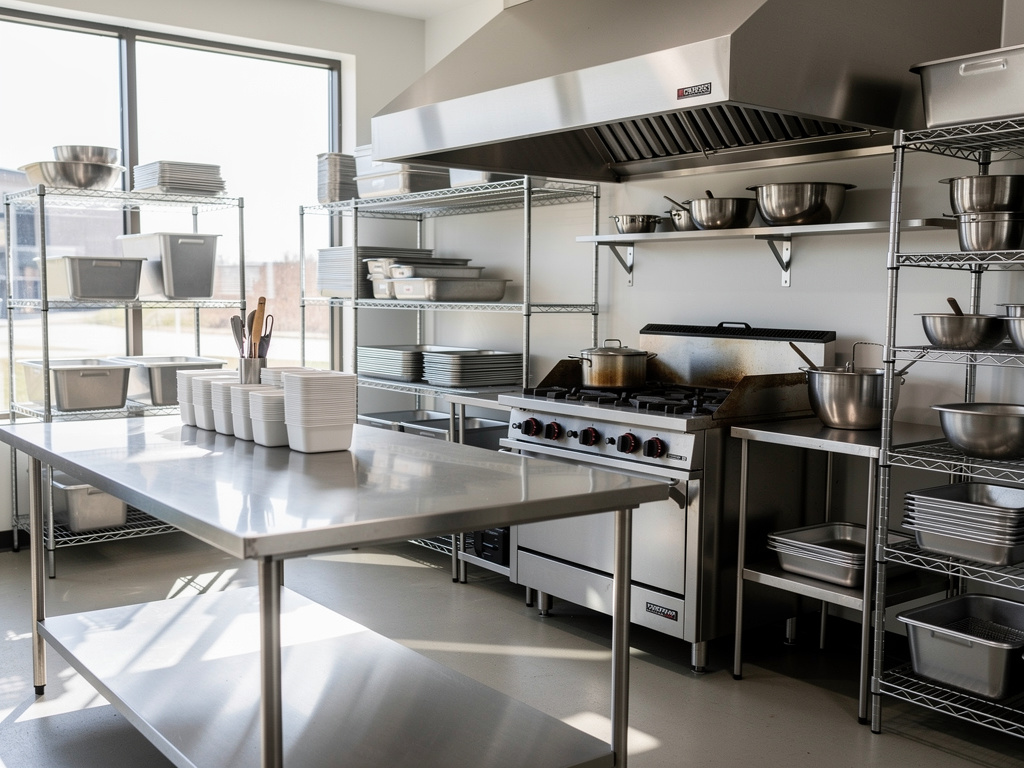


When your food business outgrows a home kitchen, you hit a big fork: rent time in a commissary or shared commercial kitchen, or buy or build your own space. Renting keeps your upfront cost low and your options open, but the hourly fees add up and you're working on someone else's schedule. Buying gives you total control and an asset you own, but it's a large capital commitment with maintenance, permits, and risk attached. This guide walks through commercial kitchen rental versus buying your own building, so you can tell which one your business is actually ready for.
The short version: Renting a commissary or shared commercial kitchen is the standard, low-risk way to scale past a home kitchen: low upfront cost, flexibility, and no maintenance, though the hourly or monthly fees compound and access is scheduled and shared. Buying or building your own kitchen gives you full control, unlimited access, and an asset, but it demands large capital, ongoing maintenance, permits, and real risk. Rent while your volume is uncertain or growing; buy or build only once your steady volume makes renting hours cost more than owning would, and you have the capital and the need for unlimited or specialized space. Run the real numbers before committing. Homegrown keeps your selling overhead low so you can prove demand before over-investing in a kitchen. This is general information, not financial advice.
This guide covers the tradeoff, when to rent, when to buy, the financial crossover, middle options, hidden costs, and mistakes. This is general information, not financial or legal advice.
The tradeoff is flexibility and low upfront cost versus control and long-term ownership: renting a commercial kitchen keeps you nimble and cheap to start, while buying or building gives you total control and an asset at a large upfront cost. Almost every other difference follows from that.
Here's how the two compare:
| Rent a commercial kitchen | Buy or build your own | |
|---|---|---|
| Upfront cost | Low, pay as you go | High, capital and financing |
| Access | Scheduled, shared | Unlimited, whenever you need |
| Control | Limited, shared equipment | Full, your equipment and layout |
| Maintenance | The facility handles it | You handle it |
| Best for | Early, growing, or uncertain volume | High, steady volume with capital |
What each side really means:
The takeaway: renting is the flexible, low-cost, low-commitment path, and owning is the high-cost, high-control, long-term one. The rule is to match the choice to your certainty and capacity, since renting fits uncertainty and owning fits proven, steady demand.
Renting makes sense when your business is early or growing, your volume is uncertain or seasonal, and your capital is limited, which describes most food businesses scaling past a home kitchen. It's the standard, sensible starting point, and often the right choice for years.
When renting is the right call:
Shared and incubator commercial kitchens exist specifically to serve growing food businesses at this stage, and university food-business programs like the University of Wisconsin's guide to starting a food business point new producers toward exactly these shared facilities, which is why renting is the near-universal starting point. The takeaway: renting is the flexible, affordable, low-risk way to scale past a home kitchen while your business is still finding its footing. The rule is to rent while your volume is uncertain or growing, using a commissary kitchen to bridge from home to scale.
Buying or building your own kitchen makes sense when you have high, steady, predictable volume, renting hours would cost more than owning, and you need unlimited access or specialized equipment, plus the capital to do it. It's a later-stage move that a minority of small food businesses reach.
When owning is worth it:
The takeaway: buying or building is the right move for high-volume, established producers whose steady demand and capital make ownership cheaper and more capable than renting. The rule is to buy only when your proven volume and finances clearly justify it, never on optimism about growth that hasn't happened yet.
You find the crossover by comparing your real, ongoing rental cost against the full cost of owning, and you do it with your own numbers, since rates and build-out costs vary too much by market for any universal figure. This calculation is the heart of the decision, and it has to be yours.
How to run the comparison:
The takeaway: the rent-versus-buy decision is a real, market-specific calculation, not a rule of thumb, so run your own numbers before committing. The rule is to build the full comparison, all-in owning cost versus realistic total rental cost, and let your actual figures, not a generic benchmark, make the call.
Between renting hours and buying a building, there are several middle options: a commissary with dedicated storage, a long-term or dedicated-hours lease, an incubator kitchen, or using a co-packer, which can fit better than either extreme. These are worth knowing before you jump to buying.
The middle-ground choices:
The takeaway: the choice isn't strictly rent-hours-or-buy-a-building, since dedicated storage, longer leases, incubators, and co-packers all bridge the gap. The rule is to consider these middle options before committing to ownership, since one of them may give you what you need without the capital and risk, alongside a clear-eyed look at commissary versus home kitchen tradeoffs.
Both renting and buying carry hidden costs that the headline price doesn't show: renting has scheduling, travel, storage, and rate-hike costs, while buying has permits, build-out, maintenance, and property costs. Missing these is how a decision that looked good on paper goes wrong.
The hidden costs to account for:
The takeaway: the real cost of either path includes these hidden items, so factor them in before deciding, not after. The rule is to price the full picture, scheduling, travel, storage, and rate hikes for renting; permits, build-out, maintenance, and taxes for buying, since the hidden costs often change the answer. Plan around the risk of a commissary rate increase either way.
For most growing food businesses, renting a commercial kitchen is the right choice until your volume, stability, and capital clearly justify owning, which is a later-stage milestone. Renting is the default; buying is the exception you earn into.
How to decide:
The takeaway: rent by default and buy only when your proven volume and finances make it clearly cheaper and necessary, using the middle options as stepping stones. The rule is to let demonstrated demand and real numbers, not ambition, decide when to stop renting and start owning.
The mistakes with this decision are buying too early, underestimating build-out and permit costs, ignoring commissary rate increases, and overlooking the travel and logistics of a rented kitchen. Each can sink an otherwise good business.
The mistakes to avoid:
The takeaway: the mistakes come from committing too early, underestimating costs, and ignoring hidden ones, all preventable with patience and a full analysis. The rule is to let proven demand and complete numbers guide the choice, and never to buy a building on optimism.
The safest way to make this decision is to prove your demand first, so you know your real volume before committing to any kitchen, and a low-overhead storefront lets you do exactly that. Homegrown is a $10-per-month online storefront, with no percentage fees beyond standard payment processing, that keeps your selling costs low while you grow.
Because your storefront costs a flat, small amount and gives you clean records of what sells, you can build and measure real demand before making any big kitchen commitment. Knowing your actual, steady order volume is exactly the information you need to run the rent-versus-buy math honestly, rather than guessing at your capacity. Keeping your selling overhead low also means more of your cash stays available for the kitchen decision when you're truly ready to make it.
To be clear about what Homegrown does not do: it is not a commercial kitchen, a commissary, or a real-estate service, and it does not finance, build, or find you a facility. Those decisions and costs are yours. What Homegrown gives you is a low-cost storefront and clean sales data, so you can prove your demand and know your real volume before investing in a kitchen you may or may not need. To build demand before you commit to a building, set up your Homegrown storefront and let real orders guide your kitchen decision.
For most growing food businesses, renting is the right choice until your volume, stability, and capital clearly justify owning. Renting a commissary or shared commercial kitchen keeps your upfront cost low, gives you flexibility, and passes maintenance to the facility, which fits early, growing, or uncertain-volume businesses, often for years. Buying or building your own kitchen makes sense only once you have high, steady, predictable volume, renting hours would cost more than owning, you need unlimited or specialized access, and you have the capital. Rent by default, and buy only when your proven demand and finances make ownership clearly cheaper and necessary.
When several things are true at once: your volume is high, steady, and predictable; your realistic rental costs would exceed the all-in cost of owning; you need unlimited access or specialized equipment a shared kitchen can't provide; and you have the capital or financing plus the appetite for a long-term commitment. Owning gives you full control and an asset, but it adds maintenance, permits, property tax, and risk. It's a later-stage move that a minority of small food businesses reach. Buying before your volume is proven and steady, on the strength of hoped-for growth, is the most common and costly mistake in this decision.
Run a full comparison with your own market's numbers. For renting, multiply the hours you realistically need per week by your local kitchen's rate, annualize it, and add membership and storage costs. For owning, total the amortized mortgage or lease payment plus build-out, equipment, permits, ongoing maintenance, property tax, and financing, not just the space's price. Then compare the complete annual figures. Owning only wins when its all-in cost is clearly below your realistic total rental cost, with margin to spare for the added risk. Rates and build-out costs vary enormously by region, so use real local quotes, not general estimates.
Beyond the hourly or membership rate, renting carries several hidden costs. Scheduling is shared, so you can only work when the kitchen is available, which can limit your production. You spend time and fuel traveling to and from the facility, and limited storage may force extra trips or paid off-site storage. And commissary rates can rise over time, so today's affordable rate may not hold, which can upend your budgeting. These aren't reasons to avoid renting, it's still the sensible starting point, but you should factor scheduling, travel, storage, and potential rate increases into your real cost before deciding.
Several middle options bridge the gap. A shared commissary with dedicated, locked storage gives you more of your own space without buying. A dedicated-hours or longer-term commissary lease can lower your rate and secure reliable access while staying flexible. Incubator or co-op kitchens are shared-use facilities built specifically for growing food businesses, often with peer support. And for a shelf-stable product, hiring a co-packer to manufacture it means you need no facility of your own at all, trading some margin for capacity. Consider these before committing to ownership, since one may give you what you need without the capital and risk of buying.
You've outgrown renting when your volume is consistently high and steady, scheduling limits at the shared kitchen are constraining your production, and a full-cost comparison shows owning would be cheaper than your realistic rental costs, and you have the capital to invest. Before jumping to buying, though, try the middle options, dedicated storage, a longer lease, or an incubator kitchen, since they often solve the constraints of basic renting without the commitment of ownership. The clearest signal is proven, predictable demand that your rented access can no longer efficiently serve, backed by numbers that make owning genuinely cheaper, not just appealing.
Renting versus buying a commercial kitchen comes down to certainty and capacity: rent while you're growing and your volume is uncertain, and buy only when proven, steady demand and real numbers make ownership clearly worth it. Prove your demand first, run the full comparison, and let the figures decide. Start your Homegrown storefront and build the demand that tells you which kitchen you actually need.



