
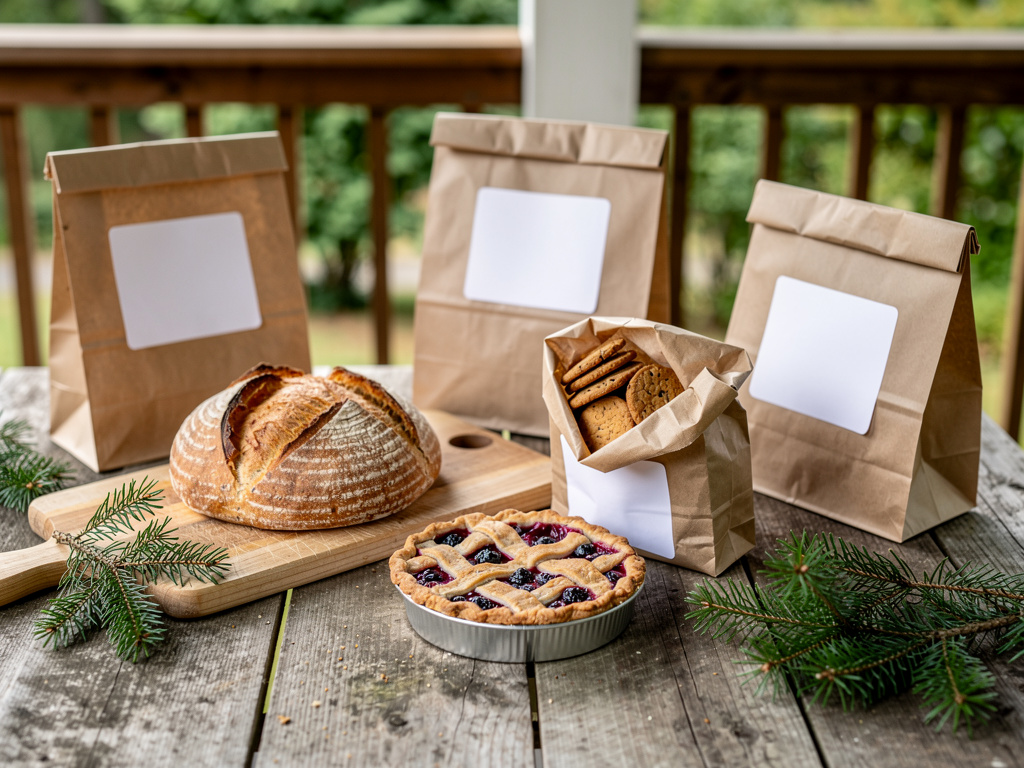


The short version: The best platform to sell baked goods in Washington State is one that lets your customer pay you in person, because WSDA's FAQ says the payment and the hand-off for cottage food happen directly between you and your customer, face to face. For most home bakers that means taking orders through Facebook, Instagram or your own order page and collecting cash or a card tap at pickup, running a Shopify store ($29 a month billed yearly) with a pay-at-pickup option, or switching on Hotplate's Cash checkout option and asking customers to choose it, since card stays on beside it (no monthly plan, and Hotplate's 5% + $0.55 fee still applies). Homegrown ($10 a month billed annually), Square Online, Hotplate's card checkout and Etsy all take card payment online at checkout, so ask WSDA in writing before you use any of them for cottage food. Every route still needs WSDA's $355 two-year Cottage Food Permit, keeps you under a $35,000 yearly sales cap, and rules out shipping.
Checked on WSDA's Cottage Food Operation page, RCW 69.22.020, WAC 16-149-040 and each platform's pricing page, October 8 and 9, 2026: the state law says cottage food "may not be sold by internet," the rule allows a website if sales are "completed as in-person transactions," and WSDA's 2026 brochure names Etsy and personal websites as places to make sales with in-person pickup, while a WSDA blog post from April 9, 2026 says online sales are not allowed under the permit. Washington's own documents disagree, so confirm your setup with WSDA. Homegrown customers create an account to place a first order, Homegrown has no drops (timed product release) feature, and its 2.9% + $0.30 card processing is paid by the vendor.
Once WSDA confirms how your customers may pay, you can set up a Homegrown storefront and try it free for 7 days.
Washington lets you sell bread, cookies, cakes and pies from your home kitchen once you hold a Cottage Food Permit from the Washington State Department of Agriculture (WSDA). For a selling platform, the rule that matters is payment. WSDA's FAQ allows orders over the internet, but it adds that the customer pays you and gets the food from you directly, and the statute itself is stricter. That one rule decides which platform fits, so this guide starts there and then compares six real setups with every fee on the table.
If you have not applied for your permit yet, our Washington cottage food law guide covers the permit, the inspection and the label line by line. This page is about the next question: once you are legal, where do you sell?
You can sell low-risk foods that stay safe without refrigeration, and only the specific products WSDA approves on your permit, which can list up to 50 master products (a product and its variations count as one). WAC 16-149-120 lists the common allowed products, and WSDA's cottage food page groups the common ones like this:
WSDA's prohibited list matters just as much for a baker. Cream, custard and meringue pies, cakes or pastries with cream, cream cheese or fresh fruit fillings or with fresh fruit garnishes, low-sugar frostings, focaccia topped with vegetables or cheese, and anything that needs refrigeration are all out. Dried fresh fruit and vegetables are out too: WSDA's FAQ says freeze-drying fresh produce is not allowed and that low-temperature dehydrators do not give a cook step.
The annual cap is $35,000 in gross sales, counted per home, not per person. The permit costs $355 for two years and comes after a home-kitchen inspection. You also need a Food Worker Card and a Washington business license (WSDA calls it a Master Business License). Every label carries WSDA's home-kitchen statement (the exact wording is in the label section below), along with the product name, your business name and permit number, ingredients, allergens and net weight.
Not by WSDA's FAQ wording: it lets you take orders over the internet, but wants the money and the food to change hands face to face. Of the six Washington sources below, three ban internet sales outright (the statute, one FAQ answer and WSDA's April 2026 blog post), two allow online orders that finish in person, and one reads looser still, which is why every platform choice below comes back to this.
Here is what each source says, as loaded on October 8 and 9, 2026:
The statute (RCW 69.22.020), one FAQ answer and WSDA's April 2026 blog post ban internet sales outright. The rule and the internet FAQ answer allow online orders if the sale finishes in person, and the FAQ counts payment as part of that. The brochure reads looser than either. Until WSDA answers for your setup, the plan that fits the rule, the internet FAQ answer and the brochure, and comes closest to the statute, is: take the order online, collect cash or tap a card in person when the customer picks up, and keep a record. Email cottagefoods@agr.wa.gov, describe exactly how customers will pay, and file the reply with your permit.
That puts Washington bakers in an unusual spot. In many states, the "best platform" question is about fees. Here, the first filter is whether a tool lets the customer pay at pickup, and of the online stores in this guide, Shopify and Hotplate document one.
A selling platform turns scattered messages into a list of orders you can bake from. Even when payment happens at your door, the order still has to come from somewhere, and a home baker juggling texts, comments and DMs loses track fast.
Common problems Washington bakers face without one:
What changes in Washington is the payment step. The platform that collects orders may not be the one that collects money, and a setup that keeps those two jobs separate is the one that fits WSDA's FAQ.
You can sell home baked goods anywhere you hand them to the customer in person inside Washington, and WSDA's sources name these places: your home, your farm stand, farmers markets, holiday bazaars, festivals, craft fairs, charitable organization functions, and a shop you run yourself. WAC 16-149-040 names farmers markets, craft fairs and charitable organization functions; WSDA's 2026 brochure adds your home, your farm stand, holiday bazaars and festivals; and WSDA's FAQ adds "other public venues" and its example of a baker selling from her own antique shop.
Where you cannot sell, from WAC 16-149-040, WSDA's FAQ and WSDA's 2025 overview slides:
Our guide to whether you can ship cottage food explains why Washington is one of the no-shipping states. If markets are your main channel, the Washington farmers market vendor permit guide covers what you need on market day. You must post a copy of your permit at every place you sell.
The six setups below cover the common routes. Each one is judged on the same three things: how the customer pays, what it costs on a $20 order, and how closely it matches WSDA's person-to-person wording.
Posting your weekly menu on Facebook or Instagram and taking orders by direct message costs nothing to run, and the customer pays you at pickup with cash or a card tap. That matches WSDA's FAQ wording more closely than any online checkout, and WSDA's brochure names Facebook as a place to make sales.
For card taps, Square Free charges no monthly subscription, and Square's fee page lists its in-person rate at 2.6% + 15¢. On a $20 loaf that is $0.67 to the baker. Cash costs nothing.
Pros:
Cons:
Best for: Bakers starting out, whose weekly orders still fit in one message thread. Our guide on whether it is legal to sell food on Facebook covers Meta's rules.
Shopify is the full online store in this list, and one of two tools here (Hotplate is the other), whose help center documents a way to take the order online and the money in person. Its help center page on manual payment methods says you can set up a manual payment method for "paying in person," mark the order paid when you collect, and that "you aren't charged third-party transaction fees for manual payments." Pair that with Shopify's pickup option and switch off online card payment in your payment settings, so the customer orders online, then pays you at the door.
Shopify Basic costs $29 a month billed yearly or $39 billed monthly, after a 3-day trial and $1 a month for the first 3 months. If the customer taps a card at pickup, Shopify's pricing page lists Basic's in-person card rate at 2.6% + 10¢, or $0.62 on a $20 order.
Pros:
Cons:
Best for: Bakers who want a full storefront and want payment at pickup from day one, and who will sell enough to cover the plan.
At $10 a month billed annually, Homegrown is built for local food vendors who sell through pickup, local delivery and farmers markets, but its checkout takes card payment online, so it does not match WSDA's person-to-person payment wording. Homegrown's own signup page says customers "pay with credit or debit card when they order," and there is no pay-at-pickup option. Ask WSDA before you use it for cottage food.
If WSDA tells you in writing that an online card payment with in-person pickup is fine for your operation, Homegrown puts a Washington baking business on one link. It costs $10 a month billed annually ($12.50 billed monthly) with no percentage fees beyond standard payment processing, and no shopper fee. Compared with the alternatives in this guide, the plan price stays flat as orders grow and only card processing scales: Shopify Basic is $29 a month billed yearly, Etsy takes 6.5% of every sale on top of its processing fee, and Hotplate adds 5% + $0.55 to each order unless you choose to pay it yourself.
What Homegrown does for a Washington baker:
What Homegrown does not do:
Best for: Washington bakers who have WSDA's written OK for online payment, and bakers in other states without Washington's payment wording.
Do not take card payments online for cottage food in Washington on any platform until WSDA confirms it in writing. RCW 69.22.090 makes selling against the chapter a misdemeanor, makes a second violation a gross misdemeanor, and allows a civil penalty of up to $1,000 per violation per day. We checked the FAQ wording on WSDA's Cottage Food Operation page on October 8, 2026.
Square Online comes with every Square plan, including Square Free at $0 a month, and it syncs with the Square reader you may already use at a market booth. The limit for Washington is the checkout. Square's help page on website payments lists cards, Apple Pay, Google Pay, Afterpay and Cash App Pay at checkout, and no pay-at-pickup option, so the customer pays online. Square Free's online rate is 3.3% + 30¢, or $0.96 on a $20 order.
Pros:
Cons:
Best for: Bakers who already run Square at the market. Our breakdown of what Square Online's free plan really costs goes deeper.
Hotplate is built for timed pre-order "drops," and its site says "customers order and pay ahead of time during a set window." Its default checkout takes the card payment at that point, which does not match WSDA's person-to-person payment wording. Hotplate has no monthly plan. Its pricing page shows customers a 5% + $0.55 fee at checkout, which is $1.55 on a $20 order, and the baker pays 2.9% + $0.30 processing on the $21.55 the customer's card is charged, or $0.92. Hotplate lets the baker pay the 5% + $0.55 instead, which raises the baker's cost to $2.43 an order.
Hotplate also lists Cash among its checkout options. Its help article "How to accept cash, Venmo, or Zelle" says you switch Cash on under Checkout in Settings, the customer picks it at checkout and sees your payment instructions, and you click Confirm Payment once you have the money. The same article says external payment methods "appear right below Card and Cash App" at checkout, and it documents no way to turn card off, so customers can still prepay online unless you ask them to pick Cash. A 2026 Hotplate changelog post says the portal now shows "the amount you need to collect on pickup." Cash can only be switched on for your whole storefront, not for a single event, and chasing a cash customer who never shows up is on you. A cash order has no card processing fee, but the Hotplate fee still applies: Hotplate's pricing help article says that on a $20 cash order the customer pays you $21.55, and Hotplate deducts the $1.55 from your payout. Cash is the option that matches WSDA's face-to-face wording; Venmo and Zelle, which Hotplate offers the same way, are app transfers, so ask WSDA before you count them as in person.
Pros:
Cons:
Best for: Bakers who sell in timed drops and switch on Cash and ask customers to choose it, or who have WSDA's written OK for card prepay. Our Hotplate alternative comparison has the full fee math.
Etsy is a national marketplace, which makes it the weakest fit for a Washington cottage food baker even though WSDA's brochure names it. Etsy's payments policy says shops using Etsy Payments "agree to ship sold items once a payment transaction is complete," and its fees policy prohibits moving a sale off Etsy. Shipping is banned for Washington cottage food, and taking the payment off Etsy breaks Etsy's rules, so neither half of an online Etsy sale fits. Etsy's fees policy does allow in-person sales through a Square reader, which skip Etsy's 6.5% transaction fee and pay Square's processing fees plus a $0.20 Etsy fee per sale (a listing renewal or a "Square manual" fee) instead, but an order placed on Etsy.com still runs through Etsy Payments and expects shipping.
Etsy charges $0.20 per listing, a 6.5% transaction fee, and US payment processing of 3% + $0.25 on the order total. On a $20 order that is $1.30 + $0.85 + $0.20 = $2.35, or 11.75% of the sale. A one-time set-up fee may also apply when you open the shop.
Pros:
Cons:
Best for: Washington bakers with a WSDA Food Processor License and a commercial kitchen, not cottage food.
The cheapest setup that fits WSDA's FAQ costs nothing: a social post with cash at pickup. Among online stores, Shopify and Hotplate are the two here that document a way to pay at pickup: Shopify's manual payment method, and Hotplate's Cash option, where the customer's cash total still includes Hotplate's 5% + $0.55 fee. The online checkouts from Homegrown, Square Online and Hotplate's default all land between $46.25 and $54 a month for the baker at 50 orders, card processing included, and Etsy costs more than twice that.
Scroll sideways to see every column.
| Setup | How the customer pays | Fits WSDA's person-to-person payment wording? | Monthly plan | Trial | Platform fee | Card processing | Customer pays on a $20 order | Baker pays on a $20 order | Baker pays in a month of 50 orders at $20 |
|---|---|---|---|---|---|---|---|---|---|
| Facebook or Instagram post, orders by message | Cash or card tap at pickup | Yes | None | Not needed | None | Cash: none. Card: Square Free in-person 2.6% + 15¢ | $20.00 | $0.00 cash; $0.67 card | $0.00 cash; $33.50 card |
| Shopify Basic with pay at pickup | Orders online, pays in person | Yes, payment happens in person | $29 billed yearly ($39 monthly) | 3 days, then $1 a month for 3 months | None on manual payments | Cash: none. Card: in-person 2.6% + 10¢ | $20.00 | $0.00 cash or $0.62 card, plus the plan | $29.00 cash; $60.00 card |
| Homegrown | Card when ordering online | No; get WSDA's written OK first | $10 billed annually ($12.50 monthly) | 7 days, no charge until day 8 | None, 0% commission | 2.9% + $0.30, paid by the baker | $20.00 | $0.88 plus the plan | $54.00 |
| Square Online on Square Free | Card on the website checkout | No; payment is online | $0 | Not needed | None | Online 3.3% + 30¢ | $20.00 | $0.96 | $48.00 |
| Hotplate, default | Prepaid by card during the order window | No; the card is charged at checkout (see the cash row) | $0 | Not needed | 5% + $0.55, paid by the customer | 2.9% + $0.30, paid by the baker | $21.55 | $0.92 | $46.25 |
| Hotplate, baker covers the fee | Prepaid by card, no added fee shown | No; same prepaid card checkout | $0 | Not needed | 5% + $0.55, paid by the baker | 2.9% + $0.30, baker pays | $20.00 | $2.43 | $121.50 |
| Hotplate, Cash option at checkout | Orders online, pays cash at pickup | Only for customers who choose Cash; card and Cash App stay on at checkout | $0 | Not needed | 5% + $0.55, inside the customer's cash total, deducted from the baker's payout | None on cash orders | $21.55 | $0.00; the $1.55 fee comes out of the customer's cash | $0.00 |
| Etsy | Card at online checkout, then shipping | No, and Etsy expects shipping | $0 (optional Etsy Plus $10) | Not offered; one-time set-up fee may apply | 6.5% transaction + $0.20 listing | 3% + $0.25 | $20.00 | $2.35 | $117.50 |
We checked every price on October 8, 2026: Homegrown on findhomegrown.com/signup, Square on its fees and online store plans pages, Shopify on its pricing page and its manual payments help page, Hotplate on its pricing page and its help articles on pricing and on accepting cash (and Hotplate's pricing page and cash article again on October 9), and Etsy on its fees and payments policies. Card fees are figured on the $20 price, one item per order, with no tax, tips or delivery fee. Hotplate's default row is the exception: the worked example on Hotplate's pricing page charges processing on more than the subtotal, so we figure that row on the $21.55 the customer's card is charged, which includes Hotplate's fee. The Homegrown month is 50 card fees of $0.88 plus the $10 plan billed annually ($56.50 on monthly billing). The Shopify card month is 50 fees of $0.62 plus the $29 plan billed yearly ($70.00 on monthly billing). Square tap figures assume a Square Free account.
On $1,500 a month in sales, about 75 orders of $20, Etsy's fees come to about $176.25 while Homegrown costs $10 plus $66 in card processing, $76.00 in all: a $100.25 monthly difference. The fee gap is real, but in Washington the payment rule comes first.
You collect the order online and the money at the hand-off, which is the setup closest to WAC 16-149-040 and WSDA's FAQ. Here is how a weekly bake runs that way:
Price in whole dollars when customers pay at pickup. A $9 loaf and a $14 cookie box mean you never handle coins, and starting a Saturday window with $50 in small bills (ten $1s and eight $5s) covers change for the first several customers who hand you a $20.
At the full $35,000 cap, sold as $20 orders, a Washington baker takes 1,750 orders a year, and the platform costs range from $0 with cash to $4,252.50 on Hotplate when the baker covers its fee, with Etsy close behind at $4,112.50. The chart shows what the baker pays in one year:
Baker's yearly cost at the $35,000 cap (1,750 orders of $20)
Source: the fees in the comparison table above, checked October 8, 2026, times 1,750 orders, with card processing included in every bar. Plans are billed annually where offered ($348 for Shopify, $120 for Homegrown). Hotplate's default bar leaves out the $2,712.50 in fees its customers pay; the baker-covers bar includes them. Cash at pickup costs $0. Bars are each cost divided by the largest.
Every card setup except Etsy and Hotplate with the fee on the baker lands within $507.50 of the others at the cap, so fees alone should not decide this. And the two cheapest card setups both take payment in person, which is the same direction WSDA's FAQ points.
You need a WSDA Cottage Food Permit, a Food Worker Card for each person who makes the food, and a Washington business license before you sell a single cookie on any platform. WSDA's cottage food page says the application averages 6 to 8 weeks from a complete application to an issued permit, and a 2026 WSDA blog post says 4 to 6; plan for the longer one. Our step-by-step Washington startup guide walks through the order. The short list:
WSDA's page says not to send recipes with the application, because the application is a public record. WAC 16-149-120 still says recipes go in with it, so ask WSDA which instruction to follow if your form asks for them.
Your online listing name must match the product name on your permit, and every package carries the full WSDA label (WSDA can allow a label sheet instead for large cakes and bulk containers, under WAC 16-149-110): 6 required details, plus a nutrition line only when you make a nutrition claim. WSDA's FAQ is strict on names: a product called "Blueberry Cake" on your permit must be labeled and sold as "Blueberry Cake," and cupcakes from a cake recipe need their own label.
Every Washington cottage food label includes:
WSDA's FAQ says you no longer need your home address on the label. On a platform listing, copy the ingredient and allergen lines from your approved label so the online version and the package agree. Our cottage food labeling guide has templates.
The cap makes a flat monthly price easier to plan around than a percentage fee, because your sales have a ceiling but percentage fees grow with every order. $35,000 a year is about $673 a week or $2,917 a month.
Three ways the cap shapes the choice:
In our pull of the Homegrown catalog's public product feed on the evening of October 8, 2026, 1,492 of 2,920 products (51%) sat in the Bakery category, listed by 188 of 313 vendors. We counted by the category each vendor chose, not by product names. The median listed Bakery price was $11.00, and 1,248 of the 1,492 were listed at $20 or less, which is why this guide figures every fee on a $20 order. A listed price is not a sale, and the feed does not show which state a vendor is in.
The most common mistake is turning on an online checkout because it is the default, without asking WSDA first. The full list:
Most of these come back to one habit: before you switch on any new ordering tool, read its checkout and fulfillment settings against WSDA's FAQ, and send WSDA a one-paragraph email describing the setup.
Pick the setup by how your customers will pay first, then by cost: a social post with cash at pickup costs $0, Shopify with pay at pickup starts at $29 a month, and Homegrown is $10 a month once WSDA approves online payment.
Washington's $35,000 cap and two-year permit make it a workable state for a home bakery. The Washington State Legislature's RCW 69.22 is the law, and WSDA's cottage food page answers the permit, label and sales questions. Rules change, so verify your state's current rules with WSDA before you sell.
Once WSDA has confirmed how your customers may pay, try Homegrown for 7 days, no charge until day 8, and give your regulars one link for next week's pickup.
The current limit is $35,000 in gross cottage food sales per year, set by RCW 69.22.050, which has WSDA review it every four years and raise it for inflation. The cap counts your gross sales of cottage food products, and it is figured per home, so two bakers in one kitchen share one $35,000 limit. Spread evenly, that is about $2,917 a month.
Yes. Washington requires a Cottage Food Permit from WSDA before you sell, at $355 for two years, and WSDA inspects your home kitchen before it issues the permit. You also need a Food Worker Card for each person who makes the food and a Washington business license, and WSDA tells you to check your city and county zoning rules for running a business from home.
You can take orders online under WSDA's FAQ, but the money and the food must change hands in person, and you cannot ship. The statute (RCW 69.22.020) says cottage food "may not be sold by internet," while WSDA's rule allows a website if sales finish in person. Ask WSDA in writing before you take card payments online, on any platform.
We do not have Washington-only sales data, so we will not rank products by state. Across Homegrown's whole catalog on October 8, 2026, 51% of listed products were in the Bakery category, at a median listed price of $11.00. In Washington, stick to WSDA's allowed list: breads, cookies, cakes with shelf-stable frosting, fruit pies that are baked, scones and candies all qualify, while pumpkin, custard and cream pies do not.
Neither RCW 69.22 nor WSDA's cottage food page lists liability insurance as a permit requirement. Markets can require it, though. The 2022 vendor handbook for Seattle's Neighborhood Farmers Markets requires general liability insurance that includes product liability, says the policy should carry at least $1 million in coverage, and requires the markets to be named as an additional insured.
Washington requires your business name and WSDA permit number, the product name, ingredients in order by weight with sub-ingredients, allergens, net weight or volume, and the statement "Made in a home kitchen that has not been subject to standard inspection criteria" in at least 11-point type (RCW 69.22.020 and WAC 16-149-110). Nutrition information is needed only if you make a nutrition claim, and WSDA's FAQ says your home address is no longer required.
The state allows it: WAC 16-149-040 permits cottage food sales at farmers markets, and you must display a copy of your permit there. Each market sets its own rules, though. Seattle's Neighborhood Farmers Markets run seven markets, and their 2022 vendor handbook says vendors who sell processed foods, including baked goods, "MUST have a current Food Processor License" from WSDA, so a cottage food permit alone may not be enough there. Ask each market's manager before you apply.
A cottage food operation bakes in your home kitchen under a WSDA permit, sells only to the end consumer, and caps sales at $35,000 a year. A food processing plant operates under a WSDA Food Processor License in an inspected facility, can sell wholesale, and has no sales cap. Under RCW 69.07.040, the yearly processor license costs $92 for gross sales up to $50,000 and $147 from $50,001 to $500,000, and WSDA's Food Processors page says every license expires June 30.
Apply to WSDA, not your county. You send the application with your labels, a kitchen diagram, signed copies of your Food Worker Cards and a copy of your business license, pay the $355 fee for a two-year permit, and pass a home-kitchen inspection. WSDA's cottage food page says the process averages 6 to 8 weeks (a 2026 WSDA blog post says 4 to 6, so plan for the longer one), and a failed inspection costs $125 to schedule again.
No. Washington's cottage food law allows sales only to the end consumer, so restaurants, coffee shops, grocery stores, wholesalers and consignment are all out. To sell to a business for resale, WSDA requires a Food Processor License and a licensed facility.
A common rule of thumb is to start with your ingredient and packaging cost per item and multiply by 3 to 4 for a retail price. A dozen sourdough dinner rolls that cost $4 in ingredients and packaging would retail for $12 to $16 on that rule. Then add the platform: at $2,000 a month in $20 orders, Etsy's fees run about $235 while Homegrown costs $98 with card processing, and cash at pickup costs nothing. Our baked goods pricing guide shows the full math.
You can sell from your home, at craft fairs, charitable events and festivals, from a shop you run yourself, and through orders taken online and handed over in person. Every sale goes directly to the end consumer inside Washington, with no shipping and no third-party delivery. A weekly market plus a porch pickup window covers the rainy months.
These answer the questions Washington bakers ask next:
Your bakery deserves an ordering system that fits the rules you bake under. When WSDA confirms how your customers may pay, Homegrown gives you one link with pickup windows, local delivery and inventory for $10 a month billed annually, with no commission and only standard card processing of 2.9% + $0.30 per order. Start your 7-day trial; you are not charged until day 8.
*This guide is general information, not legal advice. Cottage food rules change, so verify your state's current rules with WSDA before selling. Last verified: October 9, 2026.*



