

The short version: Almost no ordering platform for small food vendors has real pre-purchase messaging, and you should be glad. Every question a customer sends before ordering is a defect in your product page, and answering it individually costs you two to five minutes while the page could have answered it once for everyone. The messaging features that do exist in this category, Hotplate's SMS and Cococart's email module, are aimed at after the order or at marketing, not at the pre-purchase question. So the honest ranking is: fix the page first, route the remaining questions to one channel, and buy messaging software last.
They are remarkably consistent across food businesses, and there are about seven of them.
Count how many of those a good product page answers before anyone types anything. All seven, if you write it properly. Which means the volume of pre-purchase messages is a measurement of how much your page is not saying, and treating it as a customer service problem rather than a copy problem is the expensive mistake.
Enough to justify an afternoon of rewriting, and the arithmetic is easy.
A single pre-purchase exchange is rarely one message. It is a question, your answer, a follow-up, and often a "great, I'll take two" that you then have to turn into an order manually. Call it three to five minutes including the context-switch.
At 15 questions a week, that is roughly an hour a week, or 50 hours a year. And it arrives in fragments while you are baking, which is worse than an hour in one block.
Now the other side. If a rewritten product page removes two thirds of those questions, you have bought back 35 hours a year for one afternoon of work. Nothing you can buy performs like that.
Our guide to writing product descriptions that sell food online covers the structure, and our piece on farm stand product descriptions covers the shorter version for a stall.
Six things, and most food listings include two of them.
Point two is the one that matters most legally and practically. An allergen question is the one you cannot afford to answer casually from your phone while your hands are floury, and a page that states it removes both the message and the risk.
Very few, and it is worth being precise about what each actually offers.
Hotplate includes SMS, and it is genuinely good, but it is aimed at reminders and drop announcements rather than at answering a question before someone buys. It is broadcast, not conversation.
Cococart sells an Email Marketing module at $19 a month and a CRM at $19, both separate from its $19 store plan. Again, these are marketing and record-keeping rather than pre-purchase Q&A.
Big Cartel includes abandoned-cart recovery on its $30 Diamond tier, which is a message sent after someone half-ordered rather than before.
Cheddar Up supports forms and sign-up sheets, which can carry questions as fields on the order rather than as a separate conversation. That is a genuinely different and often better approach.
The general storefronts, Square, Shopify, Squarespace, and Wix, all offer contact forms and, on some tiers, third-party chat integrations. None of them treats pre-purchase messaging as a first-class feature for this kind of business.
The pattern is clear: this category has decided that pre-purchase conversation is not what the software is for, and mostly they are right.
You will still get some, and the goal is one channel rather than none.
The failure mode is questions arriving in five places: Instagram DMs, Facebook comments, text messages, email, and a contact form. Each has a different notification, a different history, and a different chance of being missed at 9pm on a Friday.
Pick one and route everything to it:
That last one deserves more attention than it gets. A "notes" or "questions" field on the order means the customer places the order and asks at the same time, rather than asking, waiting, and possibly never coming back. It converts a blocking conversation into a non-blocking one.
Different job, and this is where messaging features genuinely earn their keep.
Order confirmations should be automatic and should restate the collection details. Our guide to order confirmation messages covers what to include, and a good one removes most of the "did you get my order?" traffic.
Reminders the day before collection reduce no-shows measurably. Hotplate's SMS does this natively; most platforms do it by email.
Marketing messages are a separate thing again, with separate rules and separate consent requirements. Our guide to text message marketing for food vendors covers what is involved, and it is worth reading before you start collecting numbers rather than after.
The ranking is: automatic confirmations are essential, reminders are high-value, marketing is optional. Buying a platform for its marketing messaging while its confirmations are poor is the wrong way round.
One thing worth settling before you send anything at scale: consent. Marketing texts and marketing emails are regulated differently from transactional messages about an order someone placed, and the difference matters. A confirmation is expected; a Thursday announcement about next week's bake is marketing, and it needs permission that was actually given rather than assumed. The FTC's privacy and data security guidance for businesses covers the general obligations around customer data, and the specific rules for messaging are worth checking before you build a list rather than after.
Two categories, and both are worth having a stock response ready for.
Requests you will not take. A custom order you do not have capacity for, a delivery outside your radius, a dietary requirement you cannot safely meet. The instinct is to soften these into a maybe, which produces a longer conversation and a worse outcome. A short, warm, definite no takes thirty seconds and preserves the relationship better than three days of vagueness.
Allergen questions you are not certain about. This is the one to be careful with. If you genuinely do not know whether a supplier's ingredient carries a cross-contamination risk, say so rather than guessing. "I make everything in a kitchen that also handles nuts, so I cannot guarantee it is safe for a severe allergy" is an honest answer and it is the right one even though it loses the sale.
Having both of those written down somewhere you can copy from is a genuinely useful ten minutes. You will use them repeatedly, and writing them calmly in advance produces better answers than composing them at 9pm with flour on your hands.
If your listings currently cannot carry the ingredient and collection detail that prevents most of this, loading your real products into a trial storefront is the fastest way to find out whether the structure exists to say it once.
Yes, and this is the honest argument against everything above.
A customer who asks a question and gets a warm, quick answer often becomes a regular. Small food businesses compete on exactly that: you are a person, not a website, and the conversation is part of what people are buying. Automating it away entirely would be a mistake.
So the distinction worth holding is between questions that reveal something and questions your page should have answered.
The first kind should trend towards zero. The second kind should trend upwards, and you will have far more time for it once the first kind stops arriving.
Our guide to handling customer questions at an unattended farm stand covers the version of this problem where you are not even there to answer.
Step one is the one nobody does and it takes almost no effort. Write each question on a list as it arrives. By Sunday you will know exactly which three sentences are missing from your listings, and it will not be the three you would have guessed.
Step six matters because the first rewrite never catches everything. Questions cluster around whatever is newest: a product you just added, a pickup point you just opened, a price you just changed. Recounting monthly for the first quarter turns this from a one-off tidy-up into a habit that keeps the volume down permanently.
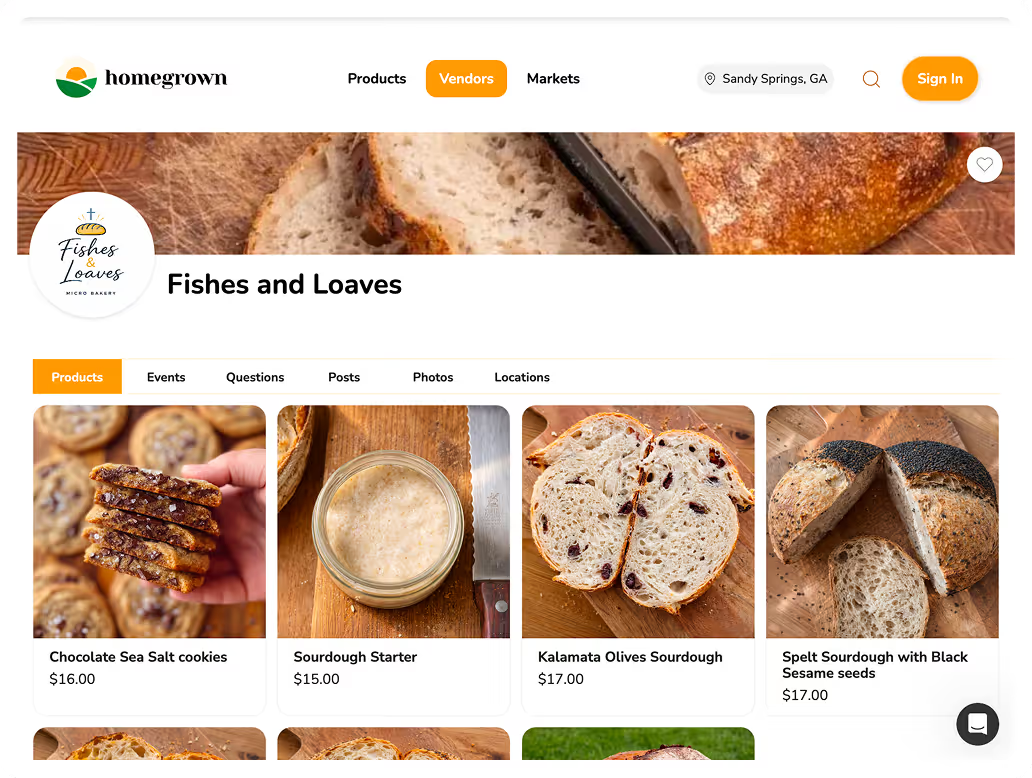
If you want a storefront where collection details, cutoffs, and delivery rules sit in the order flow rather than in a conversation, Homegrown is $10 a month billed annually with 0% commission and 2.9% plus $0.30 processing published up front, and it handles pickup at each place you sell with its own schedule and cutoff, local delivery with a radius and a route, and sales tax calculated, filed, and remitted in all 50 states. The honest bounds, said plainly: there is no live chat, no SMS, and no built-in email marketing. If broadcast texting is central to how you sell, Hotplate includes it and this does not. What a storefront does is remove the questions about availability, timing, and price, which are most of them. You can put your real products and pickup rules into a trial and see how many of the seven questions the listing answers without you typing anything.
Every platform below shows the same four commercial facts, because a table that lists one platform's transaction fee and not another's is not a comparison. "Not published" means exactly that: the company does not state it publicly.
| Platform | Pre-purchase questions | Subscription (annual) | Free trial | Platform fee | Card processing |
|---|---|---|---|---|---|
| Homegrown | No built-in pre-order chat, questions arrive by your own channel | $10/mo billed annually | 7-day free trial | $0 platform fee (0% commission) | 2.9% + $0.30 processing |
| Etsy | Buyer-seller messaging built in | No subscription | n/a | $0.20 listing + 6.5% commission | 3.0% + $0.25 processing |
| Bakesy | Quote and approval thread per custom order | $9.99/mo Standard (monthly only) | 30-day free trial | $0 platform fee | 3.9% + $0.30 processing, optional |
| MyCustomBakes | Quote workflow with customer approval | $10/mo flat (no annual) | Free trial offered | $0 platform fee | Processing not stated |
| Square Online | No native pre-purchase messaging | Free tier; paid from $29/mo per location | 30-day trial on paid plans | $0 platform fee | 3.3% + $0.30 free tier, 2.9% + $0.30 paid |
| Shopify | Needs an app for chat | $29/mo Basic | 3-day trial, then $1/mo for 3 | 2% platform fee if not on Shopify Payments | from 2.9% + $0.30 processing |
Very few treat it as a core feature. The general storefronts support third-party chat widgets on some tiers. Hotplate has SMS for reminders and drop announcements rather than pre-purchase conversation.
Usually not first. Live chat commits you to being available, and most pre-purchase questions are better solved by a product page that answers them once for everyone rather than repeatedly for individuals.
Allergens, by a wide margin. Nuts, dairy, gluten, and eggs. This is also the question you least want to answer casually from your phone, which makes it the strongest argument for stating it in every listing.
Answer the seven recurring questions in your listings: ingredients and allergens, shared-kitchen status, collection details, shelf life and storage, what can be changed, and a real photograph. Most vendors see volume drop by more than half.
One channel, chosen deliberately and stated publicly. Best of all is a notes field on the order form, because the question arrives attached to an order rather than blocking one.
For reminders before collection, yes, and it measurably reduces no-shows. For pre-purchase questions it is the wrong tool. Consent rules apply to marketing messages, so read up before collecting numbers.
No, they free it up. Automating "we got your order, here is where and when" leaves you more time for the conversations that actually build regulars, like a birthday cake request.
Pre-purchase messaging is a feature almost nobody in this category sells, and that is the right call. Every question that arrives before an order is a sentence missing from your product page, and answering it individually costs three to five minutes while the page would have answered it once for everyone.
Count your questions for a week, sort them into the seven that recur, and rewrite your listings to answer them. At 15 questions a week you are buying back roughly 35 hours a year for one afternoon of work, which beats any software on this page.
Then keep exactly one channel open for the rest, and spend the time you saved on the questions worth having: the birthday cake, the wedding, the wholesale enquiry. Those are the conversations that grow a food business, and they get buried under a hundred repeats of "does it have nuts in it."