
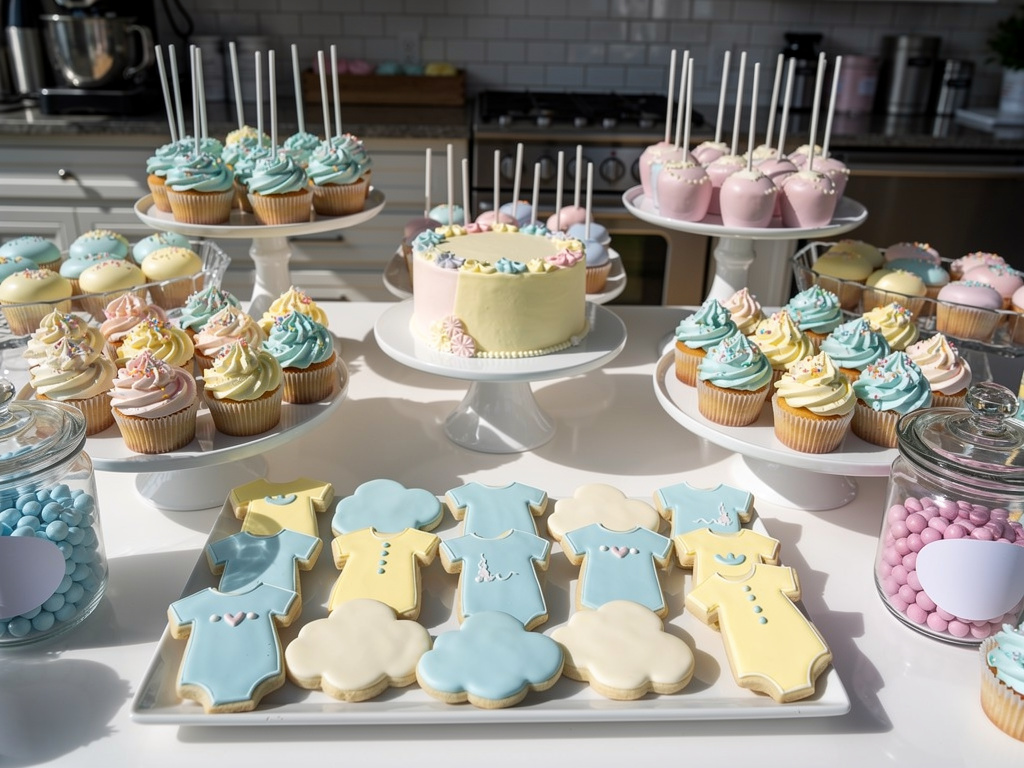


A baby shower dessert table, a beautifully styled spread of decorated cookies, cupcakes, cake pops, and candy in the shower's colors, is one of the highest-value orders a home baker can land. It's not a single item; it's a curated, themed centerpiece that anchors the whole party, and hosts happily pay for the wow factor. Landing and delivering these well takes more than baking, though: you're planning quantities for a crowd, coordinating with the host, and styling a table. This guide walks through how to sell baby shower dessert tables from home, from what goes on them to how to price them.
The short version: A baby shower dessert table is a custom, themed spread of treats, decorated cookies, cupcakes, cake pops, candy, and often a small cake, styled to the shower's colors. The treats are mostly cottage-food eligible since baked goods and candy are standard approved categories, and you skip perishable fillings that need refrigeration. Unlike a boxed product, a dessert table is an event order: you plan quantities per guest, coordinate the theme and headcount with the host, take a deposit, and style and deliver the table. Price it per guest or per table, covering the heavy decorating labor and the styling. Homegrown gives you the storefront to take custom dessert-table orders with deposits. This is general information, not legal advice.
This guide covers what goes on a dessert table, cottage food eligibility, planning quantities, working with the host, styling and delivery, pricing, and mistakes to avoid. This is general information, not legal or food-safety advice.
A baby shower dessert table is a curated, themed assortment, decorated cookies, cupcakes, cake pops, candy, and often a small centerpiece cake, all styled to the shower's colors and theme. Variety and cohesion are what make it special.
What makes a strong table:
The takeaway: a great dessert table curates decorated cookies, cupcakes, cake pops, candy, and a centerpiece cake around one cohesive theme. The rule is to design the whole table as one styled centerpiece, the same curation mindset behind custom cake orders.
Yes, most baby shower treats are cottage-food eligible, because decorated cookies, cupcakes, cake pops, and candy are baked goods and confections, which are standard approved categories in most states. This makes a dessert table a legally straightforward product.
Why the treats qualify:
The takeaway: baked goods and candy are cottage-eligible in most states, so a shelf-stable dessert table is legally straightforward. The rule is to build the table from shelf-stable treats and skip perishable fillings, the same foundation as starting a cottage food business.
You plan dessert table quantities by the guest count, allowing several treats per guest across the whole table, so there's abundance without waste. Getting the count right protects both the look and your margin.
Here's a rough per-guest planning guide:
| Guest count | Treats to plan (approx.) | Table feel |
|---|---|---|
| 15 guests | 45-60 pieces | Ample small table |
| 25 guests | 75-100 pieces | Full, abundant table |
| 40 guests | 120-160 pieces | Large centerpiece display |
How to plan well:
The takeaway: plan several treats per guest spread across items, with a small buffer and a locked headcount. The rule is to plan quantity from the guest count so the table looks abundant and your costs stay controlled.
You work with the host by confirming the theme, colors, flavors, dietary needs, headcount, date, and delivery up front, then taking a deposit. Clear coordination is what makes a custom event order go smoothly.
How to coordinate:
The takeaway: confirm theme, flavors, dietary needs, headcount, date, and delivery up front, then take a deposit. The rule is to lock every detail in writing before you start, since a custom event order leaves no room for surprises.
You style and deliver a dessert table with height, abundance, and cohesion, then set it up or hand it off intact and photo-ready. Presentation is half the product on a dessert table.
Styling and delivery tips:
The takeaway: style with height, abundance, and cohesion, then deliver intact and photo-ready. The rule is to treat the table as a styled centerpiece and protect it in transit, since its look is much of what the host is paying for.
You price a dessert table per guest or per table, covering ingredients, the heavy decorating labor, styling, packaging, delivery, and setup, with a minimum that makes a custom order worth it. Decorating labor is the biggest cost, so price it honestly.
Pricing guidance:
The takeaway: price per guest or table, covering the heavy decorating labor, styling, and delivery, with a minimum. The rule is to price the real custom labor, not just ingredients, using a smart pricing strategy.
The biggest mistakes are underpricing the decorating labor, no deposit or written terms, weak allergen labeling, and poor quantity planning. Each is avoidable with structure.
Mistakes to avoid:
The takeaway: the mistakes that matter most are underpricing, skipping deposits and terms, weak labeling, and poor quantity planning, all avoidable with structure. The rule is to price the labor, take a deposit, plan quantities, and deliver intact.
A baby shower dessert table is a high-value custom order that needs deposits, clear terms, and a date, so you need a clean way to take orders and get paid, without losing a cut of every table. That's what Homegrown is for.
Homegrown gives you an online storefront to sell your dessert tables as custom orders, take deposits, set minimums and delivery options, and collect payment, all for a flat $10 a month with no percentage fees beyond standard payment processing. For a high-value custom table you've priced carefully around hours of decorating, a per-order commission takes a real bite out of the margin. A marketplace-style platform charges a percentage of every order, and a general website builder wasn't made for custom event orders with deposits and dates. Homegrown bundles the storefront, custom order terms, and payment into one flat rate, so your dessert-table margin stays yours. It won't suit everyone, if you make one table a year for a friend for cash, you may not need a storefront yet, but the moment you're taking custom event orders online, a flat monthly rate beats handing a percentage to a marketplace.
Ready to sell your dessert tables online? Set up your Homegrown storefront and start taking custom orders.
In most states, yes, as long as the treats are shelf-stable. Decorated cookies, cupcakes, cake pops, and candy are baked goods and confections, standard approved cottage food categories. Avoid perishable fillings like fresh cream, custard, or cream-cheese frosting that need refrigeration, confirm your state's rules, and follow its registration and labeling requirements.
Plan roughly three to four pieces per guest across the whole table, spread among cookies, cupcakes, cake pops, and candy. So a 25-guest shower needs about 75 to 100 pieces for an abundant look. Build in a small buffer for breakage and extra guests, and lock the final headcount with the host by a deadline.
Price per guest or per table, covering ingredients, the heavy decorating labor (which is the biggest cost), styling and props, packaging, delivery, and any on-site setup, with a minimum order. Detailed decorating is slow, skilled work, so price it honestly rather than like a simple batch of cookies. Offering tiers gives hosts a budget fit.
Yes. A dessert table is a date-critical custom order that ties up your time and materials, so a deposit secures the date and covers your costs if plans change. Confirm the theme, flavors, guest count, dietary needs, date, and delivery in writing up front. Clear terms protect both you and the host.
You can offer both. Full on-site setup, styling the table with height and props, is a premium service worth charging for. Or offer a well-packaged drop-off with a simple setup guide as a lower-priced option. Either way, package decorated treats to arrive intact, since a centerpiece table's look is much of what the host is paying for.
Shelf-stable, sturdy, decorative treats: decorated cutout cookies, frosted cupcakes with stable frosting, cake pops, chocolate, bark, and a simple centerpiece cake. Avoid anything cream-filled, custard-based, or needing refrigeration. Building height with stands and a centerpiece cake, and keeping colors and styling cohesive, is what makes the table photograph beautifully.



