
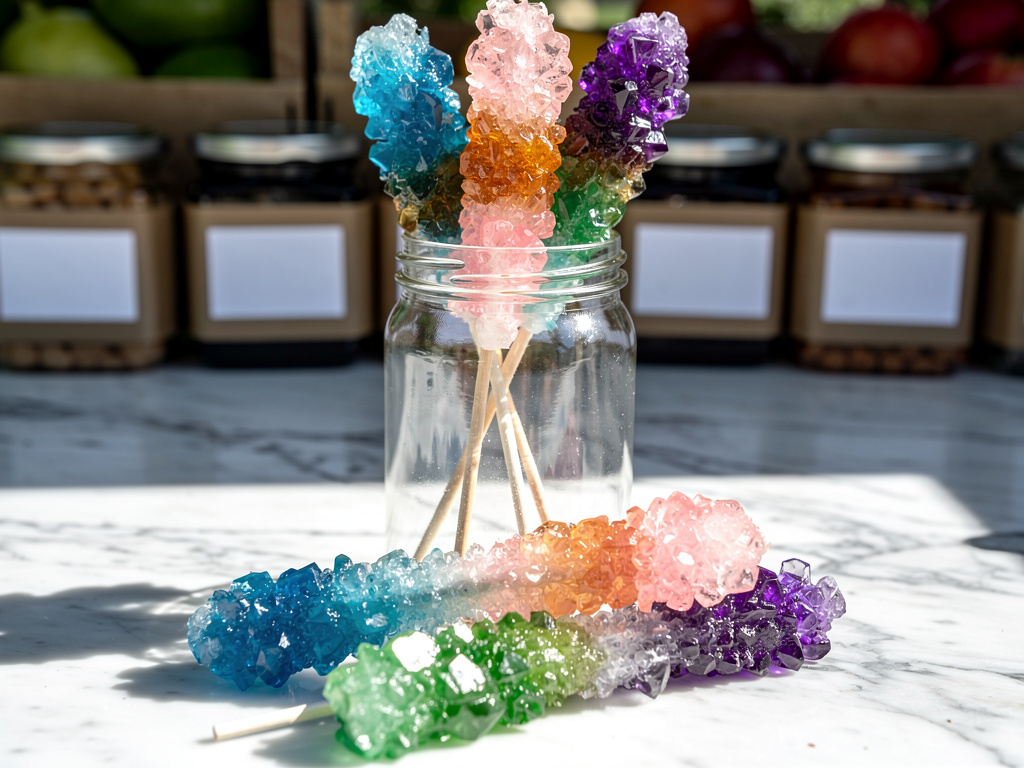


Rock candy is one of the easiest confections to sell legally and one of the hardest to rush. It's pure crystallized sugar, so it's shelf-stable, ships without a worry, and qualifies as a cottage food almost everywhere. But those beautiful crystals take a week or more of undisturbed growth, and that single fact, the long, slow production time, is what shapes the whole business. If you plan for the wait and price for the craft, rock candy opens up some genuinely lucrative markets, from wedding favors to cocktail bars. This guide walks through selling rock candy from home, from the cottage food rules to the production lag to who actually buys it.
The short version: Rock candy is pure crystallized sugar grown on strings or sticks from a supersaturated syrup over roughly a week or more. Because it's essentially just sugar, it's extremely shelf-stable, non-hazardous, and cottage-food eligible as a candy in virtually every state, and it ships beautifully. The real constraint isn't safety, it's time: crystals need a week-plus of undisturbed growth, so you have to plan production and event lead times around that. The best markets are party and wedding favors, cocktail and coffee swizzle sticks for bars and cafes, and gift and novelty sales. Price above cheap wholesale to reflect your handmade colors, flavors, and packaging. Homegrown gives you the storefront to sell it and take event orders with real lead time, but you grow the candy.
This guide covers what rock candy is, cottage food, making it, markets, pricing, production planning, and mistakes. This is general information, not legal advice.
Rock candy is sugar crystallized into large, glittering crystals on a string or stick, grown slowly from a supersaturated sugar solution, and it sells because it's beautiful, nostalgic, and useful across several markets. It's part candy, part decoration, part science project, which gives it more selling angles than most sweets.
Why rock candy has broad appeal:
The takeaway: rock candy sells on looks, nostalgia, and versatility, giving you more markets than a typical candy. The rule is to lean into all of its angles, favor, gift, garnish, and novelty, since its versatility is exactly what makes it worth the long production time.
Yes, rock candy is one of the most clearly cottage-food-eligible products there is, because it's essentially pure crystallized sugar, a shelf-stable, non-hazardous candy that virtually every state permits. There's almost no food-safety question with rock candy, which makes the legal side refreshingly simple.
Why it qualifies so cleanly:
The takeaway: rock candy is a near-ideal cottage food, shelf-stable, non-hazardous, and widely permitted, with shipping as an easy bonus. The rule is to confirm your state's candy rules and caps, then sell with confidence, the same simple starting point as any cottage food business.
You make rock candy by dissolving far more sugar into hot water than it would normally hold, creating a supersaturated solution, then suspending a seeded string or stick in it so sugar crystals grow over about a week or more as the water evaporates. The long wait is the crystallization itself, and it can't be rushed.
How the process works:
The takeaway: rock candy is simple in ingredients but slow in production, since the crystals need a week-plus of undisturbed time to form. The rule is to respect the growth window, because the single biggest operational fact of this business is that you can't make rock candy quickly, only patiently.
Rock candy sells into several distinct markets: party and wedding favors, cocktail and coffee swizzle sticks for bars and cafes, and gift, novelty, and science-kit sales. Each is a real opportunity, and the business-facing ones can be especially valuable.
Here's how the main markets compare:
| Market | What they buy | Why it works |
|---|---|---|
| Weddings and parties | Custom-colored favor sticks in bulk | Match themes and colors; high-volume orders |
| Bars and coffee shops | Swizzle sticks and stirrers | A premium, reusable garnish for drinks |
| Gifts and novelty | Colorful sticks and bags | Nostalgia and visual appeal |
| Science and education | Kits and demonstrations | The crystallization is a classic experiment |
A few notes on the strongest markets:
The takeaway: rock candy reaches consumers and businesses alike, and the wedding-favor and cocktail-stirrer markets can be especially lucrative bulk channels. The rule is to pursue the business and event markets, not just walk-up candy sales, since a single wedding or a standing cafe order dwarfs individual pieces.
You price rock candy well above cheap bulk wholesale, because your handmade colors, flavors, and packaging are worth far more than a factory swizzle stick, and you price on your real cost and long production time plus a margin. Wholesale prices are a floor to rise above, not a target to match.
Here's the pricing landscape to understand:
The takeaway: don't let cheap wholesale rock candy set your price, since your handmade, customized product serves a different, higher-value market. The rule is to price for the craft, the customization, and the long production time, treating wholesale as a floor you comfortably clear, much like pricing any handmade gift product.
You plan rock candy production around its week-plus growth window by starting batches far ahead of when you need them, staggering batches, and quoting event customers realistic lead times. Because you can't speed up crystallization, scheduling is the core operational skill of this business.
How to manage the production lag:
The takeaway: rock candy rewards planners, since the crystals set the pace and you have to work around them. The rule is to start early, stagger batches, and quote honest lead times, using a pre-order system so you grow to confirmed orders rather than scrambling.
The mistakes that hurt a rock candy business are underestimating the production time when quoting events, underpricing against cheap wholesale, and crystallization failures. Each is avoidable with planning and technique.
The mistakes to avoid:
The takeaway: the mistakes come from ignoring the production time, underpricing, and technique slips, all fixable with planning and care. The rule is to plan around the growth window, price above wholesale, and get the crystallization right.
Rock candy's long production time and strong event markets make advance ordering essential, and a simple storefront is exactly where you take those orders with real lead time. Homegrown is a $10-per-month online storefront, with no percentage fees beyond standard payment processing, where you can list your rock candy, take wedding and event orders, and offer pickup or shipping.
You list your colors, flavors, and formats, take custom wedding-favor and bulk orders with clear lead times, and get paid up front, so you start growing batches against confirmed sales. Because rock candy is shelf-stable, you can offer local pickup and, where your state permits, ship it anywhere, which suits both gift buyers and out-of-town event orders. Because your storefront keeps clean records, you also see which colors and markets sell, so you plan your rolling batches around real demand. A flat monthly price means a big wedding-favor order isn't eaten by per-sale percentage fees, the way it would be on a marketplace like Etsy.
To be clear about what Homegrown does not do: it does not grow your candy, speed up crystallization, or make your product for you. The week-plus of patient production is yours. What Homegrown gives you is the storefront to take orders with real lead time, sell to consumers and businesses, and ship your shelf-stable candy where allowed. If your rock candy is ready to sell, set up your Homegrown storefront and start taking event orders with the lead time your process needs.
Yes, rock candy is one of the most clearly cottage-food-eligible products there is, because it's essentially pure crystallized sugar, a shelf-stable, non-hazardous candy with no dairy, fresh ingredients, or moisture. Cottage food laws commonly list candy among permitted products, and Texas, for example, names candy explicitly and defines allowed foods as those that don't require temperature control for safety, which rock candy easily meets. Confirm your own state's candy rules, any sales caps, and labeling requirements, and check shipping rules if you plan to mail it, but eligibility is broad and the food-safety side is refreshingly simple.
About a week, and sometimes closer to two. Rock candy forms when a supersaturated sugar solution slowly deposits crystals onto a seeded string or stick as the water evaporates, and that crystallization simply takes time, you can't rush it. During the growth window, the batch must be left undisturbed, since disturbing the solution ruins the crystals. This long production time is the single most important operational fact of the business: you have to start batches well ahead of when you need them, stagger production for steady supply, and quote event customers realistic lead times that include the full growth period.
Several markets are strong, but the most valuable tend to be business and event channels. Weddings and parties buy custom-colored favor sticks in bulk, often as large single orders you can match to a theme. Bars and coffee shops use rock candy swizzle sticks as premium drink garnishes, a genuine business-to-business niche. Gift, novelty, and science-kit sales run year-round on the candy's looks and nostalgia. Pursuing the wedding-favor and cocktail-stirrer markets, rather than only walk-up candy sales, is where the real money is, since one event or standing order dwarfs individual pieces.
Price well above cheap bulk wholesale. Factory-made rock candy sticks sell for well under a dollar each in large cases, but that reflects factory economics, not your handmade, custom-colored, flavored, and packaged small batches. Price on your real cost of syrup, sticks, and packaging, plus a real value for your labor and the week-plus of production time each batch requires, then add a margin. Charge premiums for custom wedding colors, bulk favor assembly, and personalized packaging. Treat wholesale as a floor you comfortably clear, not a price to match, since your product serves a higher-value market.
Yes, rock candy ships beautifully, which is one of its big advantages. Because it's dry, sugar-dense, and completely shelf-stable, it travels without refrigeration or spoilage risk, so mail-order gift sales and out-of-town event orders are natural, as long as your state permits shipping cottage foods. This shippability, combined with its long shelf life, makes rock candy a strong candidate for reaching customers far beyond your local area and for fulfilling bulk wedding-favor orders for clients in other cities. Confirm your state's shipping rules, then use the candy's durability to expand your market well past local sales.
Usually one of three reasons. First, the solution wasn't truly supersaturated, if not enough sugar was dissolved into the hot water, there's nothing extra to crystallize out. Second, the batch was disturbed during the growth window, which interrupts crystal formation. Third, the crystals grew on the container instead of the string, which happens if the seeded string isn't properly coated or is touching the sides. The fixes are to fully saturate your syrup with sugar, seed your string well, suspend it without touching the container, and then leave the batch completely undisturbed for the full week-plus growth period.
Rock candy is a rare confection that's easy to sell legally and hard to rush, and the vendors who succeed are the ones who plan around its week-long growth and price for the craft. Respect the production time, chase the wedding and cocktail markets, and charge above wholesale. Start your Homegrown storefront and take your rock candy and event orders with the lead time your crystals require.



