
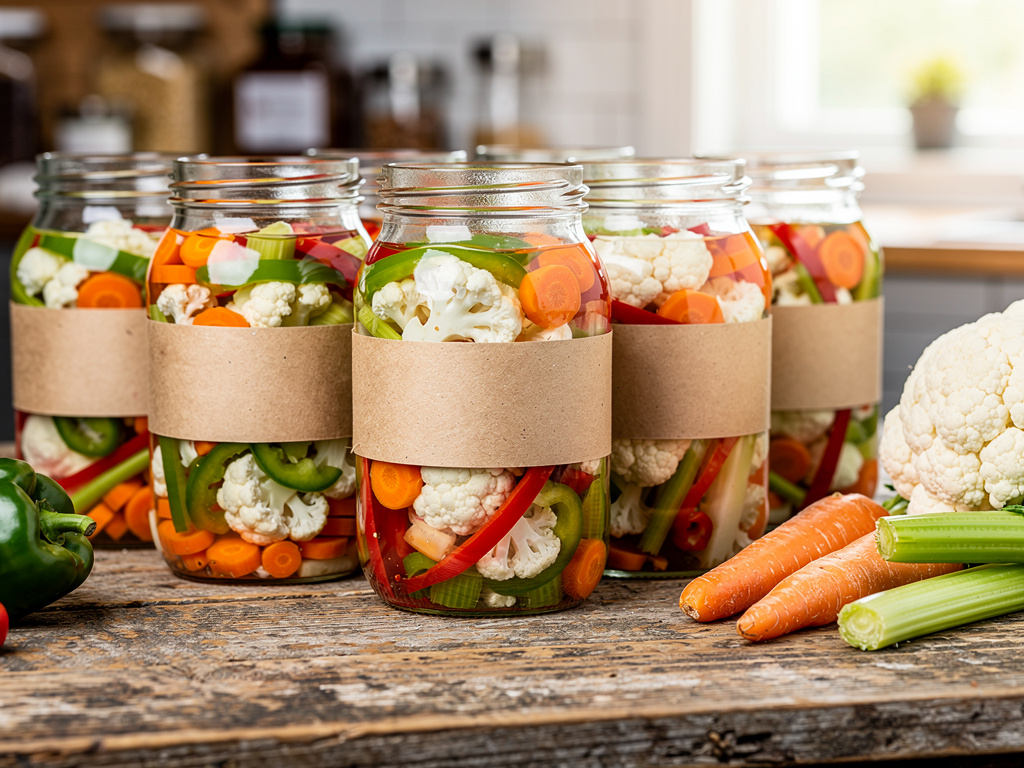


Giardiniera, the crunchy Italian pickled vegetable mix, is a fantastic condiment to sell, but it hides a serious food-safety fork that trips up new makers. There are two giardinieras: a vinegar-brined version that's high-acid and shelf-stable, and a Chicago-style oil-packed version that carries a real botulism risk and generally can't sit on a shelf at all. Which one you make changes everything, whether it's legal to sell as a cottage food, whether it needs refrigeration, and whether it's safe. This guide walks through selling giardiniera from home, starting with the distinction that matters most.
The short version: Vinegar-brined giardiniera is a high-acid pickled vegetable mix that, when made to a tested recipe at the right acidity and water-bath canned, is shelf-stable and may qualify as a cottage food in states that allow acidified pickles. Oil-packed Chicago-style giardiniera is riskier: low-acid vegetables in oil create an oxygen-free environment where botulism can grow, so it must be refrigerated and often isn't cottage-food eligible. State rules vary sharply, some states, like Idaho, ban pickled, fermented, and vegetable-in-oil products from cottage food entirely, so you must check your state. Never alter a tested recipe's acidity, and never sell oil-packed giardiniera at room temperature. Homegrown gives you the storefront to sell what you can legally make. This is general information, not legal or food-safety advice.
This guide covers the two styles, cottage food eligibility, the oil risk, making the vinegar version safely, pricing, selling, and mistakes. This is general information, not legal or food-safety advice.
Giardiniera is an Italian-American pickled vegetable mix, cauliflower, carrots, celery, and peppers, that comes in two very different styles: vinegar-brined and oil-packed, and the difference is a food-safety and legal fault line, not just a recipe preference. You must know which one you're making.
Here's how the two styles compare:
| Vinegar-brined | Oil-packed (Chicago-style) | |
|---|---|---|
| Acidity | High-acid when made to a tested recipe | Low-acid vegetables in oil |
| Shelf stability | Shelf-stable if water-bath canned | Not shelf-stable; must refrigerate |
| Botulism risk | Low when properly acidified | Real risk at room temperature |
| Cottage food | May qualify where acidified pickles are allowed | Usually not eligible |
The two styles, and why it matters:
Getting this distinction right is the foundation of selling giardiniera safely and legally. The takeaway: giardiniera comes in a shelf-stable vinegar style and a refrigeration-required oil style, and confusing them is dangerous. The rule is to always know which style you're making, since it determines the safety, the storage, and the legality of your product.
It depends heavily on the style and your state: a properly acidified, water-bath-canned vinegar giardiniera may qualify as a cottage food where acidified pickles are allowed, while oil-packed versions and low-acid products often don't, and some states exclude pickled products entirely. This is a real "check your state" situation.
What the eligibility picture looks like:
The takeaway: a shelf-stable vinegar giardiniera can qualify in states that allow acidified pickles, but oil versions usually can't, and some states exclude the whole category. The rule is to confirm your state's specific rules first, expecting real variation, the same care as any cottage food business.
Oil-packed giardiniera is riskier because packing low-acid vegetables in oil creates an oxygen-free environment where the bacteria that cause botulism can grow and produce toxin at room temperature, which is exactly the condition to avoid. This is why the oil style must be refrigerated and often can't be sold as a cottage food.
Why oil packing is dangerous:
The takeaway: the oil in Chicago-style giardiniera is exactly what makes it hazardous at room temperature, so it demands refrigeration and usually falls outside cottage food. The rule is to never sell oil-packed giardiniera shelf-stable, and to treat it as a refrigerated, higher-risk product, in line with basic food safety.
You make vinegar giardiniera safely by following a tested recipe exactly, using vinegar of the correct acidity to reach a safe pH, and water-bath canning it, never altering the recipe's acid ratios. Acidity is the entire safety mechanism, so precision is non-negotiable.
The safety essentials:
The takeaway: safe vinegar giardiniera comes from a tested recipe, correct-strength vinegar, unaltered acid ratios, and proper water-bath canning. The rule is to follow a tested acidified-pickle recipe exactly, because with pickled products the acidity is the safety, and guessing at it is dangerous.
You price giardiniera on your real cost of vegetables, vinegar, jars, and labor plus a margin, positioned as an artisan condiment, with real small-batch examples running roughly $10 to $18 for an 8-to-16-ounce jar. It's a specialty condiment, so price it above commodity pickles.
How to price it well:
The takeaway: giardiniera supports specialty-condiment pricing, so cost your labor and position it accordingly rather than as commodity pickles. The rule is to price for the craft and the specialty niche, using real maker prices to anchor, not the grocery shelf.
You sell giardiniera as a versatile artisan condiment, for sandwiches, charcuterie boards, and Italian dishes, through farmers markets, gift sets, and, for the shelf-stable vinegar version, shipping where allowed. Its condiment versatility and Chicago heritage give you a real marketing story.
The selling approach that fits:
The takeaway: giardiniera sells as a versatile, heritage-rich condiment, with the vinegar version shippable and the oil version strictly local and refrigerated. The rule is to sell the condiment story and match your channel to the style, shipping only the shelf-stable vinegar version, and to list it on a proper online pickle storefront.
The mistakes with giardiniera are selling oil-packed versions at room temperature, altering a tested recipe's acidity, assuming all states allow pickled products, and skipping water-bath canning. The first two are genuine safety hazards.
The mistakes to avoid:
The takeaway: the mistakes center on the oil-safety hazard, acidity control, and state-specific legality, all avoidable with the facts. The rule is to keep oil versions cold, never alter tested acidity, confirm your state allows pickled products, and always water-bath can the vinegar version.
Once you've made a safe, shelf-stable vinegar giardiniera to a tested recipe, you need a clean way to sell it, and for a jarred artisan condiment that's simple. Homegrown is a $10-per-month online storefront, with no percentage fees beyond standard payment processing, where you can list your giardiniera, take orders, and offer local pickup or shipping.
You list your jars at your specialty prices, take payment at order time, and fulfill by pickup, local delivery, or, for the shelf-stable vinegar version, shipping where your state allows. Because your storefront keeps clean records, you learn which products sell and can plan production around real demand. A flat monthly price means your specialty-condiment margins aren't eaten by per-sale percentage fees stacking up on every jar, the way they would on a marketplace like Etsy.
To be clear about what Homegrown does not do: it does not make your giardiniera, verify its acidity, or make your product legal in your state. Your recipe, your canning, and your state's rules are your responsibility, and the vinegar-versus-oil distinction is a genuine safety matter. What Homegrown gives you is the storefront to sell the giardiniera you can legally and safely make, so the selling runs smoothly. If your vinegar giardiniera is ready, set up your Homegrown storefront and sell your artisan condiment with confidence.
It depends on the style and your state. A vinegar-brined giardiniera, made to a tested recipe that reaches a safe acidity and is properly water-bath canned, is high-acid and shelf-stable, and may qualify as a cottage food in states that allow acidified pickles. Oil-packed Chicago-style giardiniera carries botulism risk, must be refrigerated, and often isn't cottage-food eligible. Some states, like Idaho, exclude pickled, fermented, and vegetable-in-oil products from cottage food entirely. So confirm your own state's cottage food rules first, since eligibility ranges from allowed-with-a-tested-recipe to banned outright depending on the style and where you live.
Because packing low-acid vegetables in oil creates an oxygen-free environment where Clostridium botulinum, the bacterium that causes botulism, can grow and produce toxin at room temperature. Fresh vegetables and garlic are low-acid and can carry botulism spores, and surrounding them with oil removes the oxygen that would otherwise inhibit the bacteria. That's why oil-packed giardiniera is not a shelf-stable pantry product, it must be refrigerated and treated as perishable, and it's frequently excluded from cottage food even in states that allow vinegar pickles. Never store or sell oil-packed giardiniera at room temperature.
Make the vinegar version, and make it by the book. Follow a tested, research-based recipe exactly, use vinegar of the correct acidity, typically 5 percent, and never reduce the vinegar or alter the acid ratios, since the acidity is what keeps the product safe by reaching a pH of 4.6 or below. Then process the filled jars in a boiling-water bath for the recipe's specified time to make it shelf-stable, rather than relying on brining alone. Acidity is the entire safety mechanism for pickled products, so precision with the vinegar strength and the recipe ratios is non-negotiable.
Vinegar giardiniera packs the vegetables in a vinegar brine of known acidity; made to a tested recipe and water-bath canned, it's high-acid and shelf-stable, and it's the version that can qualify as a cottage food where acidified pickles are permitted. Oil-packed, Chicago-style giardiniera packs the vegetables in oil, often after a vinegar cure, and must be refrigerated because the oil creates an oxygen-free environment where botulism can grow. They are not interchangeable from a safety or legal standpoint, one is a shelf-stable pantry product, the other is a refrigerated, higher-risk item, so always know which you're making.
Price it as an artisan condiment on your real costs plus a margin. Real small-batch giardiniera makers sell jars in a premium range, roughly $10 for a smaller jar up to the high teens for a 16-ounce jar, well above commodity pickles. Total your vegetables, vinegar, spices, jars, labels, and a real hourly rate for the chopping, brining, and canning, then add a margin and check it against comparable makers. Giardiniera is a distinctive Italian-American specialty condiment, so price it as one rather than competing with mass-market pickles. Treat those figures as real examples, not a fixed market average.
Only the shelf-stable vinegar version, and only where your state allows. A properly acidified, water-bath-canned vinegar giardiniera keeps on the shelf and can be shipped where your state permits shipping cottage foods. The oil-packed version, however, must be kept refrigerated and should not be shipped as a shelf-stable product, since that would recreate the exact room-temperature condition that makes it a botulism hazard. So confirm your state's shipping rules, and ship only the vinegar style. For the oil version, keep sales local and refrigerated, treating it as the perishable product it is.
Giardiniera is a wonderful condiment to sell, but only if you respect the fork in the road: the shelf-stable vinegar version, made to a tested recipe, is your sellable product, while the oil version is a refrigerated, higher-risk item. Confirm your state's rules, control your acidity, and never shortcut the safety. Start your Homegrown storefront and sell the giardiniera you can make safely and legally.



