


The short version: A small farm stand selling a few thousand dollars a year cannot justify platform fees of $79 to $399 a month. The best options are Homegrown ($10/month on the yearly plan, plus 2.9% + 30 cents per card payment), EatFromFarms ($15/month net plus card processing, with farm-specific features), Square Online (a free plan with 3.3% + 30 cents per online card payment, best for Square POS users), and Google Forms (free for testing demand). Enterprise platforms like Barn2Door, Local Line, and GrazeCart make sense for bigger farms with delivery routes, wholesale accounts and sell-by-weight products.
Checked September 14, 2026: every price and fee below on each company's own website. Homegrown's prices come from its signup page, read the same morning.
Want stand customers to order ahead? You can set up a Homegrown storefront free for 7 days.
What is the best online ordering platform for a farm stand? For a small stand, the best fits are Homegrown ($10 monthly on the yearly plan), EatFromFarms (a net $15 a month or less) and Square Online's $0 plan, each plus card fees. Enterprise tools like Barn2Door, Local Line, and GrazeCart are platforms that cost about $79 to $399 per month (with payment processing additional on top) and are built for farms with delivery routes, wholesale accounts, and CSA subscribers.
If you run a small roadside farm stand that sells produce, eggs, honey, or baked goods seasonally, those platforms are overkill. You do not need variable-weight pricing, wholesale invoice management, or delivery route optimization. You need a simple way for customers to pre-order and pay before they pick up at your stand.
This guide compares online ordering platforms that actually fit small farm stand operations — based on what they cost, what they do, and what a stand operator realistically needs.
Before comparing platforms, it helps to understand what a small farm stand operation actually looks like — because most e-commerce platforms are designed for a different kind of business.
Here is what many small farm stands have in common:
Given this profile, here is what a farm stand actually needs from an online ordering platform:
And here is what a farm stand does NOT need:
Most farm e-commerce platforms are built around those enterprise features. That is why they cost about $79 to $399 per month, and why they are a poor fit for a stand selling tomatoes and corn on a country road.
The same NOFA Vermont report found that farms start paying someone to staff the stand at around $50,000 in stand sales, and every farm with an unstaffed stand in its survey sold under $25,000. An ordering page does the most for that unstaffed stand, because customers can order and pay when nobody is there. Our guide to a farm stand pre-order system walks through the weekly routine.
Here is how the major options stack up for small farm stand operations.
Swipe or scroll the table sideways to see every column.
| Platform | Monthly Cost | Transaction Fees | Setup Fee | Best For |
|---|---|---|---|---|
| Homegrown | $10/mo (annual) or $12.50/mo (monthly) | 2.9% + 30 cents per card payment | None | Solo vendors who share their own link |
| EatFromFarms | $15/mo net, first 4 months ($60) paid up front | Stripe rates (2.9% + 30 cents for US cards) | None | Farms with existing customers |
| Square Online | Free, or $49/mo per location on Plus | 3.3% + 30 cents online on the free plan, 2.9% + 30 cents on Plus | None | Square POS users |
| Google Forms | Free | None (it does not take payments) | None | Testing demand |
| GrazeCart | $89/mo on Starter; higher plans priced after a form | Not listed on its pricing page | None, setup help included | Meat farms (variable weight) |
| Barn2Door | $99-$299/mo billed yearly | 2.9% + 30 cents | $399-$599, one time | Hobby farms ($99) up to high-volume farms ($299) |
| Local Line | $99-$399/mo monthly, or $79-$319/mo billed yearly | 2.5-2.9% + 30 cents | None | Wholesale + retail farms |
The price gap is enormous. A small farm stand paying $10/month for Homegrown spends $120 per year on its ordering platform, before card processing. The same stand on Barn2Door's entry plan spends $1,587 in the first year ($99 a month billed yearly plus the $399 setup fee), before card fees. Both charge the same 2.9% + 30 cents on each card sale, so card fees never close that $1,467 difference. That is a lot to pay for a stand that needs only a few of Barn2Door's features.
On price, the best pick for a farm stand is Square Online's free plan: 20 online pre-orders of $30 in a month cost $25.80 in card fees there, compared with $33.40 on Homegrown's yearly plan and $38.40 on EatFromFarms, card processing included. Barn2Door's entry plan and Local Line's monthly Core plan each come to $122.40 for the same month, more than three times Homegrown's total.
Swipe sideways to see all ten options and every column.
| Platform and plan | Plan per month | Card fee per order | Card fees on 20 orders of $30 | Total for the month |
|---|---|---|---|---|
| Square Online, free plan | $0.00 | 3.3% + $0.30 | $25.80 | $25.80 |
| Homegrown, yearly plan | $10.00 | 2.9% + $0.30 | $23.40 | $33.40 |
| Homegrown, monthly plan | $12.50 | 2.9% + $0.30 | $23.40 | $35.90 |
| EatFromFarms | $15.00 net | 2.9% + $0.30 (Stripe) | $23.40 | $38.40 |
| Square Online, Plus plan | $49.00 | 2.9% + $0.30 | $23.40 | $72.40 |
| GrazeCart, Starter plan | $89.00 | Not listed | Not listed | $89.00 plus card fees |
| Local Line Core, billed yearly | $79.17 ($950 a year) | 2.9% + $0.30 | $23.40 | $102.57 |
| Local Line Core, monthly | $99.00 | 2.9% + $0.30 | $23.40 | $122.40 |
| Barn2Door Entrepreneur | $99.00 billed yearly, plus $399 once | 2.9% + $0.30 | $23.40 | $122.40 |
| Google Forms | $0.00 | No card payments | $0.00 | $0.00, and you collect payment yourself |
How the math works: 20 pre-orders at $30 each is $600. Each order's card fee is the percentage of $30 plus the flat amount, so 2.9% + 30 cents is $1.17 an order and 3.3% + 30 cents is $1.29 an order, times 20 orders. Local Line's yearly Core price is $950 divided by 12. Setup fees, sales tax and any GrazeCart card fees are left out. Every rate was read on the company's own website on September 14, 2026.
The free plan does not stay cheapest forever. Square charges 0.4 percentage points more per online payment than Homegrown, so Homegrown's $10 plan, billed yearly, costs less once your online card sales pass $2,500 a month. Below that, pick on features: Homegrown groups orders by pickup day and lets you set order cutoff dates, while Square Online connects to Square's point of sale at the stand.
Square's free plan charges a different rate online than at the stand. Its pricing page lists 2.6% + 15 cents for a tap, dip or swipe and 3.3% + 30 cents for a card payment made online, so the same $30 order costs you 93 cents at the table and $1.29 as a pre-order.
Three things can change these numbers for your stand:
The best farm e-commerce platform for a growing farm is the one that handles the job your stand cannot: selling meat by the pound, running subscriptions or keeping a separate price list for restaurants. Here is what each one lists on its own pricing page:
The best farm software for selling online and in person is the one that keeps both sales in one count of what you have left. Square's free plan does this with no monthly fee, charging 2.6% + 15 cents per in-person card payment. Barn2Door sells its point of sale device for $59 and reimburses it for farms that reach $1,000 in sales within 6 months of buying it. Local Line lists its point of sale device at $399. Homegrown handles online pre-orders and pickup, and walk-up customers can scan your storefront's QR code to check out on their own phone. A stand that wants to swipe cards at the table can add a reader app like Square's.
Built for small local vendors who sell at farmers markets, farm stands and similar direct-to-consumer channels, Homegrown gives each vendor their own ordering page. Each storefront is also listed in the Homegrown marketplace automatically.
Why farm stands pick Homegrown:
Treat the marketplace listing as a small extra. EatFromFarms, Square Online and Homegrown all give you a storefront, and on all three your regulars find it because you share the link at the stand, on social media and by text. Customers create a Homegrown account to check out, and Homegrown calculates sales tax on each order. Our free QR code generator turns your storefront link into a printable sign, so walk-up customers can scan it and order ahead for next week.
At $10 a month billed yearly, Homegrown costs less than the net $15 a month EatFromFarms lists and less than every enterprise plan in this guide. A stand selling $1,000/month in 40 online orders of $25 pays $41.00 in card processing ($29.00 plus 40 times 30 cents) and keeps $949.00 after the $10 plan: no commission, no percentage for Homegrown, no add-on fees.
Start your free trial at Homegrown
EatFromFarms costs a net $15 per month, or less depending on how you set up your account, according to its pricing page. Its features page lists inventory management, order and sales reports, and pickup locations that each get their own ordering window and pickup time, and your store can run on your own web address. Opening an account takes pre-payment of the first 4 months ($60). Online card payments run through Stripe, whose standard rate is 2.9% + 30 cents per US card payment.
What EatFromFarms does well for farm stands:
The limitation is discovery. Your store is its own website, and it can run on your own web address, so plan on sharing the link directly. For a stand with an established local customer base, this works fine. For a stand trying to attract new customers, your sign, your social posts and word of mouth do that work, as they do on every platform in this guide.
EatFromFarms' farm-specific features (inventory management, pick lists, bundles) are genuinely useful for produce stands with fluctuating availability. If you manage 30+ products that change weekly, its pick lists for each pickup and its pre-set bundles save time when you pack orders.
Square Online offers a free plan with no monthly fee, so the only cost of each online sale is the card fee. On that plan, card payments cost 3.3% + 30 cents online and 2.6% + 15 cents in person, according to Square's online store plans page. If you already use Square at your stand, the online store connects automatically.
What Square Online does well for farm stands:
Where it falls short for farm stands:
Square Online is the right choice specifically for vendors who already process payments through Square at their stand. The unified tracking across in-person and online sales is genuinely valuable for understanding your total business. But if you do not already use Square, the general-purpose platform has more settings to work through than a food-focused platform.
Google Forms costs nothing and proves whether your customers will actually pre-order before you commit to any platform.
Here is the setup:
What works:
What does not work:
Google Forms is the right starting point for a farm stand operator who is not sure whether customers will pre-order. Run it for a month. If customers use it, upgrade to a paid platform. If they do not, you have spent nothing.
A farm stand storefront on Homegrown is one page with your products, prices and pickup days, and customers order from it before they drive over. Rustic Pantry Farmstand in Darby, Montana is a real example. Its storefront lists sourdough loaves, muffins, brownies and cookies, and its pickup card lists Porch Pickup on Saturday, September 19, Sunday, September 20 and Saturday, September 26, from 9:00 AM to 4:30 PM.
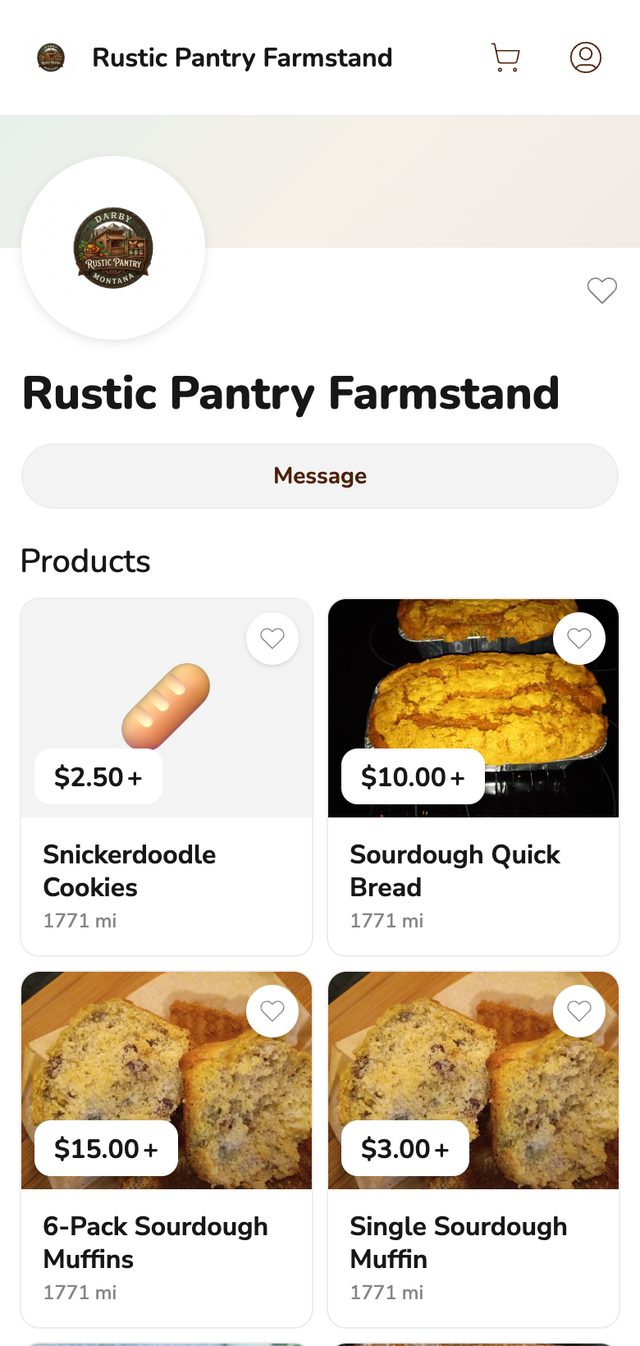
Those pickup days are what make pre-orders work. Customers pick a day when they order, and Homegrown gives you an order summary for each pickup day, so you know what to bake or harvest before anyone arrives.

Most farm vendors on Homegrown keep their product list short. In our catalog pull of August 14, 2026, the 39 vendors who list at least one vegetable, fruit, egg or dairy product had a median of 6 products each, and 24 of them listed fewer than 10.
In a pull of the Homegrown catalog on August 14, 2026, 39 of the 219 vendors listed at least one vegetable, fruit, egg or dairy product. Together they listed 388 of the 1,804 products. 14 of them listed 10 to 40 products, 1 listed more than 40, and 13 sold in 3 or more categories. These are product listings, and they are not sales figures.
How many products the 39 farm vendors on Homegrown list
Vendors who list produce, eggs or dairy, counted by all the products they list, from the Homegrown catalog pulled August 14, 2026.
A short list is an advantage online. With 6 products, updating what is ready this week takes a few minutes, which is why a simple ordering page fits most stands better than software built for hundreds of products.
Barn2Door, Local Line, and GrazeCart are good platforms — for the operations they are designed to serve. But they are a poor fit for small farm stands, and here is the math that proves it.
The cost math does not work. A small farm stand averaging $6,500 per year in revenue would spend $1,188 to $3,588 per year on Barn2Door's yearly plans (18-55% of revenue), before setup fees and card processing. Even a mid-size stand doing $47,000 per year would spend 2.5-7.6% of revenue just on platform fees — before ingredients, booth costs, and labor.
The features are irrelevant. Variable-weight pricing, wholesale B2B price lists, delivery route optimization, barcode scanning, and multi-location hub management are designed for larger farms with employees, delivery trucks, and institutional buyers. A stand selling tomatoes, corn, and jam does not need any of this.
Seasonal billing hurts. Enterprise platforms charge whether you sell or not. Barn2Door bills its plans yearly, and Local Line's monthly plans run $99 to $399 before card processing. A farm stand that closes from November through March but keeps a Local Line monthly plan running pays $495 to $1,995 for those five months of zero revenue. Local Line lets you cancel a monthly plan at any time, so you skip that bill only if you cancel in the fall and sign up again in spring. Platforms with lower monthly costs ($12.50/month on Homegrown's monthly plan, which you can cancel) or no monthly fees (Google Forms, Square Online free plan) make seasonal economics work.
If Barn2Door is the platform you are weighing, our Barn2Door alternatives guide compares it plan by plan.
Cornell Small Farms' article on selling farm products online does not rank platforms. It says there is no one-size-fits-all solution, and it lists six things to check before you pick a platform, including its fees, how easy it is to manage your inventory and orders, and how order fulfillment fits with the rest of your marketing. What works for a diversified farm with CSA subscribers and restaurant accounts does not work for a roadside stand with a cash box and a handwritten sign.
Answer these five questions to pick the right platform for your farm stand and your budget:
Oregon State Extension's guide on farm direct marketing and on-farm sales facilities covers the broader picture of running a successful farm stand — from site selection to customer flow. The online ordering platform is one piece of a larger operation, and it should be the simplest, most affordable piece.
Most farm stand operators are better served by reading about how to add online ordering to an existing market business than by evaluating enterprise farm software. The goal is pre-orders and payments — not a technology project.
If you are debating whether you need a website, a marketplace, or just an order form, the answer for most farm stands is simple: an order form with payment processing. Everything else is overhead you do not need yet.
Google Forms is free but requires manual payment collection. Among the paid online store builders for farms in this guide, Homegrown's plan is $10 per month billed yearly, plus 2.9% plus 30 cents for each card payment. EatFromFarms lists a net $15 per month, or less depending on how you set up your account, plus Stripe's card fees. Square Online has a free plan with 3.3% plus 30 cents per online card payment, which costs less than Homegrown until your online card sales pass $2,500 a month. Enterprise platforms like Barn2Door ($99+/month billed yearly), Local Line ($79+/month billed yearly), and GrazeCart ($89+/month) are significantly more expensive.
Not necessarily. If your stand does well with walk-up traffic and cash sales, you may not need online ordering at all. Online ordering becomes valuable when customers ask to pre-order, when you want to reduce waste by harvesting only what is sold, or when you want to reach customers who do not drive past your stand. Start with Google Forms to test demand before committing to a paid tool.
You can, but it is overkill for most farm stands. Shopify's Basic plan is $39 per month, or $29 per month billed yearly, and it is built to sell almost anything online, including products you ship across the country. The setup is more complex than food-specific platforms, and you pay 2.9% plus 30 cents on each online card sale, or a 2% fee on top if you use an outside payment provider. Most farm stand operators should not build a Shopify store when simpler options exist.
Farm stands need: a simple ordering page, pre-order capability, payment collection, easy weekly product updates, and low monthly cost. Farm stands do NOT need: variable-weight pricing, wholesale price lists, delivery routing, barcode scanning, CSA subscription management, or multi-vendor hub tools. Match the platform to what you actually do, not what enterprise software offers.
Our rule of thumb, not an industry standard, is to keep platform costs under 5% of monthly revenue. For a stand doing $1,000/month, that means under $50/month, which rules out Barn2Door, Local Line, and GrazeCart. A $10 Homegrown plan billed yearly is 1% of $1,000 in sales. Card fees come on top on any platform that takes cards: at 40 orders of $25, Homegrown's 2.9% plus 30 cents adds $41.00. For seasonal stands, look for platforms with low fixed costs so you are not paying $79+/month during months when you have zero revenue.
For most small farm stands, no. Barn2Door's entry plan costs $99/month billed yearly plus a one-time $399 setup fee, $1,587 in the first year before card fees of 2.9% plus 30 cents per transaction. Barn2Door markets that plan to part-time and hobby farmers, and it includes sell by weight and subscriptions. Its 1-on-1 onboarding manager and routing integration start on the $159 Business plan, which it describes as for full-time family farms. A seasonal stand doing $6,500-$47,000/year would spend 3-24% of revenue on platform fees alone. Simpler alternatives at $10-$15/month deliver the core ordering and payment features that small stands actually need. Our Barn2Door alternatives guide covers the other options.
Yes, if you pick the right billing. Homegrown's $12.50 monthly plan is month-to-month and cancels in one click, while its $10 price is billed yearly. EatFromFarms asks for the first 4 months ($60) up front, then charges $15 per month. Square's free online store plan has no subscription at all, and Square Plus can be canceled anytime. You can sign up in April and cancel in November if your stand is seasonal. This is significantly better than annual plans on enterprise platforms where you pay year-round whether you sell or not. For an online store builder for farms open all year, the yearly plans cost less per month.
For a small farm stand, the GrazeCart alternatives that cost less are the free Square Online plan, Homegrown at $10 per month billed yearly and EatFromFarms at $15 per month, each plus card fees. GrazeCart's Starter plan is $89 per month and includes sell by weight, inventory tracking and pickup locations, which matter most to meat farms. If you want an online store builder for farms with sell by weight and wholesale price lists, Local Line's Core plan ($99 per month, or $950 billed yearly) is the closer match, with 2 price lists. Barn2Door's $99 entry plan sells by weight, but its multiple price sheets start on the $159 Business plan, both billed yearly.
Yes. The free Square Online plan costs $0 a month and charges 3.3% plus 30 cents for each card payment made online, with pickup and local delivery included. Google Forms is also free, but it does not take payments, so you collect by cash or a payment app at pickup. Homegrown charges a plan fee, $10 a month billed yearly or $12.50 month to month, and starts with a 7-day free trial.
You do not need enterprise farm software to take pre-orders at your farm stand. You need a simple ordering page that customers can find, a way to collect payment, and a platform that does not eat your margins.
Homegrown costs $10 a month when billed yearly, with 0% commission, no setup fee and card processing at 2.9% + 30 cents a sale. Set up your ordering page in 15 minutes, share the link at your stand and with your regulars, and keep more of what you sell.
Start with a free Google Form for a few weeks if pre-orders are new to you. If regulars order ahead, move to a paid ordering page before your busiest month, so payment happens at checkout instead of at the table. If you already take cards with Square at the stand, try Square's free online store before you pay for anything. At the end of the season, count your online orders and add up what you paid in plan and card fees. That total tells you whether to stay put or move to a bigger platform next year.



