


The short version: LocallyGrown.net starts at $0, takes 3% of completed sales only after your first $15,000, and has you connect your own Stripe account. Local Food Marketplace starts at $129 a month billed annually for a single farm, or $149 a month for a food hub, and does not publish its processing rate. The crossover is easy to calculate: LocallyGrown's 3% does not equal Local Food Marketplace's cheapest annual plan until you are past $66,600 in yearly sales. Below that, one of these is free and the other is $1,548. Above it, you are paying for multi-farm infrastructure that a one-farm operation does not use.
Figures came from each company's own pricing pages, LocallyGrown in July 2026 and Local Food Marketplace in July 2026.
They both run multi-grower ordering, and that is where the similarity stops.
LocallyGrown.net is a long-running, small-scale system for local food markets where several growers list into one order cycle. It is a solo-operator product: support comes directly from the person who builds it. You connect your own Stripe account, so money moves from customer to you without sitting anywhere in between.
Local Food Marketplace is food-hub software. It is built for an organization aggregating many producers, with named distribution days, producer accounts, routing, and a launch package to get you running. It has a separate, cheaper tier line for a single farm, but the product is shaped around hubs.
The difference that decides most cases:
These two serve opposite ends of the same local-food idea, one volunteer-scale and one staffed, and the pricing gap reflects it honestly. Our LocallyGrown alternative guide maps the space between them.
Same four disclosures on both. Where a figure is not published, this says so rather than guessing.
| LocallyGrown.net | Local Food Marketplace | |
|---|---|---|
| Subscription | $0. No setup cost, nothing charged monthly | Farm/producer: $129 Starter · $169 Standard · $249 Premium, per month billed annually. Food hub: $149 Starter · $249 Standard · $349 Premium. Enterprise quoted |
| Free trial | Not applicable, it is free to start | Not published |
| Platform fee | 3% of completed sales, after your first $15,000. Refunded and cancelled orders are not charged | The subscription is the fee. Extra producers in packs of 5 at $25/mo; extra distribution days from $70/mo; SNAP setup a one-time $999 |
| Card processing | 2.9% + $0.30, paid to Stripe directly through your own account | Not published |
Two things stand out. LocallyGrown publishes every number including the one it does not collect, since Stripe's rate goes to Stripe. Local Food Marketplace publishes tiers in detail but leaves processing off the page entirely, which for a hub moving real volume is the largest number on the invoice.
The arithmetic is worth doing before anything else, because it settles most of this.
Local Food Marketplace's cheapest farm plan is $129 a month billed annually, or $1,548 a year. LocallyGrown charges nothing on your first $15,000, then 3%.
For LocallyGrown's fee to reach $1,548, you need $51,600 in fee-bearing sales. Add the $15,000 that is free, and the real crossover is:
$66,600 in annual sales.
Under that, LocallyGrown costs less. Worked at four volumes:
Stripe's 2.9% plus $0.30 sits on top of the LocallyGrown column at every volume, and something equivalent almost certainly sits on top of the Local Food Marketplace column too. Since that rate is not published, a straight comparison of the totals is not possible, and anyone telling you otherwise is filling in a blank.
For a hub, the same calculation runs against $149 a month, or $1,788 a year, which moves the crossover to roughly $74,600.
LocallyGrown, in almost every case, and the reason is structural rather than financial.
Local Food Marketplace meters two things a single farm does not have much of: active producers and named distribution days. Its farm Starter plan gives you one producer and one distribution day. If you deliver on Tuesdays and Saturdays you are already at Standard, $169 a month, or $2,028 a year, to add a second day.
LocallyGrown does not meter either. You are paying a percentage of what you sell, and the shape of your week does not change the bill.
The counterargument is real though. A farm at $150,000 a year pays LocallyGrown roughly $4,050 and Local Food Marketplace $2,028 for two distribution days. At that volume the subscription wins clearly, and the percentage model has become the expensive one. Percentage pricing is friendliest when you are small and gets progressively worse as you grow, which is the trade every vendor makes when choosing it.
Local Food Marketplace, and it is not close.
A hub aggregating twenty producers needs producer accounts, per-producer availability and pricing, split payouts, packing and routing by distribution day, and someone to call when a Tuesday goes wrong. That is exactly the product, and the launch package exists because standing a hub up is genuinely a project.
The details that matter when you compare tiers:
Count your producers and your distribution days before you look at the prices. Those two numbers select your tier, and the tier selects the price.
It is worth noticing how differently these two models fail. If LocallyGrown gets expensive, it is because you are selling a lot, which is a good problem. If Local Food Marketplace gets expensive, it is because you added a producer or a delivery day, which may or may not have brought in revenue to cover it. Percentage pricing tracks your success. Metered pricing tracks your complexity. Neither is wrong, but they punish different things, and a hub that grows by adding small producers feels the metered version far more than a hub that grows by selling more through the same ones.
If you want a third reference point while deciding, running the same month through a flat-fee single-vendor storefront costs nothing and tells you how much of your bill is aggregation and how much is just selling.
Processing is not on the pricing page, so the demo is where you find out.
Question one first. On a hub doing $200,000 a year in card payments, a half-point difference in processing is $1,000, which is most of the gap between two subscription tiers.
Question two is the one hubs regret skipping. If funds sit with the platform before reaching producers, you are extending credit to your own suppliers on someone else's timetable, and the first time a payout is late you will be the one fielding the calls. Ask how many days, and ask what happens to that money if the platform has a bad quarter. It is an awkward question and it is a completely normal one to ask of anyone holding your growers' money.
Our look at LocallyGrown.net for small markets covers the product in more detail.
A market that runs on volunteers and modest volume has no business paying $149 a month, and LocallyGrown at 3% knows it. That is the whole case, and for many markets it is enough.
Our comparisons of Local Line vs Barn2Door and Barn2Door vs GrazeCart cover the wider farm-software category, where subscription pricing is the norm.
The staffing question decides it. If your hub has payroll, the platform can have a subscription; software priced like an employee makes sense only where there are employees.
Probably not the second one, and it is worth saying before anyone books a demo.
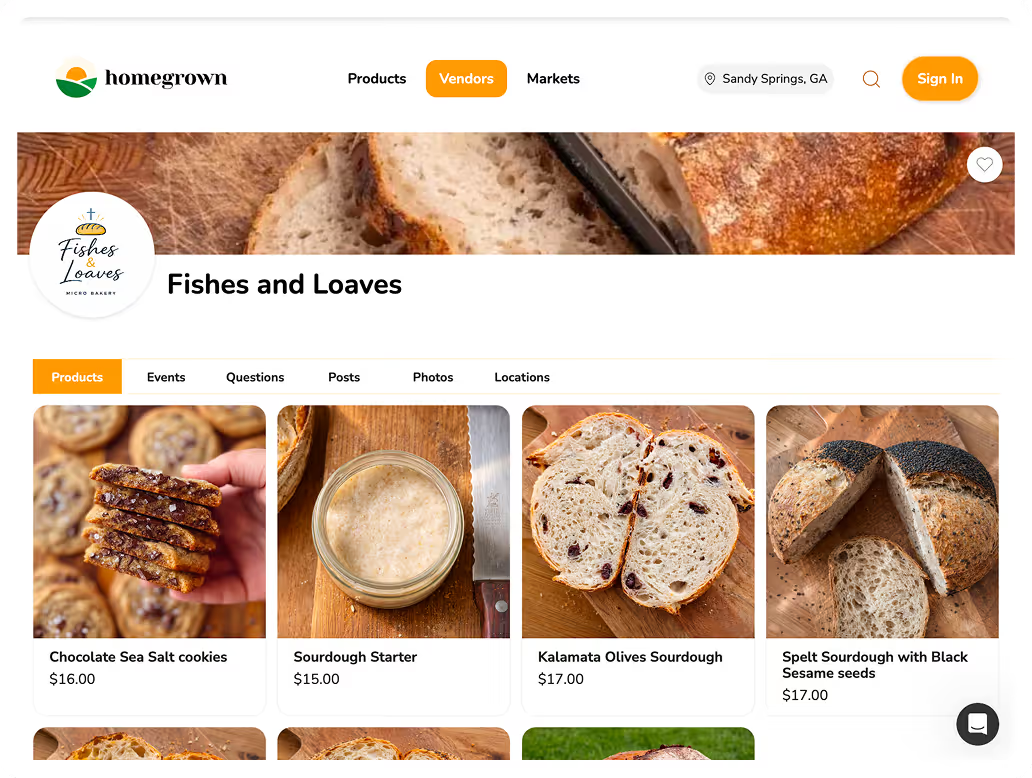
If you are one person selling bread, jam, or eggs, you do not have producers to manage or distribution days to meter. Local Food Marketplace's farm Starter tier at $1,548 a year is aimed at a farm running a real subscription program, not at a vendor who needs an ordering link. LocallyGrown is a much closer fit and free below $15,000, but it is still built around a multi-grower market cycle rather than around your own storefront.
The wider context is that most direct-marketing operations are small. USDA's 2022 Census of Agriculture describes a sector dominated by farms selling at markets and stands rather than through aggregated hubs, and that is the shape most software in this category is not built for.
For that shape, Homegrown is $10 a month billed annually with 0% commission and 2.9% plus $0.30 processing published up front, and it handles pickup at each place you sell, local delivery with a radius and a route, and sales tax calculated, filed, and remitted in all 50 states. The honest bounds: it is a single-vendor storefront. It does not aggregate producers, does not split payouts across farms, does not run distribution-day packing, and does not do CSA subscriptions. If you are a hub, it is not a candidate and Local Food Marketplace is the right conversation. If you are one vendor who has been evaluating hub software because it is what turns up in search, you can put a week of orders through a single-vendor storefront and find out whether you ever needed the rest.
That last one deserves the emphasis. A hub with $80,000 in annual sales that improves margin by one point has found $800, which is half a Local Food Marketplace subscription. Software cost is a real line and it is rarely the biggest lever in the room.
Worth saying plainly: neither platform recruits your producers or your customers, and a multi-vendor market with no vendors is software with no business inside it. The tool is the easy part.
Nothing to start. It charges 3% of completed sales, and your first $15,000 in sales is free. Refunded and cancelled orders are not charged. You connect your own Stripe account and pay Stripe's published 2.9% plus $0.30 separately.
Food hub plans are $149, $249, and $349 a month billed annually. Farm and producer plans are $129, $169, and $249. Enterprise is quoted. Tiers are limited by active producers and named distribution days.
No. Subscription tiers are detailed on the pricing page but payment processing is not listed. Ask for it specifically before signing, because at hub volume it is likely larger than the subscription.
Around $66,600 in annual sales against the $129 farm plan, since 3% of the $51,600 above the free threshold equals $1,548. Against the $149 hub plan the crossover is roughly $74,600.
Local Food Marketplace, properly, with producer accounts, per-producer availability, and payouts. LocallyGrown supports multiple growers in one market but without hub-grade producer management.
Local Food Marketplace offers SNAP with a one-time $999 implementation fee. LocallyGrown's published materials do not mention it, so ask directly if it matters to your program.
With annual billing, yes, at a stated value of $499 to $1,499 depending on tier. On monthly billing the cost is spread across your first six months instead, so it is deferred rather than waived.
These are not really competitors. LocallyGrown.net is free until $15,000 and then takes 3%, which makes it the obvious choice for a small market or a single farm under roughly $66,600 a year. Local Food Marketplace is $1,548 a year and up for infrastructure a small operation does not have any use for.
The comparison becomes real at hub scale. Once you are aggregating twenty producers across named distribution days, LocallyGrown's 3% is both expensive and structurally wrong, and Local Food Marketplace is doing a job nothing free is going to do.
One thing to settle before you sign either: get Local Food Marketplace's processing rate in writing. It is the one number missing from an otherwise detailed pricing page, and at hub volume it will be the largest line on the bill.