


The short version: Texas allows home bakers to sell baked goods and almost any other food made at home directly to consumers without a commercial kitchen license. The exceptions are meat, poultry, seafood, ice products, low-acid canned foods, CBD or THC products and raw milk. Annual sales are capped at $150,000 in gross income, and the state adjusts that cap for inflation. You can sell at farmers markets, from your home, or through online orders that you, an employee or someone in your household hand to the customer in person. The best platform for managing these orders is Homegrown ($10 per month annual, $12.50 monthly), which handles ordering, payments (2.9% + $0.30 per transaction), pickup scheduling, and inventory — all through one shareable link. Other options include Square Online (a free plan that charges 3.3% + $0.30 per online card payment), Shopify ($39 per month, or $29 per month billed yearly, plus 2.9% + $0.30 per online card payment), and Etsy (6.5% per transaction, 3% + $0.25 processing and $0.20 per listing).
Checked September 13, 2026: the Texas rules on the state health department's cottage food page and in the statute itself, and every price on each company's own site, Homegrown's signup page included.
If you bake in Texas and want local customers to order ahead for pickup or delivery, you can set up a Homegrown storefront and try it free for 7 days.
The best platform to sell baked goods in Texas is Homegrown, which gives you an online storefront for $10 per month with local pickup and delivery scheduling, inventory management, and built-in card processing at 2.9% + $0.30 per payment. It works without a website, and Homegrown charges no marketplace fees or commission on your sales. Texas home bakers can sell baked goods directly to consumers under the Texas Cottage Food Law (Chapter 437 of the state's Health and Safety Code), and Homegrown is built for exactly this type of local, pickup-based food business.
Texas state law lets home bakers sell up to $150,000 a year of food made in their own kitchen. Under the Texas Cottage Food Law, you can sell baked goods and almost any other food made in your home kitchen without a permit or a kitchen inspection, as long as you finish an accredited food handler course first. The law covers foods like these:
The annual sales cap is $150,000 in gross income from cottage food sales, and DSHS adjusts it each year for inflation. You must label products with your name and address (or a DSHS registration number in place of the address), the name of the product, any major food allergen it contains, and this statement: "THIS PRODUCT WAS PRODUCED IN A PRIVATE RESIDENCE THAT IS NOT SUBJECT TO GOVERNMENTAL LICENSING OR INSPECTION." Every sale must go directly to a consumer, with one exception. You can sell foods that do not need refrigeration at wholesale to a registered reseller that Texas law calls a cottage food vendor, who can offer them at farmers markets, farm stands, restaurants and retail stores.
These rules come from the Texas Department of State Health Services cottage food page and Chapter 437 of the Texas Health and Safety Code, both read on September 13, 2026. Our Texas cottage food law guide goes deeper, and the free label requirements tool walks you through what a label needs.
Senate Bill 541 took effect on September 1, 2025, and it is the version of the law in force when we read the statute in September 2026. It raised the sales cap, opened the food list to almost everything, and made room for wholesale through registered resellers.
The food handler course is still required. Anyone who runs a Texas cottage food operation must complete an accredited food handler training program, and helpers outside your household need the same training unless you supervise them directly. The DSHS cottage food page lists a Texas A&M AgriLife Extension course called Cooking Up A Cottage Food Business among its training materials.
A selling platform turns scattered texts, DMs and payment apps into one link where customers order and pay. On Homegrown that link costs $120 a year, or $12.50 month to month, and each card payment costs 2.9% + $0.30.
Say you start out selling at a farmers market and through word of mouth. Orders come in through text messages, Instagram DMs, and Facebook comments. That works while orders are few. It breaks down once you have more orders than you can keep straight across three apps.
Common problems Texas bakers face without a platform:
A selling platform solves all of these by giving your customers one link to browse products, choose quantities, pay, and schedule pickup.
Selling baked goods locally in Texas comes down to three things: a food handler course, a label on every product, and sales made face to face, through orders you deliver yourself, or at wholesale to a registered cottage food vendor. No city or county permit is needed for any of it.
Five steps take you from a home kitchen to your first local order.
For the paperwork side, our guide on how to start a cottage food business in Texas covers each step in more detail.
You can sell from your home, at farmers markets, by delivering orders yourself, online with an in-person handoff, or through a registered reseller.
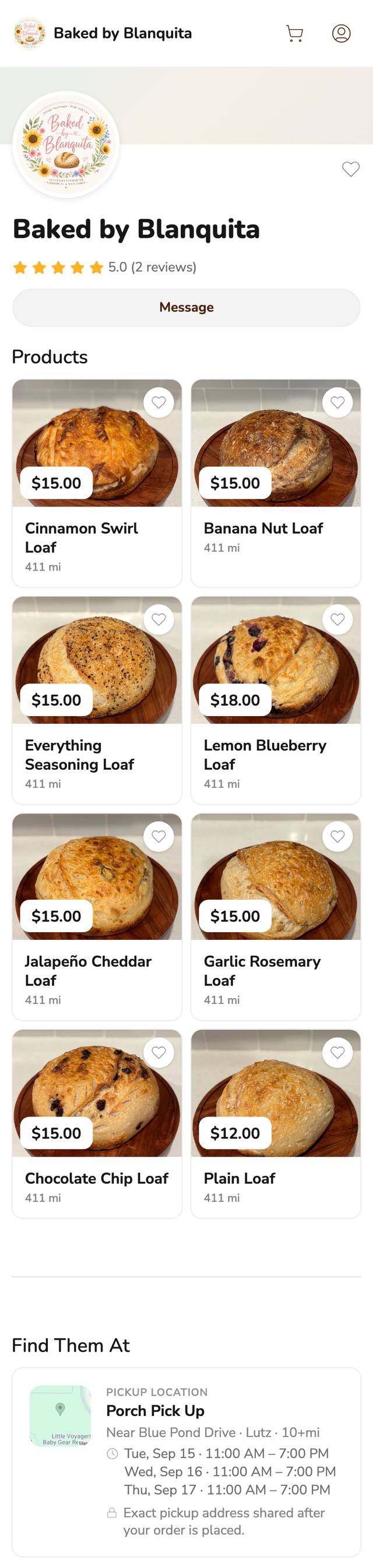
Once your labels and pickup plan are ready, a Homegrown storefront gives customers one link to see your menu, pay by card and pick a pickup time. Here is what one looks like on a phone. Baked by Blanquita is a bakery in Lutz, Florida, so Texas rules do not apply to it, but a Texas baker would use the same setup: a menu with prices, pickup days and a hidden home address.
In a pull of the Homegrown catalog on August 14, 2026, 876 of the 1,804 products were bakery products, listed by 122 of the 219 vendors. Bread and sourdough made up 350 of those bakery products, and cookies made up 147. These are listings from vendors in many states, not sales, and not only Texas.
The 876 bakery products on Homegrown, by type
Each product counted once, by the first type its name matches, from the Homegrown catalog pulled August 14, 2026.
Bread and cookies are the most listed bakery products on Homegrown. A short first menu of one loaf, one cookie and one seasonal bake lets you see what your neighbors reorder before you add more.
Homegrown is built for local food vendors who sell through pickup, local delivery and farmers markets. That fits Texas cottage food law, which requires online orders to be handed to the customer in person. There is no website to build and no design decisions to make. Your storefront is also listed on Homegrown's marketplace automatically, but plan on your own link to bring in most orders. You list your products, set your pickup locations and times, and share one link.
Here is what Homegrown includes:
For Texas bakers selling $500 to $2,000 per month through farmers markets and home pickup, Homegrown keeps the subscription at $10 per month when billed annually, and card processing on those sales comes to $20.50 to $82 if orders average $25, while giving customers a professional ordering experience.
Pros:
Cons:
Best for: Texas home bakers who sell through farmers markets, home pickup, and social media.
Start your free 7-day trial with Homegrown.
Etsy gives you access to a large marketplace audience, but the fees add up quickly. Etsy charges a $0.20 listing fee per listing, 6.5% transaction fee, and 3% + $0.25 payment processing fee. On a $25 box of cookies, that is approximately $2.83 in total fees — roughly 11.3% of the sale price. Those rates match Etsy's fee policy and its payments policy for US shops on September 13, 2026. Etsy may also charge a one-time shop set-up fee, and its Offsite Ads program takes 12% or 15% of any order that an Etsy ad on another site brings in.
Pros:
Cons:
Best for: Texas bakers who want shoppers browsing a big marketplace to find them, and who will hand every Etsy order over in person, because Texas cottage food law does not allow shipped orders.
Square Online's free plan costs $0 a month, and each online card payment costs 3.3% + $0.30, according to Square's plans page.
Square Online offers a free tier with Square branding. If you already use Square at farmers markets, it syncs your in-person and online payments. The free plan is limited — no custom domain, Square branding on your page, and basic features only. Pickup and local delivery are listed for every plan, including the free one. Square Plus costs $49 a month per location and lowers online card payments to 2.9% + $0.30.
Pros:
Cons:
Best for: Texas bakers who already use Square at farmers markets and want a free online ordering option.
Shopify's Basic plan costs $39 per month, or $29 per month billed yearly, and online card payments through Shopify Payments cost 2.9% + $0.30 each, per Shopify's pricing page.
Shopify is a full e-commerce platform designed for online retail businesses. On the Basic plan, it provides full store management, app integrations, shipping tools, and built-in local pickup and local delivery. If you use an outside payment processor instead of Shopify Payments, Basic adds a 2% transaction fee. For a home baker selling locally under Texas cottage food law, Shopify provides far more infrastructure than needed.
Best for: Texas food businesses that have outgrown cottage food and operate with a commercial kitchen license, selling statewide or nationally.
Swipe or scroll the table sideways to see every platform.
| Feature | Homegrown | Etsy | Square Online (Free) | Shopify |
|---|---|---|---|---|
| Monthly cost | $10 (annual) or $12.50 monthly | $0 (listing fees apply; a one-time set-up fee may apply) | $0 | $39, or $29 billed yearly |
| Transaction fee | 0% | 6.5% | 0% | 0% with Shopify Payments (2% otherwise) |
| Card processing | 2.9% + $0.30 | 3% + $0.25 | 3.3% + $0.30 online | 2.9% + $0.30 online |
| Total fees on $25 order | ~$1.03 | ~$2.83 | ~$1.13 | ~$1.03 |
| Local pickup | Yes (built-in) | Workaround | Yes (free plan included) | Yes (built in) |
| Local delivery | Yes (built-in) | Workaround | Yes (your staff or couriers) | Yes (built in) |
| Multiple pickup locations | Yes | No | Yes (one per Square location) | Yes (one per store location) |
| Inventory management | Yes (batch) | Basic | Basic | Yes |
| Food-specific features | Yes | No | No | No |
| Website required | No | No (marketplace) | No (builds your site) | No (builds your site) |
| Setup time | ~15 min | No published time | No published time | No published time |
On $1,000 per month in sales from 40 orders of $25, Etsy fees total about $113 ($65 in transaction fees, $40 in payment processing and $8 in listing fees) while Homegrown costs $10 plus $41 in card processing, a $62 per month difference that adds up to $744 over a year.
Swipe or scroll the table sideways to see every column.
| Platform and plan | Plan per month | Fees per order | Fees on 40 orders of $25 | Total per month | Share of $1,000 in sales |
|---|---|---|---|---|---|
| Homegrown, yearly plan | $10.00 | 2.9% + $0.30 | $41.00 | $51.00 | 5.1% |
| Homegrown, monthly plan | $12.50 | 2.9% + $0.30 | $41.00 | $53.50 | 5.4% |
| Etsy | $0.00 | 6.5% transaction, 3% + $0.25 processing, $0.20 per listing renewed by a sale | $113.00 | $113.00 | 11.3% |
| Square Online, free plan | $0.00 | 3.3% + $0.30 | $45.00 | $45.00 | 4.5% |
| Square Online, Plus | $49.00 | 2.9% + $0.30 | $41.00 | $90.00 | 9.0% |
| Shopify Basic, billed monthly | $39.00 | 2.9% + $0.30 | $41.00 | $80.00 | 8.0% |
| Shopify Basic, billed yearly | $29.00 | 2.9% + $0.30 | $41.00 | $70.00 | 7.0% |
How the math works: 40 orders of $25 is $1,000. Card fees are the percentage times $1,000, plus $0.30 times 40 orders, which is $12. Etsy's fees are 6.5% of $1,000 ($65), 3% of $1,000 plus $0.25 times 40 orders ($40), and $8 in listing fees, since Etsy renews a listing at $0.20 each time one of several in stock sells. Sales tax, shipping and optional ads are left out. Square Online comes out cheapest on its free plan until card sales pass $2,500 a month, where the extra 0.4% on Square costs more than Homegrown's $10 plan.
For a Texas cottage food baker, the question is not which platform has the most features. It is which platform matches how you actually sell. Texas cottage food law requires online orders to be handed over in person, and apart from wholesale to a registered cottage food vendor, every sale goes straight to the consumer. That means your platform needs local pickup and in-person delivery. A platform built for local food ordering removes the overhead of text-message orders while keeping costs low. The rules themselves are on the DSHS cottage food page, and the law behind them is Chapter 437 of the Texas Health and Safety Code.
Start your free 7-day trial with Homegrown.
Texas lets a cottage food operation earn up to $150,000 per year in gross income from cottage food sales, and DSHS adjusts that cap each year for inflation. This cap applies to gross revenue from all cottage food sales combined. At $150,000 per year, you are averaging $12,500 per month, which is 500 orders of $25 every month. Until you sell more than about 500 orders of $25 a month, volume alone will not push you out of the cottage food exemption and into a commercial kitchen license.
You need a food handler course, but no license. Under Texas cottage food law, everyone who runs a cottage food operation must complete an accredited food handler training program, and helpers outside your household need that training too unless you supervise them directly. You do not need a license from the Texas Department of State Health Services, and your home kitchen does not need to be inspected. However, you must follow labeling requirements: your name and address (or a DSHS registration number in place of the address), the product name, any major food allergens, and the statement that the product was produced in a private residence that is not subject to governmental licensing or inspection. Cities, counties and local health departments cannot require a permit or fee to produce or sell cottage foods, though other local rules, such as where you can set up a stand, still apply.
Yes, with limitations. Texas law allows you to take orders online and accept payment electronically, but you, an employee or a member of your household must hand the food to the customer in person, at pickup or by delivery. Before you accept payment, post your label information online where the customer can read it. You cannot ship cottage food products through common carriers like UPS or USPS. This means an online ordering platform that schedules pickup and delivery (like Homegrown) fits how Texas cottage food sales work.
Bread and cookies are the most listed baked goods on Homegrown: in our catalog pull of August 14, 2026, 350 of the 876 bakery products were breads or sourdough and 147 were cookies, counting vendors in every state. That is a count of listings, and it does not measure sales. Other baked goods that suit a Texas cottage food menu include decorated sugar cookies for events, banana bread, cinnamon rolls, brownies, fruit pies, custom cakes for celebrations, and conchas and pan dulce. Seasonal products like king cake before Mardi Gras and pecan pie before Thanksgiving fit the calendar too. Products that travel well for pickup and look good in a photo are the easiest to sell ahead of time on social media.
Texas cottage food law does not require liability insurance, but you may still want it. As one example, FLIP (the Food Liability Insurance Program) lists its FLIP Pro policy for food vendors from $299 a year, or $25.92 a month, on its website as of September 13, 2026. A general liability policy covers incidents related to your food products. Some farmers markets require proof of insurance to participate. While not legally required, insurance protects your personal assets if a customer has an allergic reaction or other food-related issue.
A simple starting rule is to calculate your ingredient cost per product, then multiply by 3 to 4 for retail pricing. This accounts for ingredients, packaging, labor, overhead (utilities, equipment wear), and profit margin. For example, if a batch of 24 cookies costs $8 in ingredients, your per-cookie ingredient cost is $0.33 — so retail price would be $1.00 to $1.33 per cookie, or $12 to $16 per dozen. Factor in your platform costs: Homegrown adds a flat $10 per month billed annually and 2.9% + $0.30 on each card sale, while Etsy takes a 6.5% transaction fee, 3% + $0.25 in processing and a $0.20 listing fee on each sale. On $25 orders the flat fee costs less once you pass 5 orders a month: at 6 orders, Homegrown totals $16.15 and Etsy $16.95. Our free pricing calculator runs the numbers for your own recipes.
Yes. A Texas cottage food operation does not need a separate permit to sell at farmers markets, and state law bars local governments from requiring one. You operate under the cottage food exemption, not under a food establishment permit. However, individual farmers markets may have their own vendor requirements — application fees, proof of insurance, tent and display standards, and product sampling rules. Check with each market directly. Ask each market how its vendor application handles cottage food production operations.
In Texas, a cottage food production operation and a home bakery are not the same thing. A cottage food operation sells directly to consumers under the cottage food exemption, with no license, no kitchen inspection, a $150,000 annual cap, and almost any food other than meat, seafood and the other exclusions listed above (foods that need refrigeration require DSHS registration). A bakery that sells wholesale to stores and restaurants on its own, or sells more than the cap, falls outside that exemption: a food business selling at wholesale needs a DSHS license under Chapter 431 of the Health and Safety Code, and a business serving the public needs a food establishment permit. That path comes with inspections, and it can change which kitchen you are allowed to use, so ask DSHS or your local health department before you plan it. The usual path is to start under the cottage food exemption and look at a licensed setup only when you near the $150,000 cap or want to sell to stores yourself.
No. Texas cottage food law has no cottage license, and no city or county can make you buy a permit to make or sell cottage foods. You do need an accredited food handler course. Registering with DSHS is required only if you sell foods that need refrigeration, and it is optional if you want a registration number on your labels in place of your home address. A cottage food vendor who buys your products at wholesale to resell must register too.
Yes, since September 1, 2025. Desserts that need refrigeration, like cheesecake and cream pie, are allowed for Texas cottage food operations if you register with DSHS, put the date made on the label, include the safe handling statement on the label, invoice or receipt, and keep them at 41°F or below while you store and deliver them. They cannot be sold at wholesale through a cottage food vendor. Shelf-stable desserts like cookies, brownies and fruit pies need no registration.
Your products deserve a storefront where customers pay no service fee on top of your prices and you pay no marketplace commission. Homegrown gives Texas bakers a shareable ordering link, built-in payments, and local pickup and delivery scheduling for $10 per month on the yearly plan, plus 2.9% + $0.30 per card payment. Start your free 7-day trial.



