

The short version: If you sell at a market stall and online, the only question that matters is whether both share one catalog, one stock count, and one payout account. On that test Square is the strongest answer, and it is worth saying plainly rather than burying: its point-of-sale app is free with a reader, its online store has a genuinely free tier, and both run off the same item library. Big Cartel includes in-person selling from your phone on its $144-a-year Platinum plan. Cococart and Cheddar Up both offer a point-of-sale as well. Platforms without any in-person option force you to run two systems, and two systems means your stock is wrong in both.
All figures came from each company's own pricing pages in July 2026.
Four things, and vendors usually only check the first.
Number two is the one that bites. A vendor with 40 loaves, some pre-ordered and some sold at the stall, needs a count that decrements from both directions. Two systems give you two counts, and the failure shows up as a customer arriving to collect something you already sold to someone else.
Because it was built from the point-of-sale outwards, and the online store is an extension of the same catalog.
So a market vendor can run stall and online for $0 in subscription, paying only card processing: 3.3% plus 30¢ online on the free plan, or 2.9% plus 30¢ on the $49 and $149 tiers.
The catch worth knowing: Square's paid plans are priced per location, so three markets on Plus is $147 a month rather than $49. For a multi-market vendor, the free plan is often the better buy despite its higher online rate. Our Square Online free plan breakdown works that through, and our Square Online versus Shopify comparison covers where Square strains.
If you already have a Square reader in a box from a market two summers ago, you are most of the way there already.
The honest limitation is at the other end. Square's online store is a general storefront, so it handles pickup and local delivery as options rather than as a scheduling system. A vendor at three markets, each with its own day and cutoff, will find Square's per-location pricing multiplying and its scheduling thin. That is the trade: Square is unbeatable at the counter and ordinary at the calendar.
Worth walking through, because the difference from two systems is concrete rather than theoretical.
Thursday evening. Orders close. You pull one list, grouped by product, and know exactly what to bake.
Friday. You bake the pre-orders plus a deliberate surplus for walk-ups, decided from last month's numbers rather than a guess.
Saturday morning. You load the van against the same list. Pre-paid orders are marked as you hand them over, so you always know what is left in the box.
During the market. Walk-up sales go through the reader and decrement the same count. When the surplus is gone, the online listing shows sold out without you touching anything.
Saturday evening. One report, one payout account, one honest number for the day.
With two systems, every one of those steps has a manual reconciliation bolted onto it, and the last one does not really happen at all. That is the actual argument for a shared catalog, and it is worth more than the subscription difference between any two platforms on this page.
If your pre-order side is the part that is currently held together by a spreadsheet, running one market week through a storefront with real per-market cutoffs will tell you quickly whether the scheduling is the gap or the point-of-sale is.
Three worth knowing, each fitting a different shape of business.
Big Cartel Platinum, at $12 a month billed annually ($144 a year), includes selling in person and taking payments from your phone, plus iOS and Android apps, inventory tracking, and unlimited discounted shipping labels. It takes 0% commission and lets you connect your own processor, so a rate you negotiated elsewhere carries over. Our Big Cartel pricing breakdown covers what each tier includes.
Cococart sells its point-of-sale as a module: free at the basic level, $59 a month for POS Pro, alongside its $19 online store. That modular structure suits a café or a food truck with a window more than a market vendor. Its transaction and processing fees are not published, which you should resolve before committing.
Cheddar Up includes a point-of-sale with tap-to-pay on a phone. Its costs sit in the processing: 3.95% plus 95¢ on the free plan, 3.59% plus 59¢ on Pro at $15 a month. On a $25 order that free-plan rate is 7.8%, which is expensive for retail volume.
Worth pricing, because "I'll just use both" is the default and it is not free.
Take a vendor with $2,000 a month, split evenly between a Saturday stall and online orders.
Reconciliation. Two dashboards, two deposit streams, two sets of numbers to add up. Call it thirty minutes a week, or 26 hours a year.
Stock errors. Two counts means overselling is a matter of when. Once a month is optimistic. Each one is a refund, an apology, and a customer who is fractionally less likely to return.
Wrong decisions. If your stall numbers live in one place and your online numbers in another, nobody ever adds them up properly, which means questions like "is the Wednesday market worth it?" get answered on feel. Our guides to farmers market booth ROI and the break-even point on a booth only work if you have one honest set of figures.
Two subscriptions, if both systems charge.
None of that is catastrophic. All of it is avoidable by choosing one system that does both, which is why this capability outranks almost every other feature comparison for a market vendor.
Worth asking, because the answer is changing and a reader is not the only option.
Yes, if a meaningful share of your stall sales are walk-up impulse buys from people who do not carry cash. That is most markets now, and turning those away is expensive.
Less so, if nearly all your stall traffic is collecting pre-paid orders. In that case the stall is a collection point, the money arrived days ago, and a reader is for the occasional extra sale.
That second case is worth aiming for deliberately. Our guide to getting market regulars ordering online between markets covers moving volume in that direction, and our piece on moving a farm stand from cash to online payments covers the transition.
The practical middle: take pre-orders for the bulk, keep a reader for the rest. That gives you predictable production and captures the walk-up trade, and it is the setup most established market vendors end up with.
Still real, still worth accepting, and worth a moment of thought about records.
Cash at a market is fine and some customers strongly prefer it. What it is not is invisible: cash sales are income and need recording like everything else. A point-of-sale that lets you log a cash sale keeps your stock count and your books correct without extra work, which is a small feature with an outsized effect on your year-end.
Our guide to cash basis versus accrual accounting covers the wider bookkeeping question, and the IRS's recordkeeping guidance covers what you are expected to retain.
The practical rule: log cash sales in the same system as everything else, on the day, at the stall. Reconstructing a market day from memory on Sunday evening is how numbers become approximate.
Worth a paragraph because it is the one place where selling in two ways creates a genuinely new obligation rather than just more admin.
Sales tax is generally determined by where the sale happens. Online orders collected at your home may fall under one rate; a stall in a town twenty miles away may sit in a different county or city district with a different combined rate. So a vendor selling both ways can be collecting two or three different rates without noticing.
What to check:
Point four catches people out, and it is the strongest practical argument for logging cash through the same system rather than counting it into a tin. A return built from card sales alone understates what you collected, which is an error in the direction nobody wants to explain later.
None of this is complicated once it is set up correctly, and all of it is painful to unpick a year later. Ten minutes in the settings on day one is the whole fix.
Steps two and three are the whole test and take five minutes with a real product. Plenty of platforms pass one and fail the other, which is worse than failing both because you will not notice until a Saturday.
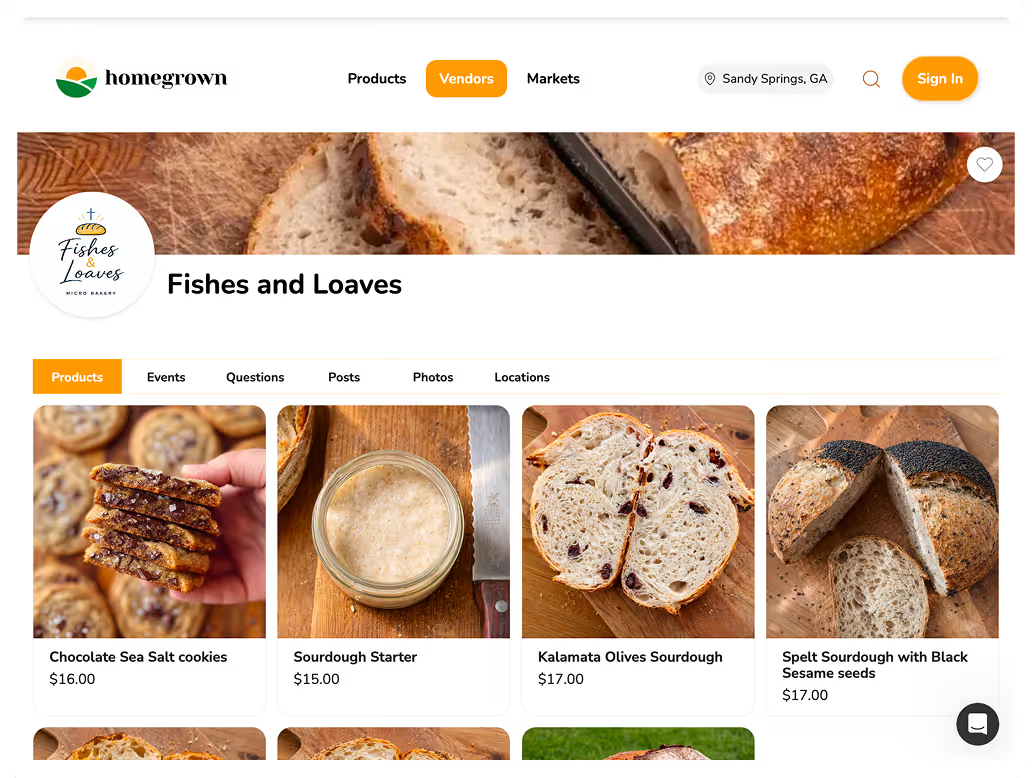
If your booth is mostly a collection point rather than a shop, Homegrown is $10 a month billed annually with 0% commission and 2.9% plus $0.30 processing published up front, and it handles pickup at each place you sell with its own schedule and cutoff, local delivery with a radius and a route, and sales tax calculated, filed, and remitted in all 50 states. The honest bound, and it is the decisive one for this article: there is no point-of-sale. You cannot take a card payment at the stall through it, and there is no reader. If walk-up card sales are a meaningful part of your market day, Square is the better answer and you should use it. Where a storefront helps is the other half: pre-orders collected at the stall, with per-location cutoffs. Plenty of vendors run a reader for walk-ups and a storefront for pre-orders, and you can test whether the pre-order half works for your markets without touching how you take payment at the table.
USDA's farmers market directory is a reasonable place to check what is running near you if you are weighing whether to add a second market at all.
Every platform below shows the same four commercial facts, because a table that lists one platform's transaction fee and not another's is not a comparison. "Not published" means exactly that: the company does not state it publicly.
| Platform | In-person and online together | Subscription (annual) | Free trial | Platform fee | Card processing |
|---|---|---|---|---|---|
| Square Online | Same catalog as Square POS, inventory syncs | Free tier; paid from $29/mo per location | 30-day trial on paid plans | $0 platform fee | 3.3% + $0.30 free tier, 2.9% + $0.30 paid |
| Shopify | Shopify POS, extra hardware and cost | $29/mo Basic | 3-day trial, then $1/mo for 3 | 2% platform fee if not on Shopify Payments | from 2.9% + $0.30 processing |
| Homegrown | Online only, no point-of-sale | $10/mo billed annually | 7-day free trial | $0 platform fee (0% commission) | 2.9% + $0.30 processing |
| Cheddar Up | Collects in person and online, no POS hardware | Basic $0; Pro $15/mo annual | No trial needed, Basic is free | $0 platform fee | 3.95% + $0.95 Basic, 3.59% + $0.59 Pro processing |
| Bake.Shop | Online orders only | $149/yr (= $12.42/mo) | 14-day free trial | $0 platform fee (0% commission) | 2.9% + $0.30 processing |
| Big Cartel | Online store, POS via a third party | Platinum $12/mo ($144/yr) | 7-day free trial | $0 platform fee | Your own provider, so 2.9% + $0.30 typical |
Square, for most vendors. Its point-of-sale app is free with a reader, its online store has a free tier, and both share one item library, one stock count, and one payout account.
The app is free to use with a compatible reader. What you pay is card processing. Square Online's free plan charges 3.3% plus 30¢ online, and its paid plans at $49 and $149 charge 2.9% plus 30¢ but are priced per location.
Yes. Its $144-a-year Platinum plan includes selling in person and taking payments from your phone, with iOS and Android apps. It takes no commission and lets you connect your own payment provider.
Because two counts means you can sell the same last six loaves twice, once at the stall and once online. The error only surfaces when a customer arrives to collect something that is already gone.
Roughly 26 hours a year in reconciliation, plus regular overselling, plus the fact that nobody ever adds two dashboards together properly, which means decisions about which markets to keep get made on feel.
Many customers prefer it and it is worth taking. Log it in the same system as card sales so your stock count and your books stay correct, rather than reconstructing the day from memory afterwards.
It is a good target but rarely complete. Pre-orders give you predictable production and cash before ingredients; a reader captures the walk-up trade you would otherwise turn away. Most established vendors run both.
For a vendor selling at a booth and online, the deciding capability is one catalog, one stock count, one payout, one report. Everything else is secondary, because two systems produce wrong numbers in both.
Square is the strongest answer and deserves to be named as such: free point-of-sale app with a reader, a genuinely free online tier, one shared item library. Watch its per-location pricing if you sell at several markets, since the free plan often beats the paid one there.
Big Cartel at $144 a year is the alternative worth knowing, with 0% commission, in-person selling from your phone, and your own choice of processor. And if your stall is mostly people collecting things they already paid for, the point-of-sale question matters far less than whether your pre-order side handles each market's own cutoff.